
What Are Lead Scoring Models? A Governance-First Blueprint for 2026
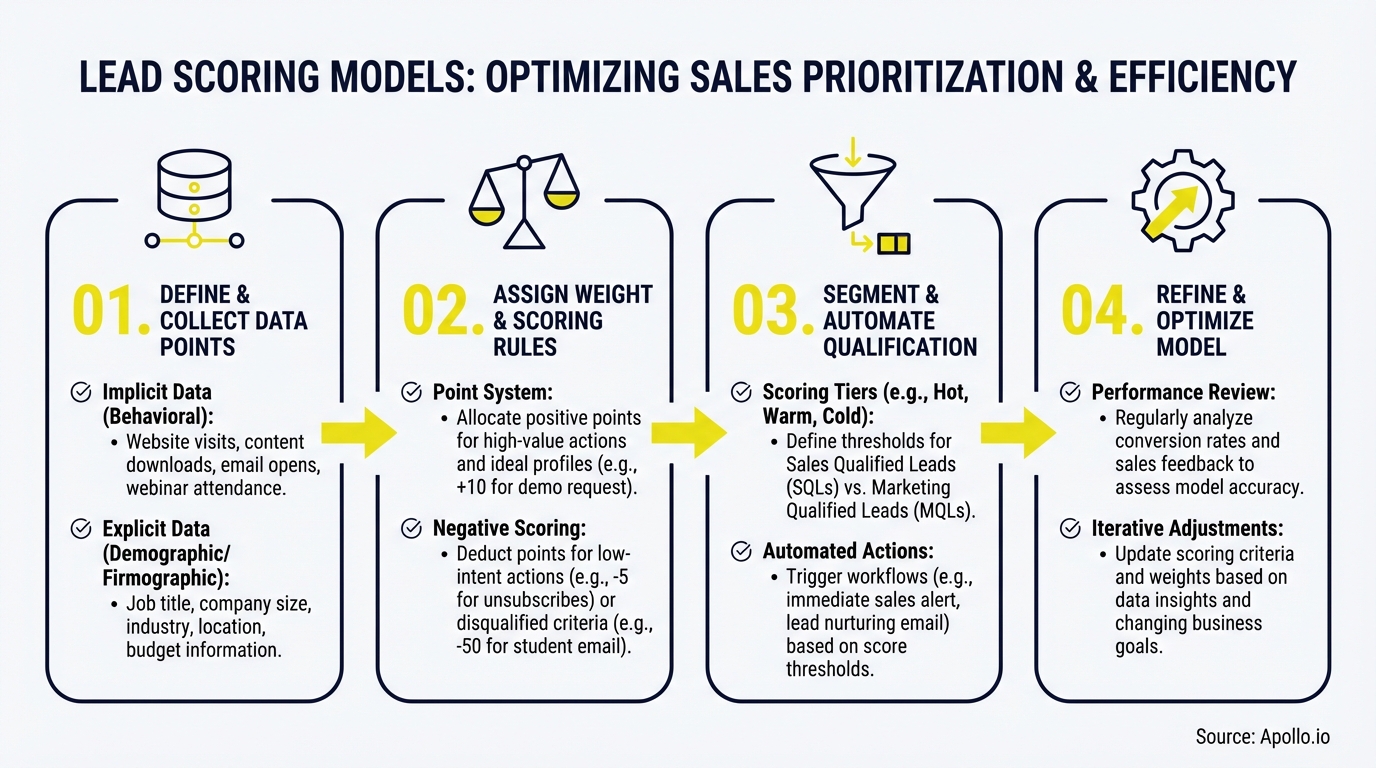
Lead scoring models assign numerical values to prospects based on their fit and engagement, helping sales and marketing teams prioritize outreach. In 2026, effective scoring requires more than point rules: it demands cross-functional governance, omnichannel tracking, and trust signals that reflect how buyers actually evaluate vendors.
The stakes are high.
According to Martal Group, B2B companies experience a 77% increase in lead generation ROI with lead scoring.
Yet HubSpot's August 2025 sunset of legacy scoring properties is forcing teams to rebuild models from scratch, exposing a critical gap: most organizations lack shared MQL/SQL definitions, governance templates, or mechanisms to capture dark social and third-party validation signals.

Scale Your Team Without The Growing Pains
Tired of inconsistent processes slowing down your growing sales team? Apollo standardizes workflows and automates lead research so every rep performs like your best. Join 550K+ companies scaling smarter.
Start Free with Apollo →Key Takeaways
- Lead scoring models combine fit scoring (firmographics, role, budget) and engagement scoring (content consumption, channel activity) to rank prospects by sales-readiness.
- Governance artifacts (MQL/SQL definitions, SLAs, RACI matrices, recycling rules) prevent scoring handoff failures and alignment gaps between sales and marketing.
- Modern models must integrate omnichannel signals (10+ touchpoints), trust signals (review-site visits, security content), and dark social proxies (direct traffic spikes, branded search lift).
- AI-powered lead scoring increases conversion by 35%, but implementation requires data quality governance, scheduled retraining, and performance monitoring to avoid drift.
- Recency weighting and score decay prevent inflated lifetime scores, improving SDR trust and prioritization accuracy.
Why Traditional Lead Scoring Models Fail in 2026
Traditional points-based models ("10 points for a demo request, 5 for a whitepaper download") break down when buyer journeys span 10+ channels, start in private communities, and prioritize peer validation over vendor content. Three systemic failures undermine legacy scoring:
Misaligned definitions create handoff chaos. A Gartner survey of 243 CSOs found 49% report sales' definition of a qualified lead differs greatly from marketing's definition.
When teams lack shared qualification criteria, high-scoring leads get rejected by SDRs, damaging trust and velocity.
Single-channel models miss real buying activity. McKinsey's 2024 B2B Pulse reports buyers use an average of 10 interaction channels (up from 5 in 2016).
Email-only or website-only scoring systematically under-scores prospects who engage via events, review sites, or community conversations.
Dark social and trust signals remain invisible. Wynter's Sticky Report found 72% of buyers start by asking trusted peers in private communities before consulting public sources.
Legacy models can't capture these trust-building moments, leaving teams blind to early buying intent.
"Apollo enriches everything we have: contacts, leads, accounts... And we don't really have to touch it, it just works."
What Is a Governance-First Lead Scoring Model?
A governance-first model treats scoring as a cross-functional system with explicit rules, ownership, and measurement. It includes three layers:
| Layer | Components | Purpose |
|---|---|---|
| Signal Taxonomy | Fit, engagement, trust, security, implementation readiness | Define what behaviors and attributes to score |
| Governance Artifacts | MQL/SQL definitions, SLAs, RACI, recycling rules, escalation criteria | Align teams on qualification standards and handoff process |
| Measurement Framework | Conversion rates by score band, model accuracy (AUC), retraining schedule | Monitor performance and prevent drift |
Need to consolidate your tech stack and unify lead data across channels? Apollo enriches 224M+ contacts automatically, eliminating manual data entry and scoring blind spots.
How to Build Trust-Weighted Lead Scoring
Trust-weighted scoring incorporates third-party validation and security signals that reflect how buyers evaluate vendors. G2's 2024 Buyer Behavior Report shows 81% of buyers consider a vendor's history with security breaches, and 31% consult review sites more than other sources.
Trust signals to score:
- Review site visits: G2, TrustRadius, Capterra profile views (high intent)
- Comparison page engagement: "[Your Product] vs [Competitor]" content consumption
- Security content: SOC 2 page views, security questionnaire downloads, compliance FAQ engagement
- Social proof consumption: Case study views with measurable outcomes, customer testimonial interactions
- Peer validation proxies: Community forum mentions (track via social listening), analyst report downloads
Research from Cirrus Insight shows a 30% increase in conversion rates using AI lead scoring that incorporates these validation signals.

Omnichannel Scoring Blueprint: Unifying 10+ Touchpoints
Modern lead scoring must unify engagement across email, web, phone, events, social selling platforms, review sites, community forums, content hubs, partner sites, and direct traffic. Score channel switching as a positive signal (indicates active research), not a penalty.
Dark social measurement via proxy signals:
- Direct traffic spikes: Sudden increases to specific product pages (indicates private shares)
- Branded search lift: Month-over-month growth in branded keyword searches
- Self-reported attribution: "How did you hear about us?" field in forms (track "colleague/peer" responses)
- Community partnerships: Track referral traffic from Slack communities, forums, and industry groups
Struggling to track multi-channel engagement in one workspace? Apollo's sales engagement platform unifies email, phone, and social outreach with automated scoring and routing.
Turn Forecasting Guesswork Into Revenue Clarity
Missing quota because your pipeline data is never up to date? Apollo delivers real-time deal visibility and intent signals that make forecasting reliable. Built-In boosted win rates 10% with Apollo's scoring.
Start Free with Apollo →MQL/SQL Governance: Definitions, SLAs, and Recycling Rules
Governance artifacts prevent the "49% misalignment problem" identified by Gartner. Teams need explicit, documented agreements on qualification standards and handoff process.
Sample MQL Definition (B2B SaaS):
- Fit Score ≥70 (director+ at 50-500 employee company in target industry)
- Engagement Score ≥50 (3+ high-intent actions in last 30 days: demo request, pricing page visit, case study view, review site comparison)
- Trust Signal Present (review site visit OR security content engagement OR peer referral)
Sample SQL Definition:
- Meets MQL criteria
- SDR-qualified via discovery call (confirmed budget, timeline, authority, need)
- Implementation readiness signal (ROI calculator use, integration docs view, migration guide download)
Sample SLA: Marketing delivers 200 MQLs/month with ≥25% MQL-to-SQL conversion. Sales contacts MQLs within 4 hours. Sales recycles unqualified MQLs back to marketing within 48 hours with rejection reason.
"We reduced the complexity of three tools into one. We're getting higher reply rates, open rates are doubled, meetings are up, and speed to booking a meeting is cut in half."
Implementation Playbook: From Model to Production
According to SuperAGI, 90% of B2B companies are predicted to use AI for sales and marketing by 2026. But implementation details derail adoption: licensing, field visibility, reporting, and data quality all create friction.
Pre-launch checklist:
- Audit CRM fields for completeness (firmographics, engagement history, channel attribution)
- Deduplicate and standardize data (company names, titles, industries)
- Map scoring rules to existing workflow automations (alerts, routing, sequence enrollment)
- Set model performance thresholds (minimum AUC score, retraining schedule)
- Document RACI (who owns scoring updates, who approves changes, who monitors performance)
Ongoing governance cadence:
- Weekly: Review MQL-to-SQL conversion by score band, identify rejection reasons
- Monthly: Analyze score distribution (are too many leads hitting max score?), adjust decay rates
- Quarterly: Retrain predictive models, update ICP criteria, audit signal taxonomy
Measurement: KPIs That Matter for Lead Scoring Quality
Track these metrics to validate scoring effectiveness and identify drift:
| Metric | Target | What It Measures |
|---|---|---|
| MQL-to-SQL Conversion | 25-35% | Are high-scoring leads actually sales-ready? |
| SQL-to-Opportunity | 40-50% | Does SQL definition predict deal potential? |
| Score Band Performance | 80+ scores convert 3x better than 40-60 scores | Is scoring differentiation meaningful? |
| SDR Accept Rate | ≥75% | Do SDRs trust the scoring model? |
| Recycle Rate | ≤20% | Are leads prematurely qualified? |
| Model Accuracy (AUC) | ≥0.70 | Does predictive model outperform random guessing? |
According to Reach Marketing, high-performing companies using lead scoring reach 6% conversion rates versus the 3.2% industry average.
Lead Scoring Model Examples by Use Case
Enterprise ABM Model: Fit score weighted 70% (account-level firmographics, buying committee identification). Engagement score 30% (multi-threading activity, executive engagement, security content consumption). Trust signals required: peer referral OR analyst validation OR executive social engagement.
PLG (Product-Led Growth) Model: Fit score 30% (company size, role). Engagement score 40% (product usage, feature adoption, activation milestones). Implementation readiness 30% (integration setup, team invites, ROI calculator use). Trust signals: community forum participation, review site activity.
Outbound SDR Model: Fit score 50% (ICP match, technographics, intent data). Engagement score 30% (email opens, reply sentiment, meeting acceptance). Channel engagement 20% (phone connects, social responses, event attendance). Recency weighting: 80% of score from last 30 days.
For more on building high-converting prospecting workflows, see our guide on outbound prospecting strategies.
Common Lead Scoring Mistakes to Avoid
Lifetime scoring without decay. A prospect who downloaded 10 whitepapers in 2023 but hasn't engaged in 6 months shouldn't have the same score as someone who requested a demo yesterday. Implement 30-day or 90-day recency windows with score decay.
Single-score models for multiple use cases. SDR triage, ABM targeting, and lifecycle nurture require different scoring logic.
Build separate models or use score components (fit, engagement, lifecycle stage) that teams can filter independently.
Ignoring negative scoring. Unsubscribes, spam complaints, job changes out of ICP, and repeated meeting no-shows should decrease scores. Negative signals prevent wasted outreach.
Over-weighting low-intent content. Blog reads and newsletter opens indicate awareness, not buying intent. Reserve high scores for demo requests, pricing page visits, comparison content, ROI calculator use, and security/compliance content engagement.
Learn how to identify and prioritize the right leads with our buyer leads identification framework.

What's Next: Lead Scoring in the AI Agent Era
As AI agents automate instant follow-up (alerts, enrichment, auto-sequences), scoring is shifting from "reporting" to "real-time routing + orchestration." High scores now trigger automated actions: immediate Slack alerts, instant data enrichment, personalized sequence enrollment, and priority routing to top SDRs.
This evolution demands even tighter governance: when scoring triggers automated outreach, mistakes scale instantly. Teams must monitor AI agent performance, set guardrails (maximum daily touches per lead), and regularly audit scoring quality to prevent spam and reputation damage.
The future of lead scoring isn't one magic number. It's a governed, omnichannel, trust-weighted system that captures how buyers actually research, evaluate, and buy, then routes them intelligently through the revenue engine.
Start Building Your Governance-First Lead Scoring Model
Effective lead scoring in 2026 requires more than point rules. It demands cross-functional governance, omnichannel tracking, trust signal integration, and ongoing performance monitoring.
Companies that implement structured scoring frameworks see measurable gains: 77% higher lead-to-opportunity conversion, 79% increase in marketing-driven revenue, and 35% improvement in conversion rates with AI-powered models.
Start with governance artifacts (MQL/SQL definitions, SLAs, RACI), build your signal taxonomy (fit, engagement, trust, security, implementation readiness), and establish measurement cadence (weekly conversion analysis, quarterly model retraining). The HubSpot legacy scoring sunset creates urgency, but also opportunity: rebuild your model with modern best practices baked in from day one.
Ready to unify your lead data and automate scoring across channels? Start your free Apollo trial and access 224M+ verified contacts with built-in enrichment, engagement tracking, and sales intelligence in one unified workspace.
Prove Apollo's ROI In Your First 30 Days
Budget approval stuck on unclear metrics? Apollo delivers measurable pipeline impact from day one—track time saved, meetings booked, and revenue generated. Built-In increased win rates 10% and ACV 10% with Apollo's scoring.
Start Free with Apollo →Don't miss these
Sales
Inbound vs Outbound Marketing: Which Strategy Wins?
Sales
What Is a Sales Funnel? The Non-Linear Revenue Framework for 2026
Sales
What Is a Go-to-Market Strategy? The 2026 GTM Playbook
See Apollo in action
We'd love to show how Apollo can help you sell better.
By submitting this form, you will receive information, tips, and promotions from Apollo. To learn more, see our Privacy Statement.
4.7/5 based on 9,690 reviews
