
A people data API is a programmatic interface that returns structured information about professionals, such as current employer, job title, work email, and location, so your CRM, outreach tools, and AI agents can query it on demand instead of relying on exported lists. Use one when you need to enrich records you already have, search for new prospects that match a profile, or resolve identity across systems. Most buying guides compare feature lists. This one gives you a way to test record quality, calculate cost per usable contact, and validate privacy controls before you sign a contract.
People data is also moving into automated workflows. On November 20, 2026, ZoomInfo said Qualified now calls its company and contact enrichment endpoints so the Piper AI agent can enrich website visitor profiles, replacing legacy APIs. Three days later, ZoomInfo announced an integration that lets monday CRM customers enrich records without leaving the CRM. Both announcements point the same way: people data is becoming an input to automated qualification and routing, not just a source for prospect lists. If an agent decides who to qualify, the accuracy of the underlying record decides whether it makes a good call. For more on how enrichment works, see this guide on how contact data enrichment drives ROI.

Skip Manual Research With Apollo
Tired of hours lost researching leads and verifying contact info? Apollo finds business contacts for you, with 98% email accuracy. Less data entry, more selling time. Start prospecting in minutes.
Start Free with Apollo →Key Takeaways
- A people data API supports three jobs: enrichment (complete a known record), search (find new records), and identity resolution (match records across systems). Pick the API for the job you actually have.
- Database size is a weak buying criterion. Test employer and title freshness, false-match rate, and field completeness on your own labeled sample.
- Compare vendors on cost per usable, target-fit contact, not cost per credit or per record.
- Ask how deletion and suppression requests propagate to your downstream tools, not just whether the vendor is "compliant."
- Run a two-week pilot with a labeled sample before committing. The protocol is below.
What Does a People Data API Actually Do?
A people data API accepts an identifier (an email address, a name plus company, or a profile URL) and returns attributes about that professional. Alternatively, it accepts search criteria (title, industry, company size, location) and returns a list of matching people.
The response is structured JSON that your systems write to a CRM, a data warehouse, or an agent's working context.
This guide focuses on professional contact data: business titles, employers, and work emails used for B2B sales, marketing, and recruiting operations. It is different from consumer lookup or background-check services. Consumer lookups raise separate legal and ethical questions, and the evaluation criteria below do not apply to them.
What Is the Difference Between Person Enrichment, People Search, and Identity Resolution?
The three jobs use different endpoints, bill differently, and fail differently. Choosing the wrong one is a common reason pilots disappoint.
| Job | Input | Output | Typical Use | Main Failure Mode |
|---|---|---|---|---|
| Person enrichment | Email, name + company, or profile URL | Title, employer, work email, location, other fields | Fill gaps in CRM records; shorten web forms | Wrong person matched; stale employer or title |
| People search | Filters (title, industry, size, geography) | List of matching people | Build prospect lists; find buying committees | Matches that fit the filter but not your ICP |
| Identity resolution | Records from multiple systems | Unified or linked person record | Deduplicate CRM; connect web, email, and ad data | False merges of two different people |
McKinsey's 2024 B2B Pulse found that buyers use an average of 10 interaction channels, and that among respondents likely to switch suppliers, 51% cited inadequate cross-channel customer tracking. A people data API can be one component of consistent identity across those channels.
It is not a complete omnichannel solution on its own.
When Should You Use an API Instead of a UI or CSV Export?
Use an API when the data needs to flow without a human in the loop: enriching leads as they arrive, scoring inbound traffic, or giving an AI agent live context. Use a UI or export when a person is doing one-off research.
The tradeoff is engineering time: an API requires authentication, error handling, and a data model, but it removes manual copy-paste work. Salesforce's 2024 survey of 5,500 sales professionals across 27 countries found that representatives spent 70% of their time on nonselling activities.
Automating enrichment addresses part of that, specifically research and manual data entry. It will not remove all nonselling work.
How Do You Evaluate People Data API Quality?
Evaluate quality by testing each vendor against a labeled sample of your own records and scoring five dimensions: match rate, false-match rate, field completeness, field age, and email validity. Vendor-reported database size and accuracy percentages are measured on the vendor's own terms, so your sample is the only comparison you can trust.
Data ages quickly, which is why freshness matters more than size. The U.S. Bureau of Labor Statistics reported 39.198 million quits during 2024 in its July 2025 release. Those are quit events, not unique people, and they are not a measured B2B contact-decay rate. They do show how much employer and title data changes. A separate source, Data Partners, claims that over 23% of B2B email addresses degrade within 12 months. And Coffee.ai reports that sales roles have a median tenure of only 3.3 years, compared with 6.1 years for management, so title and corporate email fields turn over quickly in sales-heavy segments.
What Belongs on a People Data API Quality Scorecard?
| Metric | How to Measure | Why It Matters |
|---|---|---|
| Match rate | Records returning a result ÷ records submitted | Shows coverage of your segment, not the vendor's whole database |
| False-match rate | Manually verify a sample of matches against ground truth | A wrong person is worse than no result |
| Employer freshness | Share of matches where current employer is correct | Drives routing, personalization, and deliverability |
| Title accuracy | Share of matches where title matches reality | Drives persona targeting and lead scoring |
| Required-field completeness | Share of matches with all fields you need populated | A partial record may not be usable |
| Email validity | Bounce rate on a small, controlled test send | Protects sender reputation |
| Field age | Vendor-supplied last-verified timestamp, if available | Lets you refresh stale fields selectively |
Data quality is becoming a differentiator in the market. In October 2025, People Data Labs announced processes to remove undeliverable addresses from its recommended work-email and personal-email fields, moving them to historical records.
The takeaway for buyers: a drop in populated email fields can reflect a quality improvement, not a decline. Evaluate usable contacts, not record counts.
How Do You Run a People Data API Pilot?
Run a pilot by building a labeled sample from your own CRM, sending the same records to each vendor, and scoring the results against the scorecard above. Two weeks is enough for most teams.
The steps below keep the comparison fair.
- Build a labeled sample. Pull 300 to 500 records that reflect your real mix of industries, company sizes, and seniority. Verify a subset by hand (current employer, title, email) so you have ground truth.
- Segment it. Split the sample by the segments you sell into. A vendor that performs well in North American SaaS may perform poorly in manufacturing or in EMEA.
- Send identical inputs to each vendor. Use the same identifiers and the same fields so the comparison is fair.
- Score the results. Record match rate, false matches, field completeness, and email validity per segment.
- Run a controlled email test. Send to a small, consented subset and track bounces. Do not send to a large list while testing.
- Calculate cost per usable contact. Use the formula in the next section.
- Document limitations. Record the sample size, date, and segments, so the result isn't over-generalized later.
For a deeper look at building a repeatable program around this, see the guide to building a data enrichment strategy.
How Do You Calculate Cost Per Usable Contact?
Cost per usable contact equals total spend divided by the number of records that are correctly matched, fully populated, and fit your target profile. It is a better comparison than price per credit because credits are consumed whether or not the result is useful, and vendors define a "credit" differently.
Formula: Cost per usable contact = Total API spend ÷ (Records submitted × Match rate × (1 − False-match rate) × Required-field completeness × ICP-fit rate)
| Input | Vendor A (Illustrative) | Vendor B (Illustrative) |
|---|---|---|
| Records submitted | 1,000 | 1,000 |
| Total spend | $X | $X |
| Match rate | 80% | 70% |
| False-match rate | 5% | 2% |
| Required-field completeness | 70% | 85% |
| ICP-fit rate | 60% | 60% |
| Usable contacts | ~319 | ~286 |
The figures above are illustrative to show the arithmetic, not benchmarks of any vendor. The point: the vendor with the higher match rate does not automatically produce more usable contacts once false matches and missing fields are counted.
Treat a downloadable worksheet with this formula as the first deliverable of any pilot, and add dated benchmark results with methods and limitations once you have them.
Structured, up-to-date records matter commercially. Grand View Research tracks the data enrichment solutions market and is a useful starting point for sizing the category. Tracking cost per usable contact by segment will tell you more than category-level figures about what to buy.
Need a system where search, enrichment, and outreach share one record? See how Apollo enrichment fits into your workflow.

What Does a Minimal People Data API Request and Response Look Like?
A minimal enrichment call sends an identifier and receives a structured person record. The example below is generic and illustrative.
Field names and endpoints differ by vendor, so check each provider's documentation.
POST /v1/people/enrich
Authorization: Bearer <API_TOKEN>
Content-Type: application/json
{
"email": "jane.doe@example.com",
"first_name": "Jane",
"last_name": "Doe",
"company_domain": "example.com"
}
200 OK
{
"match": true,
"person": {
"first_name": "Jane",
"last_name": "Doe",
"title": "VP of Sales",
"company": "Example Inc.",
"work_email": "jane.doe@example.com",
"location": "Austin, TX"
},
"last_verified": "2026-11-01"
}Apollo also offers a REST API for querying contacts and companies. See the Apollo API page for documentation and details.
How Should the Pipeline Handle Retries, Deduplication, Suppression, and Deletion?
A production pipeline needs four safeguards beyond the API call itself:
| Stage | What to Build | Why |
|---|---|---|
| Retries | Exponential backoff on rate-limit and transient errors; idempotency keys where supported | Prevents duplicate charges and lost records |
| Deduplication | Match on a stable key before writing to the CRM; log merges | Avoids false merges of different people |
| Suppression | Maintain a do-not-contact list checked before every enrichment write and every send | Respects opt-outs across tools |
| Deletion | A job that removes or anonymizes records downstream when a deletion request arrives | Prevents deleted data from reappearing via re-enrichment |
The deletion step matters because enrichment can reintroduce data you removed. If your suppression list is not checked before each enrichment write, a re-enrichment run may restore a record that someone asked you to delete.
Get Pipeline You Can Actually Forecast
Pipeline forecasting a guessing game because lead data goes stale? Apollo keeps business contact records fresh and complete, backed by 98% email accuracy. See where every opportunity stands and spot gaps before the quarter slips away.
Start Free with Apollo →What Should You Ask About Privacy, Suppression, and Deletion?
Ask how the vendor sources its data, what uses are permitted, and how deletion and suppression updates reach your downstream workflows. "Compliant" is not an answer by itself. You want to understand the mechanism.
Public awareness gaps explain why this question matters. Pew's 2023 survey of 5,101 U.S. adults found that 67% understood little or nothing about companies' use of their personal data, and 73% felt little or no control over it.
That is consumer research, not a survey of B2B API buyers, but it shows why provenance, permitted uses, and deletion handling are product requirements, not footer text.
Regulators are also focused on the data supply chain. A September 2025 California Privacy Protection Agency memo reported approximately 530 registered data brokers.
On August 25, 2026, CalPrivacy announced that more than 500,000 Californians had registered for its DROP deletion system, with 654 data brokers participating and brokers' processing obligations beginning August 1, 2026. California requires covered data brokers to access DROP at least every 45 days and maintain ongoing suppression controls.
These obligations do not automatically apply identically to every B2B data buyer, so confirm your own obligations with counsel. The practical procurement question is: how does a suppression event at the source reach your CRM and outreach tools?
| Question to Ask | What a Good Answer Includes |
|---|---|
| How is business contact information sourced, and what uses are permitted? | A plain-language description of provenance, permitted uses, and any restrictions in the contract. |
| How do suppression and deletion requests reach my systems? | A documented mechanism (webhook, re-query, or scheduled refresh) and a stated timeline, not a promise to "handle it." |
| Can I store enriched records, and for how long? | Clear retention and caching terms, so your warehouse and CRM stay inside the contract. |
| What audit trail exists? | Request logs, record identifiers, and timestamps you can use to prove when a record was fetched or removed. |
| Who owns opt-out handling after the data lands in my CRM? | A shared-responsibility explanation. Your team controls who it contacts and how it uses the product. |
Bring legal and RevOps into this review before the pilot, not after. The answers shape your pipeline design, especially the suppression list and refresh cadence.
How Does Apollo Fit Into a People Data API Workflow?
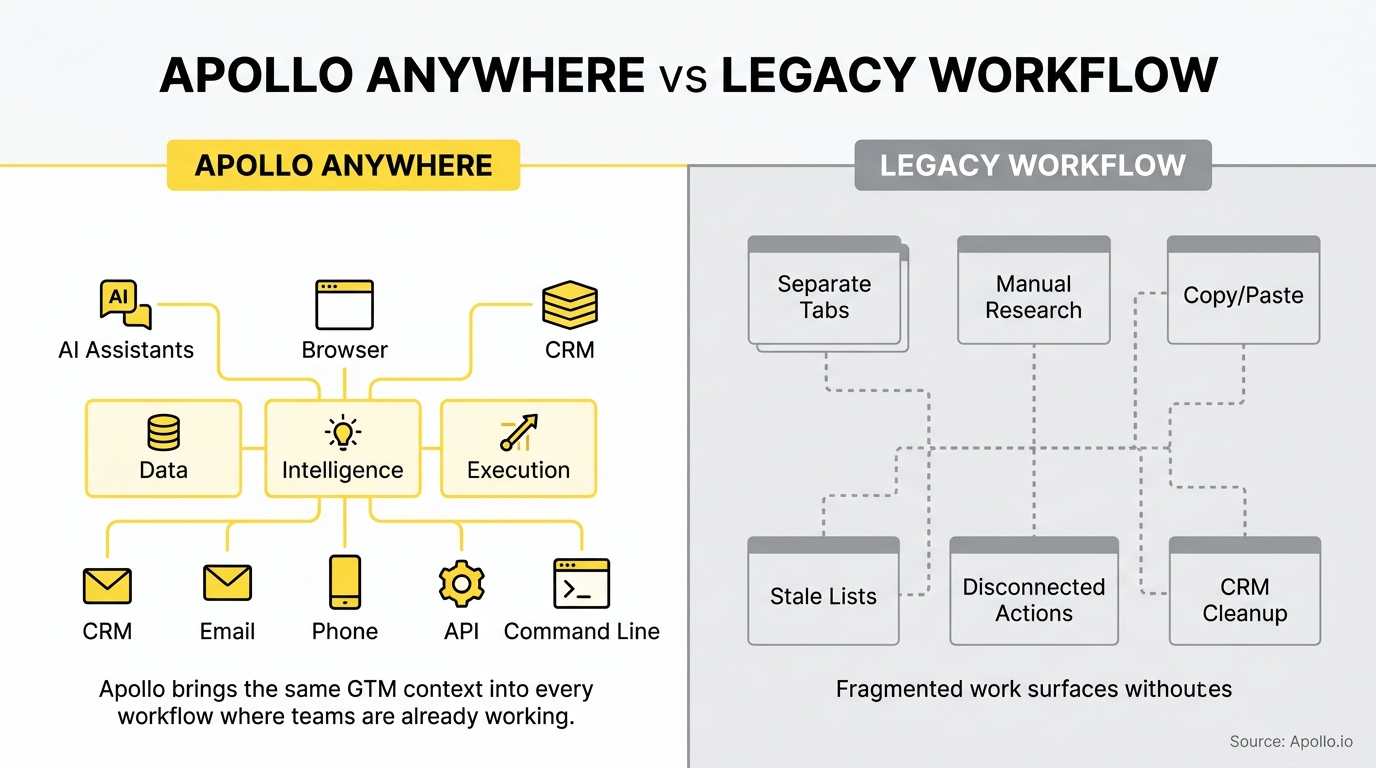
Apollo brings B2B data, sales engagement, and AI-powered execution together in one connected go-to-market system, so teams don't have to stitch together separate vendors for research, outreach, and analysis. The same business contact information you enrich through the API is available where reps work: the data enrichment workflow, the Chrome extension, Salesforce, and AI assistants through Apollo MCP.
Different roles use that surface differently:
- RevOps leaders run enrichment on inbound leads and CRM records, then track fill rate and bounce rate against the scorecard above.
- GTM Engineers and AI Builders call Apollo from scripts, agents, and apps using the API, CLI, and Apollo MCP, treating it as infrastructure for headless GTM workflows.
- SDR and BDR managers push enriched contacts straight into sales engagement sequences, so outreach starts from the same record the API returned.
"Apollo enriches everything we have: contacts, leads, accounts... And we don't really have to touch it, it just works."
Connecting enrichment to execution also reduces glue code. Collin Stewart of Predictable Revenue described the payoff of keeping both on one platform:
"The thing that made me most excited as somebody who's been in sales development a long time was Apollo's integration between sales data and sales engagement and the magic that you can make happen when those two are together on the same platform."
If your pipeline also needs to connect to CRMs, warehouses, and automation tools, review Apollo's integrations before you design custom sync jobs.

What Should You Do Next?
Choose a people data API by testing it on your own records, not by comparing feature lists. Build a quality scorecard, run a blind pilot on a representative sample, calculate cost per usable contact, and confirm how suppression and deletion reach your downstream systems.
Then wire the winning API into your CRM and outreach workflow with retries, deduplication, and a suppression check before any send. Teams that treat enrichment as a measured pipeline, not a one-time purchase, catch quality drift early and spend credits where they produce replies and meetings.
To see how enrichment, sales intelligence, and outreach work in one workspace, Start Free with Apollo.
Prove Apollo's ROI Before The Next Budget Review
Budget approval stuck on pipeline impact nobody can quantify? Apollo puts prospecting, outreach, and data in one workspace, so wins show up fast. Leadium tripled annual revenue and Built-In gained 10% win rate and 10% ACV. Start free and see value this week.
Start Free with Apollo →Don't miss these
Revenue Operations
Top Market Intelligence Tools for B2B Teams in 2026
Revenue Operations
Sales Operations Analyst Salary: 2026 Compensation Guide and Benchmarks
Revenue Operations
Sales Compensation Software: How to Automate Commission Management
See Apollo in action
We'd love to show how Apollo can help you sell better.
By submitting this form, you will receive information, tips, and promotions from Apollo. To learn more, see our Privacy Statement.
4.7/5 based on 9,690 reviews
