
6 Best Nooks Competitors for Sales Calling in 2026
Nooks built its reputation as an AI-assisted sales engagement platform centered on parallel dialing, conversation intelligence, and virtual salesfloors for outbound SDR teams. It's a focused tool for teams that want AI agents helping with calling, coaching, and workflow automation.
But as revenue teams scale, many find that a dialer-first tool doesn't cover the full go-to-market motion: prospecting data, multi-channel sequencing, inbound routing, CRM enrichment, and pipeline analytics often end up living in separate systems, forcing reps and RevOps to stitch together a stack rather than work from one source of truth.
That gap is why sales leaders start searching for Nooks alternatives: they want calling and coaching capabilities without giving up unified data, sequencing, and reporting. Some teams also run into pricing structures that scale quickly per seat as they add users, and want to evaluate platforms with more transparent or flexible pricing models.
This guide compares six platforms sales teams evaluate as Nooks alternatives in 2026, starting with Apollo, an AI GTM system that combines sales intelligence, dialer, multi-channel engagement, and data enrichment in one workspace, followed by five dialer- And engagement-focused competitors: Orum, SalesLoft, Outreach, ZoomInfo, and Cognism.

Skip The Manual Research, Apollo Verifies
Spending hours hunting down emails and phone numbers that turn out dead. Apollo verifies business contact data before you dial, so reps sell instead of searching. 98% email accuracy means fewer bounces and more real conversations.
Start Free with Apollo →Key Takeaways
- Platform Scope: Apollo combines sales intelligence data, dialer, multi-channel sequencing, and CRM enrichment in one system, while most other alternatives specialize in dialing, engagement, or data individually.
- Sales Intelligence Capabilities: Apollo and ZoomInfo both offer large-scale B2B contact and company databases, while Orum, SalesLoft, and Nooks-style dialers rely more heavily on conversation intelligence and calling workflows than on native prospecting data depth.
- AI Features: Every platform in this list markets AI capabilities, from AI dialers and coaching (Orum, Nooks) to AI agents for revenue orchestration (Outreach, SalesLoft) to AI research and enrichment (Apollo, ZoomInfo, Cognism).
- Customer Base: Apollo serves B2B GTM teams, GTM Engineers, and AI Builders building headless GTM workflows with the Apollo API, CLI, and MCP, alongside Sales Professionals, SDRs/BDRs, AEs, RevOps, Marketing, and Revenue Leaders, while competitors here skew toward SDR-heavy outbound teams or enterprise RevOps organizations.
- Pricing Models: Apollo publishes transparent per-seat pricing starting at $49/user/month, while Orum, SalesLoft, Outreach, ZoomInfo, and Cognism require contacting sales for quotes.
Apollo

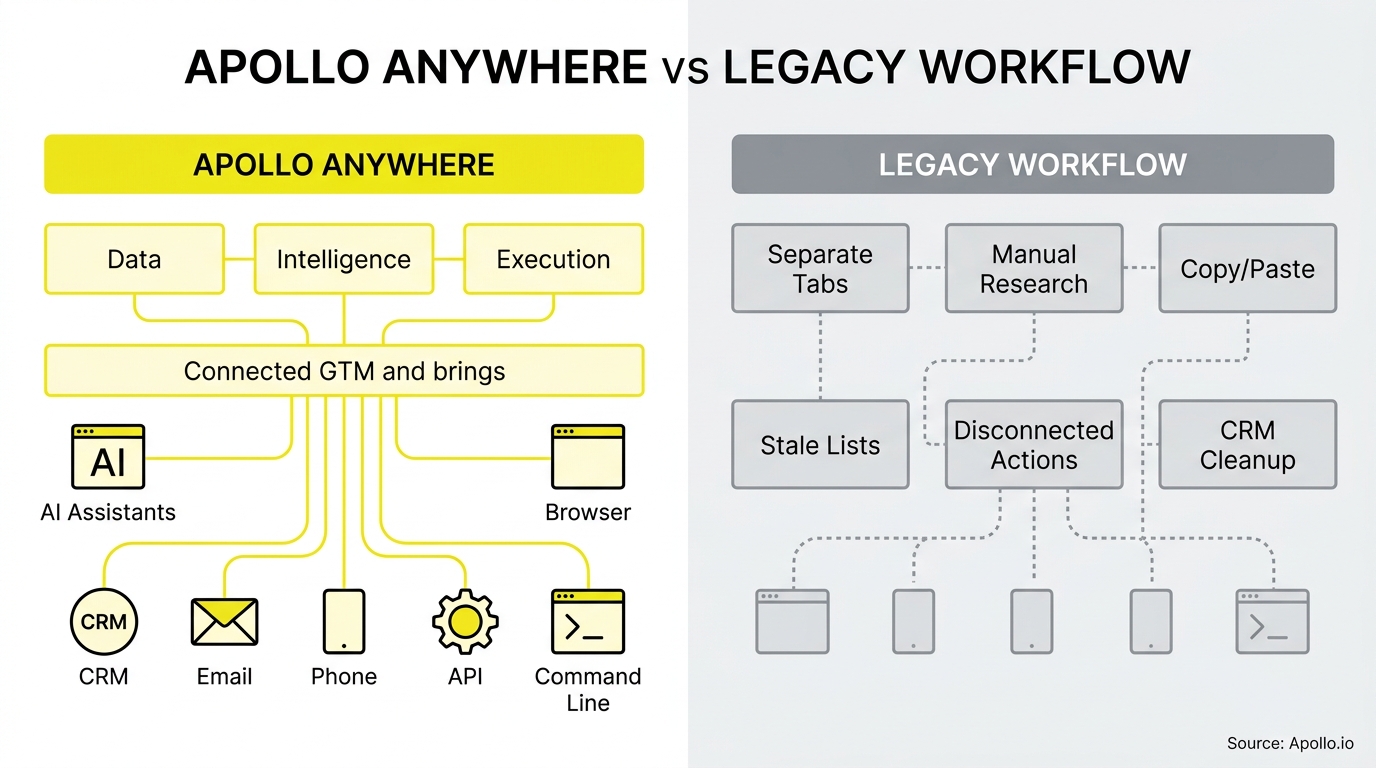
Apollo is an AI GTM system that unifies data, intelligence, and execution. Built open by design, it meets sellers inside the tools they already use, from AI assistants like ChatGPT, Codex, Claude, and Perplexity via Apollo MCP, Apollo's Model Context Protocol, to the Chrome extension and Salesforce, rather than asking teams to switch contexts to get value. For technical and advanced users, Apollo CLI provides terminal-native access for headless GTM workflows.
On the outbound side, Apollo lets teams define an ICP, then uses AI to find, research, and rank accounts and contacts, verify emails and phone numbers, and monitor sender health. Execution runs through multi-channel sequences spanning email, calls, social, and tasks, backed by a Power Dialer and Parallel Dialer, plus an AI Sequence Builder that creates sequences from natural language prompts. On the inbound side, Apollo captures website visitor activity, enriches short-form submissions automatically, and routes leads through configurable routers with round-robin, multi-host, or criteria-based booking. The 65+ filters available for prospecting let teams build precise, targeted lists rather than broad exports.
Apollo's AI Dialer removes manual dialing entirely: Power Dialer moves through prioritized call lists automatically, while Parallel Dialer calls multiple numbers at once and connects reps to the first person who answers. AI-researched call scripts, auto-logged outcomes, AI-generated call summaries pushed to CRM, and automatic voicemail drop round out the calling workflow, with real-time coaching for managers who want to join live calls.
On the data side, Waterfall Enrichment pulls from multiple vendors in a customizable source order, while CRM Enrichment keeps Salesforce and HubSpot records in sync through scheduled, real-time, or one-off jobs. Contacts are continuously validated and refreshed through Apollo's Living Data Network rather than sitting static in a database.
Apollo's pricing is published directly on its pricing page: Free at $0 (900 credits/year, 2 sequences, basic filters), Basic at $49/user/month (30,000 credits/year, unlimited sequences, CRM integrations, 6 intent topics), Professional at $79/user/month (48,000 credits/year, US dialer, 5 mailboxes, automated workflows, AI research), and Organization at $119/user/month with a 3-user minimum (72,000 credits/year, international dialer, 15 mailboxes, SSO, advanced security). Annual billing saves 20%.
According to Ramp's vendor data, drawn from real spend across American businesses, Apollo is the fastest-growing vendor in the Sales Data Providers category as of August 2026, with adoption up 5 percentage points year-over-year and a 22% competitor switch rate. Separately, Ramp's Sales Data Providers category data shows Apollo tied for the highest new-adopter share among first-time category buyers, reinforcing that companies evaluating sales data and engagement tools for the first time are choosing Apollo at a high rate.
Customers describe the consolidation directly. Kevin Warner, CEO at Leadium, said
"Apollo became the single source of truth for uswhere everything originates from and where all the data returns to.", Kevin Warner, LeadiumCollin Stewart, CEO at Predictable Revenue, noted
"We reduced the complexity of three tools into one.", Collin Stewart, Predictable RevenueAnd Andrew Froning, BDR Leader at Cyera, shared
"Having Apollo and having everything be in one system was a game changer, for BDRs specifically.", Andrew Froning, Cyera
Apollo is rated 4.7/5 on G2 and recognized as a Top 100 Best Software Product and a Top 50 Sales Product, alongside the 2026 MarTech Breakthrough Award for "Best AI-Powered Sales Solution". Apollo serves B2B GTM teams, GTM Engineers, and AI Builders building headless GTM workflows with the Apollo API, CLI, and MCP, alongside Sales Professionals, SDRs/BDRs, AEs, RevOps, Marketing, and Revenue Leaders.
Orum

Orum is a live conversation platform built around AI-assisted parallel dialing, real-time coaching, and conversation intelligence. It automates manual dialing tasks and is designed to help SDR teams have more live conversations in less time, with connect-rate optimization built on AI that Orum states is trained on over 1 billion real sales calls.
Key Features:
- AI-powered parallel dialing with up to 5 lines (Launch) or 10 lines (Ascend)
- AI Coaching Suite with roleplay agents, AI scorecards, and a coaching portal
- Virtual salesfloor with live listen-in and leaderboards
- International calling across 160+ countries and regions (Ascend tier)
- Spam protection through number rotation and reputation monitoring
Pricing: Orum's pricing is not publicly displayed on their official pricing page; both the Launch and Ascend tiers require requesting a quote, with a 3-seat minimum. According to Vendr, the Median Avg Contract Value is $21,300 per year, based on data from 90 purchases, with Vendr-observed per-seat pricing ranging from $100-$150/user/month (Professional) to $150-$200+/user/month (Enterprise).
Pros:
- Unlimited dials included on all paid plans
- Virtual salesfloor supports team-based calling culture and live coaching
- AI coaching add-ons available across all plans
Cons:
- No public pricing displayed; both core tiers require a sales conversation
- Data enrichment is limited to 200 credits/month even on the higher Ascend tier
- Primarily focused on calling workflows, with less depth in native prospecting data
Considering Orum? Here's how Apollo compares.
SalesLoft

SalesLoft is a predictive revenue system and sales engagement platform that connects revenue data with AI agents to help teams fill their funnels, prioritize seller actions, and understand deal risk. It combines cadence automation, conversation intelligence, and pipeline analytics for sellers and RevOps across the customer lifecycle.
Key Features:
- Conductor AI and AI Agents that prioritize seller workflows and analyze buyer signals
- Conversation Intelligence with call recording, transcription, and AI insights
- Deals and Opportunity Management with real-time pipeline visibility
- Automated Forecasting using historical trends and engagement data
- Rhythm, an AI-powered workflow automation module
Pricing: SalesLoft's pricing is not publicly displayed on their official pricing page, which shows only "Advanced" and "Elite" tiers with demo request buttons. According to Vendr, the Median Avg Contract Value is $30,740 per year, Deals handled: 304, based on data from 704 purchases. Vendr lists Essentials ($75-$100/user/month list), Advanced ($125-$150/user/month list), and Premier ($165-$200+/user/month list) tiers, with add-ons like Conversations and Rhythm priced separately.
Pros:
- Combines cadence automation with conversation intelligence and forecasting
- Rhythm module offers AI-driven workflow automation across the revenue cycle
- Established platform with deep integrations for RevOps use cases
Cons:
- Conversations and Rhythm are priced as add-ons, increasing total cost
- Typically requires a minimum of 10-15 users, limiting fit for smaller teams
- No public pricing available on the official site
Related reading:Apollo vs SalesLoft
Turn More Leads Into Real Opportunities
Marketing leads piling up but stalling before they ever hit sales-ready. Apollo scores and prioritizes prospects so your team chases buyers who actually convert. Built-In saw a 10% lift in win rate using Apollo's scoring.
Start Free with Apollo →Outreach

Outreach is an AI Agent Platform for Revenue Teams providing end-to-end revenue orchestration across prospecting, deal management, forecasting, coaching, and account expansion. It uses agentic AI intended to work every deal and account for every rep, combining seat-based and consumption-based pricing powered by AI credits.
Key Features:
- AI-powered agents including a Revenue Agent, Personalization Agent, and Deal Agent
- Outreach Omni, a conversational agent for unified account and opportunity management
- Conversation intelligence with real-time transcription and coaching
- Meeting Prep Agent for automated briefings with account history
- Revenue forecasting with AI forecast projection and scenario planning
Pricing: Outreach's pricing is not publicly displayed on their official pricing page, which lists four Amplify tiers (Essentials, Core, Plus, Pro) ranging from 10,000 to 100,000 AI credits, each requiring a sales conversation. According to Vendr, the Median Avg Contract Value is $45,540 per year, Deals handled: 545, based on data from 910 purchases.
Pros:
- Agentic AI spans the full revenue cycle from prospecting to forecasting
- Credit-based consumption model can scale usage across different workflows
- Meeting Prep Agent and Omni agent support account-level context in real time
Cons:
- All four tiers require contacting sales; no published pricing
- Credit-based consumption adds a layer of usage tracking on top of seat costs
- Higher-tier features like advanced forecasting are gated to the top plan
Related:Apollo vs Outreach

ZoomInfo

ZoomInfo is an AI-assisted go-to-market platform built on B2B data. It provides sales, marketing, and recruiting teams with contact information, company intelligence, buyer intent signals, and account-based marketing tools, unifying data across CRM and marketing automation systems.
Key Features:
- Contact and company data with email addresses and direct dial phone numbers
- AI-powered account prioritization and buyer intent signals
- Website visitor identification and tracking
- Integrated conversation intelligence (Chorus) and website chat
- CRM and marketing automation integrations (Salesforce, HubSpot, Marketo)
Pricing: ZoomInfo's pricing is not publicly displayed on their official pricing page, where all sales and marketing tiers (Professional, Copilot Advanced, Copilot Enterprise, Marketing Demand, ABM Lite, ABM Enterprise) require submitting a contact form. According to Vendr, the Median Avg Contract Value is $33,500, Deals handled: 1,012, based on data from 1,569 purchases.
Pros:
- Broad B2B data coverage spanning sales, marketing, and recruiting use cases
- AI-driven buying group identification and account summaries
- Multiple product lines (SalesOS, MarketingOS, TalentOS, OperationsOS) for different teams
Cons:
- Credit-based pricing means each export consumes usage, adding cost unpredictability
- No pricing shown publicly; a phone number is required just to view a quote
- Multiple product lines can mean separate contracts for sales vs. Marketing needs
Here's a detailed comparison of Apollo vs ZoomInfo.
Cognism

Cognism is a B2B sales intelligence and data enrichment platform that provides phone-verified contact data, company information, and intent signals. It uses a credit-based consumption model where users pay per contact reveal, with Diamond Data offering phone-verified mobile numbers, and it emphasizes compliance-first European B2B data.
Key Features:
- Diamond Data, phone-verified mobile numbers Cognism states improves connect accuracy
- Intent data through Bombora Company Surge to identify active research signals
- Actionable signals for hiring, funding, and M&A to time outreach
- AI-powered company research, persona builder, and account search
- Credit-based model where a credit is reused unless the contact changes jobs
Pricing: Cognism's pricing is not publicly displayed on their official pricing page, which offers Standard and Pro tiers (5 seats included) that both require talking to sales. According to Vendr, the Median Avg Contract Value is $36,000, Deals handled: 107, based on data from 108 purchases.
Pros:
- Diamond Data offers phone-verified mobile numbers with a credit-reuse model
- Compliance-first positioning for European B2B data
- AI persona builder and account search assist targeted list building
Cons:
- Credit-based reveal model can create cost unpredictability at scale
- CRM Enrichment and Data-as-a-Service are priced as separate add-ons
- No public pricing; both tiers require a sales conversation
Related reading:Apollo vs Cognism
Comparison Table
| Platform | Starting Price | Platform Scope | Dialer | Pricing Transparency |
|---|---|---|---|---|
| Apollo | $49/user/month (Basic) | Data, dialer, multi-channel sequencing, inbound, enrichment | Power Dialer + Parallel Dialer (US dialer from Professional; international dialer on Organization) | Published on official pricing page |
| Nooks | Not publicly displayed (Vendr: $70-$80/seat, annual) | AI parallel dialer, conversation intelligence, sequencing | AI-assisted parallel dialer | Not publicly displayed; Vendr benchmark available |
| Orum | Contact sales (Vendr: $100-$150/seat) | Live conversation platform, parallel dialing, coaching | AI-powered parallel dialer (5-10 lines) | Not publicly displayed; Vendr benchmark available |
| SalesLoft | Contact sales (Vendr: $75-$100/seat list) | Cadence automation, conversation intelligence, forecasting | Available via Conversations module | Not publicly displayed; Vendr benchmark available |
| Outreach | Contact sales (credit-based) | Agentic revenue orchestration, prospecting to forecasting | Available via engagement workflows | Not publicly displayed; Vendr benchmark available |
| ZoomInfo | Contact sales (credit-based) | B2B data, intent signals, ABM tools | Not a core focus; data-first platform | Not publicly displayed; Vendr benchmark available |
| Cognism | Contact sales (credit-based) | Phone-verified data, intent signals, enrichment | Not a core focus; data-first platform | Not publicly displayed; Vendr benchmark available |
How to Choose the Right Nooks Alternative
Start by mapping what your team actually needs beyond calling. If dialing is the only gap in your stack, a dialer-focused tool might close it.
But if reps are also juggling separate systems for prospecting data, sequencing, and CRM hygiene, look for a platform that consolidates that workflow rather than adding another point solution.
Evaluate data coverage carefully. Platforms like ZoomInfo and Cognism lead with B2B contact data, while Apollo pairs that same category of data, continuously validated through its Living Data Network, with execution tools like sequencing and dialing built natively into the same system.
If your team already has a data provider and just needs engagement and coaching, a SalesLoft- Or Outreach-style platform may fit; if you're consolidating multiple tools, weigh the cost of add-on modules (like SalesLoft's Rhythm or Conversations) against an all-in-one starting price.
Finally, factor in pricing transparency and seat minimums. Several platforms in this comparison require a sales call before you see a number, which can slow down evaluation.
Apollo publishes tier pricing at $49/user/month and up, as detailed above, letting teams build a business case without a sales cycle just to understand costs.
Frequently Asked Questions
What makes Apollo the best Nooks alternative?
As detailed in the Apollo section above, Apollo combines sales intelligence data, an AI dialer, multi-channel sequencing, and CRM enrichment in one workspace, and serves B2B GTM teams, GTM Engineers, and AI Builders building headless GTM workflows with the Apollo API, CLI, and MCP, alongside Sales Professionals, SDRs/BDRs, AEs, RevOps, Marketing, and Revenue Leaders.
Are these Nooks alternatives cheaper than Nooks?
It depends on the platform and tier. As referenced in the pricing sections above, most competitors here (Orum, SalesLoft, Outreach, ZoomInfo, Cognism) require contacting sales for a quote, while Nooks's own pricing, per Vendr, is $70-$80/seat annually. Apollo publishes its pricing starting at $49/user/month, which teams can review directly on the Apollo pricing page without a sales call.
Do these alternatives include a dialer like Nooks?
Yes, most do. Apollo includes a Power Dialer and Parallel Dialer natively, Orum is built entirely around parallel dialing, and SalesLoft and Outreach offer calling capabilities within their broader engagement platforms.
ZoomInfo and Cognism are primarily data providers and are not dialer-first tools.
Which alternative is best for teams that also need B2B contact data?
Teams that need both dialing and sales intelligence data in the same system should look closely at Apollo, which pairs its dialer with a contact and company database as covered in the comparison table above. ZoomInfo and Cognism specialize in data but are not built around calling workflows, so teams choosing them for data depth would likely pair them with a separate engagement or dialer tool.

Conclusion
Nooks serves outbound SDR teams looking for AI-assisted parallel dialing and coaching, but teams that need prospecting data, multi-channel sequencing, inbound routing, and enrichment in the same system often find themselves managing multiple tools and contracts. The alternatives compared here, Apollo, Orum, SalesLoft, Outreach, ZoomInfo, and Cognism, each take a different approach, from dialer-first platforms to data-first platforms to full revenue orchestration suites.
Apollo stands out by combining data, dialer, sequencing, and enrichment in one system with transparent, published pricing starting at $49/user/month, backed by real customer results and a growing base of GTM teams migrating from single-purpose tools, as reflected in the Ramp adoption data cited above. For teams evaluating Nooks alternatives in 2026, Apollo offers a way to consolidate calling, prospecting, and engagement without the added complexity of separate contracts and sales cycles.
Turn Tool Spend Into Tracked Revenue
Struggling to prove ROI before your next budget review? Apollo replaces scattered tools with one platform your CFO can actually measure. Leadium 3x'd annual revenue after consolidating their stack into Apollo.
Schedule a Demo →Don't miss these
Sales
Inbound vs Outbound Marketing: Which Strategy Wins?
Sales
What Is a Sales Funnel? The Non-Linear Revenue Framework for 2026
Sales
What Is a Go-to-Market Strategy? The 2026 GTM Playbook
See Apollo in action
We'd love to show how Apollo can help you sell better.
By submitting this form, you will receive information, tips, and promotions from Apollo. To learn more, see our Privacy Statement.
4.7/5 based on 9,690 reviews
