
A marketing operations lead owns the systems, data, and processes that let marketing launch campaigns, hand off leads, and prove results. Titles vary by employer: some companies use "lead" for a senior specialist, others for the head of a small team, and others treat it as a synonym for manager or director.
This guide defines the role, separates lead from manager, and gives you a 90-day plan you can run.
The job sits where marketing meets sales, finance, and IT. If you want context on how those functions differ, see the difference between sales and marketing.
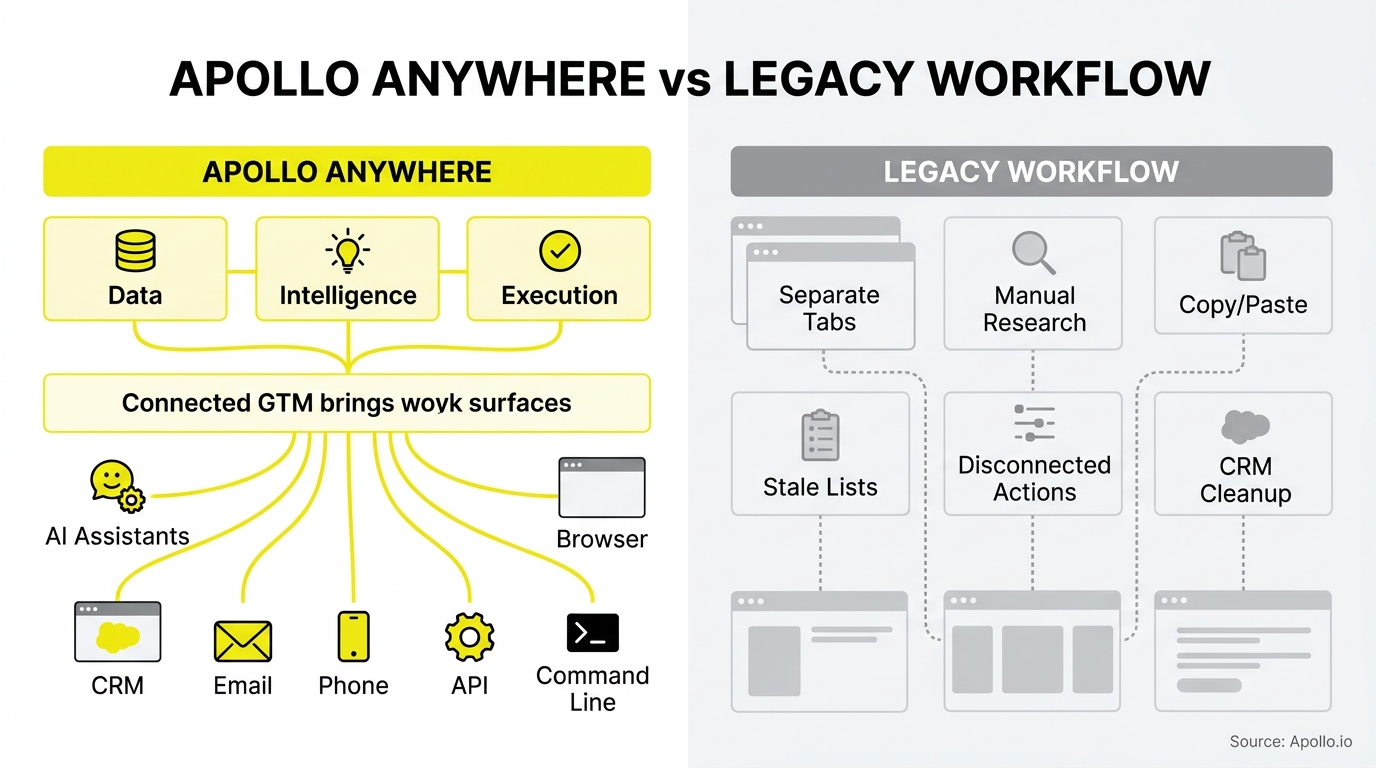

Skip Manual Research, Apollo Finds Contacts
Hours lost researching leads and verifying contact info instead of selling? Apollo puts business info at your fingertips, backed by 98% email accuracy. Spend your day talking to buyers, not building spreadsheets. Start free today.
Start Free with Apollo →Key Takeaways
- A marketing operations lead is accountable for the stack, the data, campaign workflows, lead handoff, and measurement.
- The lead role usually sets standards and decision rights. Managers more often run day-to-day execution. Check each job description, because titles are inconsistent.
- The first 90 days work best in three phases: diagnose (days 1-30), prioritize (31-60), implement (61-90).
- AI agents now need an owner, an inventory, and an audit trail. Operations leads are the natural fit.
- Judge the role by outcomes: stack utilization, handoff speed, data quality, and cost per qualified opportunity.
What Does a Marketing Operations Lead Do?
A marketing operations lead designs and maintains the operating system behind marketing: tools, data definitions, workflows, reporting, and governance. Campaigns are the output.
The lead makes them repeatable, measurable, and connected to sales.
| Responsibility Area | What the Lead Owns | Typical Deliverable |
|---|---|---|
| Stack and integrations | Tool selection, adoption, and overlap review | Stack scorecard and retirement plan |
| Data and lead management | Field definitions, enrichment, routing, and scoring rules | Data dictionary and lead lifecycle map |
| Campaign operations | Intake, naming, QA, and launch workflows | Campaign brief template and launch checklist |
| Measurement | Attribution rules, dashboards, and pipeline reporting | Shared funnel report agreed with sales |
| Governance | Permissions, consent handling, and AI agent oversight | Access matrix and agent inventory |
Historically, this work sat under labels like "marketing ops," "demand operations," or "marketing technology." Many teams now fold it into revenue operations. The scope is the same: keep the machine running and make its output trustworthy.
Marketing Operations Lead vs. Manager: What Is the Difference?
A marketing operations lead sets standards, priorities, and decision rights, while a manager more often runs day-to-day execution. A lead is not simply a senior admin, and a manager is not a junior lead.
Scope varies by company, so read the responsibilities, not the title.
| Dimension | Operations Lead | Operations Manager |
|---|---|---|
| Focus | Strategy, architecture, governance | Execution, queue management, QA |
| Stakeholders | CMO, RevOps, Sales leaders, IT, Finance | Campaign owners, SDR managers, analysts |
| Decisions | Tool purchases, data standards, routing logic | Workflow settings, list hygiene, scheduling |
| Success measure | Stack utilization and pipeline quality | On-time launches and error rates |
On smaller teams, one person does both. That is fine, as long as someone owns the standards.

What Should a Marketing Operations Lead Do in the First 90 Days?
The first 90 days work best in three phases: diagnose, prioritize, and implement. Resist rebuilding anything before you understand what already exists.
| Phase | Focus | Output |
|---|---|---|
| Days 1-30: Diagnose | Audit tools, data fields, routing rules, and reports. Interview sales, finance, and IT. | Stack inventory and list of top handoff failures |
| Days 31-60: Prioritize | Rank problems by revenue impact and effort. Agree on shared definitions with sales. | Roadmap with owners and success metrics |
| Days 61-90: Implement | Fix the top two or three issues. Retire overlapping tools. Publish governance rules. | Working fixes, updated dashboards, documented process |
Start with lead handoff. A slow or unclear handoff costs more than any missing feature. Collin Stewart of Predictable Revenue described what changes when data and engagement sit in one place:
"The thing that made me most excited as somebody who's been in sales development a long time was Apollo's integration between sales data and sales engagement and the magic that you can make happen when those two are together on the same platform."
How Should a Marketing Operations Lead Manage the Stack and AI Agents?
Treat every tool and every AI agent as an asset with an owner, a purpose, and an audit trail. Overlap and unmanaged automation are the two most common sources of wasted spend and bad data.
- Inventory: list each tool, its owner, its data inputs, and what it writes back to the CRM.
- Retire overlap: if two tools cover the same job, pick one and sunset the other.
- Document agents: record what each AI agent can read, write, and send, and who approves changes.
- Review quarterly: check utilization against cost before renewals.
Consolidation helps here. Apollo brings B2B data, sales engagement, and AI-powered execution together in one connected go-to-market system, so teams don't have to stitch together separate vendors for research, outreach, and analysis. Operations leads can review data enrichment and sales engagement in one workspace, and check available integrations before adding anything new.
For clean records, Mark Turner of Built-In put it simply:
"Apollo enriches everything we have: contacts, leads, accounts... And we don't really have to touch it, it just works."
Market signals point the same direction. According to Ramp's Sales Data Providers category data, Apollo was the fastest-growing vendor in the category as of November 2026. Teams that run workflows inside AI tools can also use Apollo's AI platform, including Apollo MCP in assistants like Claude, ChatGPT, and Perplexity. Customers select the contacts and actions, and outputs are tailored based on input and context.

How Do You Measure a Marketing Operations Lead?
Measure the role by outcomes the CMO, RevOps, and sales leaders can verify: how well the stack is used, how fast leads move, how clean the data is, and what a qualified opportunity costs. Activity counts like tickets closed tell you little.
| Metric | What It Shows | How to Track It |
|---|---|---|
| Lead-to-opportunity conversion rate | Whether routing, scoring, and handoffs work | Compare conversion by source, segment, and score band each month |
| Speed to lead | How quickly a new lead reaches the right rep | Measure time from form fill or signal to first rep touch |
| Data quality rate | Whether records are complete, accurate, and deduplicated | Audit the share of records with valid email, title, company, and owner |
| Stack utilization | Whether tools earn their cost | Track active users and feature adoption against license counts |
| Cost per qualified opportunity | Efficiency of the full demand engine | Divide program and tooling spend by sales-accepted opportunities |
| Campaign launch cycle time | How fast the team ships | Track days from approved brief to live campaign |
Set a baseline for each metric in the first 90 days, then review trends quarterly. A single month of data can mislead, especially when seasonality or a large campaign skews volume.
Fill Your Funnel With Buyers Who Convert
Struggling to fill the top of the funnel with leads that never turn into real opportunities? Apollo helps you target the right companies and people with 98% email accuracy, so your pipeline reflects real buyers. Start free today.
Start Free with Apollo →What Mistakes Should a Marketing Operations Lead Avoid?
Most failures in this role come from a handful of repeatable patterns. Watch for these:
- Buying tools before fixing process. A new platform will not repair unclear lead definitions or broken routing. Document the process first.
- Over-engineering scoring models. Complex models that sales does not trust get ignored. Start simple and refine with feedback.
- Skipping data governance. Without field standards and ownership rules, duplicates and stale records return within months.
- Working in isolation from sales. Definitions and handoffs only hold when sales and RevOps help write them.
- Automating without review. Whether a workflow is rule-based or AI-driven, set approval steps and monitor outputs before scaling.
- Reporting vanity metrics. Leadership needs pipeline and cost data, not just opens and clicks.
Frequently Asked Questions
What does a marketing operations lead do day to day?
They manage the marketing tech stack, maintain data quality, build and monitor lead routing and scoring, support campaign launches, and produce reporting that ties marketing activity to pipeline. They also coordinate with sales, RevOps, and IT on process changes.
What skills does a marketing operations lead need?
Strong skills include CRM and marketing automation administration, data analysis, process design, project management, and clear communication with stakeholders. Familiarity with integrations, attribution, and AI-assisted workflows is increasingly useful.
Is a marketing operations lead a management role?
It depends on the company. In smaller teams, the lead is often a senior individual contributor who sets standards and owns the stack.
In larger organizations, the role may include direct reports and budget ownership.
How is a marketing operations lead different from a RevOps lead?
Marketing operations focuses on marketing systems, campaigns, and data. RevOps spans marketing, sales, and customer success, aligning processes and reporting across the full revenue cycle.
The two roles work closely and often share ownership of lead flow and CRM hygiene.
What should a marketing operations lead prioritize first?
Start with an audit of the stack, data, and lead lifecycle. Fix the issues that block pipeline visibility, such as inconsistent definitions, duplicate records, and broken routing, before adding new tools or campaigns.
Conclusion
A marketing operations lead keeps the revenue engine running by owning the stack, the data, and the processes that move leads to sales. Success comes from clear definitions, clean data, disciplined automation, and metrics that leadership can trust.
Start with an audit, align with sales early, and measure outcomes like conversion, speed to lead, and cost per qualified opportunity.
Ready to give your team accurate contact data and streamlined outbound workflows? Start with Apollo and see how it fits into your marketing operations stack.
Prove Apollo's ROI Before Renewal Season
Budget approval stuck on unclear ROI? Apollo puts pipeline, meetings, and win rates in one place, so you can show what your spend returns. Built-In saw +10% win rate and +10% ACV. Start free and build your case fast.
Start Free with Apollo →Don't miss these
Revenue Operations
Top Market Intelligence Tools for B2B Teams in 2026
Revenue Operations
Sales Operations Analyst Salary: 2026 Compensation Guide and Benchmarks
Revenue Operations
Sales Compensation Software: How to Automate Commission Management
See Apollo in action
We'd love to show how Apollo can help you sell better.
By submitting this form, you will receive information, tips, and promotions from Apollo. To learn more, see our Privacy Statement.
4.7/5 based on 9,690 reviews
