
Marketing in 2026: Strategies, Trends, and Best Practices
Marketing used to mean getting attention. In 2026, it means giving a 13-person buying committee enough evidence to defend a decision they haven't even discussed with sales yet. Gartner reports that 81% of buyers actively tune out ads, and over half take steps to block them entirely. That shift changes what marketing has to do: it's no longer about reach, it's about building proof that survives internal scrutiny long after your team leaves the room.
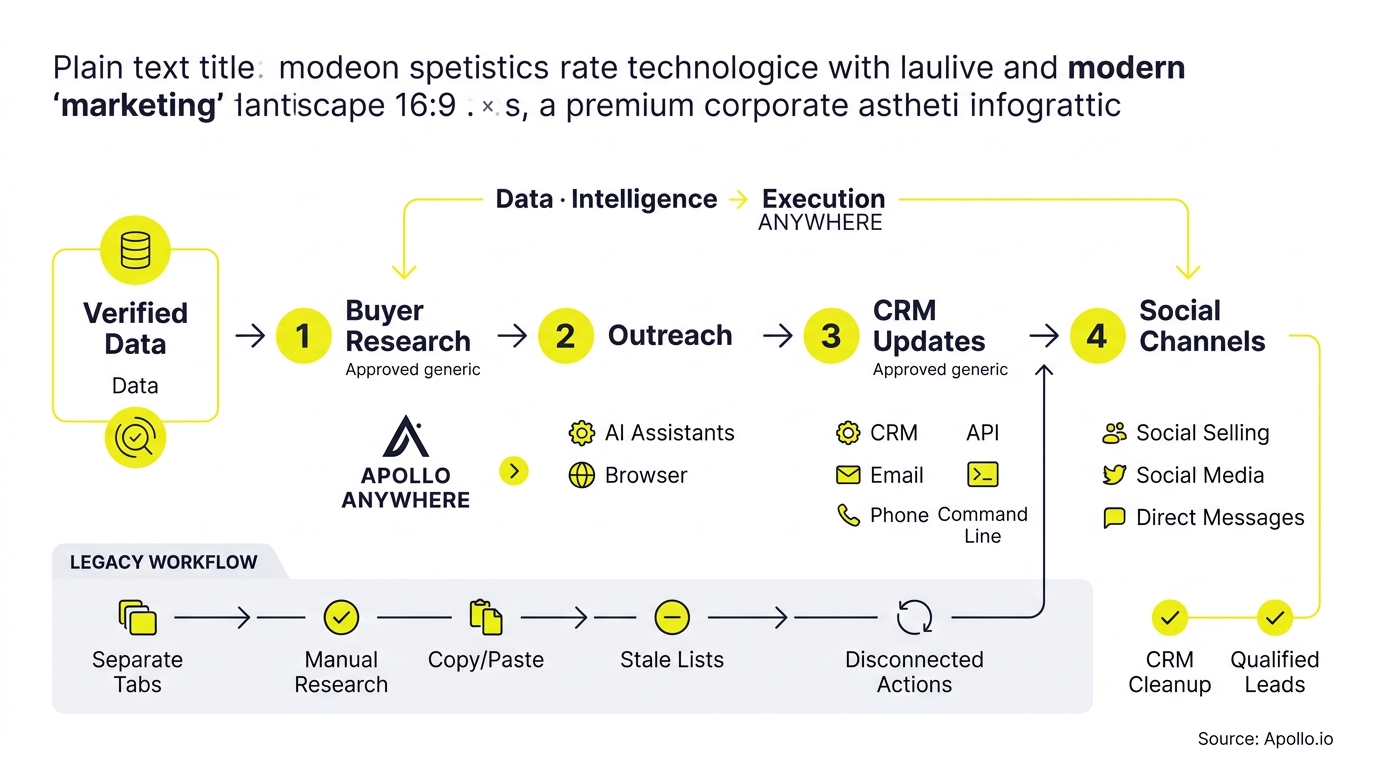

Skip The Research, Apollo Verifies Contacts
Burning hours chasing bad emails and dead phone numbers instead of selling? Apollo hands your team verified contact data instantly, with 98% email accuracy built in. Redirect that research time straight into your pipeline.
Start Free with Apollo →Key Takeaways
- Marketing today means equipping every stakeholder in a buying group with role-specific proof, not just generating awareness.
- The traditional 4Ps framework still matters, but B2B teams need a decision-enablement layer on top of it.
- AI is reshaping how buyers research vendors before sales ever gets involved, making evidence-based content non-negotiable.
- Budget pressure means marketers must connect every campaign to measurable revenue impact, not vanity metrics.
- Consolidating your GTM tech stack frees up budget to invest in the content and data that actually move deals forward.
What Is Marketing?
Marketing is the set of activities a business uses to identify, attract, and retain customers by communicating value clearly enough that buyers choose to act. It spans research, positioning, content, distribution, and measurement.
In B2B specifically, marketing has evolved from single-buyer persuasion into a system for helping entire buying committees reach consensus.
Historically, marketing was defined by the 4Ps: Product, Price, Place, and Promotion. That framework still applies to how you package and distribute an offer.
But it was built for a world with one buyer, not a distributed group evaluating a purchase largely before ever speaking to a salesperson.
How Is Marketing Different From Sales?
Marketing creates demand and educates the market at scale, while sales converts qualified interest into closed revenue through direct, one-to-one conversations. Marketing owns awareness, positioning, and content; sales owns negotiation, objection handling, and closing. Explore the full breakdown in What Is the Difference Between Sales and Marketing?
The line is blurring fast. Harvard Business Review argued in September 2026 that companies running AI separately in each function are missing the bigger opportunity: a single, AI-enabled go-to-market engine spanning discovery, engagement, and conversion.
For RevOps leaders, this means campaign data, sales signals, and messaging finally need to live in one connected system instead of two disconnected ones.
Why Does Marketing Matter More Under Budget Pressure?
Marketing matters more under budget pressure because every dollar has to prove its path to revenue, not just impressions or clicks. According to Digital Applied, the median B2B marketing budget sits at 9.1% of company revenue in 2026, and CMOs are under constant pressure to justify that spend against pipeline outcomes.
Alignment matters just as much as spend. Research from Unify GTM found that marketers who align their go-to-market signal layers report 11% annual revenue growth, compared to under 1% for teams that don't. That gap shows why fragmented tools and disconnected data are now a growth risk, not just an operational annoyance.
For Marketing Leaders managing shrinking budgets, this means killing tools that don't tie directly to pipeline. What B2B Marketing Metrics Actually Drive Revenue Growth? breaks down which numbers to report up and which to retire.

How Do You Market To A Complex Buying Group?
You market to a complex buying group by mapping content and proof to each stakeholder's specific concerns instead of writing one asset for a single persona. Salesforce research confirms that buying committees have expanded, and most of the decision-making now happens before a seller is ever contacted.
A practical stakeholder proof matrix looks like this:
| Stakeholder | Primary Concern | Proof They Need |
|---|---|---|
| Economic Buyer | ROI and budget justification | Case studies with measurable outcomes |
| Technical Evaluator | Integration and security | Documentation, architecture diagrams |
| End User | Ease of adoption | Product demos, trial access |
| Procurement | Contract terms, risk | Pricing transparency, SLAs |
| Executive Sponsor | Strategic alignment | Analyst mentions, peer validation |
Give internal champions a one-page consensus checklist summarizing proof for each row. It's the single highest-leverage asset you can create for a stalled deal.
Turn Marketing Leads Into Real Pipeline
Watching marketing-qualified leads stall before they ever become sales-ready opportunities? Apollo's intent signals surface prospects actually in-market, so reps chase buyers instead of names on a list. Built-In improved win rates using Apollo's scoring.
Start Free with Apollo →How Is AI Changing Marketing In 2026?
AI is changing marketing by moving buyer research into large language models before a human sales conversation ever happens. Buyers increasingly compare vendors and synthesize information through AI tools, which means your content needs to be structured for machine retrieval, not just human scanning.
The gap between AI investment and readiness is stark. Gartner's 2026 CMO Spend Survey found that CMOs now allocate 15.3% of marketing budgets to AI, yet only 30% report having mature AI readiness.
That mismatch is why so many AI pilots stall: teams buy tools before they fix workflows or data foundations.
For AI Builders and RevOps leaders architecting this stack, the fix isn't more point solutions. It's a connected system where enrichment, engagement, and intelligence share the same data layer. Struggling to find qualified leads across disconnected platforms? Search Apollo's 240M+ contacts with 65+ filters instead of stitching together separate data and outreach tools.
How Can SDRs And AEs Use Marketing Content To Book More Meetings?
SDRs and AEs can use marketing content as pre-built credibility that shortens the trust-building phase of outbound. When an SDR references a thought-leadership piece or a case study in outreach, prospects respond faster because the groundwork is already laid.
This matters because thought leadership directly moves buyers to act: 75% of decision-makers said a thought-leadership asset prompted them to research a vendor they hadn't previously considered, and 90% said strong thought leadership makes them more receptive to being contacted. SDRs should treat marketing's best assets as sequence fuel, not just nurture material.
For Account Executives running live deals, marketing content also arms champions internally. Spending hours writing manual follow-up emails with no supporting proof? Automate your sequences with Apollo's multi-channel platform and attach the right proof points automatically based on deal stage.
How Do You Measure Marketing ROI?
You measure marketing ROI by tracking pipeline influence and revenue attribution, not just top-of-funnel volume like impressions or form fills. A measurement scorecard should include: pipeline generated, influenced revenue, sales cycle length, cost per opportunity, and content engagement by buying-committee role.
RevOps leaders should build this scorecard once and report it consistently across marketing and sales. Fragmented tools make this harder because attribution data lives in five different places. Consolidating platforms is one reason Census reported, "We cut our costs in half," after simplifying their stack, and why the team at Predictable Revenue said, "We reduced the complexity of three tools into one."
Dig deeper into the specific numbers that matter in What B2B Marketing Metrics Actually Drive Revenue Growth? and how to structure reporting in How to Structure a Marketing Team for Revenue?
What Marketing Channels Should B2B Teams Prioritize In 2026?
B2B teams should prioritize channels based on where their buying committee actually researches, which now spans an average of 10 interaction touchpoints per purchase according to McKinsey's B2B Pulse research. That means owning a consistent presence across email, content, social, and direct outreach rather than betting everything on one channel.
Practical prioritization for 2026:
- Email: Still the highest-control, highest-ROI channel for nurture. See What Is B2B Email Marketing?
- Inbound + outbound blend: Neither works alone anymore. Compare approaches in Inbound vs. Outbound Marketing
- Lifecycle nurture: Match content to buying stage, not just persona. See What Is Lifecycle Marketing?
- Digital funnel design: Map the full path from click to closed deal in How to Build a B2B Marketing Funnel That Converts in 2026
What's The Best Way To Consolidate Your Marketing Tech Stack?
The best way to consolidate your marketing tech stack is to audit every tool against a single question: does this connect directly to pipeline and revenue reporting? Skaled's RevOps research confirms that data cleanliness and tech stack consolidation have become strategic priorities, not nice-to-haves, in 2026 revenue operations.
Cyera's team summed up the payoff simply: "Having everything in one system was a game changer." Founders and RevOps leaders under ROI pressure should look for platforms that combine data enrichment, engagement, and pipeline visibility instead of licensing five separate point solutions.
Tired of managing five different subscriptions with data that doesn't sync? See how Apollo's go-to-market platform unifies data, outreach, and reporting in one workspace. Explore the tools landscape further in What Are the Best B2B Marketing Tools for 2026?

Conclusion: Building Marketing That Survives Internal Scrutiny
Marketing in 2026 isn't measured by reach or output volume. It's measured by whether your content and data can survive a 13-person committee poking holes in it after your team has left the room.
That means building role-specific proof, connecting every campaign to revenue, and giving buyers evidence they can defend internally without you in the meeting.
Apollo brings B2B data, sales engagement, and AI-powered execution together in one connected go-to-market system, so marketing and revenue teams don't have to stitch together separate vendors for research, outreach, and analysis. Start a Trial to see how consolidating your stack frees up budget for the content and proof points that actually close deals: Start a Trial.
Turn Pipeline Spend Into Proven Revenue
Struggling to prove ROI before the next budget review? Apollo replaces scattered tools with one platform and shows pipeline impact from week one. Leadium tripled annual revenue after consolidating into Apollo.
Start Free with Apollo →Don't miss these
Sales
Inbound vs Outbound Marketing: Which Strategy Wins?
Sales
What Is a Sales Funnel? The Non-Linear Revenue Framework for 2026
Sales
What Is a Go-to-Market Strategy? The 2026 GTM Playbook
See Apollo in action
We'd love to show how Apollo can help you sell better.
By submitting this form, you will receive information, tips, and promotions from Apollo. To learn more, see our Privacy Statement.
4.7/5 based on 9,690 reviews
