The leading CRM systems in 2026 are Salesforce, HubSpot, and Microsoft Dynamics 365, and the best fit depends on team size, sales motion, and service needs rather than market share alone. This guide separates commercial leadership from buyer suitability so you can build a shortlist you can defend. (CRM strategies that actually work covers the operating model behind the tool you choose.)

Skip Manual Research With Apollo's Data
Tired of burning hours researching leads and verifying contact info? Apollo puts business contact details at your fingertips with 98% email accuracy, so you reach real buyers faster. Quota pressure doesn't wait. Start prospecting free today.
Start Free with Apollo →Key Takeaways
- Leadership is not suitability. Revenue share shows who sells the most CRM software, not which platform fits your workflows.
- Sales CRMs and service suites are different categories. Evaluate them separately.
- Adoption decides ROI. A CRM your reps avoid produces stale data and weak forecasts.
- AI agents are only as good as CRM data. Test data quality and permissions before scaling automation.
- Run scripted workflow trials instead of comparing feature lists.
Which CRM Systems Should You Shortlist by Use Case?
Shortlist by use case first, then check market position. The table below reflects vendor positioning and category norms.
Verify current plan costs on each vendor's pricing page before purchase, because pricing changes often and varies by edition and billing term.
| Use Case | Platforms to Evaluate | Best Fit | Main Limitation to Test |
|---|---|---|---|
| Small business, fast setup | HubSpot, Zoho, Pipedrive | Teams that need quick adoption and light admin | Advanced customization and reporting depth as you scale |
| Mid-market, sales and marketing alignment | HubSpot, Salesforce | Teams that want shared data across funnel stages | Cost growth as seats and add-ons increase |
| Enterprise, complex process and governance | Salesforce, Microsoft Dynamics 365 | Multi-team orgs with custom objects and approval flows | Implementation effort and admin ownership |
| Microsoft-centered environments | Microsoft Dynamics 365 | Teams already standardized on Microsoft tools | Licensing complexity across modules |
| Service-led organizations | Service suites (evaluated separately) | Support-heavy teams with case management needs | Sales workflow depth may differ from a sales CRM |
Verification note: product capabilities and pricing were not retested for this guide. Confirm each vendor's current plans before purchase.
What Does "Leading" Actually Mean for a CRM System?
A CRM is "leading" in at least three distinct ways: revenue share, technology prevalence, and buyer fit. These measures answer different questions and should not be conflated.
| Type of Leadership | What It Measures | What It Does Not Tell You |
|---|---|---|
| Revenue share | Vendor revenue in the CRM market | Whether it suits your team or budget |
| Technology prevalence | How many companies are detected using a tool | Satisfaction, depth of use, or outcomes |
| Buyer fit | Match to your workflows, data, and team skills | Industry-wide popularity |
Salesforce is the revenue leader. According to CRM Reviews, Salesforce holds a 20.0% to 20.7% share of the worldwide CRM applications market, marking its 12th or 13th consecutive year at #1. Revenue share is not customer adoption share, and it is not a recommendation for every buyer.
How Big Is the CRM Market in 2026?
The CRM market is large and still growing. Gartner reports that the global CRM software market grew 13.4% to reach $128 billion in vendor revenue. Separately, Gartner sizes the standalone CRM sales software market at $25.7 billion in 2024 (12.2% growth), projected to expand at a 12.8% CAGR through 2029.
Scale tells you the category is established. It does not show that any one platform delivers better returns. Concentration also has limits: according to Quantum Run, over 65% of the broader CRM and RevOps software market is distributed across providers outside the top five, which is why a shortlist beyond the biggest names is reasonable.

What Is the Difference Between a Sales CRM and a Service Suite?
A sales CRM manages leads, accounts, opportunities, and forecasts. A service suite manages cases, support queues, and customer engagement after the sale.
Gartner's October 2025 CRM Customer Engagement Center assessment covered 11 vendors and defined that category around unified, AI-augmented customer service.
That framing matters. Do not assume a strong sales CRM delivers equivalent service orchestration, or the reverse. If your team handles both, score each capability separately in your evaluation.
Which CRM Is Best for Small Businesses?
Small teams should prioritize speed to adoption and low admin overhead. Small Business Majority's August 2024 research found that 6 in 10 surveyed small-business owners used a digital CRM, and among CRM users, 55% reported increased sales and 50% reported improved customer retention.
These are self-reported benefits, not causal ROI estimates.
For small teams, shortlist platforms known for fast setup, such as HubSpot, Zoho, and Pipedrive, then test one real workflow end to end before committing.
Which CRM Is Best for Enterprise Teams?
Enterprise buyers should weight customization, governance, integration breadth, and admin capacity. Salesforce and Microsoft Dynamics 365 are the usual starting points.
Both support complex objects, approval flows, and role-based permissions, but they typically need dedicated implementation resources and ongoing admin ownership.
Plan for the operating model, not just the license. Data sync discipline matters at this scale; see how data sync improves B2B sales and marketing ROI for the mechanics.
How Should You Score and Compare Leading CRM Systems?
Use a weighted scorecard and score only what you have tested. Weight adoption heavily, because Gartner's 2024 revenue and sales technology research reports that 50% of sellers felt overwhelmed by the technologies required for their work.
| Criterion | Suggested Weight | How to Test It |
|---|---|---|
| Ease of adoption | 25% | Time for a new rep to complete core tasks unaided |
| Data quality and hygiene | 20% | Duplicate rate, field completeness, activity capture accuracy |
| Workflow fit | 20% | Run the three scripted trials below |
| Integration coverage | 15% | Confirm native connectors for your stack |
| Total cost of ownership | 10% | Seats, add-ons, admin time, AI usage costs |
| AI and governance readiness | 10% | Permissions, audit trail, action controls |
Label each score as observed (you tested it) or vendor-claimed (you read it). Keep those separate in your final write-up.
What Three Workflow Trials Should You Run Before Buying?
Run the same scripted trial in every finalist so results are comparable. Use a copy of real data, not demo records.
Trial 1: How Fast Can a Lead Move From Capture to Qualified Opportunity?
- Import 200 sample leads, including 20 intentional duplicates.
- Route them to reps by territory using each platform's native rules.
- Convert 10 leads to opportunities and log the clicks and minutes required.
- Record duplicate handling and any manual cleanup.
Trial 2: Can the CRM Keep Records Current With Minimal Manual Entry?
- Connect email and calendar for three test users.
- Run a week of normal activity.
- Audit how many meetings, emails, and contacts were captured correctly.
- Note anything that needed human correction.
Trial 3: Can Reps Work the Pipeline Without Living in the CRM?
- Test assistant, mobile, or email-based access to update deals and prepare for meetings.
- Confirm permissions block actions a user should not take.
- Check that every automated change appears in an audit trail.
Scripted trials expose real friction that feature checklists hide. Keep a log and share it with every stakeholder.
Fill Your Funnel With Buyers Who Are Ready
Struggling to fill the top of the funnel with quality leads? Apollo surfaces the right business contacts at right moment, so more leads turn into real opportunities. Teams using Apollo's AI Assistant are up 2,156% since December 2025.
Start Free with Apollo →How Is AI Changing the Leading CRM Systems in 2026?
Vendors are moving CRM capability into assistants and agents, but the evidence on productivity is still mixed. Recent announcements show the direction:
- Microsoft (November 17, 2026): announced a generally available updated Sales plugin for Dynamics 365 in Copilot, supporting account planning, meeting preparation, pipeline prioritization, and deal-risk insights.
- HubSpot (September 16, 2026): introduced a self-updating CRM and rebuilt Breeze Assistant.
- Salesforce and Anthropic (August 26, 2026): announced Salesforce in Claude with 37 prebuilt sales skills, with select-customer pilot availability and a planned September open beta rather than general availability.
These are vendor-announced capabilities, not proof of universal performance gains. Gartner's July 28, 2026 forecast adds a counterweight: AI agents will outnumber sellers 10 to 1 by 2028, yet fewer than 40% of sellers will report improved productivity.
What Should You Test Before Trusting AI Agents on CRM Data?
- Data quality: identity matching, duplicate handling, and activity capture.
- Permissions: what an agent can read and change, and who approves it.
- Cost: Microsoft says its public-preview Sales Development Agent begins consuming Copilot credits on December 1, 2026. Model usage costs per qualified opportunity, not just seat prices.
- Outcomes: measure admin time saved, conversion, cycle length, and incremental pipeline.
Gartner also reports that organizations providing AI-enabled next-best actions were 2.6 times more likely to achieve commercial growth. That is an association, not proof that buying AI causes growth.
Training and workflow redesign matter as much as the feature set.
How Do You Plan a CRM Migration and Drive Adoption?
Treat migration as a data project first and a software project second. Clean data before you move it, then phase adoption by team.
- Audit current data. Remove duplicates, fix field mappings, and archive dead records.
- Define success metrics. Pick adoption, data completeness, and cycle-time targets before launch.
- Pilot with one team. Collect friction reports and adjust fields and views.
- Train by role. Short, role-specific sessions beat one long overview.
- Review at 30, 60, and 90 days. Track the metrics you set and retire unused fields.
Data quality is the foundation. Data enrichment fills CRM gaps so reps start with usable records, and the CRM integration strategy guide shows which connections to prioritize first.
How Do Multi-Channel Buyers Change CRM Requirements?
Buyers move across many channels, so your CRM must keep context continuous. McKinsey's 2024 B2B Pulse research found that buyers used an average of 10 interaction channels, and more than half would likely switch suppliers after an unsatisfactory cross-channel experience.
It also reported that 71% of respondents offered e-commerce, with online sales at 34% of revenue among organizations offering that channel.
Evaluate how each CRM connects account history, commerce data, and post-purchase service. Isolated feature wins matter less than continuity.
How Does Apollo Fit Alongside Your CRM?
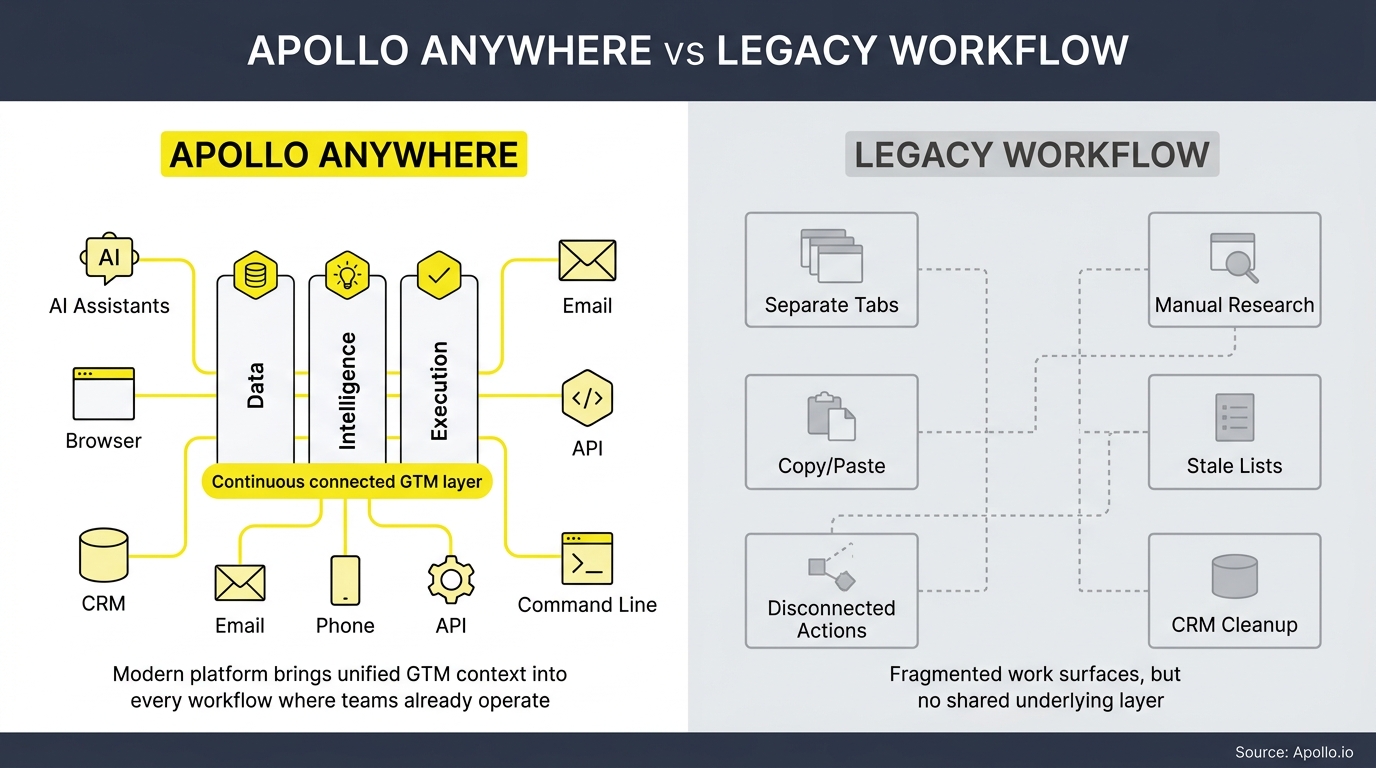
Apollo works with your CRM rather than replacing the system of record. It brings B2B data, sales engagement, and AI-powered execution together in one connected go-to-market system, so teams don't have to stitch together separate vendors for research, outreach, and analysis.
Apollo serves B2B GTM teams, SDRs, BDRs, AEs, RevOps, marketing, and revenue leaders.
Records are only as useful as the data behind them. Weak contact data undermines routing, reporting, and AI agents. Tired of dirty CRM data? Start free with Apollo's 240M+ verified contacts to keep records current. For connection steps, see the Apollo CRM integration guide.
"Apollo enriches everything we have: contacts, leads, accounts... And we don't really have to touch it, it just works."
Spending hours on manual outreach once the CRM is in place? Automate your sequences with Apollo and sync activity back to your CRM.
"Having Apollo and having everything be in one system was a game changer, for BDRs specifically."
What Worksheets Should You Use to Finalize Your CRM Decision?
Use two simple worksheets to turn research into a decision. Copy these into a spreadsheet and share them with stakeholders.
| Migration Readiness Worksheet | Owner | Status |
|---|---|---|
| Duplicate and dead-record audit complete | RevOps | Not started / In progress / Done |
| Field mapping approved | RevOps and Sales Leadership | Not started / In progress / Done |
| Integration list confirmed | IT or RevOps | Not started / In progress / Done |
| Pilot team selected | Sales Leadership | Not started / In progress / Done |
| Adoption Tracking Worksheet | Baseline | 30 Days | 60 Days | 90 Days |
|---|---|---|---|---|
| Weekly active users (%) | ||||
| Records updated within 24 hours of rep activity (%) | ||||
| Sequences or tasks launched from CRM records (count per rep) | ||||
| Rep time spent on manual data entry (self-reported) |
Review both worksheets in a weekly RevOps standup during the pilot. If a metric stalls for two consecutive weeks, fix the workflow before expanding to more teams.
What Should a RevOps Leader Prioritize When Choosing a CRM?
A RevOps leader should prioritize data integrity, integration depth, and reporting flexibility over feature count. A CRM that reps avoid produces unreliable forecasts, no matter how many modules it includes.
- Data model fit: Confirm custom objects, fields, and permissions match your sales process.
- Integration coverage: List every tool that must sync, then test each one during the pilot.
- Enrichment and hygiene: Decide how data enrichment will keep records current after go-live.
- Admin burden: Estimate how many hours of ongoing configuration your team can support.
How Should an SDR Manager Evaluate CRM Workflow Fit?
An SDR manager should evaluate how many clicks it takes a rep to find a prospect, start outreach, and log the result. Shadow two reps for a day during the trial and note every point where they leave the CRM.
Pair the CRM with a prospecting layer so reps can search business contact information and push qualified records straight in. Apollo also connects to AI assistants through Apollo MCP, so reps can pull data into the tools they already use. Review the supported CRM integrations before you finalize your shortlist.
What Are Common Questions About Leading CRM Systems?
Do I Need to Replace My CRM to Use Apollo?
No. Apollo works alongside your existing CRM and syncs data and activity both ways. Teams can keep their system of record and add prospecting, enrichment, and engagement on top.
How Long Should a CRM Pilot Last?
Run the pilot long enough to cover a full sales cycle stage, from lead capture to qualified opportunity. Most teams use the 30, 60, and 90 day checkpoints in the adoption worksheet above to decide whether to expand.
What Does Apollo Cost Alongside a CRM?
Apollo offers a Free plan at $0. Paid plans start with Basic at $49/user/month on annual billing, and Organization is $119/user/month billed annually (min 3 users). Check Apollo's pricing page for current billing options on all plans.
Which Matters More: Features or Adoption?
Adoption matters more. A CRM with fewer features that reps update daily gives you cleaner pipeline data than a feature-heavy system that sits idle.

How Do You Choose the Right CRM and Get Started?
Choose the CRM that passes your three workflow trials, scores highest on your weighted matrix, and fits a migration plan your team can execute. Then fill the gaps around it with data, enrichment, and outreach that sync back to your records.
Apollo brings B2B data, sales engagement, and AI-powered execution together in one connected go-to-market system, so teams don't have to stitch together separate vendors for research, outreach, and analysis. Users control who they contact and how they use the product.
Ready to pair your CRM with a unified GTM workspace? Start a Trial with Apollo today.
Prove Pipeline ROI Faster With Apollo
Budget review coming and no clear numbers to defend your tool spend? Apollo puts prospecting, outreach, and pipeline tracking in one workspace, so wins are easier to see and defend. Built-In saw +10% win rate and +10% ACV.
Start Free with Apollo →Don't miss these
Sales
Inbound vs Outbound Marketing: Which Strategy Wins?
Sales
What Is a Sales Funnel? The Non-Linear Revenue Framework for 2026
Sales
What Is a Go-to-Market Strategy? The 2026 GTM Playbook
See Apollo in action
We'd love to show how Apollo can help you sell better.
By submitting this form, you will receive information, tips, and promotions from Apollo. To learn more, see our Privacy Statement.
4.7/5 based on 9,690 reviews
