
Lead generation creates and captures demand from people who show interest in your company. Prospecting is the outbound, research-led work of identifying and engaging accounts that fit your ideal customer profile before they raise a hand. The two overlap, and most revenue problems come from the handoff between them, not from either activity alone. Use this guide to fix that handoff first, then choose the tools. For a deeper look at the demand side, see demand generation vs lead generation.
Struggling to find qualified leads? Search Apollo's 240M+ contacts with 65+ filters and build your first target list in minutes.

Apollo Builds Your Lead List While You Sell
Tired of burning hours researching leads and verifying contact info? Apollo puts verified business contacts at your fingertips with 98% email accuracy. Give your team back its selling time and start filling pipeline today.
Start Free with Apollo →Key Takeaways
- Lead generation attracts and captures interest; prospecting proactively researches and engages fit accounts. Both feed the same pipeline.
- The handoff (routing, acceptance criteria, rejection reasons, recycling rules) is where most pipeline leaks.
- Relevance beats volume. Personalized outreach to small, segmented lists outperforms broad sends.
- Buyers often choose a preferred vendor before contacting sales, so familiarity built early shapes outbound results.
- Measure sourced and influenced pipeline separately, and judge teams on qualified meetings and opportunities, not activity counts.
How Do Lead Generation and Prospecting Compare?
Lead generation is marketing-led and attraction-based, while prospecting is sales-led and outreach-based, but the line between inbound and outbound is blurry in practice. A webinar attendee may be prospected, and a prospected account may later fill out a form.
| Dimension | Lead Generation | Prospecting |
|---|---|---|
| Primary goal | Capture and convert interest into leads | Identify and open conversations with fit accounts |
| Typical owner | Marketing (demand gen, content, ops) | SDRs, BDRs, AEs |
| Starting signal | Form fill, content download, event, page visit | ICP match, trigger event, intent, job change |
| Direction | Mostly inbound, attraction | Mostly outbound, direct engagement |
| Key output | Marketing-qualified leads | Sales-qualified meetings and opportunities |
| Overlap | Nurtures and routes leads to sales | Re-engages and recycles leads from marketing |
Who Owns Lead Generation in B2B Companies?
Marketing owns lead generation at most B2B companies. The CMO Survey's 2025 industry breakout found marketing owns it at 79.5% of B2B product companies and 76.4% of B2B services companies, versus 31.7% of B2C product companies.
That ownership split is why the handoff to sales needs written rules, not assumptions. SDRs, RevOps leaders, and marketing leaders should agree on definitions before a single lead is routed.
Why Does Relevance Matter More Than Volume in Prospecting?
Relevance matters more because buyers actively filter out irrelevant outreach. According to Gartner, 61% to 67% of B2B buyers prefer an overall rep-free buying experience, choosing self-directed digital channels and AI over engaging directly with sellers. Generic outreach competes against a buyer who would rather not talk to you at all.
The response data bears this out. MailWarm reports high-volume, non-personalized cold email response rates have slipped to between 0.45% and 3.43% on broad sends. By contrast, FlowStrata notes that deeply personalized cold emails reflecting account-specific business challenges yield response rates between 15% and 22%. Small lists also win: CopyCrest found campaigns targeting highly segmented lists under 50 prospects average a 5.8% to 6.2% reply rate, compared to 2.1% to 2.4% for lists over 500 to 1,000 prospects.
| Approach | Reported Response Rate | Source |
|---|---|---|
| Broad, non-personalized cold email | 0.45% to 3.43% | MailWarm |
| Lists of 500 to 1,000+ prospects | 2.1% to 2.4% reply rate | CopyCrest |
| Segmented lists under 50 prospects | 5.8% to 6.2% reply rate | CopyCrest |
| Deeply personalized, account-specific | 15% to 22% | FlowStrata |
What Does the Handoff From Lead Generation to Prospecting Look Like?
The handoff is a defined sequence: engagement, fit check, routing, accept or recycle, nurture, and opportunity. Each step needs an owner and a time expectation.
Below is one worked B2B journey with illustrative timing you can adapt.
| Stage | What Happens | Owner | Illustrative Timing |
|---|---|---|---|
| 1. Engagement | Contact downloads a guide or visits a pricing page | Marketing | Day 0 |
| 2. Fit check | Verify firmographics, role, and ICP match | Marketing ops / RevOps | Within 1 business day |
| 3. Route | Assign to the correct SDR or account owner | RevOps (automated) | Within hours |
| 4. Accept or recycle | Sales accepts, or returns with a documented reason | SDR / BDR | Within 1 to 2 business days |
| 5. Nurture | Recycled leads enter a content-led sequence | Marketing | Ongoing |
| 6. Opportunity | Qualified conversation becomes a pipeline opportunity | AE | Variable |
What Acceptance Criteria Should Sales Use?
Acceptance criteria are the written conditions a lead must meet for sales to work it. Define them jointly with marketing and keep the list short.
- Role and seniority match the buyer or influencer personas.
- Company size, industry, and region fit the ICP.
- A recent, relevant behavior or trigger exists (visit, download, job change).
- Contact data is complete and verified.
What Rejection Reasons Should Be Tracked?
Track a fixed menu of rejection reasons so marketing can improve upstream. Free-text rejections cannot be analyzed.
| Rejection Reason | Recycle Action |
|---|---|
| Out of ICP | Suppress from outbound; tune targeting |
| Wrong contact, right account | Identify the correct stakeholder; re-route |
| Not ready to buy | Enter long-term nurture |
| Bad or incomplete data | Enrich and re-verify before re-routing |
| Duplicate or existing customer | Merge records; route to account owner |
Tired of dirty data breaking your handoff? Start free with Apollo's data enrichment to fill gaps before leads reach sales.

How Should Teams Qualify Leads and Prospects?
Qualify against two inputs: fit (does the account match your ICP) and signal (is there a reason to talk now). Fit is stable; signal is time-sensitive.
Combining them prevents both wasted outreach on poor-fit accounts and missed timing on strong ones.
| Fit Indicators | Signal Indicators |
|---|---|
| Industry, company size, region | Content engagement, pricing-page visits |
| Role, department, seniority | Job changes, funding, hiring surges |
| Technology in use | Intent topics, event attendance |
Qualification also has to account for buying groups. The Starr Conspiracy notes the average B2B buying committee comprises 6 to 10 stakeholders, each independently consulting 4 to 5 sources of information. A single captured contact rarely represents the whole decision. Map multiple stakeholders per account rather than treating one form fill as the buyer.
What Does a Reusable Outreach-Quality Rubric Look Like?
Score each outbound message before it is sent. A message that scores low on relevance should be rewritten, not sent at scale.
| Criterion | Question to Ask | Score (0 to 2) |
|---|---|---|
| Account relevance | Does it reference something specific to this company? | 0 / 1 / 2 |
| Role relevance | Does it address this persona's actual priorities? | 0 / 1 / 2 |
| Evidence | Does it include a verifiable, useful insight? | 0 / 1 / 2 |
| Clear ask | Is there one low-friction next step? | 0 / 1 / 2 |
| Brevity | Can it be read in under 30 seconds? | 0 / 1 / 2 |
Set a minimum passing score (for example, 7 of 10) before a sequence launches.
Apollo Turns Pipeline Guesswork Into Forecasts
Forecasts feel like a guessing game because lead quality and deal data keep slipping? Apollo brings prospecting, outreach, deal activity into one connected workspace. Fill the top of your funnel and see where every deal stands. Teams actively using Apollo's AI Assistant are up 2,156% since December 2025.
Start Free with Apollo →How Do Buying Preferences Change Prospecting in 2026?
Buyers form preferences before they ever contact sales, so prospecting should build familiarity well ahead of active intent. In November 2026, 6sense's Global B2B Buyer Experience Report, based on 4,611 recent B2B buyers, found buyers selected their preferred vendor before contacting sales 82% of the time, and 96% followed vendors between purchases.
The implication: investing only in speed-to-lead after a form fill misses the stage where deals are often shaped.
Humans still matter at the decision point. Gartner reports 69% of B2B buyers use generative AI to gather vendor and product information but still turn to sales reps to validate AI-generated insights at critical decision points. Position reps as validators who add judgment and evidence, not as gatekeepers of information.
Where Does AI Fit in Lead Generation and Prospecting?
AI fits best in research, signal monitoring, and drafting, with humans controlling targeting and final messaging. Salesforce's State of Sales findings, from 4,050 sales professionals surveyed in August and September 2025, showed 55% using AI for prospecting and 48% lacking bandwidth for adequate cold outreach.
Adoption is addressing a real capacity gap, but adoption alone does not prove better pipeline quality.
Data quality is the constraint. The same research found 51% of sales leaders using AI said disconnected systems slowed their AI initiatives.
Clean CRM records, deduplication, and account context should come before scaling automated outreach. Pilot complete workflows (signal, research, draft, review, send) and judge them on qualified meetings, not email volume.
Spending hours on manual outreach? Automate your sequences with Apollo while keeping a human review step on messaging.
"Apollo allowed us to 3x our annual revenue without any decrease in efficiency."
How Should Nurturing Work for Leads Sales Doesn't Accept?
Nurturing keeps recycled leads warm with relevant content until a new signal justifies sales contact. This is a documented weak spot: the CMI/MarketingProfs 2025 benchmark reported 47% of B2B marketers say their technology stack lacks efficient lead generation and nurturing processes. Simple, rule-based nurture beats elaborate programs nobody maintains. For tactics, see these lead nurturing strategies.
| Recycle Reason | Nurture Track | Re-Route Trigger |
|---|---|---|
| Not ready to buy | Educational content, quarterly check-ins | Repeat visits, pricing-page view |
| Wrong contact | Account-level content to multiple roles | New stakeholder engages |
| Poor timing | Event and trigger-based touches | Funding, hiring, leadership change |
What Metrics Should You Track for Lead Generation and Prospecting?
Track outcomes tied to pipeline, and keep sourced and influenced pipeline separate. Sourced pipeline is created by a specific activity or team; influenced pipeline had that activity somewhere in the journey.
Blending them inflates credit and hides which motions actually open deals.
| Metric | Definition | Why It Matters |
|---|---|---|
| Sourced pipeline | Opportunities first created by a team or channel | Shows who opens new deals |
| Influenced pipeline | Opportunities touched by a team or channel at any stage | Shows contribution without overclaiming |
| Lead acceptance rate | Share of routed leads sales accepts | Signals targeting and handoff quality |
| Speed to first touch | Time from routing to first outreach | Measures SLA adherence |
| Meeting-to-opportunity rate | Meetings that become qualified opportunities | Tests quality, not just activity |
| Recycle rate by reason | Share of rejections per reason code | Guides upstream fixes |
Keep cold calling metrics realistic too. Belkins analyzed over a large set of B2B cold calls, but published benchmarks vary by industry, list quality, and persona. Use them as directional reference points, then set targets from your own baseline for connect rate, conversation rate, and meetings booked per rep.
How Can Apollo Support Lead Generation and Prospecting in One Workflow?
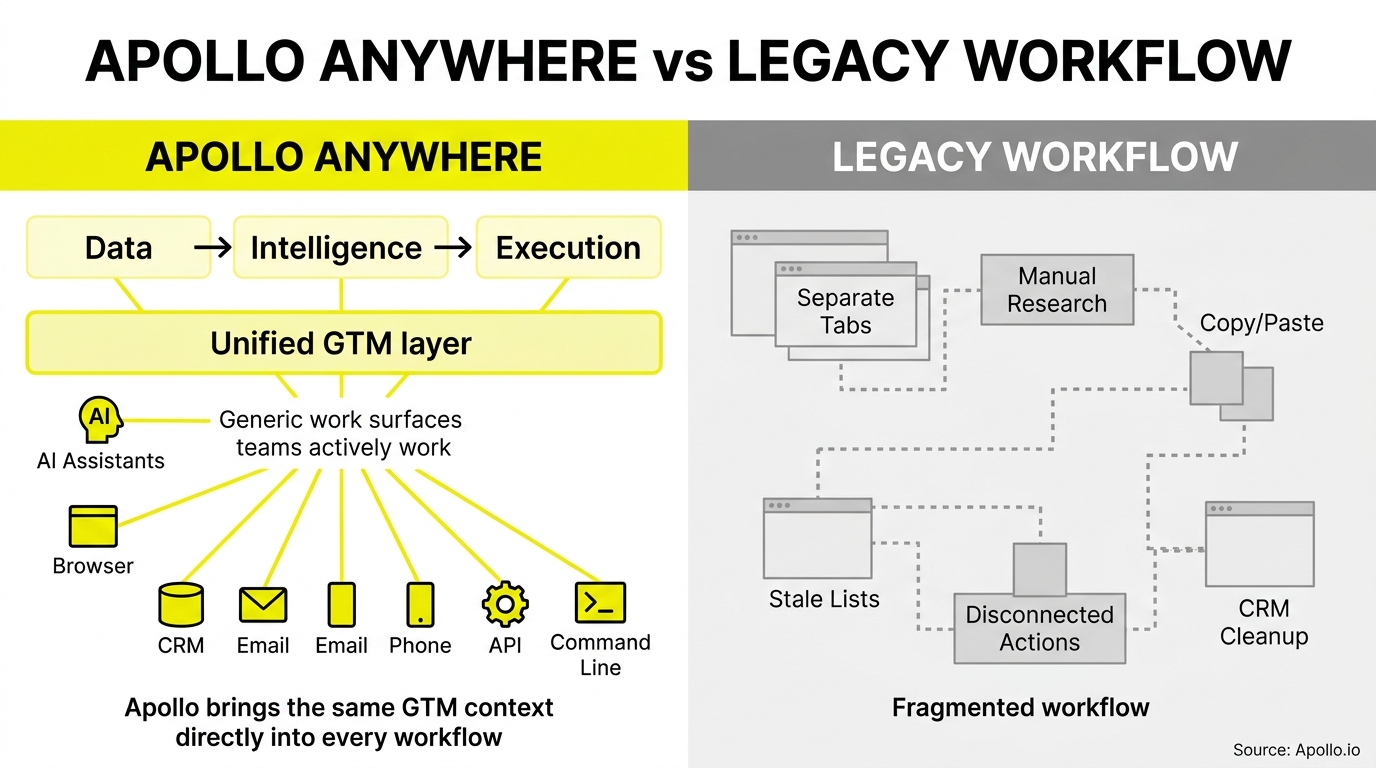
Apollo brings B2B data, sales engagement, and AI-powered execution together in one connected go-to-market system, so teams don't have to stitch together separate vendors for research, outreach, and analysis. Marketing can build and enrich lead lists, while sales can search, segment, and sequence the same records without exporting between tools.
Prospecting teams can use Apollo's B2B prospecting search to find businesses and professionals in their business capacity by title, industry, and company attributes. Teams then launch email, phone, and social touches from Apollo sales engagement.
Users control who they contact and how they use the product.
"The thing that made me most excited as somebody who's been in sales development a long time was Apollo's integration between sales data and sales engagement and the magic that you can make happen when those two are together on the same platform."
Apollo also works where teams already operate: Apollo MCP brings Apollo inside AI assistants like Claude, ChatGPT, and Perplexity, and the Chrome extension and Salesforce integration keep records current. According to Ramp's vendor data, 31% of enterprise organizations with a vendor in the Sales Data Providers category used Apollo as of November 2026, so the workflow is not limited to small teams.
How Should SDRs and RevOps Leaders Put This Into Practice?
Start with shared definitions, then automate the handoff. SDRs and RevOps leaders get the fastest gains by agreeing on what a lead, a prospect, and an accepted opportunity mean before changing tools or volume.
- Define the ICP together. Marketing and sales sign off on firmographic and persona criteria, plus disqualifiers.
- Set acceptance and rejection rules. Use the criteria and reason codes above so every recycled lead teaches the team something.
- Enrich at the point of entry. Use data enrichment so routing and scoring run on complete records.
- Route by rule, not by inbox. Assign by territory, segment, or score, and track speed to first touch against your SLA.
- Review weekly. RevOps reports acceptance rate, recycle reasons, and meeting-to-opportunity rate to both teams.
"The moment we select someone in our database, they're instantly added to a sequence and we can take action right away. We're effective and efficient with our outreach."
What Questions Do Teams Ask About Lead Generation and Prospecting?
Is Prospecting the Same as Lead Generation?
No. Lead generation attracts inbound interest through marketing programs, while prospecting is sales-led outreach to selected accounts and contacts.
Both feed the same pipeline, but they differ in who initiates contact and who owns the first conversation.
Should Sales Follow Up on Every Lead?
No. Sales should follow up on leads that meet agreed acceptance criteria. Leads that miss the bar go to nurturing with a reason code, so marketing can improve targeting upstream.
Which Metric Best Shows Whether the Two Motions Are Working?
Meeting-to-opportunity rate paired with lead acceptance rate. Together they show whether volume is turning into qualified pipeline rather than activity.

What Is the Best Way to Align Lead Generation and Prospecting?
Treat them as two entry points into one pipeline system. Agree on the ICP, write acceptance and rejection rules, enrich records before routing, and measure sourced and influenced pipeline separately.
Relevance beats volume in both motions, and shared data keeps marketing and sales working from the same facts.
Apollo gives GTM teams one workspace to find, enrich, and engage the right businesses and professionals, with AI tailored to your input and context. Ready to connect your lead generation and prospecting workflow? Get Leads Now.
Prove Pipeline ROI Fast With Apollo
Budget review coming and no clear numbers to show for your tools? Apollo puts prospecting, outreach, and deal activity in one workspace, so you can show impact on pipeline quickly. Teams actively using Apollo's AI Assistant are up 2,156% since December 2025.
Start Free with Apollo →Don't miss these
Sales
Inbound vs Outbound Marketing: Which Strategy Wins?
Sales
What Is a Sales Funnel? The Non-Linear Revenue Framework for 2026
Sales
What Is a Go-to-Market Strategy? The 2026 GTM Playbook
See Apollo in action
We'd love to show how Apollo can help you sell better.
By submitting this form, you will receive information, tips, and promotions from Apollo. To learn more, see our Privacy Statement.
4.7/5 based on 9,690 reviews
