
Demand Generation vs Lead Generation: What's the Difference?
B2B teams often confuse demand generation with lead generation, treating them as interchangeable tactics. They're not.
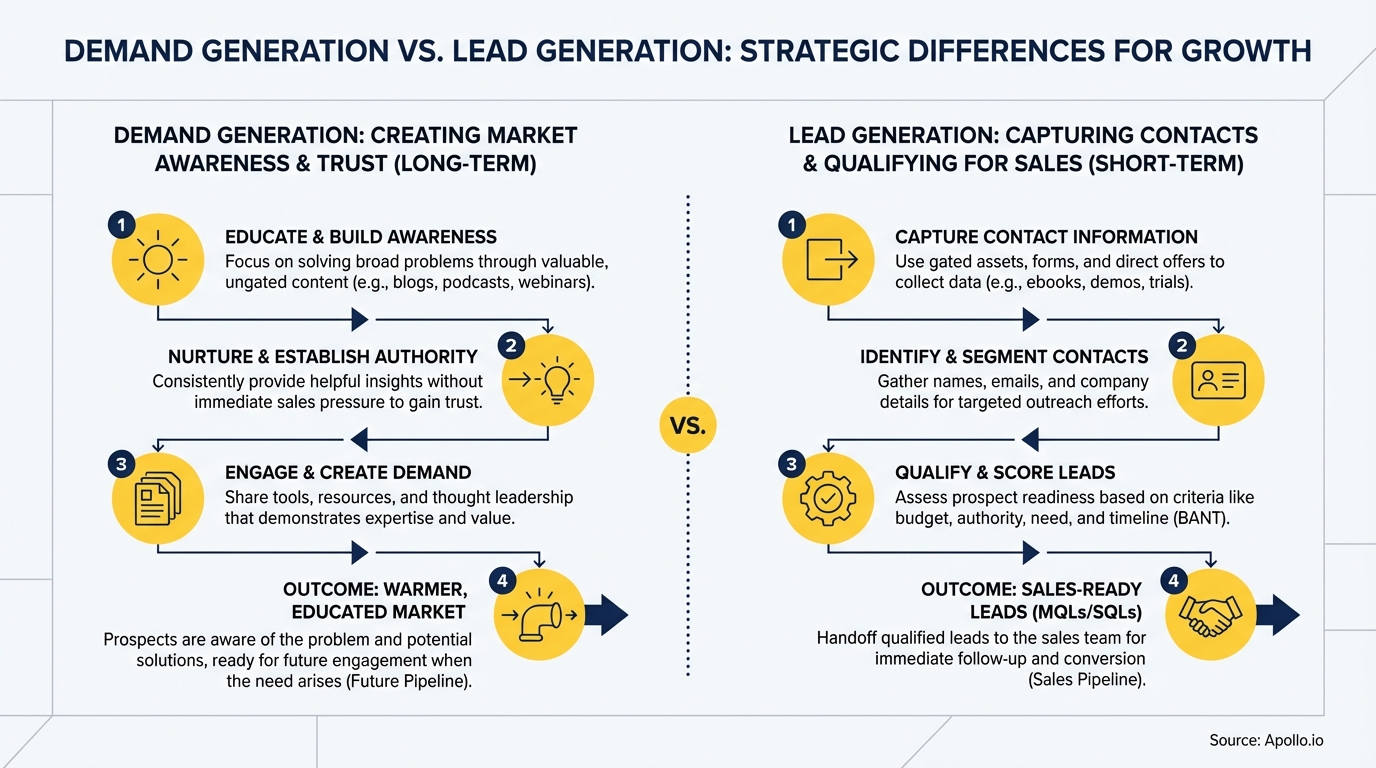
Demand generation builds market awareness and appetite for your solution. Lead generation captures contact information from interested prospects.
The distinction matters because prioritizing one over the other at the wrong stage wastes budget and stalls pipeline growth.
According to Gartner's 2024 Tech Marketing Benchmarks Survey, technology marketers with $100M+ in annual revenue now utilize an average of 16 marketing channels, blending digital and offline approaches. This multi-channel complexity demands clarity on which tactics build awareness versus which capture ready-to-buy prospects.

Get Quality Leads Fast With Apollo
Struggling with slow lead gen and inconsistent quality? Apollo delivers high-quality prospects at scale with 96% email accuracy. Join 550K+ companies hitting quota faster.
Start Free with Apollo →Key Takeaways
- Demand generation educates markets and creates buying intent; lead generation converts that intent into actionable sales opportunities
- High-growth organizations prioritize SEO and in-person events as top MQL sources, not just paid ads
- AI integration across both strategies is critical, with 92% of B2B businesses investing in AI-powered marketing tools in 2024
- Account-Based Marketing (ABM) bridges demand and lead generation by orchestrating targeted, personalized outreach at the account level
- First-party data quality determines success in both strategies, requiring unified platforms that consolidate prospecting, enrichment, and engagement
What Is Demand Generation vs Lead Generation?
Demand generation creates awareness and interest in your product category or solution. It educates buyers on problems they didn't know they had and positions your brand as the authority. Content is ungated, channels are broad, and metrics focus on engagement, brand lift, and pipeline influence.
Lead generation captures contact information from prospects who've demonstrated buying intent. It qualifies interest through gated assets, demo requests, or event registrations. Metrics focus on conversion rates, lead quality scores, and speed-to-opportunity.
The core difference: Demand generation asks, "How do we make our market smarter?" Lead generation asks, "How do we capture buyers ready to talk?"
The 5 Critical Differences Between Demand Generation and Lead Generation
| Dimension | Demand Generation | Lead Generation |
|---|---|---|
| Goal | Build awareness, educate market, create buying intent | Capture contact info, qualify prospects, drive pipeline |
| Content | Ungated thought leadership, research reports, webinars | Gated eBooks, demos, free trials, assessments |
| Metrics | Engagement rate, brand mentions, influenced pipeline | Conversion rate, MQL volume, cost-per-lead, lead velocity |
| Timeframe | Long-term (3-12 months to see impact) | Short-term (immediate conversions, weekly MQL targets) |
| Audience | Broad market, early-stage buyers, problem-unaware | In-market buyers, solution-aware, ready to evaluate |
Research by Gartner shows high-growth organizations (10%+ revenue increase) identify SEO and in-person events as their top MQL sources. This signals a shift from purely digital lead gen tactics toward integrated strategies that blend brand-building (demand) with conversion optimization (lead gen).

How AI and ABM Are Reshaping Both Strategies in 2026
According to Gartner's B2B Marketing Trends report, 92% of businesses are investing in AI-powered software to enhance marketing operations. AI now personalizes outreach at scale, automates research, and predicts which accounts are in-market.
AI in Demand Generation: Tools analyze search trends, social signals, and intent data to identify emerging topics. They generate personalized educational content and recommend optimal channels for distribution.
AI in Lead Generation: Platforms score leads in real-time based on engagement patterns, enrich contact data automatically, and trigger multi-channel sequences when prospects hit conversion thresholds.
"With this kind of AI system, my BDRs can send 10x more personalized emails. Their productivity and growth has skyrocketed."
Account-Based Marketing (ABM) sits at the intersection of demand and lead generation. According to Technology.org's research, organizations are shifting from broad lead gen tactics toward highly targeted account strategies with coordinated, personalized outreach across multiple channels.
ABM orchestrates demand-building content (ungated research, executive briefings) with lead-capturing tactics (personalized demos, account-specific landing pages) for named target accounts. This bridges the traditional divide between awareness and conversion.
Need to scale personalized outreach without sacrificing quality? Automate AI-powered sequences with Apollo's 224M+ verified contacts.
When to Prioritize Demand Generation vs Lead Generation
Prioritize Demand Generation when:
- You're entering a new market or launching a category-creating product
- Brand awareness is below 20% in your target segment
- Inbound lead volume is high but quality is poor (low conversion to SQL)
- Sales cycles are lengthening because buyers don't understand the problem
Prioritize Lead Generation when:
- You have strong brand recognition but insufficient pipeline coverage (less than 3x quota)
- Your market is mature and buyers actively search for solutions
- You need immediate pipeline to hit quarterly targets
- Marketing-sourced pipeline contribution is below company benchmarks
Most B2B teams need both simultaneously. The mix depends on market maturity, competitive position, and growth stage. Data-driven prospecting strategies help balance top-of-funnel awareness with bottom-funnel conversion.
Find Buyers Ready To Close With Apollo
Missing in-market prospects while competitors close deals? Apollo reveals buying intent signals and tracks website visitors so you reach decision-makers at the perfect moment. Built-In increased win rates 10% with Apollo's intelligence.
Start Free with Apollo →Building an Integrated Demand and Lead Generation Framework
The most effective B2B strategies don't choose between demand and lead generation. They sequence and integrate both.
Step 1: Establish First-Party Data Infrastructure
First-party data quality determines success in both strategies. Consolidate contact enrichment, intent signals, and engagement tracking in one platform. According to Statista, U.S. B2B marketing expenses are projected to reach $69 billion by 2026, but fragmented data across tools wastes 30-40% of that spend.
"Apollo enriches everything we have: contacts, leads, accounts... And we don't really have to touch it, it just works."
Struggling with incomplete contact data? Enrich leads automatically with Apollo's 96% email accuracy.
Step 2: Map Content to Buyer Journey Stages
Create a content matrix that aligns assets to awareness, consideration, and decision stages. Demand generation content (ungated) dominates awareness. Lead generation assets (gated) dominate decision stages. Effective demand generation marketing requires 3-5 ungated pieces for every gated offer.
Step 3: Implement Multi-Channel Orchestration
High-growth companies use 16+ channels on average. Orchestrate touchpoints across SEO, paid search, in-person events, email, and social. Track which channels drive awareness versus which convert leads. Outbound prospecting complements inbound lead gen by reaching buyers before they actively search.
Step 4: Align Metrics and Incentives
Demand generation teams should be measured on pipeline influence, not just MQL volume. Lead generation teams should be measured on lead quality and conversion velocity, not just volume.
Shared revenue targets prevent the common trap of prioritizing quantity over quality.
Step 5: Test, Measure, Optimize
Run A/B tests on gating decisions, channel mix, and messaging. Track cost-per-MQL, cost-per-opportunity, and blended CAC. Lead nurturing strategies bridge the gap between initial interest and sales-ready conversations.

Common Pitfalls and How to Avoid Them
Pitfall 1: Over-Gating Educational Content
Gating too much content kills demand generation. If your best insights require a form fill, you're optimizing for short-term leads at the expense of long-term brand authority.
Reserve gating for high-intent assets (demos, trials, assessments).
Pitfall 2: Ignoring Offline Channels
According to Statista, offline B2B marketing represented $39.1 billion in 2024, nearly two-thirds of total spending. In-person events, direct mail, and field marketing still drive high-quality leads, especially for enterprise accounts.
Pitfall 3: Disconnected Tech Stacks
Siloed tools fragment data and create blind spots. Consolidate prospecting, enrichment, engagement, and pipeline tracking in one platform. Automated lead generation systems eliminate manual handoffs between marketing and sales.
Conclusion: Balance Awareness and Conversion for Sustainable Growth
Demand generation and lead generation aren't opposing strategies. They're two phases of the same growth engine.
Demand generation educates your market and builds brand authority. Lead generation converts that awareness into pipeline.
High-growth B2B teams invest in both, using AI to personalize at scale, ABM to target high-value accounts, and first-party data to unify insights.
The companies winning in 2026 don't choose between building a brand and hitting quota. They orchestrate multi-channel strategies that balance long-term market education with short-term conversion optimization.
Start by auditing your current mix: Are you over-indexed on lead gen tactics that produce low-quality MQLs? Or under-invested in demand gen content that builds authority?
Ready to unify your demand and lead generation strategy? Start a free trial and access Apollo's 224M+ contacts, AI-powered personalization, and automated enrichment in one platform.
Prove Apollo's ROI In Your First 30 Days
Budget approval stuck on unclear metrics? Apollo tracks every dollar spent to pipeline generated—Built-In increased win rates 10% and ACV 10% with measurable impact. Get the ROI proof leadership demands.
Start Free with Apollo →Don't miss these
Sales
Inbound vs Outbound Marketing: Which Strategy Wins?
Sales
What Is a Sales Funnel? The Non-Linear Revenue Framework for 2026
Sales
What Is a Go-to-Market Strategy? The 2026 GTM Playbook
See Apollo in action
We'd love to show how Apollo can help you sell better.
By submitting this form, you will receive information, tips, and promotions from Apollo. To learn more, see our Privacy Statement.
4.7/5 based on 9,690 reviews
