
How to Count Insurance Agencies With 50+ Employees by Territory
The U.S. Census Bureau counted just 1,866 insurance-agency and brokerage establishments with 50 or more employees nationwide in its latest County Business Patterns release, out of 133,728 total employer establishments under NAICS 524210.
That's roughly 1.4% of the industry. If you're building a multi-state territory plan around this segment, you need a repeatable way to break that national number down by state, filter out branch-office noise, and turn it into an actual prospect list.

Skip The Research, Apollo Verifies Contacts
Spending hours manually researching leads and chasing bad emails. Apollo hands your team verified contact data instantly, no digging required. 98% email accuracy means less guessing, more selling.
Start Free with Apollo →Key Takeaways
- Only about 1,866 U.S. insurance-agency and brokerage establishments hit the 50+ employee threshold, so your territory total will be a small slice of the roughly 133,728 employer establishments in the industry.
- Use Apollo MCP when you need to pull a live, state-filtered list of insurance agencies and brokerages by headcount directly inside ChatGPT, Claude, or Perplexity, instead of exporting spreadsheets from Census tables.
- Census counts physical locations (establishments), not parent companies, so a single acquisition can multiply your territory's apparent account count without adding a new buying center.
- Agency M&A activity means territory lists go stale fast. Quarterly refreshes catch ownership changes before your reps waste calls on the wrong contact.
- Combining headcount data with revenue, technology adoption, and carrier-appointment signals gives RevOps a sharper account score than employee count alone.
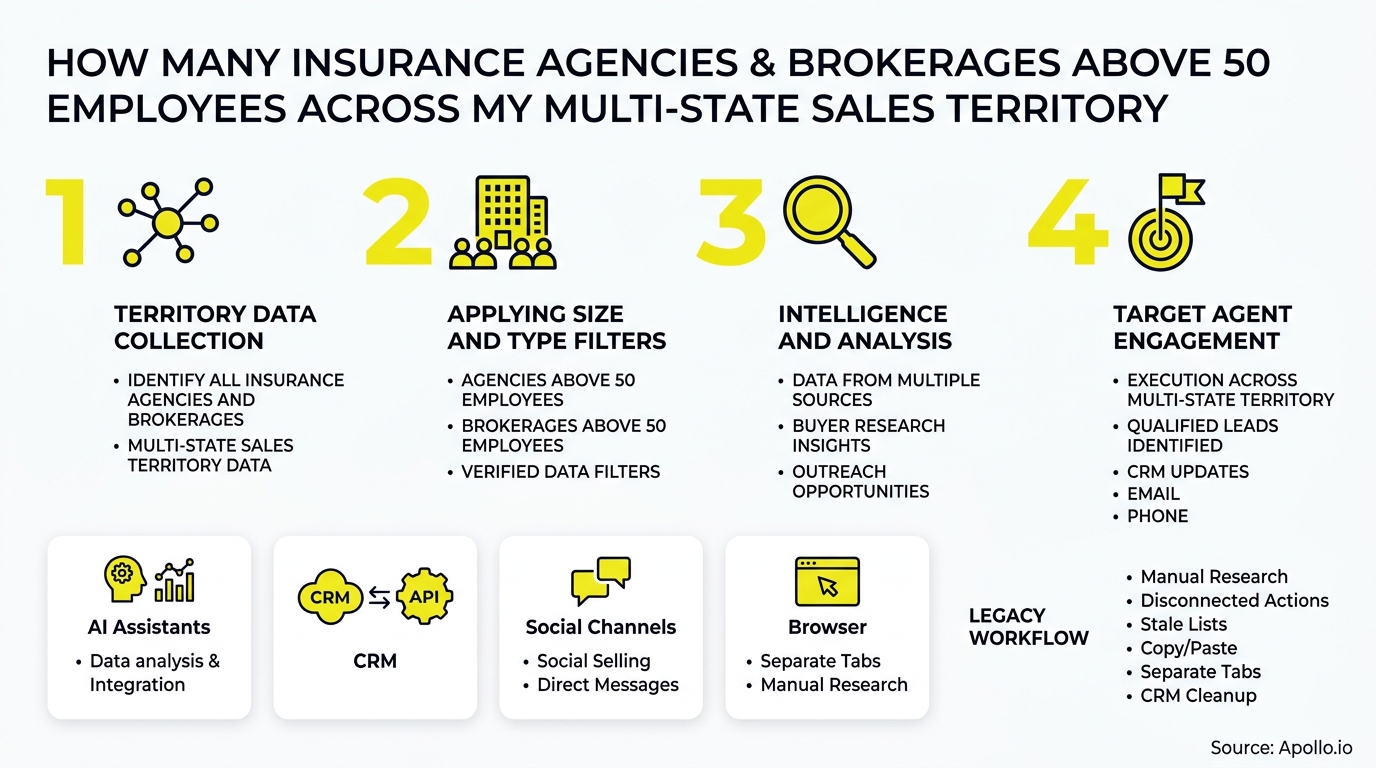
How Many Insurance Agencies And Brokerages Have More Than 50 Employees In My Sales Territory?
You calculate this by summing Census County Business Patterns employee-size bands for NAICS 524210 across the specific states in your territory. The national baseline is 1,866 establishments: 1,038 with 50-99 employees, 613 with 100-249, 144 with 250-499, 48 with 500-999, and 23 with 1,000 or more.
To get your territory number, pull the state-level breakdown for each band in every state you cover and add them together.
Because Census publishes data by state and by employee-size class, you can isolate any combination of states, whether that's a five-state Southeast region or a national enterprise territory. The table below shows the national bands as your starting reference point.
| Employee Size Band | National Establishment Count |
|---|---|
| 50-99 employees | 1,038 |
| 100-249 employees | 613 |
| 250-499 employees | 144 |
| 500-999 employees | 48 |
| 1,000+ employees | 23 |
| Total (50+) | 1,866 |
To build your own state-selector calculator, download the CBP2023.CB2300CBP table filtered to NAICS 524210, pull the state and employee-size columns, and sum the 50+ bands for your target states. Export the result as a CSV for your CRM import.
What Does "50+ Employees" Actually Mean In Census Data?
Census's "50-99" band means 50 or more employees, not strictly more than 50, so an establishment with exactly 50 staff is included in your count. This distinction matters if your ideal customer profile requires headcount thresholds like "51+" for licensing or plan-eligibility reasons, since Census won't split that band further.
Census also measures establishments, not companies. An establishment is one physical operating location.
A single brokerage enterprise can own dozens of establishments across several states, each counted separately in the CBP tables. That means your raw territory total likely overstates the number of unique decision-making organizations you're actually selling into.
For RevOps leaders building account-based territory models, this is the single most important caveat: run a parent-company deduplication pass before you hand a list to reps. Otherwise you'll route five reps to five offices that report up to one CFO.
Why Does Agency Consolidation Make Territory Counts Unstable?
Consolidation makes territory counts unstable because acquired agencies often keep operating under their original name and address while becoming part of a larger parent account. OPTIS Partners recorded 292 agency transactions in the first half of 2026, down from 342 in the same period of 2025, but still a material pace of ownership change.
Private-equity-backed and hybrid buyers represented 76% of those deals.
Gallagher's completed acquisition of AssuredPartners in August 2025 illustrates the scale effect: offices that once reported to separate ownership are now part of one enterprise account. If your territory list treats each office as an independent prospect, you risk running parallel outreach into the same parent organization, confusing buyers and wasting rep time.
This is exactly the kind of revenue operations problem that benefits from a quarterly refresh cadence rather than a one-time list pull.
Reach In-Market Buyers Before Rivals Do
Marketing leads going cold before sales ever sees them. Apollo's intent signals flag prospects the moment they're ready to buy, so your pipeline reflects reality, not guesswork. Built-In saw a 10% lift in win rate using Apollo's scoring.
Start Free with Apollo →How Do I Turn Census Data Into A Working Prospect List?
You turn Census data into a prospect list by using it for market sizing, then switching to a sales intelligence platform for the actual company names, contacts, and firmographic filters. Census tells you how many establishments exist in a state and size band; it doesn't give you company names, websites, or decision-maker contacts.
Once you know your territory's addressable count, the next step is building the actual account list. Struggling to find qualified leads that match your headcount and geography filters? search Apollo's 240M+ contacts with 65+ filters to pull insurance agencies and brokerages by employee count, state, and industry code in minutes instead of manually cross-referencing spreadsheets.
For SDRs and BDRs building outbound lists, filtering by NAICS code, headcount band, and state gets you to a working territory list far faster than manual Census exports. AEs managing existing accounts can use the same filters to spot expansion opportunities when a current customer's headcount crosses a new threshold.

How Can I Pull This Data Directly Inside ChatGPT Or Claude?
You can pull this data directly by connecting Apollo MCP to ChatGPT, Claude, Perplexity, or Codex and asking for insurance agencies and brokerages matching your headcount and state criteria, without leaving the conversation. Apollo MCP brings Apollo's search and enrichment functions into the AI tools GTM teams already use for research.
Setup is no-code: connect Apollo inside your AI tool's connectors or integrations menu via OAuth, using any Apollo plan including the free tier. From there, you can ask your AI assistant to find insurance brokerages with 50+ employees in specific states, enrich the resulting companies with verified contacts, and add qualified accounts directly to a sequence, all from one prompt.
For RevOps teams that also work in the terminal, the Apollo command-line interface offers the same data access for building custom territory scripts or scheduled data pulls.
What Other Signals Should I Layer On Top Of Employee Count?
Employee count alone misses agencies that scale revenue without adding headcount, so layering in technology adoption and revenue signals sharpens your account score. A Liberty Mutual study found agent AI usage jumped from 37% to 65% year over year, with users reporting time savings on manual work.
A 40-person, tech-forward agency can now behave like a traditional 50-plus-employee account in software spend and buying complexity.
Consider layering these signals on top of raw headcount:
- Revenue per employee: Top-performing agencies generate an average of $228,321 in revenue per employee, according to Quotesweep, a useful proxy when headcount data is stale.
- Carrier appointments and commercial-lines focus: agencies with heavier commercial books tend to need more sophisticated GTM tooling.
- Recent M&A activity: a newly acquired office signals a parent-account change worth flagging for account mapping.
- Independent agency status: there are approximately 39,000 independent P&C agencies in the U.S., according to ProducerFlow, a separate population from Census's employer-establishment count worth cross-referencing for coverage gaps.
Once you've qualified an account on these combined signals, moving it into active outreach is the next step. Spending hours manually building sequences for each new account? automate multi-channel outreach with Apollo's sales engagement platform so reps spend their time on conversations, not admin.
How Often Should I Refresh My Territory List?
You should refresh a multi-state insurance-agency territory list quarterly, given the pace of agency M&A and ownership change. With 292 agency transactions completed in just the first half of 2026, a list built in January can have meaningfully different ownership structures by summer.
A practical refresh checklist for RevOps or sales leaders:
- Re-pull Census employee-size bands annually when new CBP data releases (typically mid-year).
- Re-run parent-company deduplication quarterly against your CRM to catch newly acquired offices.
- Flag any account that shows a recent acquisition and reassign ownership before outreach resumes.
- Cross-check headcount-qualified accounts against revenue and technology-adoption signals to catch agencies that outgrew the threshold without adding staff.
Teams using sales analytics to track list decay over time can catch this drift before it shows up as wasted rep hours. Predictable Revenue's Collin Stewart noted that consolidating tools helped their team operate more efficiently: "We reduced the complexity of three tools into one." That kind of consolidation matters most when your list-refresh workflow spans multiple disconnected data sources.

Turning Territory Math Into Pipeline
Knowing that roughly 1.4% of U.S. insurance-agency establishments cross the 50-employee threshold is only useful once it's translated into a live, deduplicated, state-filtered account list your reps can act on. The math starts with Census bands, but the execution depends on tools that can filter by headcount, industry code, and geography, then move qualified accounts straight into outreach.
Apollo brings that data, enrichment, and multi-channel execution into one workspace, so RevOps and sales leaders aren't stitching together Census exports, a separate data vendor, and a third engagement tool just to build one territory plan. Whether you're pulling lists through the Apollo Chrome extension, the API, or directly inside ChatGPT and Claude via Apollo MCP, the goal is the same: fewer tabs, faster qualification, more time selling.
Ready to turn your territory math into a working pipeline? Start Your Free Trial and build your first multi-state insurance-agency list today.
Turn Territory Data Into Proven Pipeline ROI
Struggling to justify tool spend with vague pipeline math? Apollo ties territory scoring and refreshed account data directly to bookings, so budget approval stops being a guessing game. Leadium 3x'd revenue after automating their outbound with Apollo.
Start Free with Apollo →Don't miss these
Sales
Inbound vs Outbound Marketing: Which Strategy Wins?
Sales
What Is a Sales Funnel? The Non-Linear Revenue Framework for 2026
Sales
What Is a Go-to-Market Strategy? The 2026 GTM Playbook
See Apollo in action
We'd love to show how Apollo can help you sell better.
By submitting this form, you will receive information, tips, and promotions from Apollo. To learn more, see our Privacy Statement.
4.7/5 based on 9,690 reviews
