
How AI Streamlines Email Scheduling Based on Contact Engagement
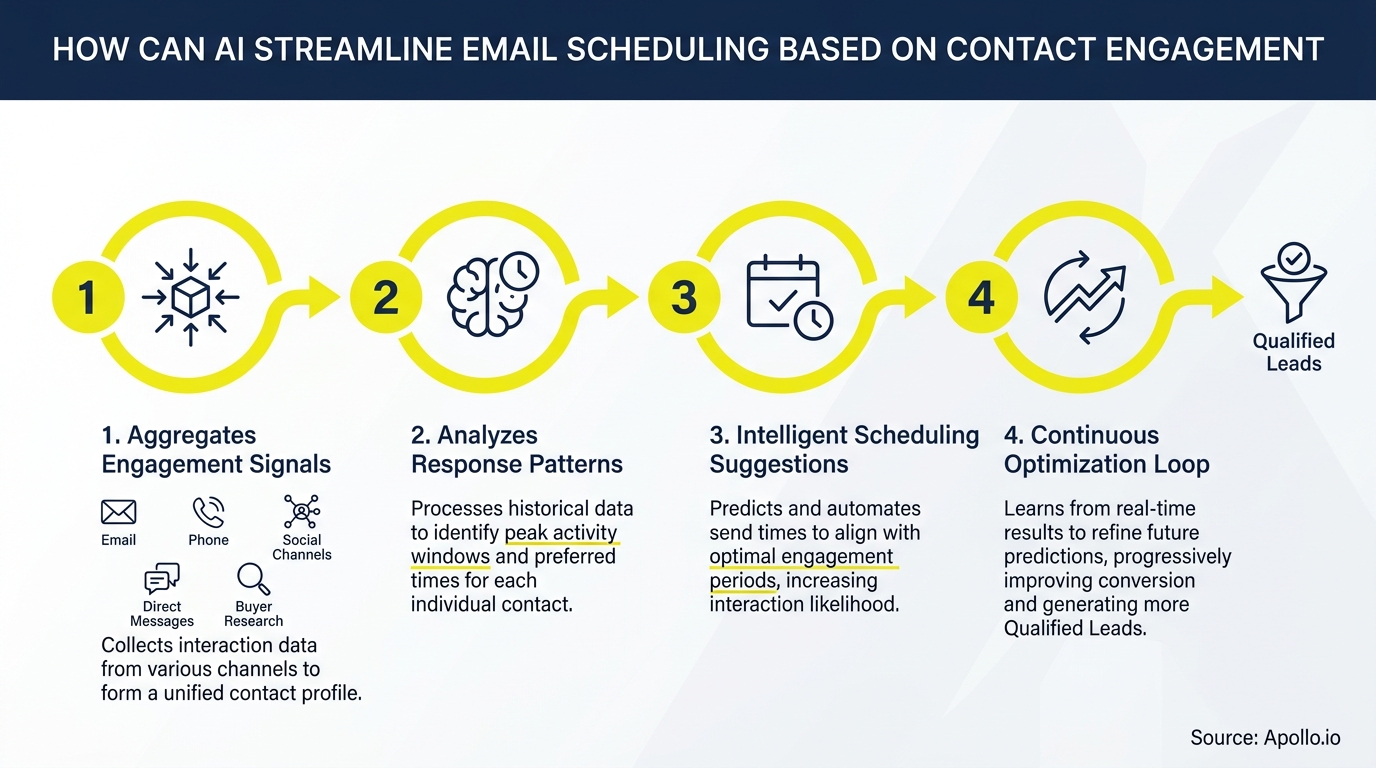
The fixed sales cadence is dying. Static 5-step, 12-day sequences treat every prospect the same regardless of whether they visited your pricing page yesterday or went dark three weeks ago. AI changes this by reading contact-level engagement signals and deciding when to send, whether to pause, and whento escalate to a call or meeting invite. The result: fewer irrelevant touches, better deliverability, and more pipeline from the same list. Learn how to build winning sequences that adapt to engagement and stop burning your sender reputation on unresponsive contacts.

Let Apollo Find Your Next Buyer
Tired of burning hours verifying contacts instead of closing deals? Apollo surfaces accurate, ready-to-engage prospects so your team sells — not researches. Join 600K+ companies building pipeline on autopilot.
Start Free with Apollo →Key Takeaways
- AI email scheduling works by reading contact-level signals (clicks, replies, site visits, intent spikes) rather than applying generic send-time rules.
- A four-action decision model (send, delay, suppress, escalate) maps each engagement signal to a specific next step tied to buying-stage outcomes.
- Open rates are unreliable for scheduling decisions in 2026 due to Apple Mail Privacy Protection. Clicks, replies, and CRM activity are stronger signals.
- Data quality is the limiting factor: AI scheduling fails when contact records are stale, incomplete, or disconnected from CRM activity.
- Measuring AI scheduling by meetings booked and pipeline created, not emails sent, aligns with how leading revenue teams now evaluate outreach efficiency.
What Is AI-Driven Email Scheduling Based on Contact Engagement?
AI-driven email scheduling uses behavioral and firmographic signals from individual contacts to determine the optimal time, frequency, and channel for outreach, replacing calendar-based rules with dynamic, data-driven decisions. Instead of sending every prospect an email on Tuesday at 10 a.m., the system reads what each contact has done recently and acts accordingly.
This is meaningfully different from legacy send-time optimization, which applies population-level averages. Engagement-based scheduling is contact-specific.
A prospect who clicked your case study link at 8 p.m. on Thursday gets a follow-up timed to that behavior pattern. A contact who has not opened or clicked in 30 days gets suppressed, not spammed.
Research from DemandSpring shows AI-driven personalization increases open rates by 29% and revenue per email by 41%. The gap between personalized and generic outreach is not marginal. It is the difference between a sequence that generates pipeline and one that damages your sender reputation.
What Engagement Signals Should AI Use to Schedule Emails?
Effective AI email scheduling prioritizes signals that indicate genuine buying intent over passive inbox behavior. The table below maps common signals to scheduling actions.
| Signal | Signal Strength | Scheduling Action |
|---|---|---|
| Reply (any sentiment) | Very High | Pause sequence, route to rep immediately |
| Clicked link in email | High | Trigger follow-up within 24 hours |
| Pricing or demo page visit | High | Escalate to call or meeting invite |
| Content download / webinar attendance | Medium-High | Send relevant follow-up within 48 hours |
| Email opened (non-MPP verified) | Low-Medium | Continue cadence, do not accelerate |
| No activity in 21+ days | Negative | Suppress from active sequence |
| Unsubscribe or bounce | Hard stop | Remove permanently, update CRM |
A Reddit user shared a firsthand perspectiveon over-automating email responses: after rolling back a fully autonomous setup, the fix was adding category-based routing with a clear escalation trigger when confidence was low. The lesson translates directly to engagement-based scheduling: AI should decide the action, but high-stakes moments (pricing inquiries, objections, contract discussions) need a human in the loop.
Why Are Open Rates Unreliable for AI Scheduling in 2026?
Open rates are unreliable scheduling signals because Apple Mail Privacy Protection (MPP) pre-fetches email images, registering opens for contacts who never actually read the message. If your AI system accelerates cadence based on apparent opens, it will over-mail Apple Mail users and inflate sequence activity against disengaged contacts.
The better approach is to weight clicks, replies, site visits, and CRM-logged activity as primary scheduling inputs. These signals require deliberate action from the contact and are not affected by inbox privacy settings. For measuring customer engagement metrics that actually work, focus on click-to-open rate (CTOR), reply rate, and meeting conversion rate rather than raw open volume.
What to use instead of opens for scheduling decisions:
- Link clicks (tracked with UTM parameters, not pixel loads)
- Direct replies (including out-of-office if followed by re-engagement)
- Website session activity tied to contact identity via CRM or IP match
- Form fills, content downloads, or event registrations
- CRM stage changes or deal activity logged by the rep
Turn Funnel Guesswork Into Pipeline Wins
Pipeline forecasting a guessing game because leads stall before they ever reach your team? Apollo surfaces high-intent prospects and moves them faster from first touch to qualified opportunity. Nearly 100K paying customers stopped guessing and started closing.
Start Free with Apollo →How Do SDRs and RevOps Teams Implement an Engagement-Based Scheduling System?
SDRs and RevOps teams implement engagement-based scheduling by connecting their email platform to CRM activity data, defining trigger rules for each signal tier, and building sequences that branch based on contact behavior rather than running linearly.
The practical build has four components:
- Signal ingestion:Connect email engagement data, website analytics, and CRM activity into one system. Data quality is the limiting factor here: without clean, enriched contact records, AI scheduling has no reliable inputs to act on.
- Scoring rules: Assign weights to each signal type. Clicks and replies score higher than opens. Intent signals (pricing page, competitor comparison page) score highest.
- Trigger windows: Define how quickly each signal should produce an action. High-intent signals should trigger follow-up within hours, not days.
- Cadence branching:Build sequences that fork at each signal checkpoint: engaged contacts move faster toward a meeting ask, disengaged contacts enter a suppression window or a lower-frequency nurture track.
Spending hours manually adjusting who gets what email and when? Automate your sequences with Apollo's multi-channel engagement platform and let engagement signals drive the next step automatically.
According to Sopro, sales professionals save an average of 2 hours and 15 minutes per day using AI, with 78% reporting it enables them to focus on higher-value, revenue-generating work. For SDRs managing large prospect lists, that time reclaimed from manual sequencing decisions translates directly into more conversations booked.

How Should AI Email Scheduling Handle Deliverability and Suppression?
AI scheduling should actively suppress disengaged contacts, space touches across an account to avoid over-mailing, and prioritize highly engaged records to protect sender reputation. Deliverability is no longer a separate concern from scheduling: they are the same problem.
A sales professional wrote on Redditabout a common deliverability trap: after validating 10,000 emails, roughly half turned out to be catchalls that were not truly verified. The majority of targets were on Outlook, making it far more effective to build sending infrastructure from Microsoft and warm up using only other Microsoft 365 addresses. This is the kind of infrastructure-level decision that AI scheduling systems need to account for alongside engagement signals.
Practical suppression rules to implement:
- Suppress contacts with zero engagement after a defined window (typically 21-30 days in active sequence)
- Cap total touches per account per week to avoid flagging the domain as spam
- Remove hard bounces immediately and soft bounces after two consecutive failures
- Pause sequences automatically when a reply is detected, including auto-replies, until a human reviews
For a deeper look at keeping outreach out of spam folders, see email deliverability best practices and how sequence diagnostics can surface deliverability issues before they compound.
How Do You Measure Whether AI Email Scheduling Is Working?
Measure AI email scheduling by pipeline outcomes, not activity volume: meetings booked, positive reply rate, and pipeline created per sequence enrolled, not total emails sent. This aligns with how leading revenue teams now evaluate outreach efficiency.
In April 2026, HubSpot shifted to outcome-based pricing for its AI agents, charging only when tasks are completed, such as recommended leads or resolved conversations. This reflects a broader market signal: automation is now judged by results, not throughput.
The same standard should apply to how RevOps leaders evaluate their AI scheduling investment.
| Metric | What It Measures | Why It Matters |
|---|---|---|
| Positive reply rate | Interested responses per contact enrolled | Leading indicator of pipeline quality |
| Meeting conversion rate | Meetings booked per sequence start | Direct revenue impact metric |
| Sequence-to-opportunity rate | Opportunities created from enrolled contacts | Connects scheduling to pipeline |
| Suppression rate | Contacts removed before sequence completion | Signals data quality and ICP fit |
| CTOR (click-to-open rate) | Clicks as a share of confirmed opens | MPP-resistant engagement indicator |
Data from InsightMark Research shows AI-personalized copy has boosted click-through rates by more than 13% in comparative tests. When combined with engagement-based scheduling, that lift compounds: the right message delivered at the right moment to a contact who has already shown intent.
Struggling to connect your outreach activity to actual pipeline? Track every touchpoint from first email to closed deal with Apollo's pipeline tools.
How Do You Get Started with Contact Engagement-Based Email Automation?
Start by auditing your contact data quality, then layer in signal collection before building trigger rules. Skipping the data audit is the most common reason AI scheduling underperforms: 61% of companies report that inaccurate data compromises their AI personalization efforts.
Data-readiness checklist before enabling AI scheduling:
- Are contact records enriched with verified business email, title, and company data?
- Is email engagement data (clicks, replies) flowing into your CRM in real time?
- Are website visits being attributed to known contacts, not just anonymous sessions?
- Do you have suppression lists for bounces, unsubscribes, and current customers?
- Are sequences branching on engagement signals, or running as flat linear cadences?
For teams building this from scratch, proven sales sequence structures provide a starting framework that can be adapted with engagement-based branching. Pair that with email personalization strategies to ensure the content triggered by each signal matches where the contact is in their buying journey.

Start Scheduling Smarter with Apollo
AI email scheduling based on contact engagement is not a feature upgrade. It is a strategic shift from volume-based outreach to interaction-quality outreach.
The teams winning in 2026 are not sending more emails. They are sending fewer, better-timed messages to contacts who have already signaled readiness, and routing the warmest leads to a human conversation before momentum fades.
Apollo consolidates the data, sequences, and engagement signals your team needs in one workspace, eliminating the friction of stitching together separate prospecting, sequencing, and CRM tools. As Cyera put it: "Having everything in one system was a game changer."
Ready to replace static cadences with engagement-driven sequences? Schedule a Demo and see how Apollo's AI sales automation adapts outreach to every contact's behavior.
Prove Pipeline ROI With Apollo
ROI pressure killing your budget approval? Apollo delivers measurable pipeline impact so you can walk into every review with hard numbers. Leadium 3x'd annual revenue — your proof starts here.
Start Free with Apollo →Don't miss these
Sales
Inbound vs Outbound Marketing: Which Strategy Wins?
Sales
What Is a Sales Funnel? The Non-Linear Revenue Framework for 2026
Sales
What Is a Go-to-Market Strategy? The 2026 GTM Playbook
See Apollo in action
We'd love to show how Apollo can help you sell better.
By submitting this form, you will receive information, tips, and promotions from Apollo. To learn more, see our Privacy Statement.
4.7/5 based on 9,690 reviews
