
How to Generate Prospects and Leads for Your Outbound Sales Team
Building an outbound sales team in 2026 means competing against buyers who already have AI doing their own research. Gartner reported in May 2026 that 69% of B2B buyers now use sales reps mainly to validate AI-generated insights, not to get first-touch information.
That changes what generating prospects and leads actually requires: relevance and timing beat raw volume every time.
This guide gives you a 90-day system for launching outbound prospecting the right way, from ICP scoring to buyer-network mapping to a governance model that keeps sales and marketing message-aligned.
If you're staffing this function for the first time, pair this with Apollo's Outbound Sales Resource Kit for templates you can deploy immediately.
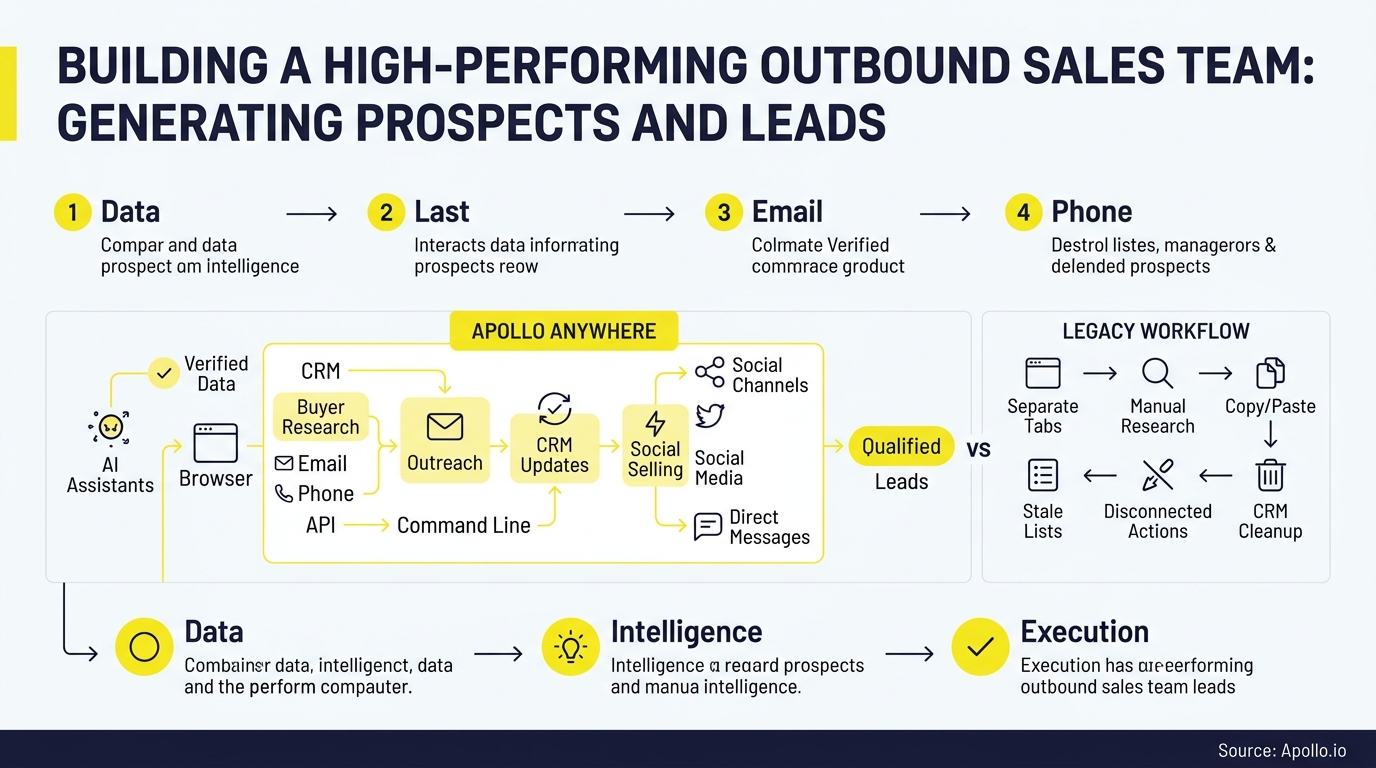

Skip The Research, Apollo Delivers Contacts
Spending hours manually researching leads and verifying contact info? Apollo hands you 240M+ verified contacts with 98% email accuracy, so reps sell instead of digging. Stop losing selling time to data entry.
Start Free with Apollo →Key Takeaways
- Relevance, not volume, drives outbound results: most buyers actively avoid vendors sending generic outreach, so your first 90 days should focus on ICP precision over list size.
- A scoring model that combines ICP fit with buying triggers (hiring, funding, leadership changes) tells reps who to call first.
- B2B deals involve buying networks, not single contacts. Multithreading across roles increases your odds of getting a meeting.
- Email deliverability rules tightened in 2025 and 2026. Poor sending hygiene can silently kill your pipeline before a single reply arrives.
- Consolidating your prospecting, enrichment, and engagement tools into one platform cuts the operational drag of managing a new outbound motion.
What Is a 90-Day Plan for Launching Outbound Prospecting?
A 90-day outbound launch plan sequences ICP definition, data build-out, messaging tests, and scaled execution across three distinct phases so a new team doesn't burn its list before finding what works.
| Phase | Focus | Key Activities |
|---|---|---|
| Days 1-30 | Foundation | Define ICP and buying triggers, build scoring model, source and enrich initial account list, set up CRM/sequence tooling |
| Days 31-60 | Testing | Run small-batch sequences by segment, test role-based messaging, establish multithreading cadence, review reply/positive-rate data weekly |
| Days 61-90 | Scale | Expand to full target list, formalize sales-marketing message governance, build funnel dashboard, launch weekly experiment cadence |
Teams building this motion from scratch often lean on outbound sales software to handle sourcing, enrichment, and sequencing in one place instead of stitching together separate tools during the highest-risk early phase.
How Do You Score ICP Fit and Buying Triggers?
ICP and trigger scoring works by combining firmographic fit criteria with time-sensitive buying signals, so reps prioritize accounts that are both a good match and actively in-market. Fit alone tells you who could buy; triggers tell you who might buy now.
| Signal Type | Examples | Weight |
|---|---|---|
| Firmographic Fit | Industry, headcount, tech stack, revenue band | Baseline qualifier |
| Growth Triggers | New funding round, headcount growth, new office/market entry | High |
| Leadership Triggers | New VP of Sales, new CRO, new RevOps hire | High |
| Intent Triggers | Job postings for roles your product supports, tech stack changes, competitor mentions | Medium-High |
| Engagement Signals | Website visits, content downloads, event attendance | Medium |
Signal-based prospecting has replaced static list-building for a reason: it keeps your active list smaller but consistently warmer. Struggling to find qualified accounts inside a list that's gone cold? Search Apollo's 240M+ contacts with 65+ filters to rebuild your target list around live triggers instead of stale firmographics.
How Do SDRs Qualify Leads Before Handoff?
SDRs qualify leads by confirming ICP fit, verifying an active trigger, and validating that a real buying-network contact has engaged, not just a single form-fill. A workflow with clear gates prevents unqualified names from clogging AE calendars.
- Gate 1 - Fit check: Does the account match your locked ICP criteria (industry, size, tech stack)?
- Gate 2 - Trigger check: Is there a documented reason this account needs your solution now?
- Gate 3 - Access check: Has the SDR identified at least two contacts across relevant roles (economic buyer, technical evaluator, end user)?
- Gate 4 - Engagement check: Has the prospect responded, opened multiple touches, or taken a meeting-worthy action?
For SDRs and BDRs building this cadence, Cirrus Insight reports it now takes an average of 8 touchpoints to secure an initial meeting with a new prospect. That persistence requirement is exactly why qualification gates matter: reps need to know which accounts are worth 8 touches and which aren't.

What Is Buying-Network Mapping and Why Does It Matter?
Buying-network mapping means treating each target account as a group of interconnected roles, not one contact, and building outreach that reaches multiple stakeholders with role-specific proof. Modern B2B deals rarely close off a single relationship.
- Economic buyer (e.g., VP Sales, CRO): needs ROI framing and risk reduction
- Technical evaluator (e.g., RevOps, IT): needs integration and data-quality detail
- End user (e.g., AE, SDR): needs day-to-day workflow proof
- Champion (any role): needs internal-selling material they can forward
Multithreading across these roles is one reason the sales acceleration formula emphasizes coordinated, role-aware sequencing over single-thread persistence. RevOps leaders find that mapping the full buying network before the first call reduces stalled deals later in the pipeline.
See Which Leads Are Actually Sales-Ready
Marketing leads piling up but stalling before they become real opportunities? Apollo scores and prioritizes prospects by buying intent, so reps chase deals that close instead of names that stall. Built-In grew win rates using Apollo's signals and scoring.
Schedule a Demo →How Do You Write Role-Based Outbound Messages That Get Replies?
Role-based outbound messages work by matching the pain point and proof point to what that specific stakeholder cares about, instead of sending one generic pitch to every contact at an account. A VP of Sales and a RevOps manager at the same company need different evidence.
| Role | Message Focus | Evidence Type |
|---|---|---|
| VP Sales / CRO | Pipeline predictability, quota attainment | Customer outcome quote, benchmark data |
| RevOps | Data quality, integration simplicity | Technical case study, integration list |
| AE / Account Executive | Faster deal cycles, pre-meeting intelligence | Workflow demo, feature walkthrough |
| SDR / BDR Manager | Rep ramp time, meeting volume | Team productivity proof |
Salesforce's research found 86% of B2B buyers are more likely to purchase when a company understands their goals, but a majority say reps don't take the time to understand their challenges first. Role-based messaging is how you close that gap at scale. For inspiration on breaking through inbox fatigue with message tone, see how humor-infused outreach can win attention without sacrificing relevance.
How Do You Govern Outbound Messaging Between Sales and Marketing?
Sales-marketing message governance means both teams agree on the same evidence, claims, and positioning before reps send a single sequence, so outbound content, rep conversations, and public-facing claims never contradict each other. Without this, prospects notice the mismatch fast.
- Maintain one shared evidence library (case studies, benchmark stats, product proof points) both teams pull from
- Require new sequence copy to be reviewed against approved claims before launch
- Sync SDR objection-handling scripts with marketing's competitive messaging quarterly
- Route any new competitor or pricing claim through a single approver
This matters more now that Forrester's Buyers' Journey Survey found 89% of B2B buyers used generative AI during their purchase process. AI tools synthesize your website, your rep's email, and your case studies together, so any inconsistency becomes visible instantly. If you're rebuilding your objection-handling playbook around this, review how to handle sales objections in 2026.
How Do You Track Outbound KPIs and Improve Weekly?
Outbound KPI tracking works by building one dashboard that connects list quality, sequence performance, and pipeline outcomes, then running a weekly experiment cycle to improve the weakest metric. Tracking leads alone without conversion context hides where the funnel actually breaks.
| Metric | What It Tells You |
|---|---|
| Reply rate by segment | Message-market fit per ICP tier |
| Meeting-to-opportunity rate | Qualification gate accuracy |
| Touches-to-meeting | Cadence efficiency (benchmark: 8 touches per Cirrus Insight) |
| Cost per lead | Efficiency of sourcing and tooling spend |
Callbox reports the median B2B cost per lead is projected to rise in 2026, which makes weekly experimentation on message relevance a margin issue, not just a performance one. Sales leaders managing this cadence benefit from centralized sales analytics that connect activity data directly to pipeline outcomes rather than reviewing spreadsheets pulled from five disconnected tools.
What Tools Do New Outbound Teams Need?
A new outbound team needs four core capabilities: verified contact data, multi-channel sequencing, call/dialer infrastructure, and a CRM connection that keeps everything in sync. Most early-stage teams try to stitch these together from separate vendors and lose weeks to integration work.
- Data and enrichment: a verified contact database with firmographic and trigger filters
- Sequencing: email, phone, and social cadences from one workspace
- Dialer: click-to-call with call recording and note capture (the customer selects the numbers to call)
- CRM sync: two-way integration so reps aren't double-entering activity
Collin Stewart of Predictable Revenue put it simply: "We reduced the complexity of three tools into one." That's the practical case for consolidation when you're building an outbound motion from zero: fewer logins, fewer data-sync failures, one source of truth. Spending hours a week reconciling data across tools? Automate your sequences with Apollo's multi-channel platform and run prospecting, enrichment, and outreach from a single workspace. For a full stack-planning framework, see how to build a sales tech stack that scales revenue.

Getting Your Outbound Engine Off the Ground
Generating prospects and leads for a new outbound sales team isn't about sending more emails, it's about sending the right message to the right buying network at the right moment. The 90-day plan, scoring model, and governance checklist above give you a repeatable system instead of a guessing game.
Founders and revenue leaders staffing this function for the first time don't need five disconnected vendors to get started. Apollo brings data, enrichment, sequencing, and call intelligence into one workspace so your first outbound hires can focus on selling instead of managing tool sprawl. To see why Apollo stands alone as the only fully agentic GTM platform, combining sales intelligence, outbound execution, and enrichment in one workspace, start free with Apollo today.
New Reps Ramp Faster With Apollo
New hires taking forever to hit quota while your process lives in someone's head? Apollo standardizes prospecting workflows so every rep follows what actually works, no tribal knowledge required. Prove the ROI with pipeline your whole team can replicate.
Start Free with Apollo →Don't miss these
Sales
Inbound vs Outbound Marketing: Which Strategy Wins?
Sales
What Is a Sales Funnel? The Non-Linear Revenue Framework for 2026
Sales
What Is a Go-to-Market Strategy? The 2026 GTM Playbook
See Apollo in action
We'd love to show how Apollo can help you sell better.
By submitting this form, you will receive information, tips, and promotions from Apollo. To learn more, see our Privacy Statement.
4.7/5 based on 9,690 reviews
