
How to Find Contacts at New Companies for Prospecting
A new business filing is not a prospect. It's a signal.
Every month, tens of thousands of new companies register, but most won't have a functioning buying committee, a working domain, or a decision-maker with budget authority for another 60-90 days. The teams that win these accounts aren't the fastest to find a name; they're the fastest to separate a real prospect from registry noise.
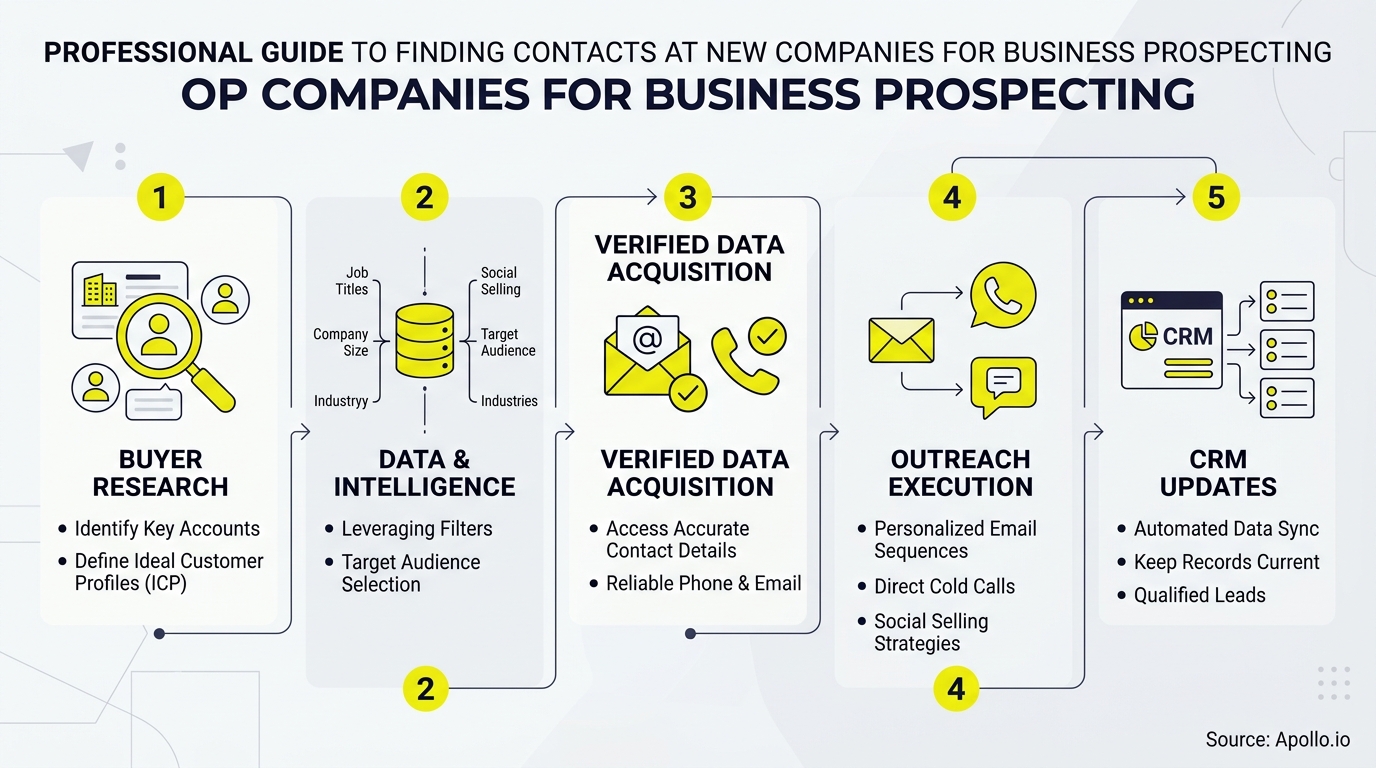
This playbook gives you a repeatable workflow: find new companies, verify they're operational, score the contacts inside them, and multithread the buying group before a competitor even knows the account exists. For a broader view of how contact discovery fits into pipeline strategy, see which lead generation approaches drive real B2B ROI.

Apollo Ends The Manual Contact Hunt
Still burning hours a day chasing down emails and phone numbers that bounce anyway? Apollo hands you 240M+ verified contacts at 98% email accuracy, so reps sell instead of scroll. Join 600K+ companies who ditched manual research for good.
Start Free with Apollo →Key Takeaways
- A business registration is a starting signal, not a qualified lead. Verify operational status before spending outreach time on it.
- Job changes and new-hire signals create a short, high-response window for outreach, so speed matters as much as accuracy.
- Most B2B deals involve a multi-person buying group, so mapping several contacts beats chasing one decision-maker.
- Multichannel sequencing (email, phone, social) consistently outperforms single-channel outreach.
- Clean, verified contact data protects both your reply rates and your sender reputation.
How Do You Find Contacts at New Companies?
You find contacts at new companies by layering three data sources: business registration/formation data, hiring and job-change signals, and verified contact enrichment. Registration data (like Secretary of State filings or EIN applications) tells you a company exists.
Hiring signals tell you it's becoming active. Enrichment gives you a verified name, title, and email to act on.
The U.S. Census Bureau recorded 5,634,736 business applications in 2025, up from 5,246,630 in 2024, a roughly 7.4% year-over-year increase, according to Federal Reserve Economic Data. That's a massive top-of-funnel pool, but formation data alone doesn't tell you who to call. You need a workflow that filters registrations down to companies actually hiring, building a website, or posting jobs, then enriches those accounts with real people.
What's the Difference Between a Filing and a Sales-Ready Prospect?
A filing is a legal registration event; a sales-ready prospect is a company showing evidence of operations, budget, and a hireable point of contact. Use this decision tree to sort one from the other before your team spends any outreach time:
| Signal | Filing Only | Sales-Ready Prospect |
|---|---|---|
| Domain/website | None or parked page | Live site with product/service pages |
| Hiring activity | No open roles | Active job postings, especially in your buyer function |
| Contact findability | No named employees | Verified employees with titles on record |
| Digital footprint | No social/professional profiles | Company page, employee profiles, press mentions |
| Funding/licensing | EIN only | Business license, funding round, or DBA filed |
If a company hits three or more "sales-ready" columns, move it into active prospecting. Struggling to tell filings from real prospects at scale? Search Apollo's 240M+ contacts with 65+ filters to filter by company founding date, headcount growth, and job postings in one view.
Why Does Timing Matter More Than Volume in New-Company Prospecting?
Timing matters more than volume because buyers are measurably more responsive in the first 90 days of a role or a company's active phase. According to professional networks, people who had joined a new company within the previous 90 days were 62% more likely to accept an InMail, and prospects were 78% more likely to accept after the sender viewed their profile first.
This is consistent with a broader shift in how sales teams prioritize outreach. Static lead lists built once a quarter are losing ground to signal-based lists refreshed continuously around hiring, funding, and role changes. professional networks's September 2026 sales intelligence tools release added semantic, intent-aware search specifically to surface these time-sensitive buyer signals faster, reducing zero-result searches from 14% to 8%, per professional networks's product release notes. The takeaway: prioritize new hires, promotions, and newly formed teams over generic titles pulled from a static list.

How Can SDRs Score and Prioritize New Company Contacts?
SDRs should score new company contacts on five factors: role recency, title authority, email verification confidence, source provenance, and buying-group coverage. Use a simple point system so reps don't waste cycles guessing which accounts to work first.
| Scoring Factor | High Score (2 pts) | Low Score (0 pts) |
|---|---|---|
| Role recency | Started role in last 90 days | Tenure unknown or 2+ years |
| Title authority | Director+ or named budget owner | Generic/individual contributor title |
| Email confidence | Verified, deliverable | Guessed pattern, unverified |
| Source provenance | First-party or licensed enrichment source | Unknown or scraped origin |
| Buying-group coverage | 3+ contacts mapped at account | Single contact only |
Accounts scoring 7+ points move to active sequencing. Accounts scoring under 4 go back into a nurture or monitoring list.
For SDRs and BDRs managing dozens of new accounts a week, this scoring model turns a messy list into a prioritized queue in minutes, not hours.
See Every Deal Before It Goes Cold
Watching leads stall between marketing and sales with no idea why? Apollo shows real-time buyer intent and deal-stage signals so reps engage prospects at the exact right moment. Built-In improved win rates using Apollo's scoring and signals.
Schedule a Demo →Who Needs to Be in the Buying Group for a New Company Deal?
A new company deal typically needs three to five mapped contacts spanning the champion, technical evaluator, and economic buyer, because most B2B purchases involve a multi-person committee rather than a single decision-maker. Build this map before your first outreach touch:
- Champion: The day-to-day user who feels the pain point first (often an individual contributor or manager)
- Technical evaluator: Reviews security, integration, or implementation fit
- Economic buyer: Controls or approves budget (VP, Director, or founder at smaller companies)
- Procurement/finance: Validates contract terms at larger organizations
- Executive sponsor: Signs off on strategic or higher-cost purchases
For Account Executives running these deals, mapping the full committee early avoids the classic failure mode: closing a champion who can't actually approve the purchase. RevOps teams can standardize this buying-group map as a required CRM field before a deal is marked "qualified," which keeps forecasting more accurate. This connects directly to forecasting accuracy best practices since incomplete buying-group data is one of the most common causes of stalled or inflated pipeline.
What Should a First Message to a New Company Contact Include?
A first message to a new company contact should reference a specific, verifiable trigger (new role, new funding, new hire) and ask a single, low-friction question.
Generic templates fail because Gartner's 2024 survey of 632 B2B buyers found 73% actively avoid suppliers who send irrelevant outreach.
Examples by channel:
- Email: "Congrats on the new role at [Company] — most [title] hires in their first 90 days are rebuilding [specific process]. Worth a quick look at how [peer company] approached it?"
- Phone: "Hi [Name], saw you just joined [Company] as [title]. I work with a lot of new [role] leaders on [specific problem] — is that on your radar yet?"
- Social: A short congratulations comment on the new role, followed by a connection request with a one-line note referencing their previous company's use case.
Sequencing all three channels performs better than any single channel alone. Martal cites Infraforge 2026 research showing that combining email, social, and phone increases prospecting results by 287% compared to email alone. Spending hours manually coordinating that sequencing? Automate multi-channel sequences with Apollo's sales engagement platform so reps spend their time on conversations, not manual follow-up.
How Do You Keep New Company Contact Data Clean and Compliant?
You keep contact data clean by verifying emails before sending, refreshing records on a set cadence, and following sender authentication requirements for every domain you send from. Enricher.io reports that roughly 30% of B2B contact data becomes outdated annually, which is especially true for newly formed companies where roles and org charts shift fast.
Build these safeguards into your CRM and sending infrastructure:
- Required CRM fields: source provenance, verification date, role start date, buying-group role
- Refresh cadence: re-verify new-company contacts every 30-60 days given higher role turnover
- Sender authentication: SPF, DKIM, and DMARC configured for any domain sending volume, plus one-click unsubscribe, per Google's bulk sender requirements
- Spam thresholds: keep reported spam rates below 0.1% and never approach 0.3%
Poor data hygiene isn't just an inbox problem. Forbes cites research showing poor data quality costs organizations an average of $12.9 million annually in wasted resources and lost opportunities. Tired of chasing bounced emails and stale records? Start free with Apollo's 240M+ verified business contacts and 98% email accuracy built into every enrichment.
How Does Apollo Simplify Finding Contacts at New Companies?
Apollo simplifies this workflow by combining company discovery, contact enrichment, verification, and multichannel outreach in a single connected system, so GTM teams don't stitch together separate tools for each step. Instead of pulling registration data from one source, enrichment from another, and sequencing from a third, teams filter Apollo's database of 240M+ people and 30M+ companies by founding date, headcount growth, and hiring activity, then move straight into scored, multithreaded outreach.
Collin Stewart of Predictable Revenue put it simply: "We reduced the complexity of three tools into one." That kind of consolidation matters for RevOps leaders managing tech stack costs and for founders trying to run outbound without a bloated toolset. Apollo serves B2B GTM teams and AI Builders using the API, CLI, and MCP, alongside Sales Professionals, SDRs/BDRs, AEs, RevOps, marketing, and revenue leaders who all need the same underlying account and contact data without rebuilding it in five different systems.

Conclusion
Finding contacts at new companies isn't a single task, it's a workflow: filter registrations for operational signals, score contacts on recency and authority, map the full buying group, and sequence outreach across channels before the window closes. Teams that treat every filing as a lead waste cycles; teams that score and verify first close faster and protect their sender reputation in the process.
Ready to put this playbook into practice? Start Prospecting with Apollo and turn new company signals into verified, sales-ready pipeline.
Apollo Turns Reps Into Revenue Machines
Can't scale outreach without hiring more reps? Apollo automates prospecting and multichannel sequences so your team does the work of a bigger headcount. GTM Ops Agency booked 4x more meetings without adding a single rep.
Start Free with Apollo →Don't miss these
Sales
Inbound vs Outbound Marketing: Which Strategy Wins?
Sales
What Is a Sales Funnel? The Non-Linear Revenue Framework for 2026
Sales
What Is a Go-to-Market Strategy? The 2026 GTM Playbook
See Apollo in action
We'd love to show how Apollo can help you sell better.
By submitting this form, you will receive information, tips, and promotions from Apollo. To learn more, see our Privacy Statement.
4.7/5 based on 9,690 reviews
