
Evaluating Apollo's Salesforce Integration for Resellers
Resellers pitching Apollo's Salesforce integration need more than a feature list. They need to know exactly what syncs, how fast, what's read-only, and which revenue models their contract actually permits.
This evaluation breaks down the architecture, governance requirements, and monetization paths so you can build a Salesforce-specialist offering that survives due diligence.

Skip The Research, Apollo Verifies Contacts
Spending hours manually researching leads and chasing down accurate emails and phone numbers? Apollo verifies contact data instantly so reps sell instead of digging. 98% email accuracy means fewer bounces and more real conversations.
Start Free with Apollo →Key Takeaways
- Apollo syncs 4 core Salesforce objects (leads, contacts, accounts, opportunities) plus 6 activity types, with most updates completing in 15-30 minutes, not instantly.
- Custom-object sync now supports up to 10 objects and 5 million records each, but data stays read-only and can't trigger Apollo workflows.
- Reseller commission structures separate subscription referrals from implementation and data-resale revenue. Read your contract before pricing a services package.
- A 30-day pilot with clear acceptance criteria protects both the reseller and the customer from mid-rollout surprises.
- The strongest reseller offer bundles Apollo licensing with CRM cleanup, field mapping, and adoption services, not just software access.
What Should Resellers Evaluate First In Apollo's Salesforce Integration?
Resellers should first evaluate the sync architecture: which objects move, how often, and in which direction. Apollo pulls leads, contacts, accounts, and opportunities from Salesforce, and pushes records back along with six activity categories: emails, notes, tasks, calls, meetings, and conversation summaries.
This bidirectional flow supports prospecting and CRM hygiene use cases, but resellers should confirm sync direction per object type before promising real-time visibility to customers. Most contact and company changes synchronize within 15-30 minutes, which fits near-real-time prospecting workflows but won't satisfy customers expecting instantaneous updates.
For RevOps leaders building a source-of-truth policy, this latency window matters. Document it explicitly in your statement of work so customers don't confuse Apollo's sync cadence with a live data feed.
How Does The Embedded Salesforce Interface Work For End Users?
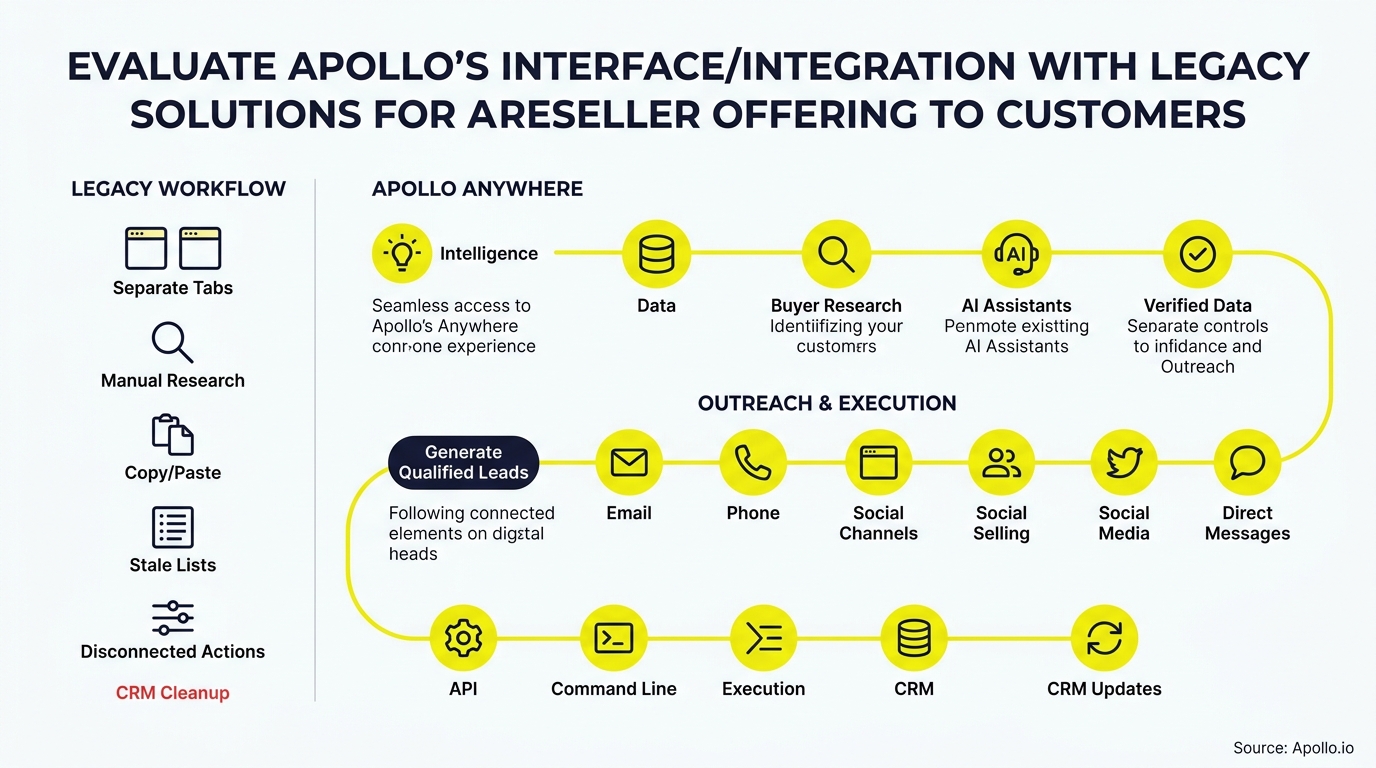
Apollo's embedded interface runs inside Salesforce as a Visualforce iframe, letting sellers work without switching tabs. Admins add it to account, contact, or lead page layouts, and it's recommended at roughly 450 pixels tall for usable screen real estate.
From that embedded view, users can search prospects, save contacts, send emails, enroll people in sequences, build lists, and export records back to Salesforce. For Account Executives managing a full pipeline, this means pulling firmographic and contact data without leaving the deal record they're already working.
Because it's Visualforce-based rather than a native Lightning component, resellers should test mobile rendering and long-term Salesforce UI roadmap compatibility before positioning it as a permanent fixture in a customer's daily workflow.
What Are The Limits Of Apollo's Custom Object Sync?
Apollo's custom-object sync pulls business-specific Salesforce data like campaign members, subscriptions, and product usage into Apollo for segmentation, but the data is read-only. Organization-plan customers can configure up to 10 custom objects, import as many as 5 million records per object, and map up to 250 fields per object, with incremental updates every 15 minutes.
The catch: custom-object records can't trigger Apollo workflows and must be tied to an existing contact or account. Treat this as an architecture decision, not a shortfall.
It's built for targeting and segmentation, not automation triggers.
| Capability | Limit | Reseller Implication |
|---|---|---|
| Custom objects | Up to 10 | Plan mapping priorities in the discovery phase |
| Records per object | Up to 5 million | Supports enterprise data volume |
| Fields per object | Up to 250 | Requires structured field-mapping documentation |
| Refresh cadence | Every 15 minutes | Set expectations, not real-time |
| Write access | Read-only | Cannot trigger Apollo automation |
This functionality is limited to Apollo Organization plans, which is a qualification question resellers need to ask before scoping a custom-object project.
How Fast Is Apollo's Salesforce Sync For Large Data Volumes?
Apollo's parallel "pull-all" processing synchronizes accounts, contacts, and leads simultaneously, which matters when onboarding companies with millions of Salesforce records. Apollo has reported sync speed improvements of up to 26.7x for accounts, 15.8x for leads, and 9.5x for contacts, allowing multi-million-record environments to complete initial sync within a day.
For resellers pitching enterprise accounts, this changes the onboarding conversation. A customer with a large, messy Salesforce instance no longer needs a multi-week data migration plan just to get Apollo populated.
Paid customers get a six-hour configuration window before sync starts automatically, which means field mapping, deduplication rules, and ownership assignments need to be finalized before that window closes, not after.
Turn Deal Stage Guesswork Into Certainty
Can't see which deals are actually moving until it's too late? Apollo surfaces buyer intent and engagement signals so you know who's ready before the forecast call. Reps using signal-based prioritization close more of the right deals.
Start Free with Apollo →How Should Resellers Structure Referral, Implementation, And Data-Resale Contracts?
Resellers must separate three distinct revenue models: subscription referral, implementation services, and data resale, because each carries different contractual terms. Apollo's Solutions Partner Program provides a commission on eligible subscription revenue when a referred customer purchases within 90 days, but implementation, support, and training revenue are excluded from that commission calculation.
Partner Fleet's directory confirms resellers can earn competitive commissions and access co-marketing incentives through Apollo's partner network, but the commission structure doesn't cover every revenue stream a reseller might build.
- Referral revenue: Governed by Apollo's Solutions Partner terms, subscription-only, time-limited to a purchase window.
- Implementation revenue: Your own fee-for-service, not commissionable, but where most reseller margin lives.
- Data-resale: Any integration that exposes or resells Apollo data to non-Apollo users requires a separate custom contract. Do not assume standard partner terms cover this.
Driver-tier and higher Solutions Partners also get multi-client Partner Seats, allowing access to multiple customer workspaces from one login with customer consent, though without billing or user-admin access. Build your pricing model around implementation and managed-service revenue first, and treat referral commission as a bonus, not the core margin.

What's The 30-Day Implementation Plan For A Salesforce-Apollo Pilot?
A 30-day pilot should move from discovery to governance to go-live, with clear acceptance criteria at each stage. Rushing straight to production sync is the most common cause of reseller rework.
- Week 1 - Discovery: Audit Salesforce object structure, identify custom objects to sync, document field-mapping requirements, and confirm plan tier (custom-object sync requires Organization).
- Week 2 - Sandbox testing: Install the managed package in a sandbox, configure a dedicated integration user, and test sync behavior against a copy of production data before touching live records.
- Week 3 - Governance and mapping: Finalize deduplication rules, ownership assignments, and field-level permissions. Confirm the six-hour configuration window plan before flipping production sync live.
- Week 4 - Go-live and validation: Monitor initial sync completion, validate record counts against Salesforce, and run acceptance testing with the customer's RevOps or sales-ops lead before declaring the pilot complete.
For SDRs and BDRs who'll use the embedded interface daily, include a short enablement session in week 4 so adoption doesn't stall after handoff.
Why Does Data Quality Determine Whether This Integration Succeeds?
Data quality determines success because a sync is only as valuable as the records flowing through it. Salesforce's own research found that reps spend a majority of their time on nonselling work, including manually entering customer information and researching prospects, according to Salesforce's stat library.
A separate survey of CRM administrators found that a substantial share believed poor-quality data cost their organization meaningful annual revenue, per the same Salesforce source. That's the real ROI argument for a reseller: fixing dirty data and automating manual entry, not just adding another tool.
Tired of dirty CRM data undermining every campaign your customers run? Show them how Apollo's enrichment closes gaps across 240M+ business contacts before you scope the Salesforce sync.
Collin Stewart of Predictable Revenue said, "We reduced the complexity of three tools into one." That consolidation story is the pitch resellers should lead with: fewer point solutions, one connected data layer between Apollo and Salesforce.
How Can Resellers Position Apollo Against Tool Sprawl?
Resellers can position Apollo as a consolidation play by showing customers how many separate tools the embedded Salesforce interface replaces. Sales teams juggling enrichment, sequencing, dialing, and reporting across disconnected vendors are the exact customer profile most receptive to this pitch.
For Sales and Revenue Leaders under budget pressure, the conversation isn't about adding software, it's about removing it. Apollo combines prospecting and enrichment, sales engagement, and Salesforce sync in one workspace instead of stitching together separate vendors for each function.
Struggling to convince a customer to consolidate their stack? Walk them through Apollo's multi-channel sequencing built on the same data layer as their Salesforce sync. Pair this with Apollo's security and compliance documentation when governance or IT stakeholders ask about data handling.
What Should A Reseller's Governance Checklist Include?
A governance checklist for Apollo-Salesforce deployments should cover access control, sync scope, and rollback planning before go-live. Skipping this step is the most common source of post-launch escalations.
- Dedicated integration user with least-privilege permissions, not a shared admin login
- Documented field mapping for every synced object, reviewed by the customer's Salesforce admin
- Deduplication rules defined and tested in sandbox before production sync
- Clear source-of-truth policy: which system wins when a field conflicts
- OAuth and managed-package version tracked against Salesforce's platform update schedule
- Written rollback plan in case sync needs to pause post-launch
Document this checklist as part of your statement of work. It protects the reseller from blame when a customer's own Salesforce hygiene, not the integration, causes a data issue.

Is Apollo's Salesforce Integration Worth Building A Reseller Offer Around?
Yes, for resellers who package Apollo licensing with implementation, governance, and adoption services rather than just reselling seats. The architecture supports real sync volume and speed, the partner program supports recurring commission, and the data-quality story gives resellers a concrete ROI narrative for customers stuck in manual CRM upkeep.
The caveats are real: read-only custom objects, a 15-30 minute sync window, and a contract structure that separates referral commission from services revenue. Build those constraints into your pitch instead of glossing over them, and you'll close pilots that don't unravel in month two.
Ready to build a Salesforce-Apollo offering your customers can trust? Start a Trial and map the integration against your first customer's Salesforce instance today.
Ramp Reps Faster, Prove ROI With Apollo
New reps taking months to hit quota while leadership questions the tool budget? Apollo gives every rep the same playbook, contacts, and workflows from day one, so ramp time drops and results show up on the next pipeline review, not next year.
Start Free with Apollo →Don't miss these
Sales
Inbound vs Outbound Marketing: Which Strategy Wins?
Sales
What Is a Sales Funnel? The Non-Linear Revenue Framework for 2026
Sales
What Is a Go-to-Market Strategy? The 2026 GTM Playbook
See Apollo in action
We'd love to show how Apollo can help you sell better.
By submitting this form, you will receive information, tips, and promotions from Apollo. To learn more, see our Privacy Statement.
4.7/5 based on 9,690 reviews
