
What Is Sales Performance Management and Why Does It Matter in 2026?
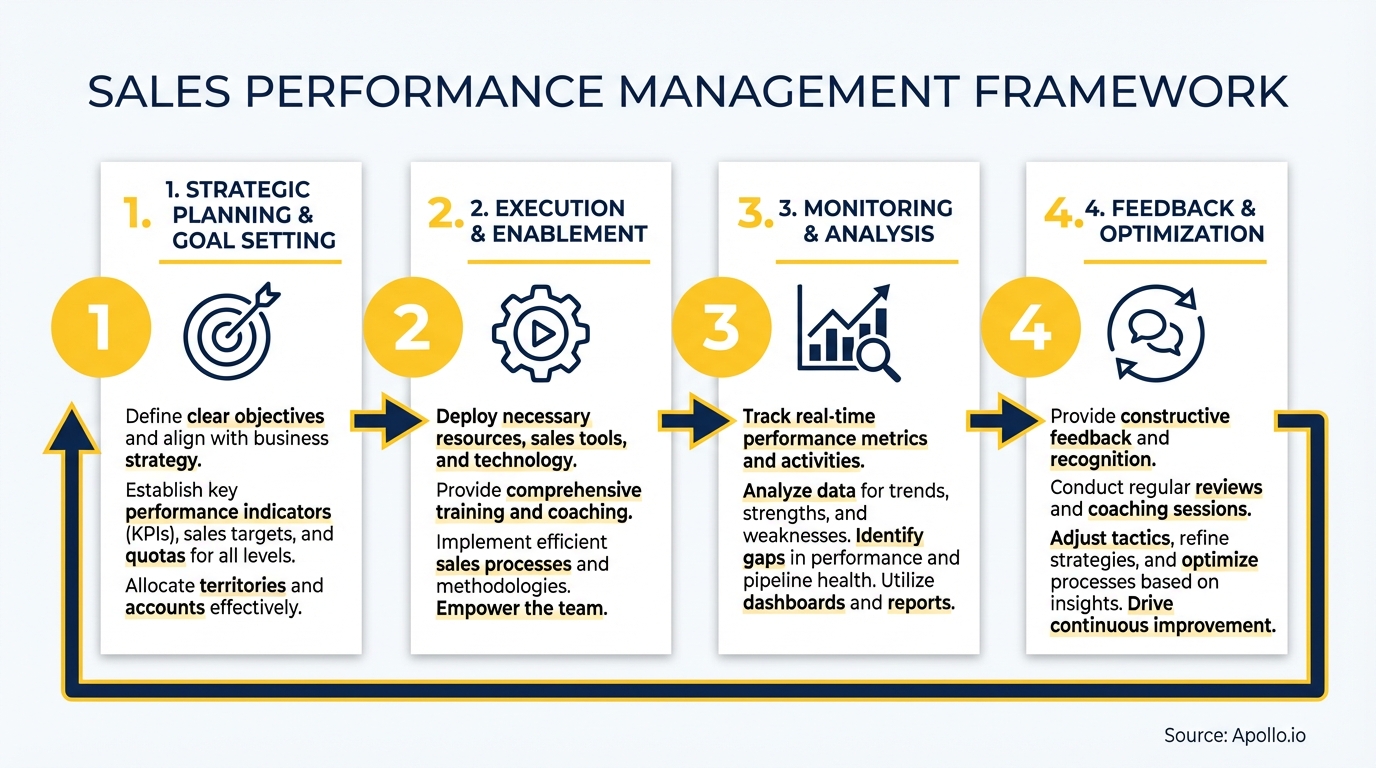
Sales performance management (SPM) is the operational backbone that turns revenue goals into reality. It's the system that connects planning, execution, compensation, and coaching into one framework designed to drive consistent results.
In 2026, SPM has evolved from back-office compensation tracking into a strategic revenue lever that CFOs, CROs, and RevOps teams depend on to cut costs, reduce friction, and align go-to-market teams.
According to Mordor Intelligence, the SPM market is expected to grow from USD 2.95 billion in 2025 to USD 3.46 billion in 2026 and is forecast to reach USD 7.61 billion by 2031 at a 17.12% CAGR over 2026-2031. This growth reflects rising C-suite investment in systems that reduce operational drag, automate compensation workflows, and provide real-time visibility into team performance.

Scale Your Team Without The Growing Pains
Struggling with inconsistent processes as your sales team grows? Apollo standardizes workflows and automates lead research so every rep performs like your best. Join 550K+ companies scaling smarter.
Start Free with Apollo →Key Takeaways
- SPM unifies quota planning, territory design, incentive compensation, performance analytics, and coaching into one system
- 77% of sellers struggle to complete tasks efficiently, and low-drag sellers achieve 1.7x higher quota attainment
- Compensation teams spend ~36 hours per payout period on manual processing
- 49% of CSOs report misalignment between sales and marketing on lead definitions
- Modern SPM platforms integrate AI for forecasting, territory optimization, and dispute resolution
What Is Sales Performance Management?
Sales performance management is a structured approach to planning, measuring, and improving how sales teams execute against revenue targets. It includes five core pillars:
| Component | Function | Key Outputs |
|---|---|---|
| Sales Planning | Territory design, quota allocation, capacity modeling | Balanced territories, realistic quotas, headcount plans |
| Performance Analytics | Real-time dashboards, rep scorecards, pipeline health | Win rates, velocity metrics, forecast accuracy |
| Incentive Compensation | Plan design, payout calculation, commission transparency | Automated payouts, dispute resolution, plan ROI |
| Coaching & Enablement | Skill development, onboarding, performance improvement | Ramp time, certification tracking, call reviews |
| Technology Infrastructure | CRM integration, data enrichment, workflow automation | Clean data, automated workflows, unified reporting |
SPM is NOT just incentive compensation management (ICM). While ICM remains the most common purchase driver, modern SPM expands into forecasting, territory optimization, and go-to-market alignment.
Companies moving to quarterly quota cycles (like Dell's 2026 restructuring) need agile SPM systems that support rapid plan adjustments without burning out finance or sales ops teams.
Why Sales Performance Management Matters More in 2026
Three forces are making SPM a board-level priority:
1. Operational Drag Is Killing Productivity: 77% of sellers struggle to complete their assigned tasks efficiently, and 83% experience high or medium operational drag.
Low-drag sellers achieve 1.7x higher quota attainment. SPM systems reduce drag by automating crediting, streamlining dispute workflows, and providing self-service commission visibility.
2. Sales Cycles Are Longer and Less Predictable: Research from Gradient Works shows sales cycles lengthened by 32% from 2021 to 2022. Companies with ACVs of $50-$100K now take nearly 9 months to close deals. SPM helps teams adapt with scenario modeling, dynamic quota adjustments, and forecast accuracy tracking.
3. GTM Misalignment Is Expensive: 49% of CSOs say sales and marketing define qualified leads differently.
This misalignment creates pipeline waste, rep frustration, and revenue leakage. SPM platforms with shared dashboards and crediting rules force cross-functional accountability.
"Apollo could be a third of the cost if you look at the full price of what we were spending on ZoomInfo, Outreach, Salesforce, and admins to make it all work."
Find Prospects Before They Talk To Competitors
Missing in-market buyers while your pipeline sits empty? Apollo reveals buying intent signals and tracks website visitors so you reach prospects at the perfect moment. Built-In increased win rates 10% with Apollo's scoring.
Start Free with Apollo →How Does Sales Performance Management Reduce Costs?
CFOs care about SPM because it quantifies and eliminates hidden costs:
Compensation Processing Burden: Compensation teams spend ~36 hours per payout period on manual calculations, dispute resolution, and auditing. At $75/hour fully loaded cost, that's $2,700 per cycle or $32,400 annually for monthly payouts. Automated SPM systems cut this time by 60-80%, freeing finance teams for strategic work like plan design and ROI modeling.
Seller Drag Tax: High-drag sellers spend 60% of their time on non-selling tasks. If your average AE costs $150K fully loaded and carries a $600K quota, operational drag is costing you $90K per rep in wasted capacity. SPM reduces drag through workflow automation, self-service tools, and clearer governance.
Misalignment Waste: When sales and marketing disagree on lead definitions, reps waste time chasing unqualified opportunities while marketing blames "lazy follow-up." SPM systems with shared pipeline stage definitions and attribution rules eliminate this friction.
Need cleaner data to fuel your SPM system? Apollo's data enrichment keeps 224M+ contacts current so your performance metrics reflect reality.
What Metrics Should You Track in Sales Performance Management?
Effective SPM requires leading and lagging indicators across three layers:
| Metric Type | Examples | Why It Matters |
|---|---|---|
| Activity Metrics | Calls, emails, meetings booked, accounts touched | Early warning system for pipeline gaps |
| Pipeline Metrics | Coverage ratio, stage velocity, conversion rates | Forecast accuracy and deal health |
| Outcome Metrics | Quota attainment, win rate, ACV, sales cycle length | Revenue realization and team effectiveness |
| Efficiency Metrics | Ramp time, CAC payback, rep turnover | Cost per dollar of revenue and scalability |
| Compensation Metrics | Payout accuracy, dispute rate, plan ROI | Seller trust and plan effectiveness |
The shift to quarterly performance measurement (as seen in Dell's 2026 restructuring) requires real-time dashboards that surface these metrics at rep, team, and executive levels. Modern sales analytics platforms integrate with SPM systems to provide this visibility.
How Do You Reduce Operational Drag in Sales Performance Management?
Operational drag is the single biggest performance killer. Here's how to eliminate it:
1. Automate Crediting and Dispute Workflows: Build clear attribution rules for split deals, team-based opportunities, and multi-touch scenarios.
Use workflow automation to route disputes to managers with SLA targets (24-48 hours for resolution).
2. Provide Self-Service Commission Visibility: Reps should see real-time progress toward earnings without emailing finance.
Transparency reduces disputes by 40-60% and increases trust in the comp plan.
3. Integrate Data Enrichment: Dirty data causes crediting errors, territory disputes, and wasted prospecting time. Consolidating your sales tech stack around platforms with built-in enrichment eliminates this friction.
4. Standardize Pipeline Stage Definitions: Create a shared glossary for "qualified," "demo completed," and "verbal commitment." Enforce these definitions in your CRM and SPM system so marketing, sales, and CS use the same language.
"The thing that made me most excited as somebody who's been in sales development a long time was Apollo's integration between sales data and sales engagement and the magic that you can make happen when those two are together on the same platform."
How Is AI Transforming Sales Performance Management?
AI is moving SPM from reactive reporting to proactive decisioning. Key applications in 2026:
Territory Optimization: AI models balance account potential, rep capacity, and travel time to recommend territory splits that maximize coverage and minimize conflict.
Quota Setting: Machine learning analyzes historical attainment, market conditions, and account health to generate realistic quotas by segment, reducing the "sandbag vs. stretch" negotiation.
Forecast Accuracy: Predictive models weigh deal stage, engagement signals, and historical patterns to produce more accurate forecasts than manual roll-ups.
Compensation Scenario Modeling: Finance teams use AI to model plan changes (accelerators, SPIFs, team components) and predict payout distribution before rolling out new plans.
Dispute Resolution: Natural language processing analyzes crediting disputes and recommends resolutions based on similar past cases and documented rules.
74% of CSOs say sellers need significant skill changes, and 58% will require reskilling by 2026. SPM systems increasingly include coaching modules that identify skill gaps and recommend training based on performance data.

What Are the Biggest Sales Performance Management Challenges?
Spreadsheet Dependence: Many teams still run territory planning and quota allocation in Excel. This creates version control issues, audit trail gaps, and formula errors that cascade into incorrect payouts.
Compensation Complexity: Multi-tier accelerators, team-based modifiers, and quarterly true-ups make plans impossible to explain. Reps who don't understand their comp plan underperform by 15-25%.
Data Silos: SPM requires data from CRM, marketing automation, product usage, and finance systems. Without integration, teams waste hours reconciling conflicting numbers.
Change Management: New quota structures or crediting rules create seller anxiety. Successful SPM implementations include change management plans with rep training, FAQ documentation, and leadership communication.
Looking for a platform that unifies prospecting, engagement, and performance tracking? Apollo's deal management combines pipeline visibility with conversation intelligence.
How Do You Align Sales and Marketing Through SPM?
GTM alignment requires shared definitions, joint accountability, and transparent metrics:
Shared Lead Definitions: Document what constitutes an MQL, SQL, and SAL. Include firmographic criteria (company size, industry), behavioral signals (content downloads, demo requests), and intent data thresholds.
Pipeline Stage Governance: Create entry and exit criteria for each stage. For example, "Discovery Completed" requires documented BANT (Budget, Authority, Need, Timeline) in the CRM.
Attribution and Crediting: Use multi-touch attribution models that credit both marketing's pipeline generation and sales' conversion work. Avoid zero-sum fights over "who sourced the deal."
Shared Dashboards: Build executive dashboards that show marketing's contribution to pipeline coverage and sales' conversion efficiency on marketing-sourced opportunities.
Joint Incentives: Consider shared metrics like "marketing-influenced pipeline converted to revenue" or "sales follow-up rate on qualified leads" to drive collaborative behavior.
What Should You Look for in Sales Performance Management Software?
Vendor-agnostic evaluation criteria for SPM platforms:
| Capability | Must-Have Features |
|---|---|
| Planning & Modeling | Territory design, quota allocation, capacity planning, scenario modeling |
| Compensation Management | Multi-tier plans, automated calculations, self-service visibility, audit trails |
| Analytics & Reporting | Real-time dashboards, rep scorecards, forecast accuracy, attainment tracking |
| Integrations | Native CRM connectors, data enrichment APIs, finance system sync |
| Workflow Automation | Crediting rules, dispute routing, approval workflows, notification triggers |
| AI & Predictive | Forecast models, territory optimization, quota recommendations |
Key questions for vendors: How long is typical implementation? What's your data refresh frequency? How do you handle split crediting? What's your audit trail for compliance?
Sales Performance Management in 2026: What's Next?
According to Argano, in 2025, SPM evolved from a back-office function to a strategic lever for revenue efficiency, profitability, and trust. This transformation continues with three emerging trends:
Revenue Performance Platforms: SPM vendors are expanding beyond compensation into full revenue operations suites that include forecasting, territory planning, and customer success metrics.
Embedded AI Agents: Early "agentic" workflows are automating routine SPM tasks like quota recommendations, territory rebalancing, and crediting dispute resolution.
Cross-Functional Incentives: More organizations are extending incentive structures beyond sales to include marketing (pipeline quality metrics), customer success (renewal rates), and product (usage adoption).
The shift to quarterly performance cycles demands more agile SPM systems. Leaders who invested in modern platforms in 2025-2026 are seeing measurable returns: faster payout processing, higher forecast accuracy, and reduced seller drag.
Start Building Your Sales Performance Management System
Modern sales performance management unifies planning, execution, compensation, and coaching into one framework that drives consistent revenue growth. By reducing operational drag, automating compensation workflows, and aligning GTM teams around shared definitions, SPM delivers measurable ROI for finance, operations, and sales leadership.
The market growth from USD 2.95 billion in 2025 to a projected USD 7.61 billion by 2031 reflects rising C-suite recognition that SPM is strategic infrastructure, not back-office overhead.
Ready to reduce drag and accelerate performance? Start Your Free Trial to see how Apollo's unified platform supports prospecting, engagement, and performance tracking in one workspace.
Prove Apollo's ROI In Your First 30 Days
Budget approval stuck on unclear metrics? Apollo tracks every touchpoint from first contact to closed deal—quantifying time saved, pipeline generated, and win rate improvements. Built-In increased win rates 10% and ACV 10% with Apollo's scoring.
Start Free with Apollo →Don't miss these
Sales
Inbound vs Outbound Marketing: Which Strategy Wins?
Sales
What Is a Sales Funnel? The Non-Linear Revenue Framework for 2026
Sales
What Is a Go-to-Market Strategy? The 2026 GTM Playbook
See Apollo in action
We'd love to show how Apollo can help you sell better.
By submitting this form, you will receive information, tips, and promotions from Apollo. To learn more, see our Privacy Statement.
4.7/5 based on 9,690 reviews
