
How to Enrich a New Inbound Lead and Automate Sequence Routing
A hot inbound lead fills out your demo form. Nine minutes later, they're on a competitor's call. According to Qualified, only 7.2% of companies respond to demo requests within five minutes, and one in ten inbound leads never gets contacted at all. The fix isn't more speed for speed's sake, it's a decision engine that enriches, verifies, and routes every lead to the right sequence before anyone even notices the delay.

Skip The Research, Apollo Finds Buyers Fast
Burning hours a day chasing down emails and phone numbers that don't work. Apollo hands your reps verified contact data instantly, so selling time stops shrinking. 98% email accuracy means fewer bounces and more real conversations.
Start Free with Apollo →Key Takeaways
- Use Apollo MCP when you need to enrich a lead and enroll it in a sequence without leaving ChatGPT, Claude, or Perplexity.
- Route by account and buying role, not just individual contact, since most B2B deals involve multiple stakeholders across departments.
- Set confidence thresholds before sequencing: high-confidence matches auto-enroll, low-confidence records go to manual review.
- Static one-size-fits-all sequences underperform signal-based branching that adjusts for intent, role, and account value.
- Use Apollo MCP when you need to check enrichment confidence or sequence eligibility mid-conversation, directly inside your AI tool.
What Does It Mean to Enrich and Route an Inbound Lead?
Enriching and routing an inbound lead means appending verified firmographic and contact data to a raw form-fill, then automatically assigning that lead to the outreach sequence that matches their role, account, and intent. It is not the same as simply filling in blank CRM fields. A lead is enriched when you know the company, title, seniority, and buying signals attached to it; it is routed only when that information determines a specific next action, like which rep, which sequence, and which channel.
This distinction matters because Forrester found that 82% of B2B marketing decision-makers say buyers expect personalized experiences across marketing and sales, and 75% expect immediate answers. Appending data without using it to personalize the sequence misses the point entirely.
How Do You Build a Lead Enrichment and Routing Decision Tree?
A lead routing decision tree works by evaluating each inbound record against a sequence of checkpoints, matching confidence, then account and role, before it ever reaches a sequence. Here's the field-by-field flow:
| Step | Check | Confidence Threshold | Fallback Action |
|---|---|---|---|
| 1. Identity match | Email/domain matches known company record | High (exact domain match) | Low match → flag for manual verification |
| 2. Enrichment | Append title, seniority, company size, industry | Medium-high (verified source) | Missing fields → hold from sequence, queue for enrichment retry |
| 3. Dedupe check | Match against existing CRM contact/account | High (fuzzy match score) | Ambiguous duplicate → route to RevOps queue |
| 4. Role classification | Identify buying role (economic, technical, user) | Medium (title-based inference) | Unclear role → default to generic nurture track |
| 5. Intent scoring | Form fill type, page visited, content downloaded | Variable by signal strength | Weak signal → lower-touch sequence |
| 6. Sequence assignment | Match role + intent + account tier to sequence | N/A (rules-based) | No matching rule → route to SDR for manual triage |
Every ambiguous result should fail toward a human, not toward an automated send. This protects both data integrity and sender reputation.
Why Does Routing By Buying Group Matter More Than Routing By Individual?
Routing by buying group matters because most B2B purchases involve multiple stakeholders, not one form-filler acting alone. Forrester's State of Business Buying research found an average of 13 internal participants influence a typical B2B purchase, and 89% of purchases involve at least two departments.
If your system enrolls each new contact from the same account into a separate, uncoordinated sequence, you risk three reps emailing the same buying group with conflicting messages. Buying-group coordination rules should:
- Detect when a new inbound lead shares a domain with an existing open opportunity
- Suppress duplicate cold sequences and instead notify the owning rep
- Classify each new contact's role (economic buyer, technical evaluator, end user) and route to a role-specific sequence variant
- Log every enrollment and suppression decision to a shared account timeline
For RevOps leaders building this logic, Apollo's pipeline tools can surface existing account activity before a new lead gets auto-enrolled, preventing the multi-rep collision problem entirely.
Turn Marketing Leads Into Real Pipeline
Marketing leads piling up but never turning into sales-ready opportunities. Apollo scores and routes prospects by buying intent so reps chase the right deals at right moment. Built-In saw a 10% win rate lift using Apollo's signals.
Start Free with Apollo →How Do SDRs and RevOps Prevent Bad Data From Reaching Sequences?
SDRs and RevOps teams prevent bad data from reaching sequences by requiring a minimum confidence score before any record auto-enrolls, and routing everything below that line to manual review. This matters because Validity's survey of CRM administrators found 24% said less than half of their CRM data was accurate and complete, and 31% said poor data quality costs their organization at least 20% of annual revenue.
For SDRs, this shows up as wasted calls to wrong numbers or emails bounced to outdated addresses. For RevOps leaders, it shows up as broken attribution and inflated pipeline reports.
A practical QA checklist:
- Verified email required: No sequence enrollment without a deliverability-checked email address
- Duplicate check passed: Confirm the lead isn't already an active contact or opportunity
- Source provenance logged: Record where the enrichment data came from and when it was last refreshed
- Consent flag checked: Confirm opt-in/opt-out status before any automated send
Struggling to find qualified leads before they go stale? Search Apollo's 240M+ contacts with 65+ filters to verify identity and role before a lead ever reaches a sequence.

How Do You Match Inbound Leads to the Right Outreach Sequence?
You match inbound leads to the right sequence by scoring role, intent signal, and account tier together, then mapping that combination to a pre-built sequence variant rather than a single generic cadence. Static, one-size-fits-all sequences are losing ground to signal-based branching.
| Signal Combination | Recommended Sequence | Channel Mix |
|---|---|---|
| Economic buyer + high intent (pricing page visit) | Executive fast-track sequence, immediate call attempt | Phone + email |
| Technical evaluator + demo request | Product-led sequence with technical resources | Email + video |
| End user + content download only | Low-touch nurture sequence | Email only |
| Enterprise account + any role | Named-account sequence with account team notification | Multi-channel, human-reviewed |
According to Overton Collective's research citing RAIN Group data, meeting booking rates for single-channel email sequences run around 2.3%, but multi-channel sequences combining email, phone, and social outreach jump to 5.1%. That's a strong argument for building sequence variants around channel mix, not just message copy. For Account Executives inheriting these leads, pre-built sales cadences tied to role and intent mean less manual sequence-building and faster first touch.
How Can You Enrich a Lead and Launch a Sequence From Inside ChatGPT or Claude?
You can enrich a lead and launch a sequence from inside ChatGPT, Claude, Perplexity, or Codex by connecting Apollo MCP to your AI tool through OAuth, no code required. Once connected, you describe the lead or paste in the form-fill details, and Apollo enriches the contact with verified emails and phone numbers, checks for duplicates, and adds the prospect to the matching sequence, all in one conversation.
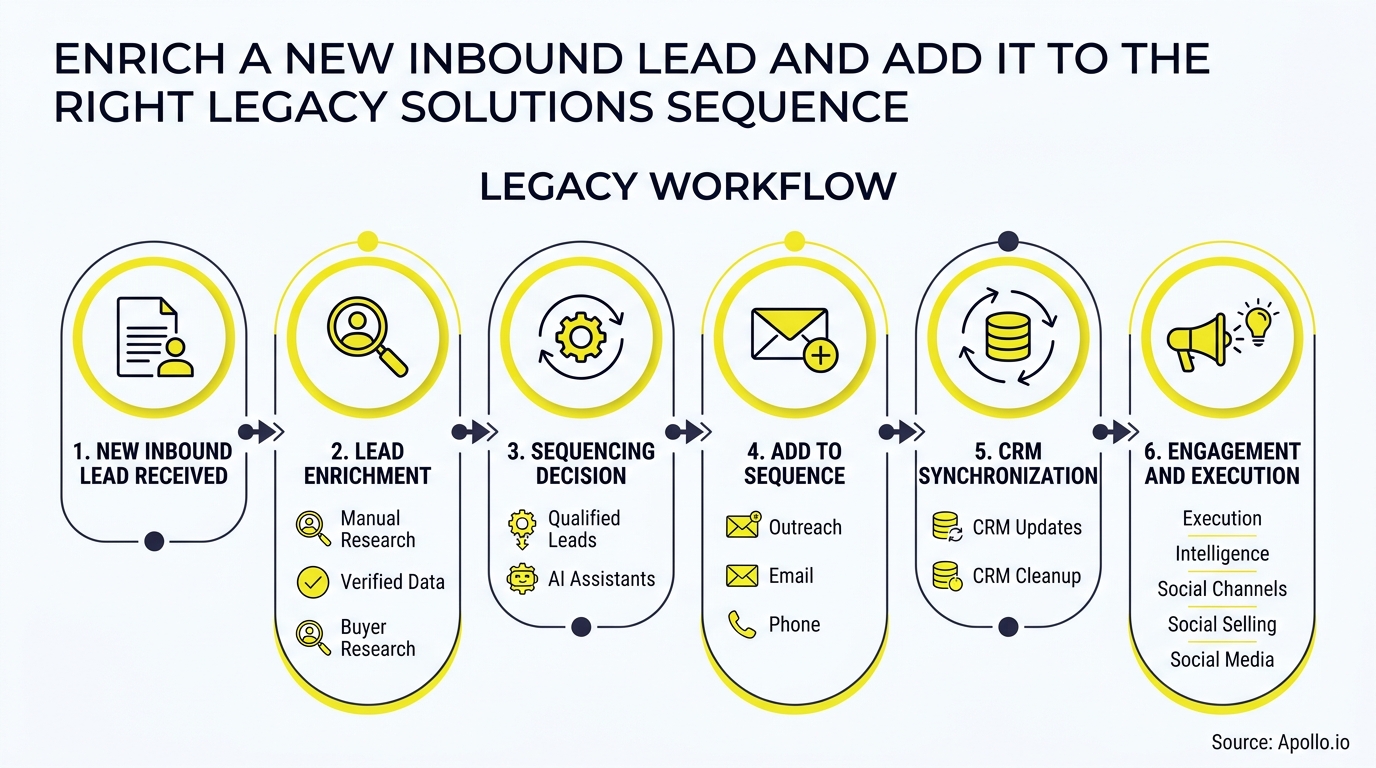
This matters because the old workflow bounces a hot lead through roughly six tools and 45 minutes: export, clean, import, dedupe, re-enrich, then build a sequence, while a faster competitor already has them on the phone. With Apollo MCP, that same flow of detect, enrich, match, and queue a personalized sequence collapses to about four minutes, inside the tool you're already working in.
Developers and RevOps engineers building custom routing logic can also use the Apollo CLI for terminal-native access to the same enrichment and sequencing actions.
What Should a 30-Day Rollout Plan Look Like?
A 30-day rollout for enrichment and routing automation should move from baseline measurement to full expansion in four stages, not a single big-bang launch. Rushing straight to full automation without a baseline is how teams end up with the irrelevant-outreach problem Gartner warns about.
- Week 1 (Baseline): Measure current time-to-first-touch, correct-owner rate, and sequence acceptance rate. Document existing manual steps.
- Week 2 (Pilot): Automate enrichment and routing for one segment only, for example, one product line or region. Keep sequence enrollment behind a manual approval step.
- Week 3 (QA exceptions): Review every low-confidence or ambiguous record that fell out of auto-routing. Tighten thresholds based on false positives.
- Week 4 (Monitor and expand): Turn on full automation for the pilot segment, track lead-to-meeting conversion, then expand to additional segments.
Gartner research found sellers who effectively partner with AI are 3.7 times more likely to meet quota, but that advantage depends on clean inputs and a staged rollout, not flipping every switch on day one.
How Do Growing Teams Cut Tool Sprawl While Automating This Workflow?
Growing teams cut tool sprawl by consolidating enrichment, deduplication, sequencing, and pipeline visibility into one connected platform instead of stitching together separate point solutions. Each additional tool in this workflow, an enrichment vendor, a dedupe tool, a sequencing platform, and a routing layer, adds another integration to maintain and another place data can break.
Collin Stewart of Predictable Revenue put it simply: "We reduced the complexity of three tools into one." Apollo brings enrichment, deduplication logic, and sequencing into a single workspace, so Founders and RevOps leaders don't have to reconcile data across systems before a lead can be worked.
Spending hours stitching together enrichment and sequencing tools by hand? Automate your sequences with Apollo's multi-channel platform and skip the export-import cycle entirely.

Frequently Asked Questions
How Do You Handle CRM Deduplication Before Sequencing?
You handle CRM deduplication by running a fuzzy match against existing contacts and accounts before any enrollment, flagging ambiguous matches for manual review rather than auto-merging. This prevents duplicate sequences from hitting the same buying group under different contact records.
What Confidence Score Should Trigger Manual Review?
Most teams set manual review for any match below a high-confidence threshold, typically when the identity match, role classification, or intent signal comes from inference rather than a verified source. High-confidence exact matches can auto-enroll; everything else should queue for a quick human check.
What Makes a Lead Eligible for an Automated Sequence?
A lead becomes sequence-eligible once it passes identity verification, has no active duplicate, includes a verified contact channel, and matches a defined role and intent combination. Leads missing any of these should fall back to manual triage instead of a default sequence.
What Is a Reasonable Lead-Routing SLA?
A reasonable SLA targets first-touch outreach within minutes of qualification, not hours. Kondo's research found up to 50% of B2B sales go to the vendor that responds first, making routing speed a direct revenue lever, not just an operational metric.
Ready to Automate Lead Enrichment and Sequencing?
Manual enrichment and routing can't keep pace with inbound speed expectations, and static sequences leave revenue on the table when they ignore role, intent, and account context. Building the decision tree, confidence thresholds, and buying-group rules outlined above turns inbound response from a bottleneck into a competitive advantage.
Apollo brings enrichment, deduplication, role-based routing, and multi-channel sequencing into one workspace, so your team can act on inbound leads in minutes instead of stitching together separate tools. Start a Trial and see how fast a lead can go from form-fill to first touch.
Prove ROI Fast With Apollo At Scale
Struggling to justify the spend before budget season hits? Apollo replaces scattered manual outreach with one platform your whole team scales on, so wins show up in weeks, not quarters. Leadium tripled annual revenue after automating with Apollo.
Start Free with Apollo →Don't miss these
Sales
Inbound vs Outbound Marketing: Which Strategy Wins?
Sales
What Is a Sales Funnel? The Non-Linear Revenue Framework for 2026
Sales
What Is a Go-to-Market Strategy? The 2026 GTM Playbook
See Apollo in action
We'd love to show how Apollo can help you sell better.
By submitting this form, you will receive information, tips, and promotions from Apollo. To learn more, see our Privacy Statement.
4.7/5 based on 9,690 reviews
