DataGrail competitors fall into two camps: privacy-specialist platforms and broader data governance suites. The right choice depends on request volume, integration count, and who owns privacy operations after go-live.
This guide gives you a fit matrix, a cost worksheet, demo scenarios, and a migration checklist. It was built for the revenue, marketing, and RevOps leaders who now sit on privacy buying committees.
If you are also rethinking the wider stack around your privacy tooling, start with this sales tech stack playbook to see where data, consent, and outreach tools should connect.

Skip Manual Research, Reclaim Selling Time
Tired of spending hours researching leads and verifying contact info instead of selling? Apollo brings 240M+ contacts and 98% email accuracy into one workspace, so reps spend time in conversations, not spreadsheets. Start filling your pipeline today.
Start Free with Apollo →Key Takeaways
- The shortlist to evaluate is OneTrust, Transcend, TrustArc, Osano, Ketch, BigID, and Securiti, with DataGrail as your baseline.
- Compare total operating cost (licensing, setup, labor, migration, administration), not subscription price alone.
- Test request-type-specific verification, authorized agent handling, and failed connector actions in every demo.
- Consolidation is reshaping the market, so ask each vendor about roadmap continuity before you sign.
- Methodology note: this comparison reflects public vendor positioning as of November 2026. We did not run hands-on tests, so every capability marked "verify" needs proof in a live demo.
Who Are the Top DataGrail Competitors and Alternatives in 2026?
The leading DataGrail alternatives are OneTrust, Transcend, TrustArc, Osano, Ketch, BigID, and Securiti. Demand is growing: Grand View Research reports the global privacy management software market was valued at roughly $5.1 billion to $5.55 billion in 2025, which explains why vendor options keep multiplying. For context on DataGrail itself, DataGrail's IDC MarketScape page states it was named a Leader in the worldwide data privacy compliance software assessment, alongside OneTrust, BigID, Securiti, and TrustArc.
| Vendor | Positioning (public messaging) | Typical Fit | Verify in Demo |
|---|---|---|---|
| DataGrail (baseline) | Privacy request automation, consent, data mapping | Teams that want integration-driven request workflows | Connector coverage, failed-action handling |
| OneTrust | Privacy, governance, and consent suite | Programs combining privacy, risk, and AI governance | Admin workload, module scope |
| Transcend | Data privacy infrastructure with request and consent tooling | Engineering-involved privacy programs | Integration effort, ownership model |
| TrustArc | Privacy management, assessments, certifications | Assessment-heavy compliance programs | Automation depth for requests |
| Osano | Consent management and privacy requests | Smaller teams starting a program | Scale limits, connector list |
| Ketch | Consent and data permissioning | Marketing-led consent programs | Downstream permission enforcement |
| BigID | Data discovery and classification with privacy modules | Teams with large, scattered data estates | Request workflow versus discovery focus |
| Securiti | Data security and privacy; now part of Veeam | Buyers consolidating security and privacy | Post-acquisition roadmap, packaging |
Should You Buy a Privacy Specialist or a Go-To-Market Platform?
Buy a privacy specialist to run privacy operations, and a go-to-market platform to run revenue operations. They solve different problems, and one does not replace the other.
- Privacy platforms (DataGrail, OneTrust, Transcend, TrustArc, and others) handle request intake, consent, data mapping, and assessments.
- Go-to-market platforms handle prospecting, outreach, and pipeline for sales and marketing teams.
- What Apollo is not: Apollo is not a privacy request automation or consent management tool. It does not replace DataGrail or any vendor in the table above.
The two categories meet in your stack. Privacy teams set the rules for how business contact information is handled, and revenue teams work inside those rules.
Users control who they contact and how they use the product, so your internal policies still apply.

How Should a Head of Privacy or RevOps Leader Evaluate These Vendors?
Evaluate on integration coverage, ownership, and workflow fit rather than feature checklists. A Head of Privacy cares about request completion and audit trails.
A RevOps leader cares about which systems of record the tool must reach and who maintains those connections.
| Evaluation Area | Question to Ask in a Demo |
|---|---|
| Integration coverage | Which of our CRM, marketing, and engagement systems have native connectors? |
| Failed actions | What happens when a connector fails mid-request, and who is alerted? |
| Ownership | Does legal, security, or engineering maintain the setup day to day? |
| Consent enforcement | Does a consent change reach downstream tools automatically? |
| Packaging | Which capabilities are in the base contract and which are separate modules? |
| Reporting | Can we export request and consent records for auditors? |
Ask each vendor for a reference customer of similar size and stack. Confirm pricing details directly with each vendor's sales team.
Apollo Shows You Who's Ready To Buy
Watching leads stall while your forecast turns into a guessing game? Apollo surfaces buyer signals and clean pipeline data in one workspace, so reps focus on in-market accounts. Teams actively using Apollo's AI Assistant are up 2,156% since December 2025.
Start Free with Apollo →Where Does Apollo Fit Alongside a Privacy Platform?
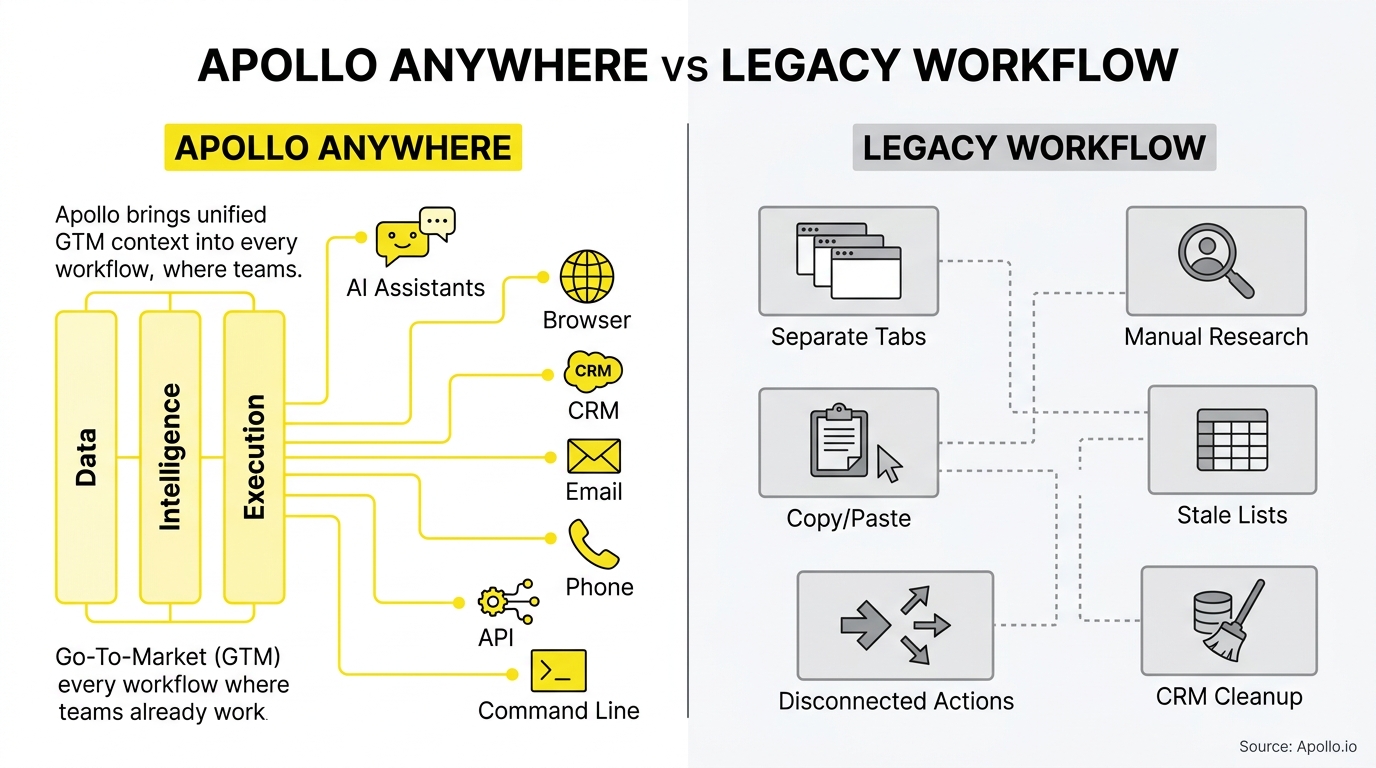
Apollo is the sales side of the stack. It brings B2B data, sales engagement, and AI-powered execution together in one connected go-to-market system, so teams don't have to stitch together separate vendors for research, outreach, and analysis.
SDRs and BDRs can find businesses and professionals in their business capacity through Apollo's prospecting tools, then run outreach through sales engagement sequences. RevOps can connect that work to existing systems through Apollo integrations. Teams that work in AI assistants can also use Apollo MCP inside tools like Claude, ChatGPT, and Perplexity.
"We reduced the complexity of three tools into one. We're getting higher reply rates, open rates are doubled, meetings are up, and speed to booking a meeting is cut in half."
Consolidating revenue tools into one workspace also gives privacy and RevOps teams fewer systems to map, which is a practical benefit when you maintain a data inventory.
"We paid less for one tool than for two tools together... we cut our costs in half."
Frequently Asked Questions About DataGrail Competitors
What Are the Closest DataGrail Alternatives?
OneTrust, Transcend, TrustArc, Osano, Ketch, BigID, and Securiti are the most commonly compared vendors. They differ in whether they lead with request automation, consent, assessments, or data discovery.
Match the vendor's core focus to your program's biggest gap.
Can a Sales Platform Replace a Privacy Platform?
No. Sales platforms such as Apollo do not handle privacy request workflows, consent management, or data mapping.
Keep a dedicated privacy tool for those jobs, and use a go-to-market platform for prospecting and outreach.
What Should a Privacy Manager Ask Before Switching Vendors?
Ask about migration of existing request history, connector parity with your current integrations, and who owns ongoing maintenance. Also confirm how consent records and audit logs export, so a switch does not break your reporting.
How Should RevOps Teams Work With the Privacy Team?
Agree on which systems hold contact records, who can export them, and how opt-outs reach engagement tools. Document the process once, then review it whenever you add a new tool to the stack.

What Should You Do Next?
Shortlist two or three privacy vendors, run the demo questions above, and confirm connector coverage against your actual stack. Treat privacy tooling and revenue tooling as separate decisions that must work together.
If your revenue team also wants fewer tools to manage, see how Apollo brings data, engagement, and AI execution into one workspace. Start a free Apollo account and see how it fits next to your privacy platform.
Final Thoughts on Choosing a DataGrail Alternative
The right DataGrail alternative depends on what you need to solve. Privacy specialists cover consent, data subject requests, and compliance workflows.
Go-to-market platforms help revenue teams find, engage, and convert the right buyers. Most teams need both, and they work best when each has a clear owner and a documented handoff.
Evaluate privacy vendors on connector coverage, request handling, and audit exports. Then give your revenue team a workspace that makes prospecting and outreach simpler to run responsibly. Get started with Apollo to bring contact data, engagement, and AI-assisted execution into one place.
Prove Pipeline ROI Fast With Apollo
Budget approval stuck on ROI you can't quantify? Apollo puts prospecting, engagement, and pipeline tracking in one workspace, so you can show leadership real impact faster. Leadium tripled annual revenue by automating inbound and speeding follow-up.
Start Free with Apollo →Don't miss these
Revenue Operations
Top Market Intelligence Tools for B2B Teams in 2026
Revenue Operations
Sales Operations Analyst Salary: 2026 Compensation Guide and Benchmarks
Revenue Operations
Sales Compensation Software: How to Automate Commission Management
See Apollo in action
We'd love to show how Apollo can help you sell better.
By submitting this form, you will receive information, tips, and promotions from Apollo. To learn more, see our Privacy Statement.
4.7/5 based on 9,690 reviews
