
Top 5 Data Axle Alternatives for GTM Teams in 2026
Data Axle is a long-standing B2B and B2C data provider offering access to business profiles, consumer records, and enrichment APIs across North America. According to Data Axle, its database includes 90M+ verified businesses and 280M+ consumers, with over 400 business attributes accessible via API or CRM integrations. For teams primarily focused on data enrichment or direct mail, it covers the basics. But GTM teams in 2026 increasingly need more than a static data feed, they need integrated prospecting, multi-channel outreach, buyer intent signals, and AI-assisted workflows built into the same system.
The most common reasons teams seek Data Axle alternatives: the platform is structured around data licensing rather than sales execution, outbound workflows require assembling tools from multiple vendors, and the per-thousand-record API pricing model makes cost unpredictable at scale. If your team needs to go from data to conversation, not just from data to a spreadsheet, these five alternatives are worth evaluating.

Research Less, Close More With Apollo
Tired of burning hours verifying emails that bounce and numbers that go nowhere? Apollo delivers 98% email accuracy so your team spends time selling, not searching. Join 600K+ companies building pipeline that actually converts.
Start Free with Apollo →Key Takeaways
- Apollo: Covers the full GTM workflow, prospecting, enrichment, multi-channel sequencing, dialing, and AI automation, with a 240M+ person database and transparent per-seat pricing starting at $49/user/month.
- ZoomInfo: Offers sales intelligence with intent data, technographics, and GTM orchestration tools; pricing is not publicly displayed and typically reflects enterprise contract structures.
- Cognism: Focuses on compliance-first B2B data with phone-verified mobile numbers and strong European coverage; pricing is not publicly displayed.
- Lusha: Provides contact and company data with AI search and buying signals; transparent credit-based pricing starts at $37.45/user/month (billed annually).
- RocketReach: Delivers verified email and phone data with broad global profile coverage; annual plans start at $33/user/month.
Apollo

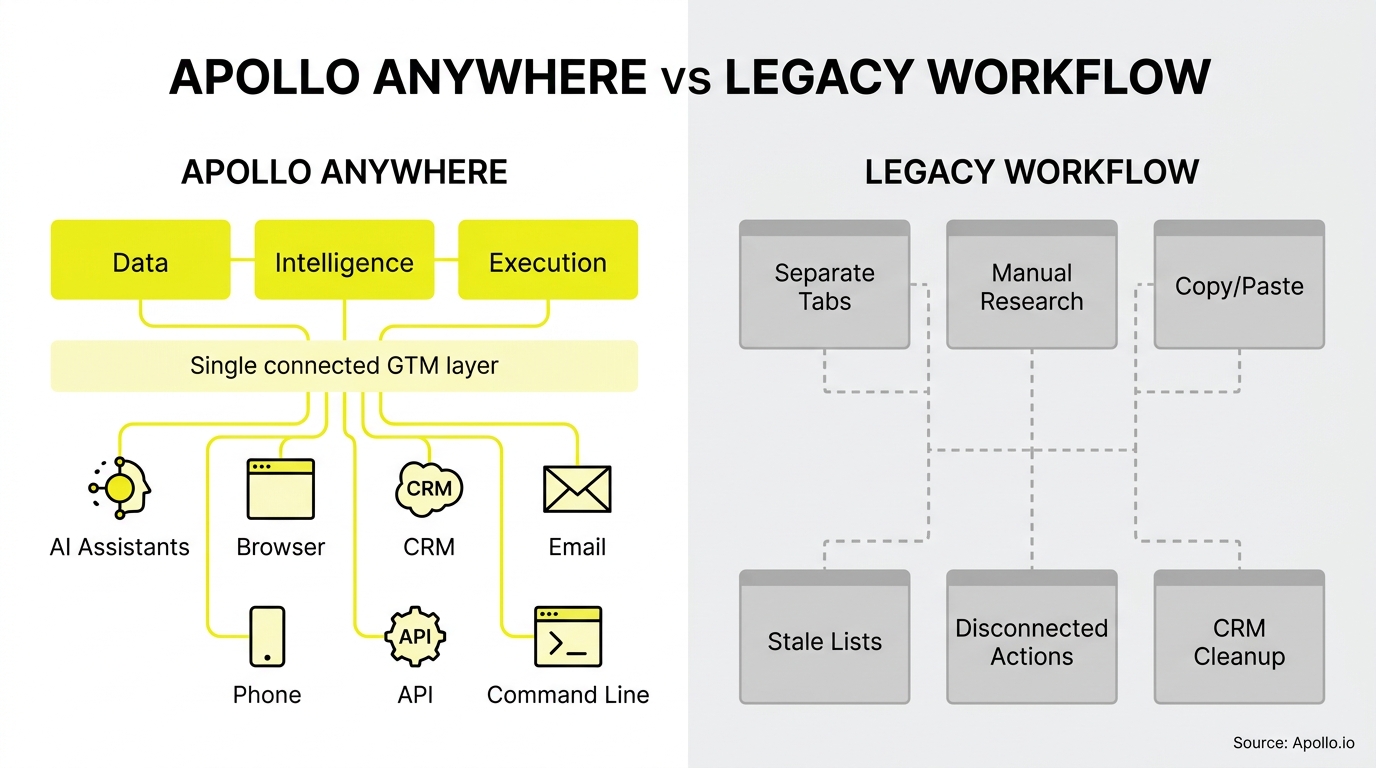
Apollo is an AI sales platform that unifies data, intelligence, and execution into one connected GTM system. Where Data Axle stops at data delivery, Apollo extends through the entire sales motion: find the right contacts, verify their information, run coordinated outreach across email, phone, and social channels, and analyze what's working, all from one workspace.
Apollo's database covers 240M+ people and 30M+ companies, with 98% email accuracy maintained through Apollo's Living Data Network, which continuously validates and refreshes contact records. Teams use 65+ filters via Apollo's advanced prospecting tools to build precise ICP lists, while buyer intent signals surface accounts showing active purchase behavior. Beyond data, Apollo's Power Dialer and Parallel Dialer reduce idle calling time, AI Sequence Builder creates multi-step outreach from natural language prompts, and automated workflows handle follow-up without manual intervention.
For teams managing inbound, Apollo's Form Enrichment, Website Visitor Identification, and routing tools turn anonymous web traffic and short form submissions into qualified, routed meetings. Apollo's data enrichment keeps CRM records current through scheduled, real-time, and one-off jobs synced bidirectionally with Salesforce and HubSpot.
Apollo serves B2B GTM teams, GTM Engineers, and AI Builders building headless GTM workflows with the Apollo MCP, compatible with ChatGPT, Codex, Claude, and Perplexity, alongside Sales Professionals, SDRs/BDRs, AEs, RevOps, Marketing, and Revenue Leaders. For terminal-native access, the Apollo CLI supports headless GTM workflows. The Chrome extension enables prospecting across the web without leaving your current context.
Pricing (Apollo Pricing, annual billing): Free at $0 with 900 credits/year; Basic at $49/user/month with 30,000 credits/year and CRM integrations; Professional at $79/user/month with 48,000 credits/year, US dialer, and automated workflows; Organization at $119/user/month (minimum 3 users) with 72,000 credits/year, international dialer, and SSO.
"Apollo became the single source of truth for us, where everything originates from and where all the data returns to.", Kevin Warner, CEO at Leadium
"Apollo enriches everything we have: contacts, leads, accounts...And we don't really have to touch it, it just works.", Mark Turner, VP of Revenue Operations at Built In
According to Ramp's vendor data, Apollo holds a 39% adoption rate among businesses using sales data provider software, up 6 percentage points year-over-year as of August 2026, and captures 30% of all first-time buyers entering the category, tying for the highest new-adopter share.
At the Sales Data Providers category level, Apollo is the fastest-growing vendor, averaging +0.6 percentage points of adoption per month as of August 2026, outpacing every other platform tracked in the category.
Apollo has earned the 2026 MarTech Breakthrough Award for "Best AI-Powered Sales Solution" and holds a 4.7/5 G2 rating across multiple categories.
ZoomInfo

ZoomInfo is a go-to-market intelligence platform providing B2B contact and company data alongside buyer intent signals, technographics, hiring trends, and GTM orchestration tools. Its platform includes modules for sales, marketing, and recruiting teams, with features such as automated outreach workflows, website visitor tracking, form enrichment, and display advertising through its ABM network.
ZoomInfo's tiered structure spans Professional, Copilot Advanced, and Copilot Enterprise for sales teams, plus Marketing Demand, ABM Lite, and ABM Enterprise for marketing use cases. The platform integrates with Salesforce, HubSpot, Marketo, and other major CRM and MAP tools.
Pricing: ZoomInfo's pricing is not publicly displayed on their official website. According to Vendr, the median contract value is $33,500, based on data from 1,568 purchases across 1,012 deals handled. Pricing varies by number of licenses, feature tier, data credits, and contract length.
Pros:
- Intent data depth: Buyer intent signals and account prioritization are well-developed across tiers.
- GTM breadth: Covers sales, marketing, and recruiting in a single contract.
- Enterprise integrations: Deep CRM, MAP, and data warehouse connectivity.
Cons:
- Opaque pricing: All tiers require a sales conversation; no self-serve pricing visibility.
- Contract rigidity: Annual commitments with credit overage costs that can scale significantly.
- Complexity at smaller scale: The multi-module structure and credit system can create friction for leaner teams.
Here's a detailed comparison of Apollo vs ZoomInfo.

Cognism

Cognism is a B2B sales intelligence platform built around compliance-first data, with a focus on phone-verified mobile numbers and strong coverage of European markets. The platform sources and verifies contact data with an emphasis on GDPR and CCPA adherence, and includes Bombora Company Surge intent data, CRM enrichment, AI-powered account research, and a persona builder.
Cognism offers Standard and Pro tiers (both starting with 5 seats), with add-ons for CRM enrichment and Data-as-a-Service delivery via API or bulk file. The credit model charges one credit per contact record revealed.
Pricing: Cognism's pricing is not publicly displayed on their official website. According to Vendr, the median contract value is $36,000, based on data from 108 purchases across 107 deals handled.
Pros:
- European data coverage: Particularly strong for teams prospecting into EMEA markets.
- Compliance focus: ISO 27001/27701 certified with built-in data handling controls.
- Phone verification: Cognism reports higher mobile connect rates through its premium verification process.
Cons:
- Limited outbound execution: Built-in engagement sequencing tools are not the platform's primary focus.
- No public pricing: Teams would contact their sales team for pricing details, making budget planning difficult upfront.
- North American coverage gaps: Coverage depth varies more significantly outside of European markets.
Related reading:Apollo vs Cognism
Lusha

Lusha is a B2B data and intelligence platform providing verified contacts and companies enriched with buying signals, AI search, and ICP scoring. Its search layer surfaces continuously updated data across people and companies, while an intelligence layer uses context to surface recommended accounts, contacts, and next actions. Lusha also provides a browser extension for prospecting from within websites and CRMs, API and MCP integrations, AI recommendations, and conversation intelligence.
Pricing (Lusha Pricing, annual billing): Free at $0 with 40 credits/month; Starter at $37.45/user/month with 4,800 credits/year; Pro at $48.95/user/month with 7,200 credits/year and 2 seats; Premium at $259.95/month with 40,800 credits/year and 5 seats; Scale at requested pricing with 25 buying intent topics and SSO. Note: Lusha's site currently displays promotional discounts; verify current pricing directly.
Pros:
- Transparent pricing: Self-serve tiers with publicly listed rates and a free tier to start.
- AI intelligence layer: AI recommendations and AI search reduce time spent on manual list-building.
- Buying signals: Intent and signal data available across tiers for account prioritization.
Cons:
- Credit costs vary by action: Phone reveals consume 5 credits vs. 1 for email, which can deplete allocations faster for phone-heavy teams.
- Sequencing not native: Outbound email sequencing and dialing are not included as core platform features.
- Smaller database: Coverage may be narrower for some international or niche industry segments.
Explore the Apollo vs Lusha breakdown.
Turn Funnel Guesswork Into Pipeline Wins
Tired of watching quality leads stall before they ever reach your pipeline? Apollo surfaces in-market buyers the moment they're ready, so your team stops chasing and starts closing. Trusted by 600K+ companies building predictable revenue.
Schedule a Demo →RocketReach

RocketReach is a lead intelligence platform offering verified contact data for sales, marketing, and recruiting professionals. According to RocketReach, its database covers 700M+ profiles and 60M+ companies worldwide, with unlimited personal and professional emails, mobile and direct phone numbers, technographics, intent data, and org charts. The platform includes an AI-powered message writer, Autopilot for automated workflows, and integrations with Salesforce, HubSpot, Outreach, and Salesloft.
Pricing (RocketReach Pricing, annual billing): Essentials at $33/user/month with 1,200 exports/year (email only); Pro at $75/user/month with 3,600 exports/year and phone numbers; Ultimate at $142/user/month with 20,000 exports/year plus intent data and healthcare data; Enterprise plans start at $6,000/year.
Pros:
- Global profile depth: RocketReach claims broad coverage across 700M+ profiles spanning multiple geographies and industries.
- Accessible entry pricing: Annual Essentials tier at $33/user/month provides a low-cost entry point for email-focused prospecting.
- Recruiter use case: Designed to serve both sales and talent acquisition teams within the same platform.
Cons:
- Export caps by tier: The Essentials tier limits users to 1,200 exports/year, which constrains higher-volume prospecting workflows.
- Engagement tools are limited: Native outbound sequencing and dialing are not core capabilities.
- Intent data gated to higher tiers: Intent data access requires the Ultimate plan or above.
Related:Apollo vs RocketReach
Comparison Table
| Platform | Database Coverage | Starting Price | Outbound Execution | AI Features | Intent Data | Free Tier |
|---|---|---|---|---|---|---|
| Data Axle | Claims 90M+ businesses, 280M+ consumers | $50/thousand records (Business API Standard) | No native sequencing or dialer | SignalFuse AI Copilot | Buyer signals via SignalFuse | No |
| Apollo | 240M+ people, 30M+ companies | $49/user/month (Basic, annual) | Multi-channel sequences, Power & Parallel Dialer | AI Sequence Builder, AI Research Agent, AI call summaries | Yes, included | Yes (900 credits/year) |
| ZoomInfo | not publicly displayed | Not publicly displayed; Vendr median ACV $33,500 | Engage module included in suite | Copilot account summaries, AI workflows | Yes, across tiers | No |
| Cognism | not publicly displayed | Not publicly displayed; Vendr median ACV $36,000 | CRM enrichment; engagement via integrations | AI account research, persona builder | Yes (Bombora) | No |
| Lusha | not publicly displayed | $37.45/user/month (Starter, annual) | No native sequencing or dialer | AI search, AI recommendations | Yes (Scale tier) | Yes (40 credits/month) |
| RocketReach | Claims 700M+ profiles, 60M+ companies | $33/user/month (Essentials, annual) | Autopilot workflows; limited native sequencing | AI message writer, AI recommendations | Ultimate tier and above | No |
How to Choose
Start with what your team actually does after data leaves the system. If your GTM motion spans prospecting, enrichment, outbound sequencing, calling, and inbound routing, and you want all of it managed without assembling a separate tool stack, Apollo's connected platform covers each layer.
Apollo's Living Data Network and 65+ prospecting filters support precise ICP targeting, while the dialer, sequencing, and AI workflow tools handle execution in the same workspace.
If your team operates heavily in European markets and compliance is a primary concern, Cognism's phone-verified mobile data and compliance certifications are relevant considerations, though pricing requires a sales conversation and outbound execution tools are more limited.
For teams prioritizing budget predictability with self-serve onboarding, Lusha's publicly listed credit tiers and RocketReach's export-based annual plans both offer accessible starting points. Lusha suits teams that want AI-assisted contact discovery; RocketReach works for organizations that need broad global profile access, including recruiting use cases.
ZoomInfo fits organizations that want intent data, ABM capabilities, and multi-department GTM coverage under one enterprise agreement, provided the team budget and procurement timeline supports a custom contract process.
For teams that also need API-level or programmatic access to GTM data, Apollo's CLI and MCP integrations make it a strong fit for GTM Engineers and AI Builders, not just traditional sales roles.
Frequently Asked Questions
What is the main difference between Data Axle and these alternatives?
Data Axle is structured primarily as a data licensing and enrichment API provider, it delivers records but does not include native outbound sequencing, dialing, or AI-driven sales workflows. The alternatives listed here, particularly Apollo, combine contact data with execution tools so teams can move from prospecting to booked meetings within one system.
Which Data Axle alternative is best for teams that need outbound execution built in?
Apollo offers the most complete outbound execution layer among the alternatives covered here, including multi-channel sequences, Power and Parallel Dialers, AI Sequence Builder, and automated workflows, as detailed in the Apollo section above. ZoomInfo also includes engagement capabilities through its suite.
Cognism, Lusha, and RocketReach are more focused on data delivery and connect more commonly with external engagement tools.
Do any of these alternatives offer a free plan?
Apollo offers a free plan with 900 credits/year and basic prospecting filters, no credit card required. Lusha also offers a free tier with 40 credits/month.
ZoomInfo, Cognism, and RocketReach do not offer self-serve free tiers, though some offer trial access on request.
How does Apollo's pricing compare to Data Axle's API pricing model?
Data Axle's Business API pricing starts at $50 per thousand records for the Standard plan, making costs variable based on volume consumed. Apollo uses a per-seat subscription model, as detailed in the Apollo section above, with fixed credit allocations per tier, which makes monthly spend more predictable for teams running consistent prospecting volumes.
Is Apollo suitable for enterprise GTM teams, not just SMBs?
Yes. Apollo's Organization tier includes SSO, advanced security, international dialing, and admin controls suited to enterprise governance requirements.
Apollo is used by 100+ teams at Fortune 500 companies and serves B2B GTM teams, GTM Engineers, and AI Builders building headless GTM workflows with the Apollo API, CLI, and MCP, alongside Sales Professionals, SDRs/BDRs, AEs, RevOps, Marketing, and Revenue Leaders across all company sizes.

Conclusion
Data Axle serves a specific need, B2B and B2C data access via API, but teams looking to run a modern GTM motion need more than a record delivery layer. The five alternatives above each address different parts of that gap, from ZoomInfo's intent-driven enterprise intelligence to Lusha and RocketReach's accessible contact data tiers.
For teams that want a single platform covering prospecting, enrichment, outbound execution, dialing, AI automation, and inbound routing, Apollo delivers the most complete GTM system across this group, with transparent pricing, a free starting tier, and coverage that spans from individual SDRs to enterprise RevOps teams and AI Builders.
Ready to see it in action? Start Free with Apollo
See Pipeline ROI From Day One
Budget approval stuck on unclear metrics? Apollo delivers measurable pipeline impact fast — teams like Leadium 3x'd annual revenue after switching. Start your free trial and show leadership the numbers that matter.
Start Free with Apollo →Don't miss these
Sales
Inbound vs Outbound Marketing: Which Strategy Wins?
Sales
What Is a Sales Funnel? The Non-Linear Revenue Framework for 2026
Sales
What Is a Go-to-Market Strategy? The 2026 GTM Playbook
See Apollo in action
We'd love to show how Apollo can help you sell better.
By submitting this form, you will receive information, tips, and promotions from Apollo. To learn more, see our Privacy Statement.
4.7/5 based on 9,690 reviews
