
Switching Back to Apollo: How Its AI Empowers Sales Teams
Switching platforms is expensive if you get it wrong twice. If you left Apollo for ZoomInfo and you're now wondering whether to switch back, the real question isn't "which database is bigger." It's whether Apollo's AI can turn your data into completed workflows, booked meetings, and updated CRM records with less manual work from your team.

Skip The Research, Apollo Finds Verified Contacts
Spending hours manually researching leads and verifying contact info? Apollo delivers 98% email accuracy so your team skips the guesswork and starts real conversations. Nearly 5M users trust Apollo to find contacts that actually connect.
Start Free with Apollo →Key Takeaways
- Apollo's AI works as an execution layer, not just a writing assistant, moving from research to CRM updates without manual handoffs.
- A structured 90-day pilot with baseline metrics and a control group is the safest way to validate a switch before committing budget.
- Most rep time is lost to non-selling work like prospect research and data entry, which is exactly where Apollo's AI targets automation.
- Tool consolidation, not just database size, is becoming the deciding factor in GTM platform decisions in 2026.
- SDRs, AEs, and RevOps leaders each get distinct value from Apollo's AI depending on where they lose the most time.
Should You Switch From ZoomInfo Back To Apollo?
Use a four-factor decision matrix, data depth, workflow consolidation, governance, and economics, before making the call. No single factor should decide a platform switch on its own.
| Factor | What To Check | Why It Matters |
|---|---|---|
| Data Depth | Contact and company coverage for your specific ICP segments | AI output quality depends on the data feeding it |
| Workflow Consolidation | How many separate tools you currently stitch together for research, outreach, and reporting | Fewer handoffs mean fewer places work stalls |
| Governance | Admin controls, permissions, and audit visibility over AI actions | Security teams increasingly question how AI agents touch customer data |
| Economics | Total cost of the workflows replaced, not just subscription price | Consolidated platforms change the real cost comparison |
Apollo serves B2B GTM teams, GTM Engineers, and AI Builders building headless GTM workflows with the Apollo API, CLI, and MCP, alongside Sales Professionals, SDRs/BDRs, AEs, RevOps, Marketing, and Revenue Leaders. If your team is stitching together a database tool, an engagement tool, and a separate AI layer, that's the clearest signal it's time to test consolidation.
How Does Apollo's AI Actually Empower Sales Teams?
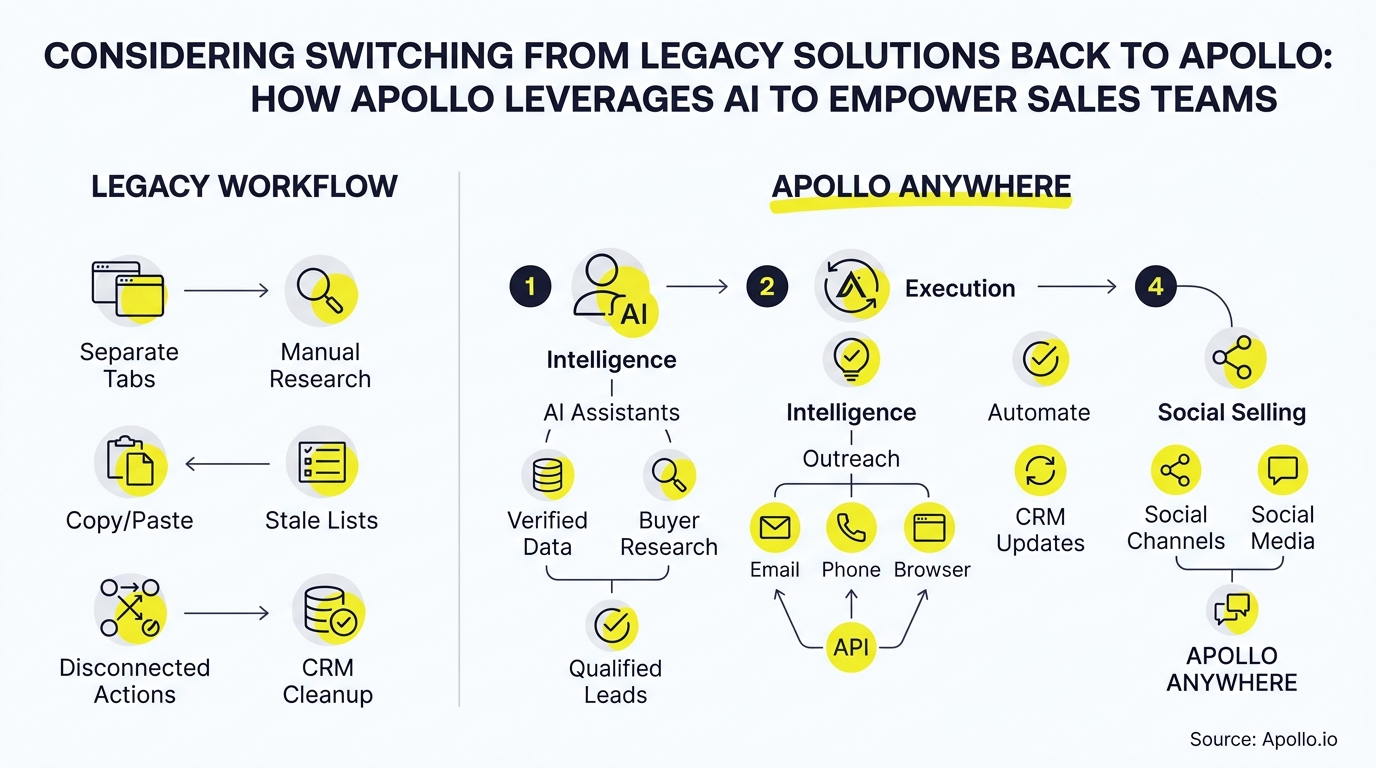
Apollo's AI empowers sales teams by acting as an execution layer that completes multistep workflows, not just a chatbot that drafts a message and stops. It moves from prospect research to list building, enrichment, sequencing, and CRM updates in one connected system.
TMCnet describes this directly: Apollo leverages AI not just as a "chatbot" but as an execution layer for sales tasks. That distinction matters because most AI tools stop at content generation and leave execution to the rep.
In September 2026, Apollo introduced scheduled outbound agents for lead discovery, sequence creation, and sequence optimization. These agents analyze ICP fit, CRM activity, campaign performance, deliverability, and engagement signals, then surface recommendations through Apollo or Slack for human approval, keeping a person in the loop before anything ships.
Struggling to find qualified leads without hours of manual list-building? search Apollo's 240M+ contacts with 65+ filters and let AI Research Agent narrow the list before you touch it.
What Specific Tasks Does Apollo's AI Automate?
Apollo's AI automates prospect research, lead scoring, message personalization, sequence enrollment, and CRM field updates. These are the exact non-selling tasks that eat into rep capacity.
Sales reps historically lose the majority of their week to non-selling activity, including prospect research, manual data entry, and lead prioritization, according to a Salesforce-commissioned analysis published by Visual Capitalist. Apollo's AI directly targets those categories:
- AI Research Agent: pulls account and contact context automatically before outreach
- AI Scoring: ranks leads by fit and intent so reps prioritize the right accounts first
- Automated Enrichment: fills missing contact and firmographic fields without manual lookup
- CRM Field Updates: syncs enriched data back to your system of record automatically
For RevOps leaders, this matters because it reduces the manual cleanup work that usually falls on their team after a data import.
How Do SDRs Book More Meetings With Apollo's AI?
SDRs book more meetings by letting Apollo's AI handle research and personalization at scale, so reps spend more time on live conversations instead of prep work. In March 2026, Apollo's AI Assistant became an end-to-end execution layer that lets users describe a GTM objective in natural language and have Apollo research prospects, build lists, enrich records, create sequences, and launch campaigns from a single instruction.
Apollo reported nearly 20,000 weekly users at launch, a figure buyers should validate against their own pipeline before assuming similar results. For SDRs managing high-volume outbound, this consolidates what used to be four separate steps into one workflow.
Spending hours a week on manual outreach prep? automate your sequences with Apollo's multi-channel platform and reclaim that time for calls.

What Does A 90-Day ZoomInfo-To-Apollo Pilot Look Like?
A 90-day pilot compares matched territory lists, tracks weekly execution metrics, and validates qualified-pipeline outcomes before you commit to a full migration. Structure it as a controlled test, not a blind switch.
| Phase | Baseline | Control Group | Success Threshold | Owner |
|---|---|---|---|---|
| Days 1-15 | Document current ZoomInfo workflow metrics (contacts sourced, sequences launched, meetings booked) | Half of reps stay on existing stack | Clean baseline data logged weekly | RevOps |
| Days 16-45 | Apollo pilot group runs matched territory lists | Control group continues on ZoomInfo | Equal or better contact-to-meeting conversion | Sales Manager |
| Days 46-75 | Expand AI-assisted sequencing and CRM sync | Control group unchanged | Reduced manual research time per rep | SDR Lead |
| Days 76-90 | Compare qualified-pipeline value across both groups | Final side-by-side review | Pipeline ROI justifies full switch | Revenue Leader |
Weekly checkpoints should track contacts enriched, sequences launched, meetings booked, and CRM records updated per rep hour, the completed-workflow metrics that matter more than raw database size.
How Do AEs And RevOps Teams Use Apollo's AI Differently?
Account Executives use Apollo's AI mainly for pre-meeting intelligence and deal tracking, while RevOps teams use it for data governance and CRM hygiene at scale. The same AI layer serves both roles differently based on where they lose time.
For AEs managing a full deal calendar, Apollo's AI Assistant can pull account context and recent engagement history ahead of a call, cutting prep time without another browser tab. For RevOps leaders, the value is in consistent enrichment and automated CRM updates that eliminate the recurring cleanup work after every list import.
RevOps teams driving growth increasingly cite fewer integrations to maintain as a core reason for consolidating onto one platform instead of stitching together a database tool, a sequencing tool, and a separate AI layer.
Reach Leads Before They Go Cold
Sending prospects to sales who aren't ready to buy? Apollo scores and prioritizes leads by buying intent, so reps chase the deals most likely to close. Built-In saw a 10% lift in win rate using Apollo's signals.
Start Free with Apollo →Is AI Sales Adoption Actually Mainstream In 2026?
Yes, AI adoption in B2B sales has moved from experimentation to routine use. According to a report covered by PR Newswire, 97% of B2B sales teams report using AI in their workflows as of 2026, though only 6% believe AI will replace their teams entirely.
That gap matters. Most teams see AI as an augmentation layer, not a replacement for reps, which is consistent with how Apollo's scheduled agents work: they surface recommendations for human approval rather than acting fully autonomously. Research from HyperQuota shows Apollo's AI platform drove over 47 million targeted prospecting actions in 2025 alone, supporting a user base that grew significantly year-over-year.
Founders and revenue leaders evaluating a switch should weigh this adoption curve against their own team's readiness. A platform with deep AI execution only pays off if reps actually use it, which is why a structured pilot matters more than a feature checklist.
What Should You Do Before Committing To A Switch?
Run the pilot, measure completed workflows, and validate governance controls before signing a new contract. Don't decide based on database size alone.
Compare what each platform actually finishes: verified contacts produced, sequences launched, meetings booked, and CRM records updated per seller hour.
Teams that have made the switch report meaningful consolidation gains. Collin Stewart of Predictable Revenue said, "We reduced the complexity of three tools into one." Census also cut tool sprawl after replacing their stack, as detailed in Apollo's customer story with Census, where the team reported cutting costs in half.
If you're rebuilding your evaluation criteria, start with a framework for building a sales tech stack that scales revenue and layer your 90-day pilot metrics on top of it.
Frequently Asked Questions
What Is The Fastest Way To Test Apollo Against ZoomInfo?
The fastest way is a matched-list pilot: pull the same territory in both platforms, run identical outreach cadences, and compare completed workflows over 30 to 90 days rather than comparing feature lists.
Does Apollo's AI Replace The Need For A Separate Sequencing Tool?
Apollo's AI Assistant builds lists, enriches records, and creates and launches sequences within the same workspace, which is why teams evaluating a switch often look to consolidate their sales automation and engagement tools into one platform instead of maintaining separate subscriptions.
How Does Apollo Handle Data Governance For AI Agents?
Apollo's scheduled agents surface recommendations through Apollo or Slack for human approval before any action is taken, keeping a person in the loop rather than allowing fully autonomous execution on customer-facing actions.

Ready To See Apollo's AI In Action?
Every day you delay testing is another day your team spends on manual research instead of selling. Run the pilot, compare completed workflows side by side, and let the data decide, not a feature list.
To see why Apollo stands alone as the only fully agentic GTM platform, combining sales intelligence, outbound execution, and enrichment in one workspace, Get Leads Now.
Scale Reps Faster With Apollo's Playbooks
New hires ramping too slowly while proof of ROI keeps slipping? Apollo gives every rep the same winning playbook from day one, so productivity scales without the guesswork. See measurable pipeline impact fast enough to justify the spend.
Start Free with Apollo →Don't miss these
Sales
Inbound vs Outbound Marketing: Which Strategy Wins?
Sales
What Is a Sales Funnel? The Non-Linear Revenue Framework for 2026
Sales
What Is a Go-to-Market Strategy? The 2026 GTM Playbook
See Apollo in action
We'd love to show how Apollo can help you sell better.
By submitting this form, you will receive information, tips, and promotions from Apollo. To learn more, see our Privacy Statement.
4.7/5 based on 9,690 reviews
