
Top 7 Clari Alternatives for Sales Leaders in 2026
Clari is an AI Revenue Orchestration Platform that unifies sales engagement, revenue intelligence, and SFA into one system, built around end-to-end pipeline coverage and AI agents that monitor deals across every stage. Many revenue teams adopt Clari for forecasting accuracy and deal visibility, but as they scale, they start looking for alternatives that combine sales intelligence, multi-channel engagement, and pipeline data in a more accessible package, often at a lower and more transparent price point.
Teams typically start evaluating Clari alternatives for a few common reasons: pricing that requires a sales conversation rather than transparent self-serve tiers, a platform architecture built primarily around forecasting and revenue governance rather than prospecting and outbound execution, and the need to consolidate data enrichment, engagement, and conversation intelligence into fewer vendor relationships. Sales leaders, RevOps teams, and GTM Engineers all have different priorities here: some need better contact data and outbound tooling, others need conversation intelligence, and others need a system that can plug into AI workflows via API or CLI.
This guide breaks down seven Clari alternatives worth evaluating in 2026, starting with Apollo, an AI GTM system built for teams that want data, intelligence, and execution in one place, followed by conversation intelligence and sales data platforms including Gong, ZoomInfo (Chorus), Avoma, Fathom, ZoomInfo, and Cognism.

Skip The Research, Apollo Finds Contacts Fast
Burning hours chasing bad emails and dead numbers instead of selling. Apollo hands you verified contact data instantly, so reps spend time closing, not digging. 98% email accuracy means fewer bounces and more real conversations.
Start Free with Apollo →Key Takeaways
- Apollo: An AI GTM system combining sales intelligence, multi-channel outbound, a built-in dialer, and data enrichment, with plans starting at $49/user/month.
- Gong: Conversation intelligence and revenue insights platform with AI agents for deal automation, priced via requested quotes with a Vendr median contract value of $54,900/year.
- ZoomInfo (Chorus): Conversation intelligence tool focused on call recording, coaching, and market intelligence, now part of the ZoomInfo suite.
- Avoma: AI meeting assistant with conversation and revenue intelligence add-ons, starting at $19/seat/month billed annually.
- Fathom: AI meeting assistant with a free tier and paid team plans starting at $15/user/month billed annually.
- ZoomInfo: B2B go-to-market intelligence platform with contact data, intent signals, and sales engagement tools, custom-priced with a Vendr median contract value of $33,500/year.
- Cognism: B2B sales intelligence platform emphasizing phone-verified data and compliance, custom-priced with a Vendr median contract value of $36,000/year.
Apollo

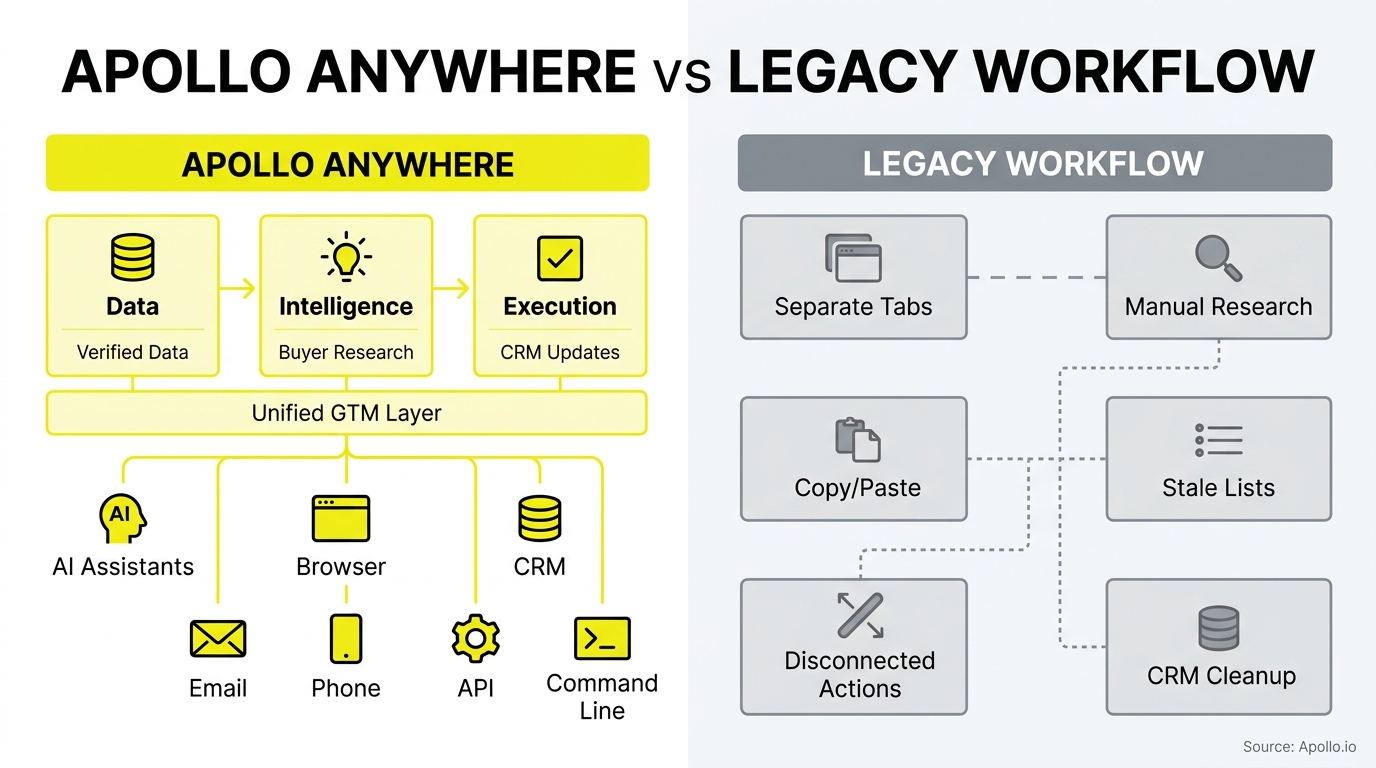
Apollo is an AI GTM system that unifies data, intelligence, and execution. Built open by design, Apollo meets sellers inside the tools they already use, from AI assistants like ChatGPT, Codex, Claude, and Perplexity via Apollo MCP, Apollo's Model Context Protocol, to the Chrome extension and Salesforce, rather than asking teams to switch contexts to get value. For technical and advanced users, Apollo CLI provides terminal-native access for headless GTM workflows.
Apollo Outbound helps teams define an ICP, let AI research and rank accounts and contacts, then run multi-channel sequences across email, calls, and social with a built-in Power Dialer and Parallel Dialer. Apollo Inbound turns website interest into qualified meetings through visitor identification, form enrichment, and AI-assisted routing, with 65+ filters for precise targeting. Data Enrichment keeps CRM records current through waterfall enrichment, scheduled CRM syncs, and REST API access for bulk jobs. Contacts are continuously validated through Apollo's Living Data Network rather than a static database, with 240M+ people and 30M+ companies at 98% email accuracy.
Pricing is transparent and published on Apollo's pricing page. The Free plan is $0 with 900 credits/year and basic filters. Basic is $49/user/month with 30,000 credits/year, unlimited sequences, and CRM integrations. Professional is $79/user/month with 48,000 credits/year, a US dialer, and AI research. Organization is $119/user/month (minimum 3 users) with 72,000 credits/year, an international dialer, SSO, and advanced security, all with annual billing savings of 20%.
Apollo integrates with Salesforce, HubSpot, Zoho CRM, Pipedrive, Outreach, SalesLoft, Orum, Nooks, and Marketo, with 50+ tools in its integrations marketplace. Customers describe the impact of consolidating their stack around Apollo: "Apollo became the single source of truth for uswhere everything originates from and where all the data returns to," says Kevin Warner, CEO at Leadium. Sylvain Giuliani, Head of Growth & Operations at Census, put it plainly: "We paid less for one tool than for two tools together...we cut our costs in half." And Mark Turner, VP of Revenue Operations at Built In, notes: "Apollo enriches everything we have: contacts, leads, accounts...And we don't really have to touch it, it just works."
According to Ramp's vendor data, drawn from real spend across American businesses, Apollo holds the #1 new adopter rank in the Sales Data Providers category as of August 2026, capturing 31% of first-time category buyers, and mid-market companies represent Apollo's largest customer segment by company size, with enterprise adoption climbing from 26% earlier in the year to 30-31% as of the latest data. Beyond Apollo's own trajectory, Ramp's Sales Data Providers category data shows Apollo as the fastest-growing vendor in the entire category, averaging +0.6 percentage points of adoption growth per month as of August 2026, ahead of every other vendor tracked in that space.
Apollo serves B2B GTM teams, GTM Engineers, and AI Builders building headless GTM workflows with the Apollo API, CLI, and MCP, alongside Sales Professionals, SDRs/BDRs, AEs, RevOps, Marketing, and Revenue Leaders. Apollo holds a 4.7/5 G2 rating, is recognized as a G2 Leader across multiple categories, and won the 2026 MarTech Breakthrough Award for "Best AI-Powered Sales Solution".
Gong

Gong is an AI Operating System for revenue teams that records and analyzes customer interactions to surface deal risk, coaching opportunities, and pipeline health. The platform includes Gong Engage for outbound prioritization, Gong Forecast for AI-powered revenue forecasting, and Gong Agents that automate tasks like CRM updates and follow-ups.
Gong's pricing is not publicly displayed on their official website. According to Vendr, the Median Avg Contract Value is $54,900, based on data from 1,127 purchases, with Vendr having handled 593 deals. Vendr data indicates Standard tier pricing around $1,400-$2,000 per seat annually, with Advanced tier pricing around $1,800-$2,600 per seat annually, plus a platform fee based on user count.
Pros:
- Automated call recording, transcription, and deal-risk analysis
- Gong Agents automate manual CRM and follow-up tasks
- Gong Revenue Graph connects interactions across the business for context
Cons:
- Pricing requires contacting sales, with add-ons like Gong Engage and Gong Forecast priced as a percentage of the base platform cost
- Vendr data indicates minimum seat commitments of roughly 10-15 seats, and reports that multi-year contracts are commonly used to reach lower per-seat rates
Want the full picture? See how Apollo compares to Gong.
ZoomInfo (Chorus)
Chorus, now part of ZoomInfo, is a conversation intelligence platform that captures and analyzes calls, meetings, and emails using proprietary machine learning. It provides transcriptions, contextual trackers for topics like pricing and objections, and coaching recommendations delivered directly to reps' inboxes.
Chorus's pricing is not publicly displayed on their official website; teams would contact ZoomInfo's sales team for pricing details.
Pros:
- Unlimited call recordings and transcriptions with contextual topic tracking
- Market intelligence features support win/loss analysis and competitive insights
- Deal Intelligence module supports forecasting with relationship visibility
Cons:
- Pricing is not publicly displayed, requiring a sales conversation to get a quote
- Primarily focused on conversation intelligence rather than outbound prospecting or data enrichment
- Now bundled under the broader ZoomInfo suite, which can add complexity for teams wanting a standalone tool
Avoma

Avoma is an AI platform that automates note-taking, scheduling, coaching, and forecasting for revenue teams, combining an AI Meeting Assistant with Conversation Intelligence and Revenue Intelligence capabilities.
Avoma's pricing starts with the Startup plan at $19/seat/month billed annually (up to 25 paid seats), the Organization plan at $24/seat/month billed annually (up to 100 paid seats, marked most popular), and the Enterprise plan at $39/seat/month billed annually only (minimum 10 paid seats). Conversation Intelligence and Revenue Intelligence add-ons are each priced at $29/seat/month billed annually, and a Lead Router add-on is available at $19/seat/month billed annually.
Pros:
- Transparent, published pricing with a free 14-day trial including add-ons
- AI Meeting Assistant supports transcription in 75+ languages
- Combines scheduling, conversation intelligence, and revenue intelligence in one suite
Cons:
- Revenue Intelligence and Conversation Intelligence are priced as separate add-ons rather than included in base plans
- Enterprise plan is billed annually only, with no monthly option
- Primarily built around meeting intelligence rather than outbound prospecting or data enrichment
Apollo vs Avoma, here's everything you need to know.
See Every Deal Stage Before It Stalls
Forecasting off gut feel because deal data is scattered and stale. Apollo gives you real-time pipeline visibility so reps chase the right opportunities at right moment. Built-In improved win rates using Apollo's signals and guidance.
Schedule a Demo →Fathom

Fathom is an AI meeting assistant that records, transcribes, and summarizes meetings across Zoom, Google Meet, and Microsoft Teams, generating action items and syncing insights to CRMs.
Fathom's pricing includes a Free tier at $0 for individuals, a Premium tier at $16/month billed annually for individuals, a Team tier at $15/user/month billed annually (2 user minimum), and a Business tier at $25/user/month billed annually (2 user minimum) that adds CRM field sync and AI scorecards. Enterprise pricing requires contacting sales.
Pros:
- Free tier available with unlimited recordings and transcriptions
- CRM field sync automatically updates records after meetings on the Business plan
- Bot-free capture option available in beta alongside traditional bot-based recording
Cons:
- Coaching metrics and AI scorecards are only available on the higher-priced Business tier
- Team and Business tiers require a 2-user minimum
- Focused on meeting capture rather than outbound prospecting or contact data enrichment
Get a full breakdown of how Apollo compares to Fathom.

ZoomInfo

ZoomInfo is an AI-assisted go-to-market intelligence platform providing B2B contact data, company intelligence, and sales engagement tools. It includes AI-driven account prioritization, buying intent signals, and ZoomInfo Copilot for outreach personalization.
ZoomInfo's pricing is not publicly displayed on their official pricing page, which lists tier names like ZoomInfo Professional, Copilot Advanced, and Copilot Enterprise without dollar amounts. According to Vendr, the Median Avg Contract Value is $33,500, based on data from 1,570 purchases, with Vendr having handled 1,012 deals.
Pros:
- ZoomInfo claims organizational charts and decision-maker intelligence across its database
- Buying intent signals track intent spikes, hiring surges, and technology changes
- Copilot Enterprise tier includes a dedicated customer service manager and white-glove onboarding
Cons:
- Pricing is not publicly displayed, and packages are split across Sales, Marketing, and other product tiers
- Credit-based usage model can create overage fees when limits are exceeded
- Higher-tier features like real-time intent signals are reserved for Copilot Enterprise
Here's a detailed comparison of Apollo vs ZoomInfo.
Cognism

Cognism provides B2B sales intelligence with an emphasis on European data coverage and compliance, combining phone-verified contact data with actionable buying signals for prospecting.
Cognism's pricing is not publicly displayed on their official pricing page, which lists Standard and Pro tiers (each with 5 seats included) on a credit-based model without dollar amounts. According to Vendr, the Median Avg Contract Value is $36,000, based on data from 108 purchases, with Vendr having handled 107 deals.
Pros:
- Cognism reports its Diamond Data offers phone-verified mobile numbers for higher connect rates
- Automatic suppression against Do-Not-Call and TPS lists supports compliance-focused outbound
- CRM Enrichment and Data-as-a-Service add-ons are available on both tiers
Cons:
- Pricing is not publicly displayed, requiring a conversation with sales for both tiers
- Credits are consumed per contact reveal, which requires monitoring usage against allocated pools
- Premium mobile data and intent data are positioned as separate add-ons or credit pools
Related reading:Apollo vs Cognism
Comparison Table
| Platform | Starting Price | Pricing Model | Core Focus | AI Features |
|---|---|---|---|---|
| Apollo | $49/user/month (Basic) | Per-seat with credit allocations; Free tier with 900 credits/year | Sales intelligence, multi-channel outbound, dialer, data enrichment | AI Sequence Builder, AI research, AI sentiment analysis, AI call summaries |
| Clari | Not publicly displayed (Vendr Median ACV: $76,000) | Per-seat + platform fee, requested quotes | Revenue orchestration, forecasting, pipeline governance | AI Revenue Agents, Revenue Cadences |
| Gong | Not publicly displayed (Vendr Median ACV: $54,900) | Per-seat + platform fee, requested quotes | Conversation intelligence, forecasting | Gong Agents, AI Trainer, deal risk prediction |
| ZoomInfo (Chorus) | Not publicly displayed | requested quotes | Conversation intelligence, coaching | ML-based transcription, contextual trackers |
| Avoma | $19/seat/month (Startup, annual) | Per-seat with paid add-ons | Meeting AI, conversation & revenue intelligence | Ask Avoma Copilot, AI scorecards |
| Fathom | $0 (Free tier); $15/user/month (Team, annual) | Per-seat with free tier | Meeting recording, transcription, summaries | Ask Fathom AI assistant, coaching metrics |
| ZoomInfo | Not publicly displayed (Vendr Median ACV: $33,500) | Hybrid per-seat + credits, requested quotes | B2B contact data, intent signals | ZoomInfo Copilot, AI account prioritization |
| Cognism | Not publicly displayed (Vendr Median ACV: $36,000) | Credit-based, requested quotes | B2B data, phone-verified contacts | AI company research, persona builder |
How to Choose
Start by identifying which layer of the revenue stack you actually need to fix. If the priority is generating pipeline through outbound prospecting, multi-channel sequencing, and a built-in dialer alongside data enrichment, a platform like Apollo covers data, engagement, and reporting from one workspace, backed by the Living Data Network for ongoing contact accuracy.
If the priority is purely analyzing sales calls and coaching reps, conversation intelligence tools focused specifically on that layer may be a tighter fit for that single use case.
Consider how each platform's pricing model matches your team's growth plans. Transparent per-seat pricing, as detailed in the Apollo section above, makes budgeting predictable as headcount grows.
Requested-quote models, common among conversation intelligence and enterprise data platforms, may offer negotiated discounts at scale but require more upfront sales cycles to understand total cost.
Finally, weigh platform scope. Teams juggling separate tools for data enrichment, outbound engagement, and forecasting often find consolidation reduces both cost and operational overhead, as reflected in customer accounts like Collin Stewart's at Predictable Revenue: "We reduced the complexity of three tools into one." Related reading: see how Apollo compares to other engagement platforms in Apollo vs Outreach vs Salesloft, or explore top market intelligence tools for B2B for additional context on evaluating sales intelligence vendors.
Frequently Asked Questions
What makes Apollo the best Clari alternative?
As detailed in the Apollo section above, Apollo serves B2B GTM teams, GTM Engineers, and AI Builders building headless GTM workflows with the Apollo API, CLI, and MCP, alongside Sales Professionals, SDRs/BDRs, AEs, RevOps, Marketing, and Revenue Leaders, combining sales intelligence, outbound execution, and data enrichment in transparently priced plans starting at $49/user/month.
Is Clari's pricing publicly available?
No. Clari's pricing is not publicly displayed on their official website.
According to Vendr, the Median Avg Contract Value is $76,000 per year, based on data from 291 purchases, with Vendr having handled 175 deals.
Which Clari alternative is best for conversation intelligence?
Gong, ZoomInfo (Chorus), and Avoma all focus specifically on call recording, transcription, and coaching insights, as covered in their respective sections above. Each has a different pricing structure and add-on model, so compare the specifics in the comparison table before deciding.
Do any of these alternatives offer free plans?
Yes. Apollo offers a Free plan with 900 credits/year and basic filters, while Fathom offers a free tier for individual users. Both are detailed in their respective sections above.

Conclusion
Clari's revenue orchestration approach works well for teams focused primarily on forecasting governance, but many sales organizations need a platform that also covers outbound prospecting, data enrichment, and multi-channel engagement without requesting a requested quotes for every tier. Among the alternatives compared here, from conversation intelligence tools like Gong, ZoomInfo (Chorus), Avoma, and Fathom to data-focused platforms like ZoomInfo and Cognism, Apollo stands out as an AI GTM system that unifies data, intelligence, and execution with transparent pricing and integrations across the tools teams already use.
With Apollo's Living Data Network, built-in dialer, AI-powered sequencing, and open access through Apollo MCP and Apollo CLI, teams can build a complete GTM motion inside one workspace instead of stitching together multiple point solutions. Start Free with Apollo and see why it's become one of the fastest-growing platforms in the sales data provider category.
Turn Tool Spend Into Tracked Pipeline Wins
Can't prove ROI on your sales stack fast enough to justify renewal? Apollo replaces scattered tools with one platform your team adopts in days, not quarters. Leadium tripled annual revenue by automating outbound with Apollo.
Start Free with Apollo →Don't miss these
Sales
Inbound vs Outbound Marketing: Which Strategy Wins?
Sales
What Is a Sales Funnel? The Non-Linear Revenue Framework for 2026
Sales
What Is a Go-to-Market Strategy? The 2026 GTM Playbook
See Apollo in action
We'd love to show how Apollo can help you sell better.
By submitting this form, you will receive information, tips, and promotions from Apollo. To learn more, see our Privacy Statement.
4.7/5 based on 9,690 reviews
