Buying intent data is a procurement decision, not a data download. The right purchase depends on which signals you need, how a provider sources them, what the total cost looks like, and whether a pilot proves incremental pipeline. This guide gives Sales Professionals, SDRs/BDRs, RevOps leaders, and marketing leaders a vendor-neutral framework to evaluate providers, normalize pricing, and validate a pilot before signing. If you want a primer on the category first, start with Apollo's guide to intent data.

Skip Manual Research - Apollo Finds Contacts
Tired of burning hours researching leads and verifying contact info while your selling time disappears? Apollo puts business info at your fingertips, with 98% email accuracy. Spend your day talking to buyers, not building spreadsheets.
Start Free with Apollo →Key Takeaways
- Run a buy-or-defer checklist before talking to vendors: define the signal, the action it triggers, and the team that owns it.
- Compare providers on coverage, relevance, freshness, provenance, and cost, using a sample feed scored against your own closed-won accounts.
- Normalize pricing into a total-cost worksheet that includes seats, integrations, data retention limits, and the labor to act on signals.
- Validate with a holdout pilot. Attributed activity is not the same as incremental pipeline.
- Pair intent with a unified workflow. Signals only create revenue when someone acts on them quickly.
Should You Buy Intent Data Now or Defer? A Buy-or-Defer Checklist
Buy intent data when you already have a defined ICP, a team ready to act on signals within days, and a baseline conversion rate to test against. Defer if any of those three are missing.
Intent data amplifies a working outbound motion; it does not replace one.
Score each statement below as yes or no:
- We have a documented ICP and a target account list of at least a few hundred accounts.
- We know our baseline reply rate, meeting rate, and opportunity conversion rate from outbound.
- A named owner (SDR manager, RevOps, or demand gen) will act on signals within a set response window.
- Our CRM and engagement tools can ingest account-level signals without manual spreadsheet work.
- We can run a pilot long enough to cover at least one sales cycle stage, with a holdout group.
- Our legal and security teams have reviewed how the provider sources data and what use cases are permitted.
Five or six yes answers means you are ready to buy. Three or fewer means fix the foundation first, often starting with a data enrichment strategy so that signals land on clean account records.
What Types of Buy Intent Data Signals Exist?
Intent data falls into four signal types: first-party, third-party (topic-level), partner or publisher-network, and review or comparison-site signals. Each answers a different question, and each has different coverage limits.
| Signal Type | What It Is | Best For | Main Limitation |
|---|---|---|---|
| First-party | Behavior on your own site, emails, and product | Identifying engaged accounts you already know | Only covers accounts that find you |
| Third-party topic intent | Content consumption across a network of B2B sites, aggregated by topic | Discovering accounts researching a category | Topic-level, so relevance depends on keyword mapping |
| Partner or publisher intent | Research activity on specific publishers or media partners | Person-level or account-level interest on trusted publishers | Coverage varies by partner network |
| Review-site intent | Visits to comparison and review pages | Late-stage evaluation signals | Narrow volume, often competitive |
For a deeper explanation of how each source is collected, see how intent data is collected. Also note the distinction between account-level signals (this company is researching your category) and contact-level signals (this person engaged). Most third-party feeds are account-level. Treat any contact-level claim as a question to probe during evaluation.
How Do You Compare Buy Intent Data Providers by Fit?
Compare providers by the use case they were built for, not by headline database size. Forrester's February 2025 Wave assessed 15 significant B2B intent data providers, which shows how crowded the category is.
The market supports many valid approaches, so fit matters more than rank.
| Evaluation Dimension | Question to Ask | Red Flag |
|---|---|---|
| Signal source | Which publishers, networks, or sensors generate the signal? | Vague answers like "proprietary web activity" |
| Coverage | What share of my ICP accounts show any signal in a 30-day sample? | No sample access before purchase |
| Relevance | Can I map signals to my own product topics and keywords? | Fixed taxonomy with no customization |
| Freshness | How quickly do new signals reach my CRM or workflow? | Weekly batch files only |
| Buying-group context | Can it show multiple stakeholders at an account? | Single account score with no detail |
| Activation | Does it connect to my CRM, sequencer, and ad platforms? | CSV export as the only option |
| Pricing | Is pricing published, requested, or negotiated by seat or volume? | No cost range without a long sales process |
Many vendors sell intent as a standalone feed, while others bundle it with prospecting and engagement. If your team has to stitch the signal to contact data and outreach manually, factor that labor into total cost. Apollo's buying intent data sits inside the same workspace as search and outreach, so signal and action share one workflow.
How Much Does Intent Data Cost, and What Pricing Questions Should You Ask?
Intent data pricing is rarely a flat number. Many providers price by seat, topic or keyword volume, account count, or contract term, and several request quotes rather than displaying prices.
Always date-stamp any figure a vendor gives you, because contracts and packaging change.
Ask every vendor these questions in writing:
- Is pricing driven by seats, accounts tracked, topics monitored, or credits?
- What is the contract minimum, and is there a termination or downgrade clause?
- Are integrations (CRM, ad platforms, sequencers) included or add-ons?
- Is there a cap on keywords or topics, and what does exceeding it cost?
- What happens to exported data and signals if we cancel?
- Are renewal increases capped?
- Can we get a sample feed against our own account list before signing?
What Does a Total-Cost Worksheet Look Like?
A total-cost worksheet adds every line item over the full contract term and divides by the number of actionable accounts surfaced.
Use this template:
| Cost Line | Year 1 | Year 2 | Notes |
|---|---|---|---|
| Platform or data license | $ | $ | Include renewal uplift |
| Seats or user licenses | $ | $ | Who actually needs access? |
| Integration or onboarding fees | $ | $ | CRM, MAP, sequencer, ad platforms |
| Companion data (contacts, enrichment) | $ | $ | Signals need people to contact |
| Internal labor to triage signals | $ | $ | Hours per week times loaded rate |
| Media or outreach spend to activate | $ | $ | Ads, sequences, SDR time |
| Total | $ | $ | |
| Cost per actionable account | Total divided by accounts that passed your relevance filter | ||
The last row is the one that matters. A cheap feed that surfaces mostly irrelevant accounts costs more per useful signal than a pricier, better-matched one. If a vendor will not show cost clearly, treat that as a procurement risk. Remember that bad contact records also eat budget; Apollo's explanation of contact data enrichment ROI shows how the companion data layer affects the math.

What Provenance, Permitted-Use, and Retention Checks Should You Run?
Before signing, confirm where the signal originates, what you are allowed to do with it, and how long you can keep it. These checks protect you from compliance surprises and from signals you cannot legally or practically use.
| Check | What to Confirm |
|---|---|
| Provenance | Named sources or network categories; how consent and notice are handled by the sources |
| Permitted use | Whether signals can be used for outbound email, calling, advertising, or only internal scoring |
| Resale and sharing | Whether agencies or affiliates can access the data under your license |
| Retention | How long signals remain accessible in your account and in exports |
| Regional restrictions | Any geographic limits on data collection or activation |
| Audit rights | Whether you can request documentation from the provider on sourcing practices |
Have your legal and security teams review the vendor's documentation, and ask for permitted-use language in the contract itself rather than relying on sales conversations.
How Do You Score a Sample Feed Before You Buy?
Score a sample feed by testing it against accounts whose outcomes you already know. A sample feed scorecard checks four dimensions: coverage, relevance, freshness, and overlap with sources you already own.
Request a 30-day sample on your named account list and a list of recent closed-won and closed-lost accounts.
| Dimension | How to Measure | Scoring Guide (1-5) |
|---|---|---|
| Coverage | Percent of your ICP accounts showing any signal in the window | 1 = near zero, 5 = broad coverage across tiers |
| Relevance | Percent of surfaced topics that match your product's real buying triggers (reviewed by an SDR) | 1 = mostly noise, 5 = mostly on-target |
| Freshness | Lag between signal and delivery to your workflow | 1 = weekly or slower, 5 = near real time |
| Source overlap | Share of signals that duplicate your first-party data or another vendor | 1 = fully redundant, 5 = mostly additive |
| Historical fit | Did closed-won accounts show signals before opportunity creation? | 1 = no pattern, 5 = clear lead indicator |
Run the same test on every shortlisted vendor with the same account list. Use a single reviewer for relevance to avoid scoring drift.
If a vendor refuses a sample, that is useful information about their confidence in the feed.
Apollo Turns Forecast Guesswork Into Clarity
Forecasts feel like a guessing game because the funnel is thin and deal data is stale? Apollo fills your pipeline with qualified prospects and keeps every stage visible in one workspace. See where deals stand and hit your number with confidence.
Start Free with Apollo →How Do You Run a Pilot That Proves Incremental Pipeline?
Run a holdout pilot: split comparable accounts into a test group that receives intent-driven outreach and a control group that follows your normal process, then compare outcomes. This distinguishes incremental pipeline from activity you would have generated anyway.
Forrester's Q1 2023 Global B2B Intent Data Survey found that over 85% of users reported business benefits. That figure reflects self-reported benefit incidence, not a verified revenue lift, so your pilot needs to measure impact directly.
What Is the Step-by-Step Pilot Protocol?
- Set the baseline. Record reply rate, meeting rate, and opportunity creation rate for your current outbound over the last two to three quarters.
- Define the account pool. Choose accounts that fit your ICP and are comparable in size, industry, and tier.
- Randomize into groups. Assign accounts to test and holdout groups at random. The holdout group gets business-as-usual treatment.
- Set the response rule. Decide in advance how fast reps must act on a signal, and what the play is (sequence, call, ad audience).
- Fix the pilot window. Run long enough to cover at least the early stages of your sales cycle. Do not end the test early because of a promising week.
- Set success thresholds before you start. For example, a minimum lift in meeting rate and a maximum cost per meeting that makes the contract worth renewing.
- Review and decide. Compare test and holdout on meetings, opportunities, and cost. Document caveats.
What Caveats Should You Document?
- Small sample sizes can produce misleading lifts. State your confidence honestly.
- Reps may work test accounts harder simply because they know about the pilot. Standardize effort where you can.
- Seasonality and campaign overlap can distort results.
- Longer sales cycles may mean opportunity and revenue outcomes arrive after the pilot ends.
Directional evidence from third parties supports the idea that intent-aligned programs can outperform. Demand Gen Report covered a study finding that target accounts identified through third-party buyer intent signals and activated demand programs generated 93% higher multi-touch engagement. Treat that as context for your hypothesis, then verify with your own holdout.
Why Is Relevance More Important Than Outreach Volume?
Relevance matters more than volume because buyers actively punish irrelevant outreach. Gartner's June 2025 findings reported that 73% of B2B buyers actively avoid suppliers that send irrelevant outreach, and 61% prefer an overall rep-free buying experience.
These figures come from a survey of 632 buyers.
The practical implication: do not use intent data as a trigger for more sequences. Use it to decide which accounts deser ve outreach, and what to say to them.
- SDRs and BDRs: Work the accounts showing a signal first. Reference the topic the account researched, not the fact that you saw it.
- RevOps leaders: Set a cap on touches per account per week so one signal does not trigger a flood of sequences.
- Sales and revenue leaders: Judge the feed on meetings and opportunities per account worked, not on activity counts.
How Does Apollo Fit Into an Intent-Led Workflow?
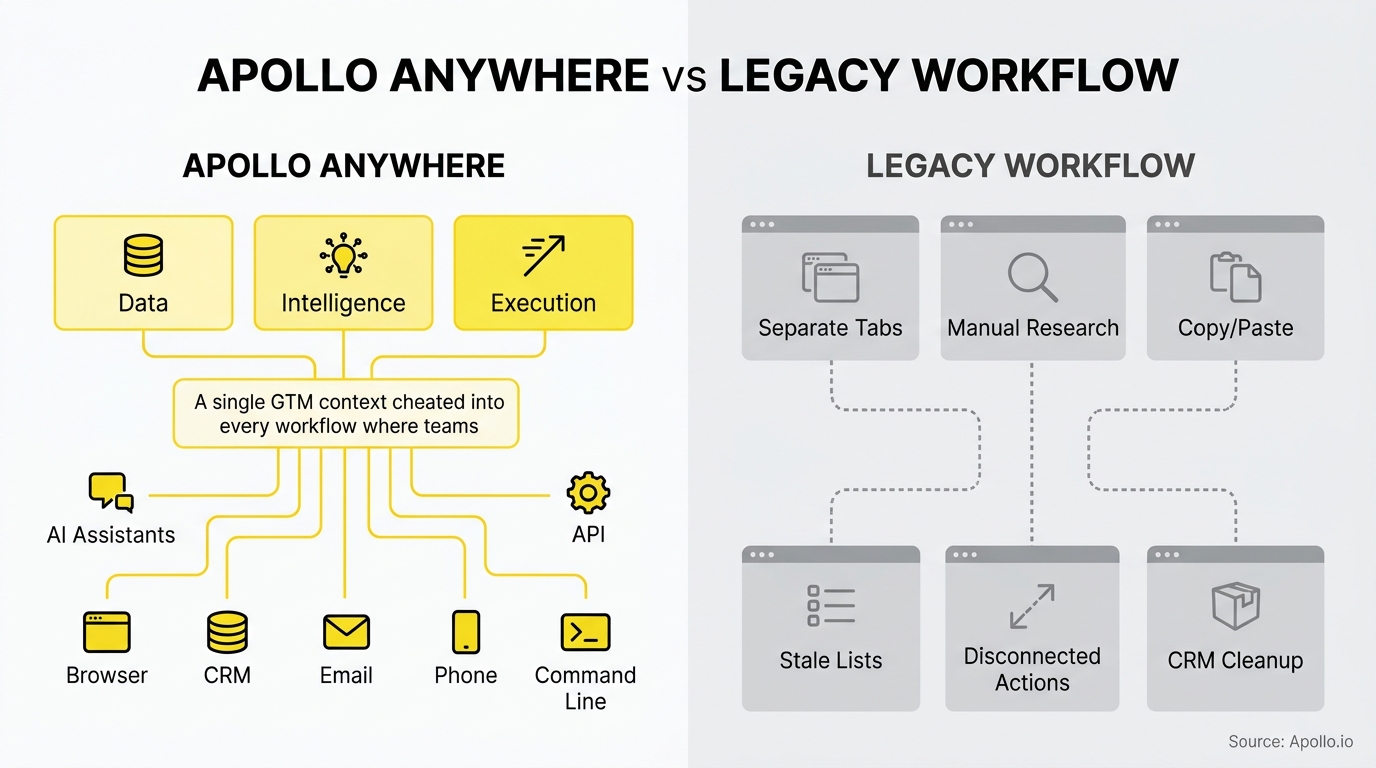
Apollo brings B2B data, sales engagement, and AI-powered execution together in one connected go-to-market system, so teams don't have to stitch together separate vendors for research, outreach, and analysis. For an intent pilot, that means a signal can be matched to the right business contacts and acted on in the same workspace.
Start with Apollo's prospecting and search tools to build the target account list and find relevant business contacts at accounts showing a signal. Then use Apollo's sales engagement to run tailored sequences for test accounts while holdout accounts follow your standard cadence. Customer selects the contacts and decides how to use the product.
Collin Stewart of Predictable Revenue described the value of having data and engagement in the same place:
"The thing that made me most excited as somebody who's been in sales development a long time was Apollo's integration between sales data and sales engagement and the magic that you can make happen when those two are together on the same platform."
Teams that work in AI assistants can also use Apollo MCP to pull Apollo data into tools like Claude, ChatGPT, and Perplexity. GTM Engineers can use it to wire account research into their own workflows.
Andrew Froning of Cyera described what a single system meant for his BDRs:
"The moment we select someone in our database, they're instantly added to a sequence and we can take action right away. We're effective and efficient with our outreach."
What Are Common Questions About Buying Intent Data?
Should a RevOps Leader Buy Intent Data Before Cleaning CRM Data?
No. Intent signals need to match to accounts and contacts, so duplicate or stale records waste the signal. Fix account matching and enrichment first, then pilot intent. Data enrichment is a practical starting point.
How Long Should an Intent Data Pilot Run?
Run it long enough to cover at least one full outreach cycle and collect meaningful meetings. If your sales cycle is long, track meetings and opportunities as leading indicators and note that revenue outcomes will arrive later.
How Should an SDR Manager Use Intent Signals Day to Day?
Treat signals as a prioritization layer. Rank the daily account queue by signal strength and fit, then personalize the first touch around the researched topic.
Avoid mentioning that you tracked the account's activity.
Is Intent Data a Replacement for Prospecting?
No. Intent data tells you which accounts may be researching a topic. You still need accurate business contacts, relevant messaging, and consistent follow-up to turn a signal into a meeting.

What Is the Bottom Line on Buying Intent Data?
Buy intent data only after you have clean account data, a clear definition of the signals you want, and a pilot design with a holdout group. Verify provenance and permitted use, score a sample feed against your own closed-won and closed-lost accounts, and compare total cost, not just list price.
Then let relevance, not volume, decide how you act on each signal.
To run that pilot in one workspace, with business contact search, sequences, and AI-powered execution connected, Start a Trial with Apollo today.
Prove Pipeline ROI Fast With Apollo
Budget review coming and no clear numbers to defend your spend? Apollo puts prospecting, engagement, and pipeline visibility in one workspace, so wins show up fast. Leadium tripled annual revenue, and Built-In lifted win rate and ACV 10%.
Start Free with Apollo →Don't miss these
Sales
Inbound vs Outbound Marketing: Which Strategy Wins?
Sales
What Is a Sales Funnel? The Non-Linear Revenue Framework for 2026
Sales
What Is a Go-to-Market Strategy? The 2026 GTM Playbook
See Apollo in action
We'd love to show how Apollo can help you sell better.
By submitting this form, you will receive information, tips, and promotions from Apollo. To learn more, see our Privacy Statement.
4.7/5 based on 9,690 reviews
