
Automated Sales Prospecting: How to Generate More Leads
Sales reps still spend only 30% of their week actually selling, according to Salesforce's State of Sales research cited by Carly. The rest disappears into research, data entry, and manual list-building. Automated sales prospecting to generate more leads fixes this by handling the repetitive work so reps can focus on conversations that close deals.
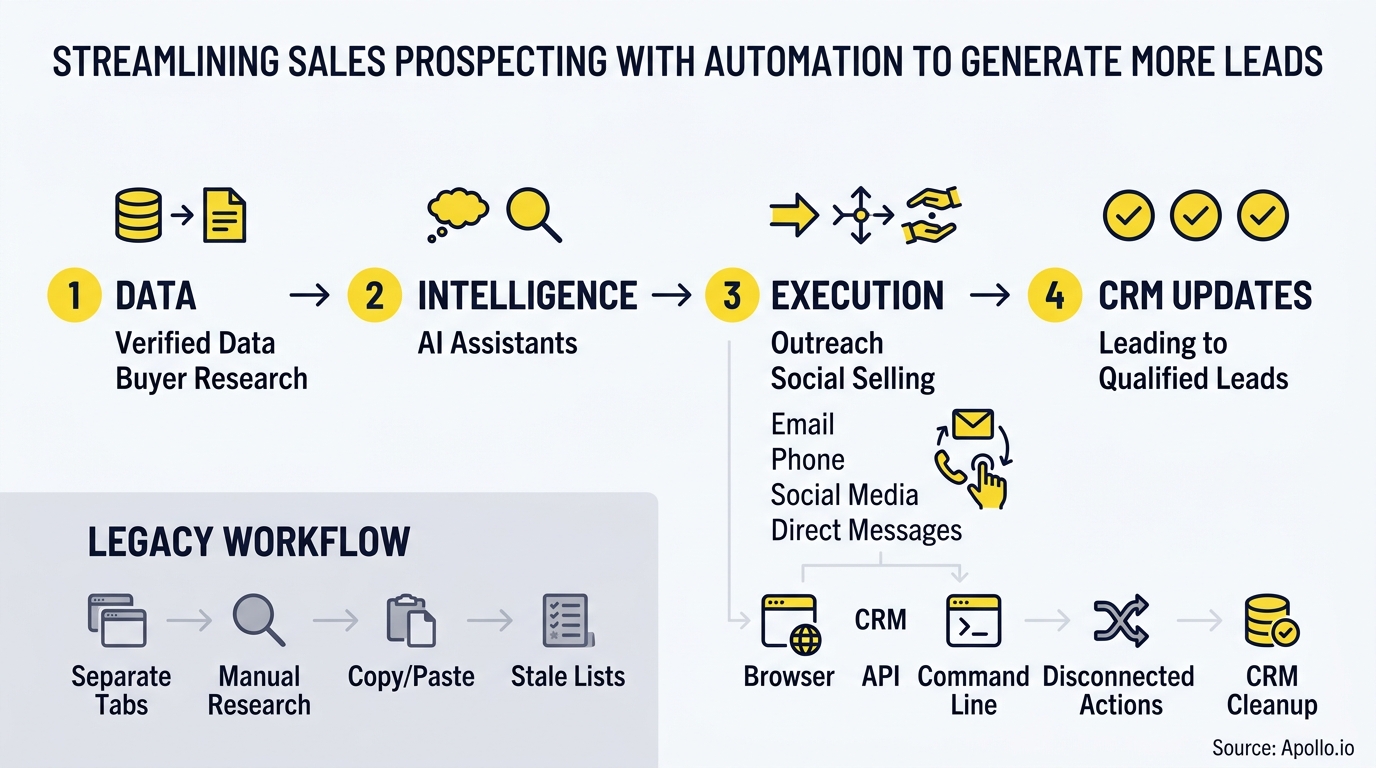
This isn't about blasting more emails. It's about building a governed system: clean data flows in, accounts get scored, buying groups get mapped, and only qualified opportunities reach a rep's calendar. Done right, automated prospecting creates more selling time and better pipeline quality, not just more noise. Start with proven prospecting strategies for finding and closing the right leads faster.

Skip The Research, Apollo Verifies Contacts Instantly
Still burning hours a day verifying emails and phone numbers by hand? Apollo hands your team verified contact data instantly, with 98% email accuracy built in. Get back to selling instead of searching.
Start Free with Apollo →Key Takeaways
- Automated prospecting works best when it targets buying groups (multiple stakeholders per account), not single contacts.
- Sellers who partner effectively with AI are more likely to hit quota than those who don't, according to Gartner research.
- Governance (data verification, suppression lists, approval workflows) prevents automation from damaging sender reputation or deal quality.
- The best automated systems create more selling time for reps, not just more outbound volume.
- Consolidating prospecting, enrichment, and engagement into one platform reduces tool sprawl and integration overhead.
What Is Automated Sales Prospecting?
Automated sales prospecting is the use of software to identify, research, score, and initiate contact with potential buyers at scale, replacing manual list-building and one-off outreach. It combines data enrichment, intent signals, and workflow triggers to surface accounts and contacts most likely to convert.
It is not the same as spray-and-pray email blasting. Historically, "prospecting automation" meant scripted email sequences sent to purchased lists.
Now it means signal-based targeting: live job changes, funding events, website visits, and buying-committee mapping feed into prioritized, multi-channel outreach.
What it is NOT: a replacement for sales judgment. Gartner's 2024 survey found that sellers who effectively partner with AI are more likely to meet quota than those who don't, according to Gartner's newsroom release. Automation handles research and prioritization; humans handle objections and relationship-building.
How Does an Automated Prospecting Workflow Work?
An automated prospecting workflow moves through seven stages: data intake, verification, account scoring, stakeholder mapping, human review, multi-channel orchestration, and CRM feedback.
- Data intake: Pull firmographic and contact data from your B2B contact database.
- Verification: Confirm emails and phone numbers are current before any outreach begins.
- Account scoring: Rank accounts by fit and intent signals (funding, hiring, tech stack changes).
- Stakeholder mapping: Identify the buying group, not just one contact.
- Human review: A rep or SDR approves the target list and messaging angle.
- Orchestration: Sequences fire across email, phone, and social.
- CRM feedback: Replies, meetings, and outcomes sync back to refine scoring.
Struggling to find qualified leads at the top of this funnel? Search Apollo's 240M+ contacts with 65+ filters to build your starting list.
Why Does Buying-Group Mapping Matter More Than Volume?
Buying-group mapping matters because most B2B deals now involve many stakeholders, and messaging one contact ignores the rest of the committee. Forrester found that a typical buying decision includes 13 internal stakeholders and nine external influencers, according to Forrester's research summary.
Gartner's 2025 research reinforces this: unhealthy conflict shows up in the majority of B2B buying teams, and content relevant to the whole group improves consensus, while content relevant to only one individual can hurt it. Automated prospecting should therefore build a buying-group map for each target account: economic buyer, technical evaluator, end user, and procurement.
Use a simple template:
| Role | Concern | Channel |
|---|---|---|
| Economic buyer | ROI, budget | Email + call |
| Technical evaluator | Integration, security | Email + demo |
| End user | Ease of use | Social + video |
| Procurement | Contract terms |
How Do SDRs Book More Meetings With Automated Prospecting?
SDRs book more meetings by letting automation handle research and list-building so they can spend more time on personalized outreach and calls. Signal-personalized outreach using two to three behavioral signals achieves higher reply rates than generic sequences, according to Overloop's prospecting research.
For SDRs and BDRs, this looks like:
- Auto-enriched lead lists replacing manual professional networks searches
- Intent signals (job changes, funding, hiring) surfacing warm accounts first
- Multi-channel sequences (email, phone, social) triggered automatically after list approval
- AI-drafted first-touch messages that reps personalize before sending
Spending hours on manual outreach instead of selling? Automate your sequences with Apollo's multi-channel platform.
For Account Executives, automation shifts further downstream: pre-meeting account research, deal-risk flags, and follow-up drafting free up time for negotiation and closing. Explore more tactics in data-driven prospecting strategies for smarter lead generation.
Spot Sales-Ready Buyers Before They Cool
Marketing leads piling up but never turning into real opportunities? Apollo scores and surfaces in-market prospects the moment they're ready, so reps chase signals instead of guessing. Built-In saw a 10% lift in win rate using Apollo's intent scoring.
Start Free with Apollo →What Compliance and Governance Controls Keep Automation Safe?
Governance controls prevent automated prospecting from damaging deliverability, brand reputation, or deal quality by enforcing data accuracy, suppression rules, and approval gates before messages go out. Gmail began escalating rejections in late 2025 for senders that fail authentication or unsubscribe requirements, and organizations crossing roughly 5,000 daily messages to personal accounts are now classified as bulk senders, according to Google's sender guidelines.
Build these controls into your workflow:
- Data verification: Confirm contact accuracy before every send.
- Suppression lists: Exclude opted-out, do-not-contact, and existing customer records.
- Approval gates: Require human sign-off on new sequences and messaging.
- Volume caps: Limit daily sends per domain to protect sender reputation.
- CRM sync: Log every touch so RevOps has a full audit trail.
RevOps leaders find that this governance layer, not additional volume, is what protects long-term reply rates and deliverability.

How Do You Measure ROI From Automated Prospecting?
You measure ROI by tracking pipeline generated, win rate, and time-to-first-meeting against your baseline before automation, not just email send volume. Organizations that automate lead management see meaningful revenue increases within six to nine months, according to Overton Collective's sales automation research.
Track these metrics in an ROI calculator:
| Metric | Why It Matters |
|---|---|
| Qualified meetings booked | Measures pipeline quality, not just activity |
| Reply rate by signal type | Shows which triggers actually work |
| Win rate on automated-sourced deals | Confirms lead quality holds through close |
| Rep hours saved on research | Quantifies capacity gained for selling |
Revenue leaders should review this dashboard monthly and adjust scoring criteria as win-rate data comes in. See how sales analytics drive revenue growth for a deeper measurement framework.
How Does Apollo Consolidate Automated Prospecting Into One Platform?
Apollo brings B2B data, sales engagement, and AI-powered execution together in one connected go-to-market system, so teams don't have to stitch together separate vendors for research, outreach, and analysis. This matters for founders and RevOps leaders trying to compete without a bloated stack.
Collin Stewart of Predictable Revenue put it simply: "We reduced the complexity of three tools into one." Teams at Census reported similar results, noting they cut their costs in half after consolidating onto Apollo.
Apollo serves B2B GTM teams, GTM Engineers, and AI Builders alongside Sales Professionals, SDRs/BDRs, AEs, RevOps, marketing, and revenue leaders. For enterprise teams, Organization-tier plans add routing, governance, and admin controls needed to run automated prospecting safely at scale. Learn more about the tools powering automated sales prospecting today.
What's Next for Automated Prospecting in 2026?
The next phase of automated prospecting shifts from task-level tools to agentic workflows that research, prioritize, and maintain outreach over weeks or months. Salesforce introduced purpose-built prospecting agents in September 2026, reflecting broader movement toward AI systems that manage full prospecting cycles rather than single tasks.
McKinsey's July 2026 research found that high-growth companies were far more likely to have significantly increased AI investment, and that redesigning prospecting workflows around AI (not just adding tools) drove measurably higher revenue per relationship manager in select implementations. The lesson: workflow redesign, not tool count, determines results.
Buyers are also changing. Forrester found that the large majority of business buyers now use AI during purchasing, meaning your outbound content and self-service resources need to be as machine-readable as they are human-readable. Review outbound prospecting fundamentals to make sure your messaging holds up in both contexts.

Conclusion
Automated sales prospecting to generate more leads works when it's built as a governed system, not a volume machine. Clean data, buying-group mapping, human approval gates, and CRM feedback loops turn automation into a pipeline engine instead of a spam risk.
The teams winning in 2026 are the ones pairing AI-driven research with rep judgment, not replacing one with the other.
Ready to consolidate your prospecting stack into one workspace? Start Prospecting with Apollo today.
Prove ROI Fast, Scale Reps Without Hiring
Can't justify tool spend without hard numbers? Apollo automates outreach so reps book more meetings without adding headcount, giving leaders clear proof of pipeline impact. Leadium 3x'd annual revenue by automating outbound with Apollo.
Start Free with Apollo →Don't miss these
Sales
Inbound vs Outbound Marketing: Which Strategy Wins?
Sales
What Is a Sales Funnel? The Non-Linear Revenue Framework for 2026
Sales
What Is a Go-to-Market Strategy? The 2026 GTM Playbook
See Apollo in action
We'd love to show how Apollo can help you sell better.
By submitting this form, you will receive information, tips, and promotions from Apollo. To learn more, see our Privacy Statement.
4.7/5 based on 9,690 reviews
