
How to Address Any Questions Ahead of an Upcoming Demo
By the time a buyer books a demo, they've usually made up their mind about 80% of the way. Omnibound found that 80% of B2B deals go to the vendor the buyer already favored before ever contacting sales. If your pre-demo process doesn't address any questions ahead of an upcoming demo, you're not educating a blank slate. You're trying to change a decision that's already half-made.
That's why a role-based pre-demo questionnaire matters more than a slicker slide deck. Sales Professionals and Account Executives who send a structured intake form before the call walk into the room already knowing what finance, security, and end users care about.

Apollo Ends Manual Lead Research For Good
Spending hours a day manually researching leads and hunting for accurate emails and phone numbers? Apollo hands your reps verified contact data instantly, with 98% email accuracy. Get back to selling, not searching.
Start Free with Apollo →Key Takeaways
- Buyers finish most of their research before requesting a meeting, so pre-demo FAQs and stakeholder-specific answers do more selling than the demo itself.
- A copyable intake form lets you map questions to the right buying-committee role before the call starts.
- Deals that stay under 50 days have dramatically higher win rates, and pre-demo prep is one of the fastest ways to shorten that window.
- An internal answer library keeps pricing, security, and integration answers consistent across every rep and every deal.
- Interactive pre-demo content converts buyers at a measurably higher rate than passive collateral.
What Does It Mean to Address Any Questions Ahead of an Upcoming Demo?
Addressing any questions ahead of an upcoming demo means proactively identifying and answering a buying committee's likely concerns, pricing, security, integrations, implementation, ROI, before the live call happens. It's not a single email.
It's a system: an intake form, a role-based question map, and a shared answer library reps pull from every time.
This differs from traditional demo prep, which usually means the rep researching the company and rehearsing a pitch. Pre-demo question handling is buyer-facing: it gives the prospect a way to self-serve answers before they ever get on a call. The Center for Sales Strategy notes that buyers now complete the majority of their evaluation before ever requesting a meeting, so if your first touch is the demo invite, you're already behind.
Why Should You Send a Pre-Demo Questionnaire Before the Call?
A pre-demo questionnaire should go out because it surfaces the buying committee's real objections before you're improvising answers live. Forrester's 2024 study found that an average of 13 people participate in a B2B buying decision, spanning at least two departments.
You cannot prep for that many stakeholders without asking first.
Copy this into your scheduling confirmation email:
"Hi [Name], looking forward to our call on [date]. To make the most of our time, could you share: 1) Who else from your team will join? 2) What's the main problem you're trying to solve? 3) Any specific pricing, security, or integration questions we should be ready to answer? 4) What does success look like in the first 90 days?"
Send this 24-48 hours before the meeting. Short forms outperform long ones. Buyers have limited patience for pre-call homework, so keep it to four questions max.

Who Are the Buying Committee Roles You Need to Map?
The buying committee typically includes six distinct roles, each with different questions that need answers before the demo starts. Skipping any one of them is how deals stall in procurement.
| Role | Primary Question | What to Prepare |
|---|---|---|
| End User | Will this fit my daily workflow? | Short product walkthrough, use-case examples |
| IT/Security | Is this safe to connect to our systems? | Security documentation, data handling summary |
| Finance | What's the total cost and ROI timeline? | Pricing tiers, ROI calculator, case study numbers |
| Legal/Procurement | What are the contract terms? | MSA template, DPA, renewal terms |
| RevOps/IT Admin | Does this integrate with our stack? | Integration list, API docs |
| Executive Sponsor | Does this move the business metric I own? | Executive summary, competitive context |
Gartner's 2025 research based on 632 buyers found that 74% of B2B buying teams show unhealthy internal conflict during the decision process. A shared answer map, not six separate conversations, keeps the committee aligned instead of arguing.
See Which Deals Are Actually Sales-Ready
Guessing which leads will convert while forecasts stay unreliable? Apollo scores and prioritizes prospects with real buying signals, so reps chase the right deals at right time. Built-In improved win rates using Apollo's scoring model.
Start Free with Apollo →How Do SDRs and AEs Build a Demo Agenda That Answers Questions Early?
SDRs and AEs build an effective demo agenda by front-loading the top two or three questions from the intake form into the first five minutes, not saving them for the end. Consensus's 2026 analysis found average demo viewing time has fallen to just over five minutes, and only 42.75% of discovery demos included any buyer questions at all.
If you wait until the end to ask, you may not get the chance.
A working agenda template:
- Minutes 0-3: Confirm the business problem from the intake form
- Minutes 3-10: Answer the top pre-submitted question live, with proof
- Minutes 10-20: Guided walkthrough tied to their stated use case
- Minutes 20-25: Open floor for committee-specific follow-ups
- Minutes 25-30: Next steps and who owns them
For Account Executives managing multiple stakeholders on one call, this structure prevents the security lead from derailing the demo with a compliance question at minute two. A Reprise survey of 300+ sales and presales professionals attributed 73% of demo quality to storytelling, discovery, and speed, and found that 68% of top performers kept the demo itself to 15 minutes or less, leaving the rest for exactly this kind of Q&A.
Struggling to find the right stakeholders before the call even happens? Search Apollo's 240M+ contacts with 65+ filters to identify and pull in the finance, IT, or procurement contact before your demo goes sideways in the room.
What Belongs in an Internal Answer Library for Demo Prep?
An internal answer library needs pre-approved, consistent answers to the five categories that come up in nearly every deal: pricing, security, integrations, implementation timeline, and AI/data handling. Gartner found that 69% of B2B buyers report discrepancies between website information and what sales reps tell them.
That inconsistency kills trust faster than any single wrong answer.
Structure the library by question type, not by rep:
- Pricing: Tier breakdowns, discount policy boundaries, contract length options
- Security: Data storage location, access controls, compliance certifications on file
- Integrations: Supported systems, API limitations, typical setup time
- Implementation: Onboarding timeline, who owns setup, first-value milestone
- AI/Data Handling: How AI features are configured and what inputs they use
Assign an owner (usually RevOps or a sales enablement lead) to review and update this library quarterly. Stale answers are worse than no answers.

How Does Pre-Demo Prep Shorten the Sales Cycle?
Pre-demo prep shortens the sales cycle by resolving objections before they surface mid-deal, which keeps momentum instead of triggering another internal review cycle. Outreach found that opportunities closing within 50 days had a 47% win rate, compared to 20% or lower for deals that dragged past that window. Every unanswered question that surfaces after the demo adds days, sometimes weeks, to that clock.
Interactive pre-demo content compounds this effect. Storylane's 2026 study with Factors.ai found prospects who engaged with interactive demos along their journey converted at 10.1%, more than three times the rate of those who didn't. Buyer activity itself starts far earlier than most reps assume, reinforcing why FAQs and role-based answers need to exist well before the meeting request lands in your calendar.
Sales and Revenue Leaders tracking cycle length should treat unanswered pre-demo questions as a pipeline risk metric, not just a rep-coaching issue.
How Can RevOps Operationalize This Across the Whole Team?
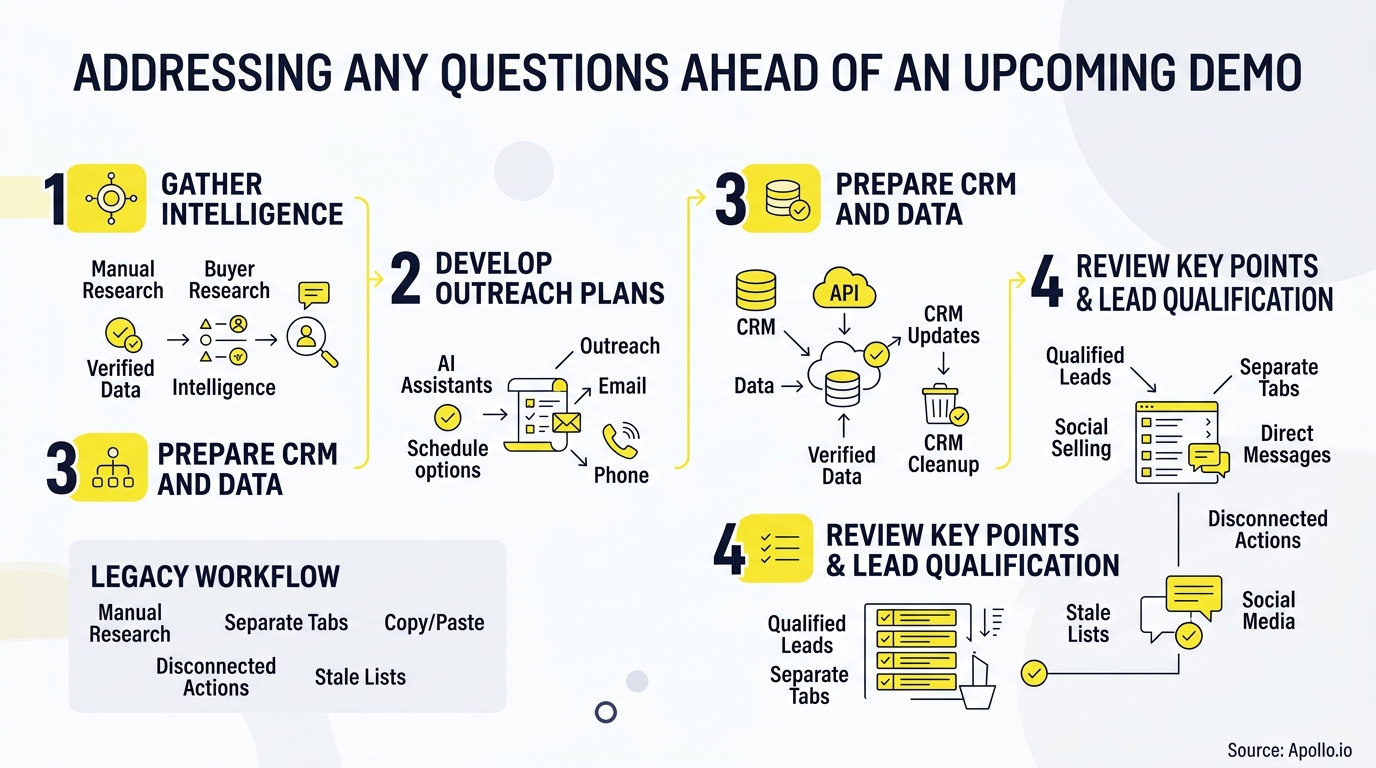
RevOps operationalizes pre-demo question handling by centralizing the intake form, answer library, and stakeholder data in one connected workflow instead of scattered docs and Slack threads. Fragmented tools are usually the root cause: one platform for contact data, another for scheduling, another for call notes.
Collin Stewart of Predictable Revenue put it simply: "We reduced the complexity of three tools into one." That's the same principle behind consolidating pre-demo research, enrichment, and outreach into a single workspace instead of stitching together a CRM, a data vendor, and a separate meeting tool.
Tired of chasing scattered contact and account data before every call? Start free with Apollo's 240M+ verified business contacts to build your buying-committee map and pre-demo answer library from the same platform where your reps already work.
Start Addressing Demo Questions Before They're Asked
The teams winning more deals in 2026 aren't the ones with the flashiest demo. They're the ones who've already answered the finance question, the security question, and the integration question before the call even starts.
Build the intake form, map the committee, stock the answer library, and let the live demo do what it does best: build trust, not deliver information the buyer already found on their own.
Apollo brings B2B data, sales engagement, and AI-powered execution together in one connected go-to-market system, so RevOps and sales teams don't have to stitch together separate vendors for research, outreach, and analysis before every demo. Explore the Apollo.io demo or book time through the Apollo demo page to see how a unified workspace makes pre-demo prep faster for every role on the buying committee.
Start Free with Apollo: Sign up free and start building your pre-demo answer library today.
Prove Pipeline ROI Before Budget Runs Out
Can't justify the spend when pipeline impact stays a guessing game? Apollo consolidates prospecting, outreach, and reporting so reps produce more without added headcount. Customer. io grew revenue 50% year-over-year after switching to Apollo.
Schedule a Demo →Don't miss these
Sales
Inbound vs Outbound Marketing: Which Strategy Wins?
Sales
What Is a Sales Funnel? The Non-Linear Revenue Framework for 2026
Sales
What Is a Go-to-Market Strategy? The 2026 GTM Playbook
See Apollo in action
We'd love to show how Apollo can help you sell better.
By submitting this form, you will receive information, tips, and promotions from Apollo. To learn more, see our Privacy Statement.
4.7/5 based on 9,690 reviews
