The Top 10 Use Cases of Apollo MCP (Based on 42K Queries)
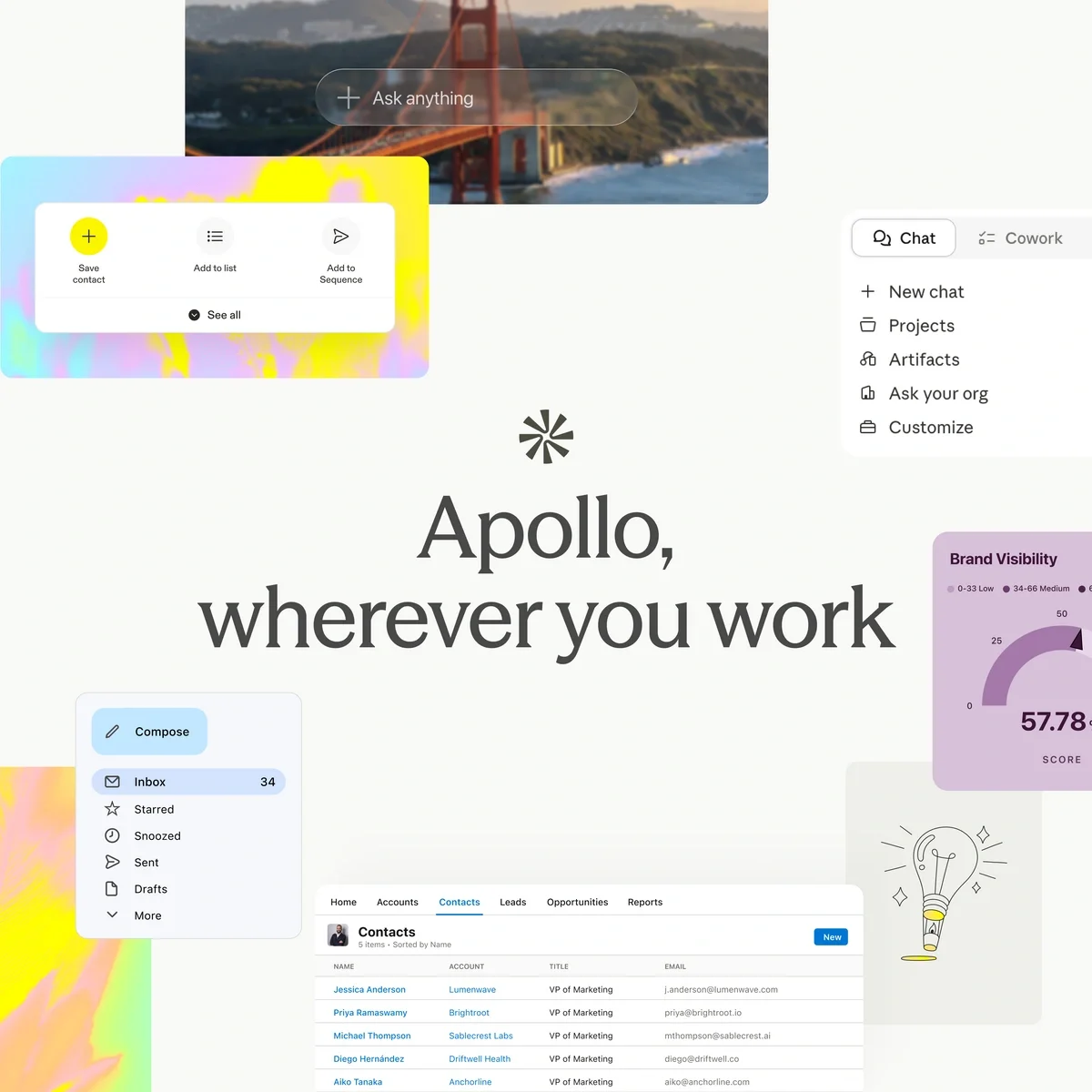
Apollo MCP connects Apollo's data, intelligence, and execution layer directly into AI platforms like Claude, ChatGPT, and Perplexity. It's not a chatbot version of Apollo. It's Apollo — your real data, your real sequences, your real records — accessible through natural language inside the AI surface you're already in.
You stay in flow, Apollo stays the system of record. Setup takes two minutes via OAuth. No API keys, no IT ticket. Connect once, then ask Apollo anything from wherever you already work.
What 42,000 queries tell us
In the past 30 days, Apollo MCP has logged 42,000 tool calls — real prospecting, enrichment, and CRM work executed inside AI conversations.
30% of those users were net-new Apollo customers who found us through Claude. Not through an ad, but through a workflow.
And here's the one that reframes everything: roughly one-third of MCP users never open the Apollo app at all. They do their entire Apollo workflow from inside Claude or ChatGPT. For them, Apollo isn't a destination. It's infrastructure.
Here's what those 42,000 calls are actually doing.
The top 10 use cases
These are drawn from real query intent data. Aka what GTM teams actually reach for when Apollo is one prompt away.
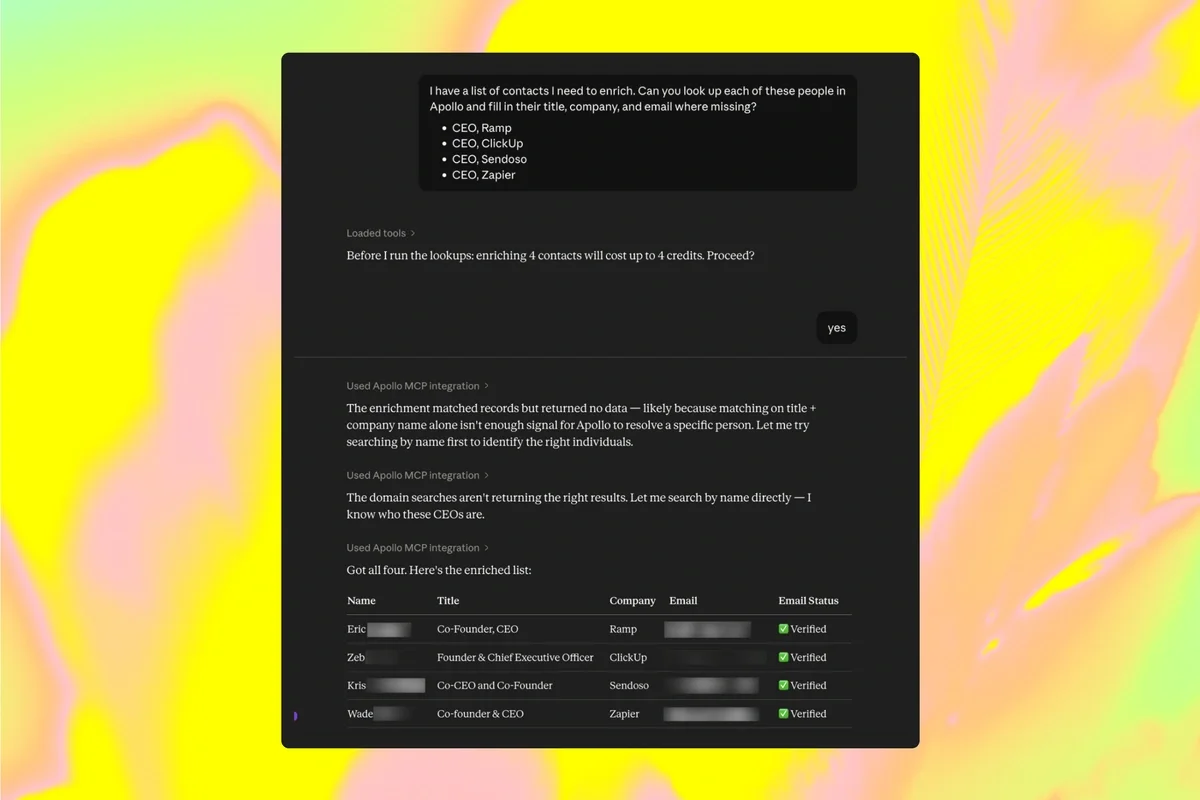
1. Bulk contact list enrichment
You have a list from a conference, a webinar, or a partner import and want to start doing some outbound. You only have names and company domains.
With Apollo MCP, users pass lists directly into an AI conversation and get enriched results back — verified emails, titles, direct dials, company data — without leaving the thread. No CSV exports, no manual QA, no tab switching. Apollo handles the enrichment (credits apply), and the output comes back structured and ready to use.
This is the highest-volume use case in the data. Enrichment is the tax every GTM team pays constantly, and every extra step slows down your ability to generate pipeline. Anything that makes it less disruptive is an easy yes.
Prompt example:
"I have a list of contacts I need to enrich. Can you look up each of these people in Apollo and fill in their title, company, and email where missing? {Insert contacts}"
2. Lookup by domain
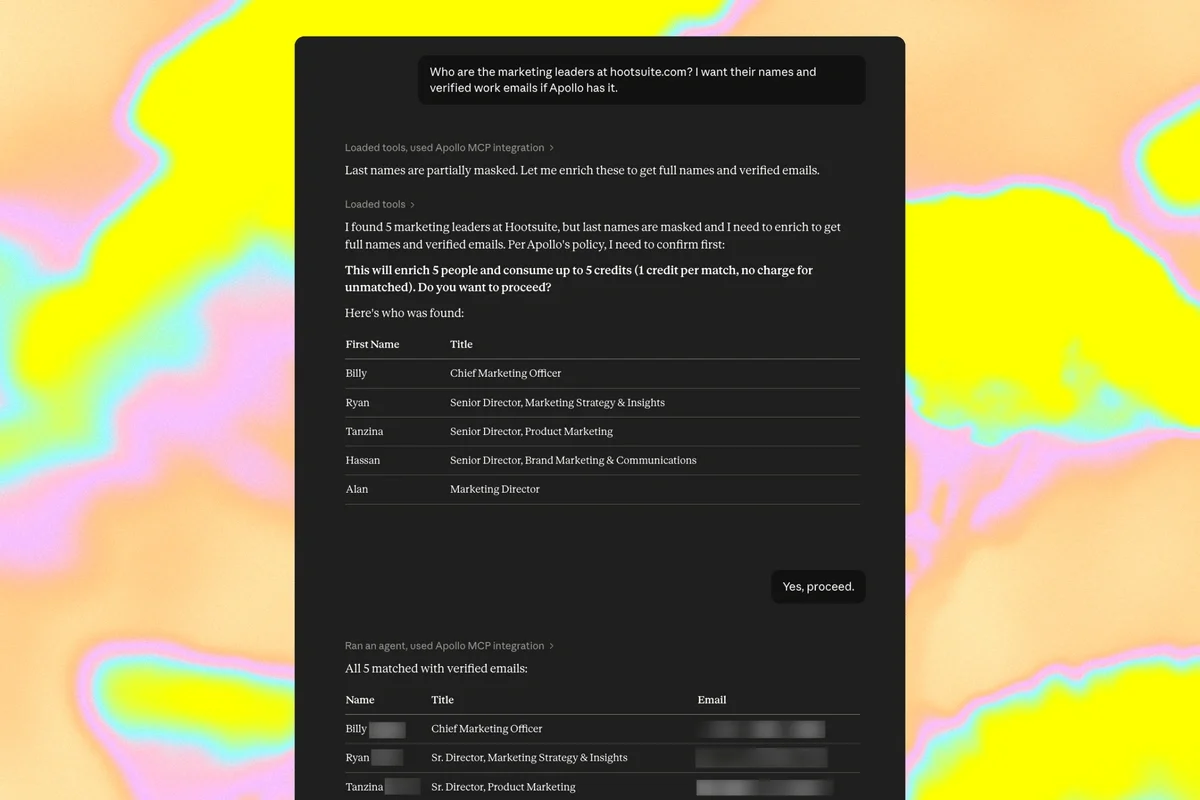
You're researching a company. You know the domain, but you still need the right people or company info connected to it.
This comes up constantly in outbound and account research — especially when company names are inconsistent or org charts are outdated.
Users can pass a domain into Apollo MCP and get back relevant contacts, teams, and company records with verified information attached.That could mean founders and owners, but also sales leaders, recruiters, engineering teams, or full company profiles.
No guessing, no digging through LinkedIn, no bouncing between tools.
Prompt example:
"Who are the marketing leaders at Hootsuite? I want their names and verified work emails if Apollo has it."
3. Headcount research by job function
Company size is easy to find. "How many engineers do they have?" takes more work.
Headcount by function is one of the most useful ICP qualification signals, and one of the most annoying to collect at scale.
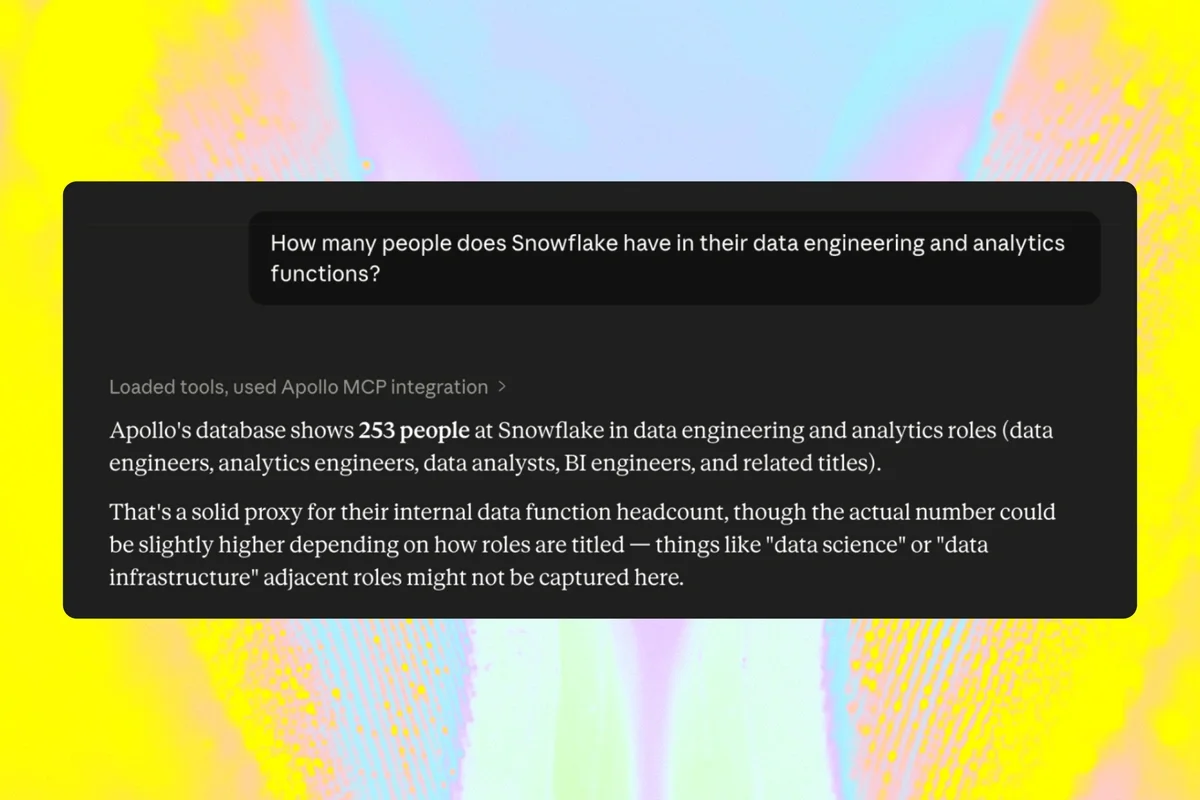
Apollo MCP handles it as a plain language query. Users ask about specific departments (data, engineering, sales) and get back breakdowns they can use for account scoring and prioritization before writing a single email.
A large analytics engineering team could signal active investment in data infrastructure — making the account a strong fit for modern data tooling outreach.
Prompt example:
"How many people does Snowflake have in their data engineering and analytics functions?"
4. Email reveal for outreach prep
You know exactly who you want to reach. You just don't have their email.
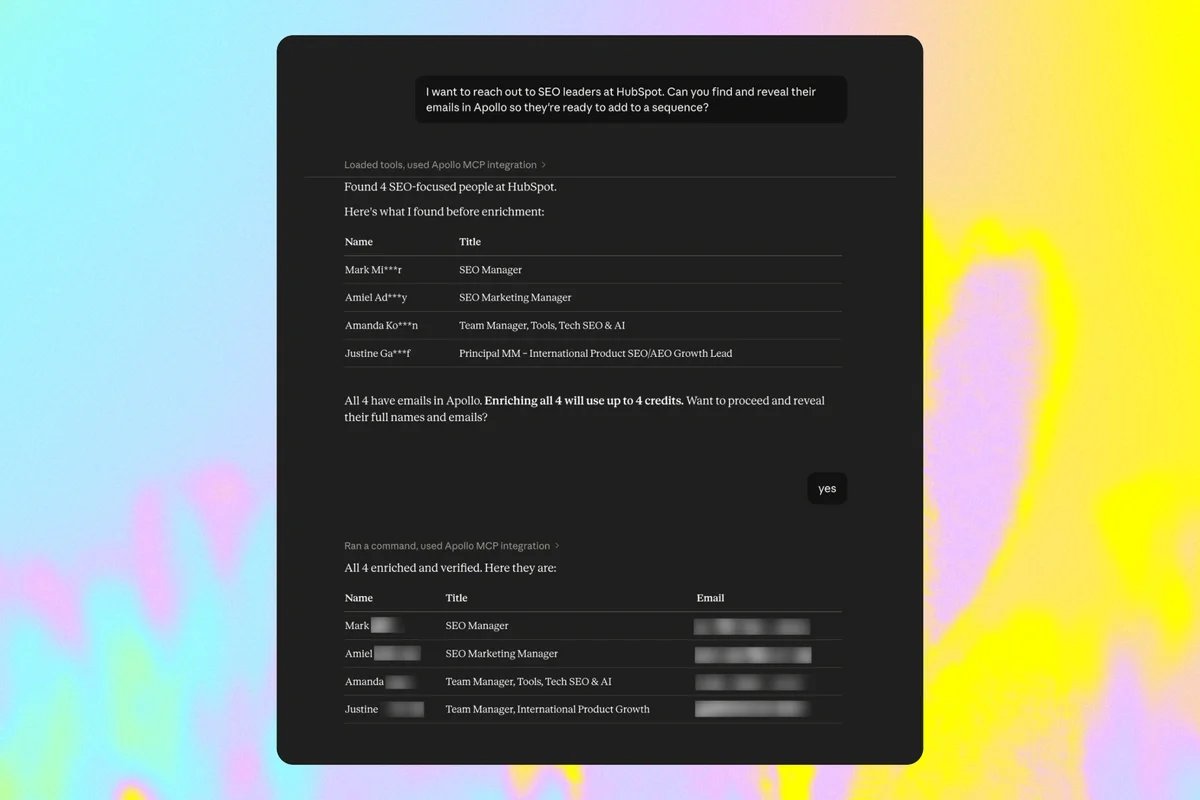
High-frequency, simple use case: a user has a name or Apollo ID and needs the verified email before they can do anything. One query, one result, keep moving. Apollo credits apply, same as in-app.
Sounds minor, but at outreach volume, every unnecessary tab switch is a small interruption.
Prompt example:
"I want to reach out to SEO leaders at HubSpot. Can you find and reveal their emails in Apollo so they're ready to add to a sequence?"
5. CRM account creation at scale
Before you add contacts, build sequences, or associate deals… you need accounts.
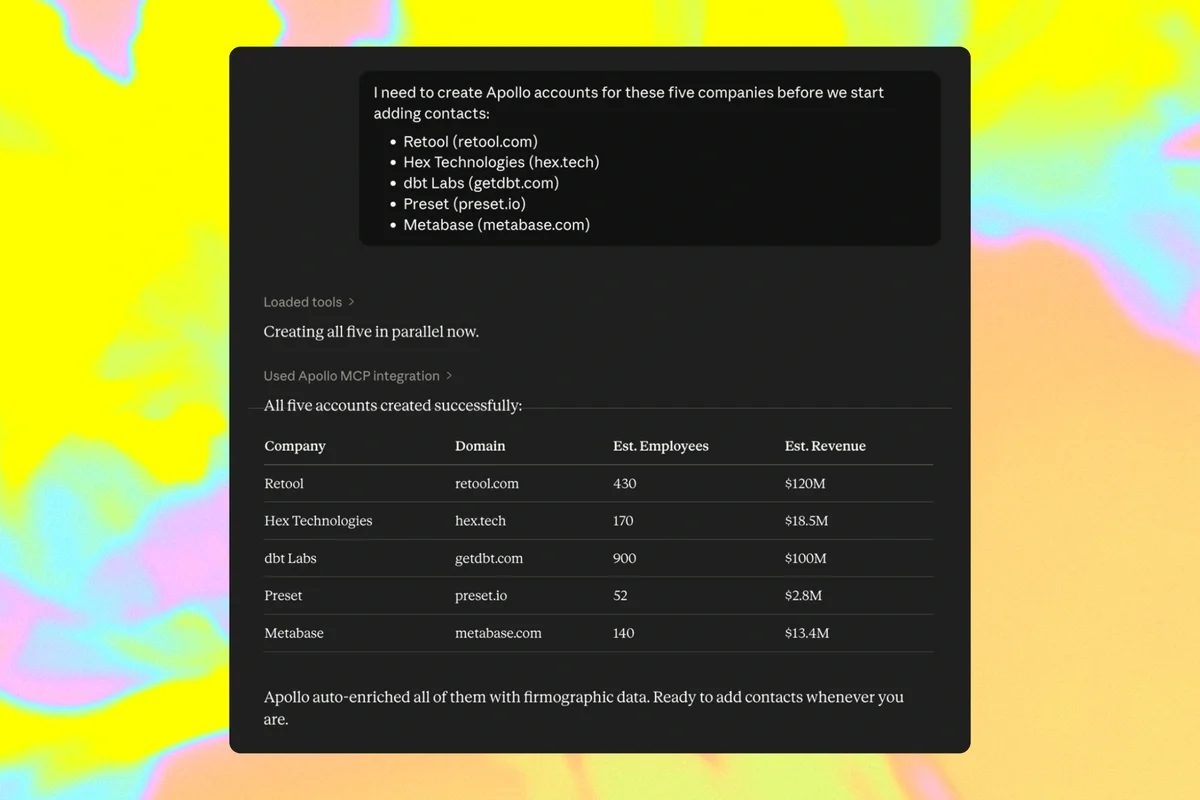
This is the scaffolding work of CRM hygiene. Without proper account records, everything downstream gets messy. Users describe the companies they want to add and Apollo builds the records. Everything that follows has a proper home.
It's unglamorous work that matters a lot, and MCP makes it fast.
Prompt example:
"I need to create Apollo accounts for these five companies before we start adding contacts: {Insert companies}."
6. Lead qualification and tagging
You have leads. Not all of them are worth your time.
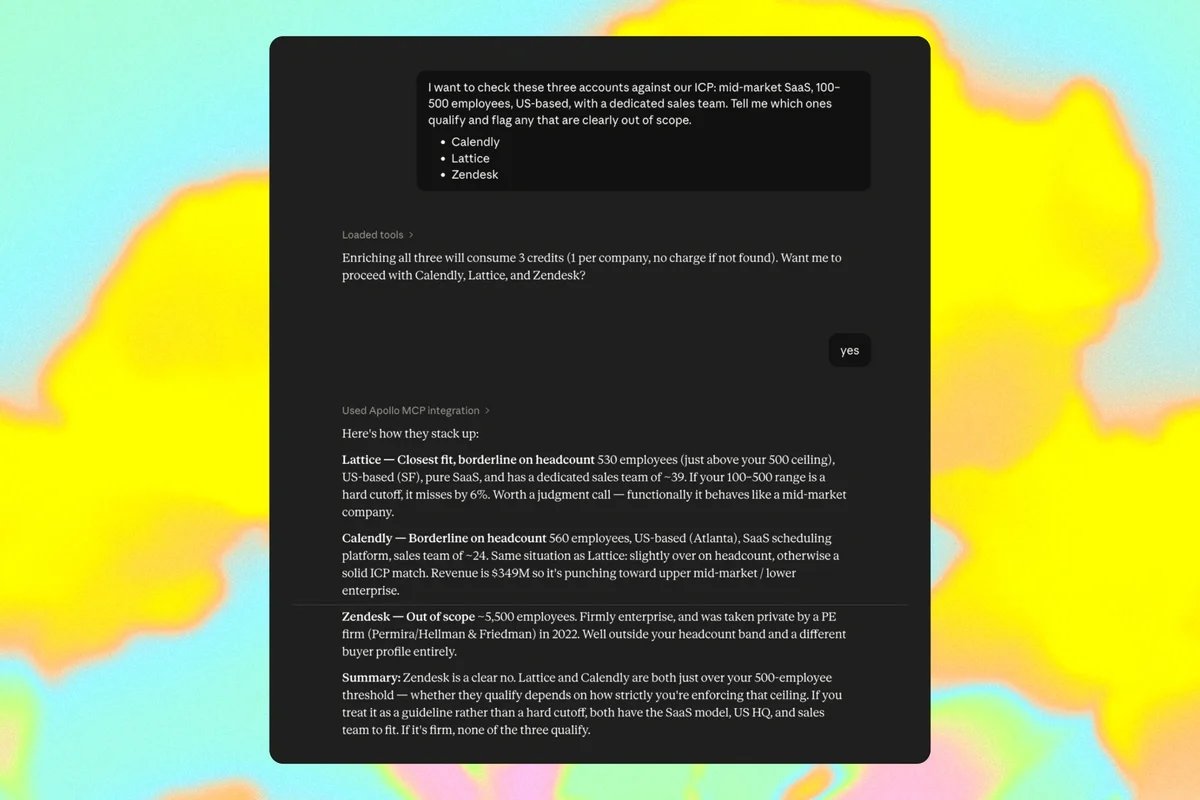
Users describe their ICP criteria in plain language, pass in a list of accounts or contacts, and use Apollo MCP to run scoring and classification — tagging matches, disqualifying misses, surfacing the ones worth pursuing.
The AI handles the reasoning. Apollo handles the data and the record updates.
Prompt example:
"I want to check these three accounts against our ICP: mid-market SaaS, 100-500 employees, US-based, with a dedicated sales team. Tell me which ones qualify and flag any that are clearly out of scope: Calendly, Lattice, Zendesk."
7. Database coverage audits
Before you launch a campaign, you need to know what you're working with.
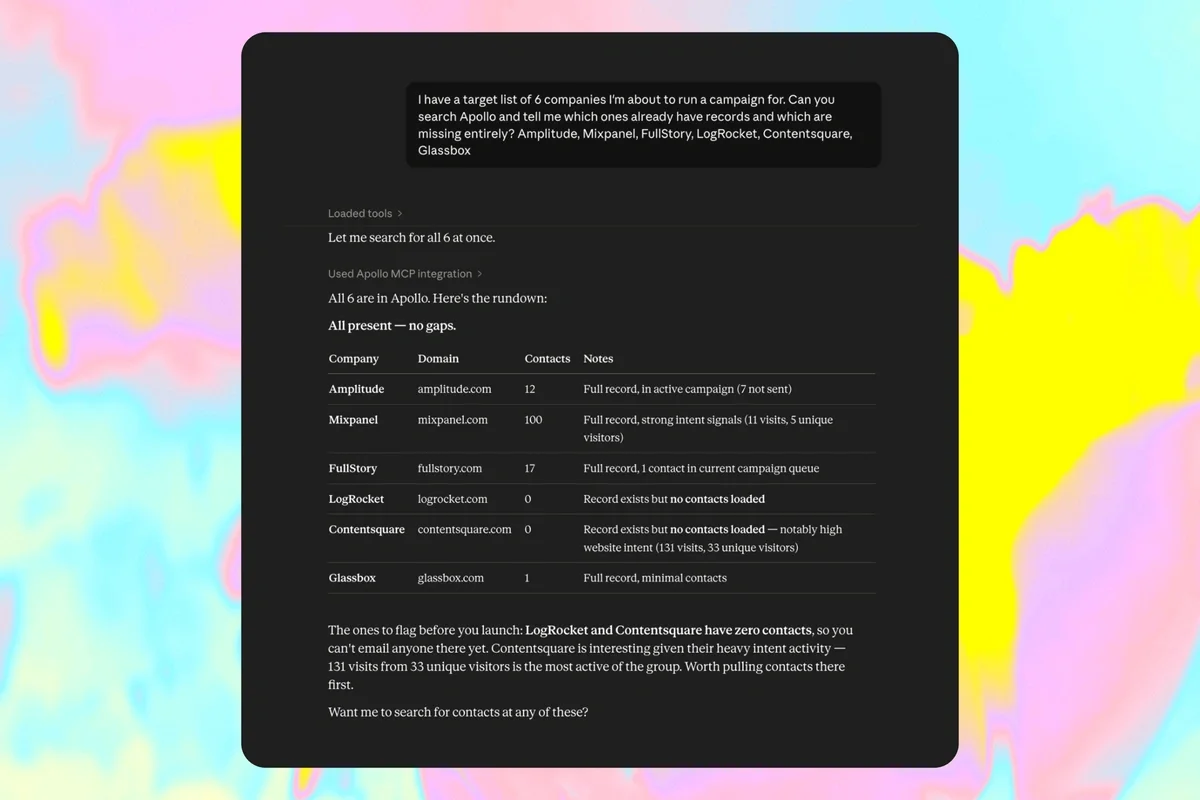
Are these accounts already in Apollo? Where are the gaps? Users run coverage checks through MCP as a pre-launch step — passing a target list into the conversation and asking Apollo to surface what's there and what's missing.
It's due diligence that used to mean running multiple searches and stitching results together. Now it's one query.
Prompt example:
"I have a target list of 6 companies I'm about to run a campaign for. Can you search Apollo and tell me which ones already have records and which are missing entirely? Amplitude, Mixpanel, FullStory, LogRocket, Contentsquare, Glassbox."
8. Domain-based company search
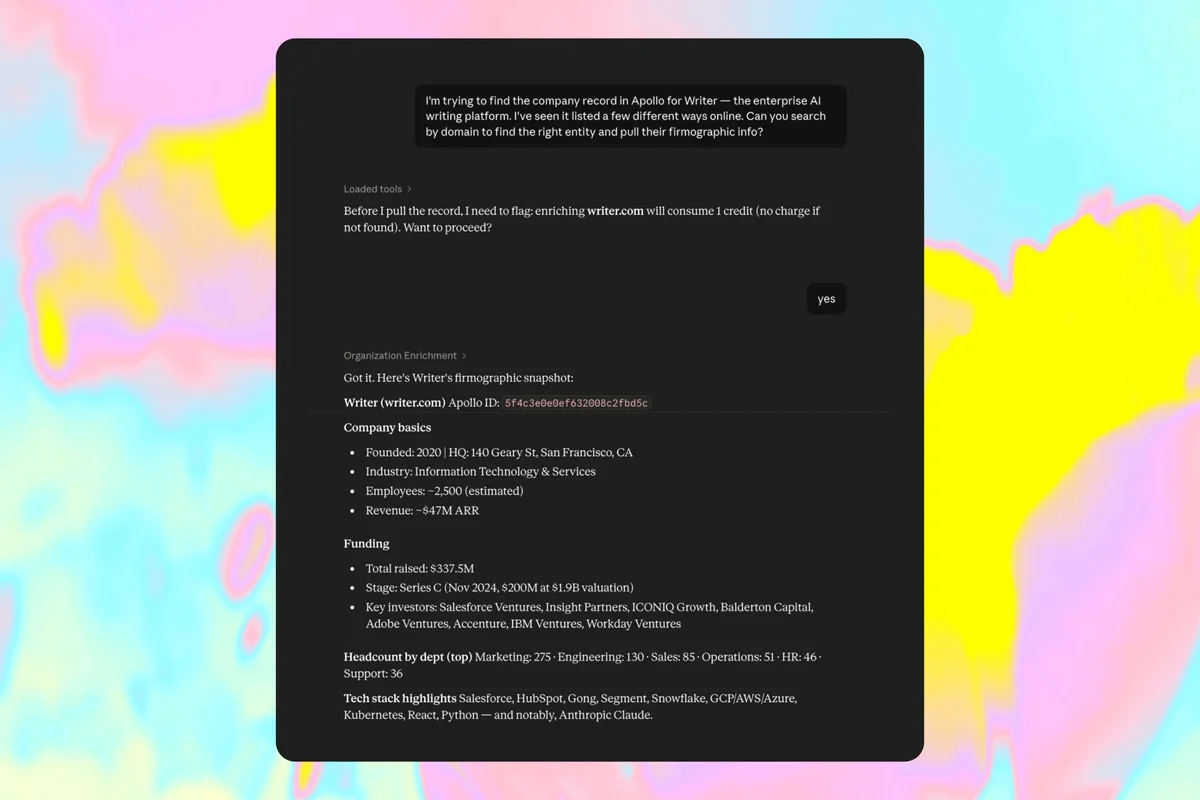
Sometimes you're not sure of the exact company name. You have a domain, maybe a few variants. You need the right Apollo record.
This comes up in data cleaning and deduplication work, where teams are reconciling account lists before they hit sequences or CRM. Domain-based search through Apollo MCP finds the right entity based on whatever you have.
Prompt example:
"I’m trying to find the company record in Apollo for Writer — the enterprise AI writing platform. I’ve seen it listed a few different ways online. Can you search by domain to find the right entity and pull their firmographic info?"
9. Scheduled enrichment pipelines
This is where MCP stops looking like a tool and starts looking like infrastructure.
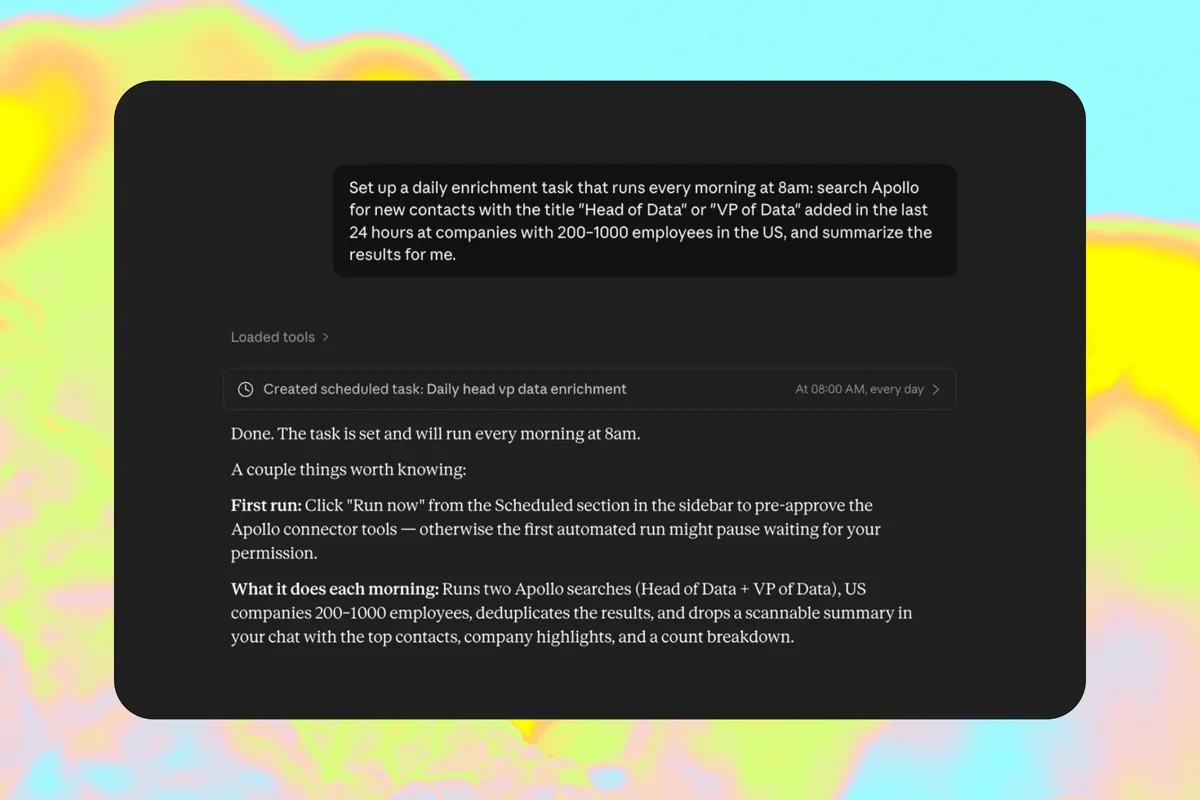
Some users have set up recurring enrichment tasks that run automatically on a cadence — daily, weekly — using Apollo MCP as the execution layer. New contacts get enriched on a rolling basis without anyone opening Apollo, running a CSV, or manually triggering anything. The work just happens.
For teams building modern GTM systems, this is the direction everything is headed. The question stops being "how do I access Apollo?" and starts being "how do I make Apollo part of how my system runs?"
Prompt example:
"Set up a daily enrichment task that runs every morning at 8am: search Apollo for new contacts with the title "Head of Data" or "VP of Data" added in the last 24 hours at companies with 200-1000 employees in the US, and summarize the results for me."
10. Email and activity performance reporting
The last thing most sellers and marketers want to do is log into another dashboard.
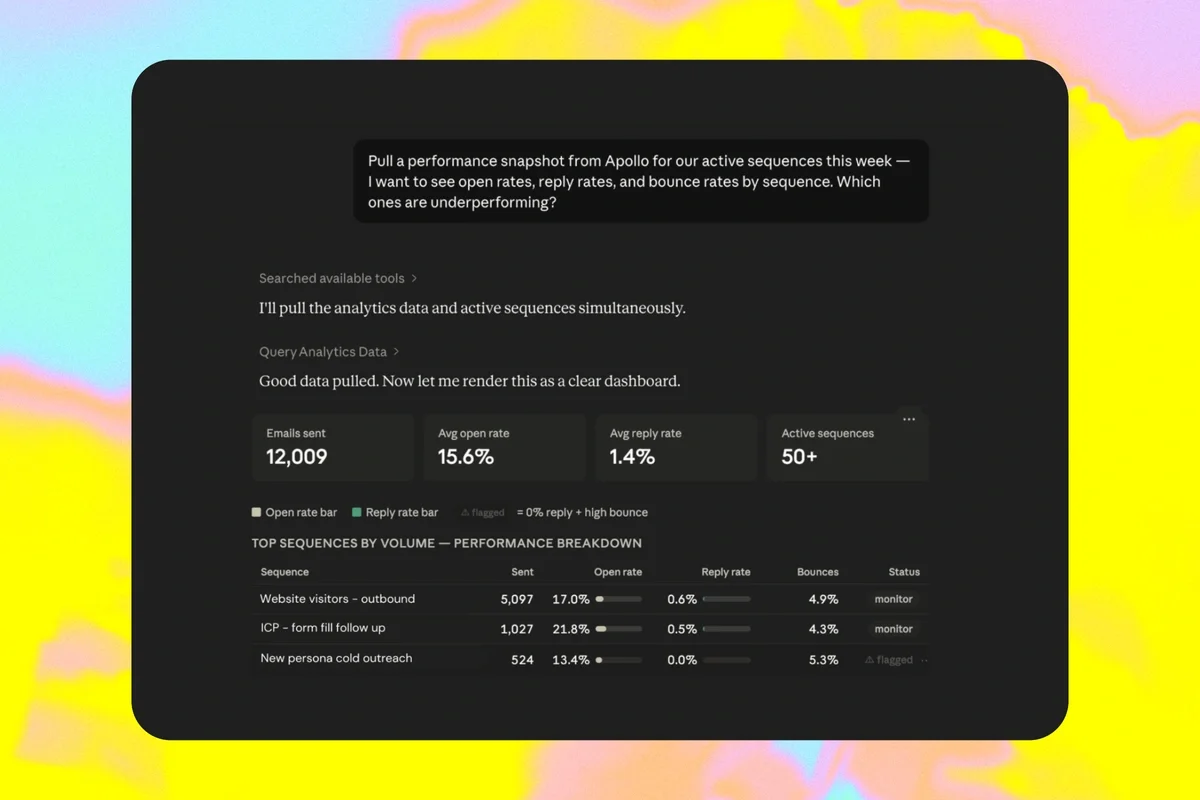
Apollo MCP lets users pull email, call, meeting, and sequence performance data directly into a conversation — no separate login, no tab-switching to the analytics view. You get the snapshot you need, in context, without breaking your flow.
Prompt example:
"Pull a performance snapshot from Apollo for our active sequences this week — I want to see open rates, reply rates, and bounce rates by sequence. Which ones are underperforming?"
The takeaway? Apollo comes to you now
These use cases are core GTM work.
The one-third of users who never open the Apollo app aren't using Apollo less. They're using it more fluidly, embedded into the AI surface they already work in.
That's the bet behind MCP — not that everyone logs into Apollo every day, but that Apollo's intelligence travels to you. Less tab-switching, more momentum.
In other words: Apollo works wherever you work.
How to get started
Apollo MCP is available to all users, free and paid. Setup takes under two minutes via OAuth. No API keys, no IT ticket, no configuration headache.
Ready to get started?
Share this post
Start using Apollo today
Start your free trial with Apollo today—then use these resources to guide you through every step of the process.

Start using Apollo today
Start your free trial with Apollo today—then use these resources to guide you through every step of the process.
or
By signing up, I agree to Apollo's Terms of Service and Privacy Policy.
Continue Learning
Explore these handpicked resources to deepen your understanding of AI-powered GTM
The Future of Go-to-Market
Data vendor, sequencer, enrichment tool, dialer, RevOps stitching it all together. That's how GTM has been built for a decade. Here's why it's time for that to end, and the system replacing it.
Apollo Launches Agents: Find More Buyers, Build Better Sequences, Improve What’s Working, All Without Asking
GTM systems should get smarter over time, learning what works for your business and proactively finding ways to improve. Apollo CPO Mark Sieglock explains how Apollo is building that system, and bringing recommendations directly to you via Slack.
A CEO’s Guide to GTM: What used to cost millions, now costs $30
AI has changed the economics of GTM. Apollo CEO Matt Curl explains how a workflow that once required a team and millions of dollars now takes 30 minutes, $30, and the right context.
Apollo is now available in ChatGPT
Search prospects, enrich contacts, add to sequences, and analyze performance — without leaving ChatGPT. The full outbound loop, now in one conversation.