Sales Analytics Is Leaving the Dashboard for the AI Assistant

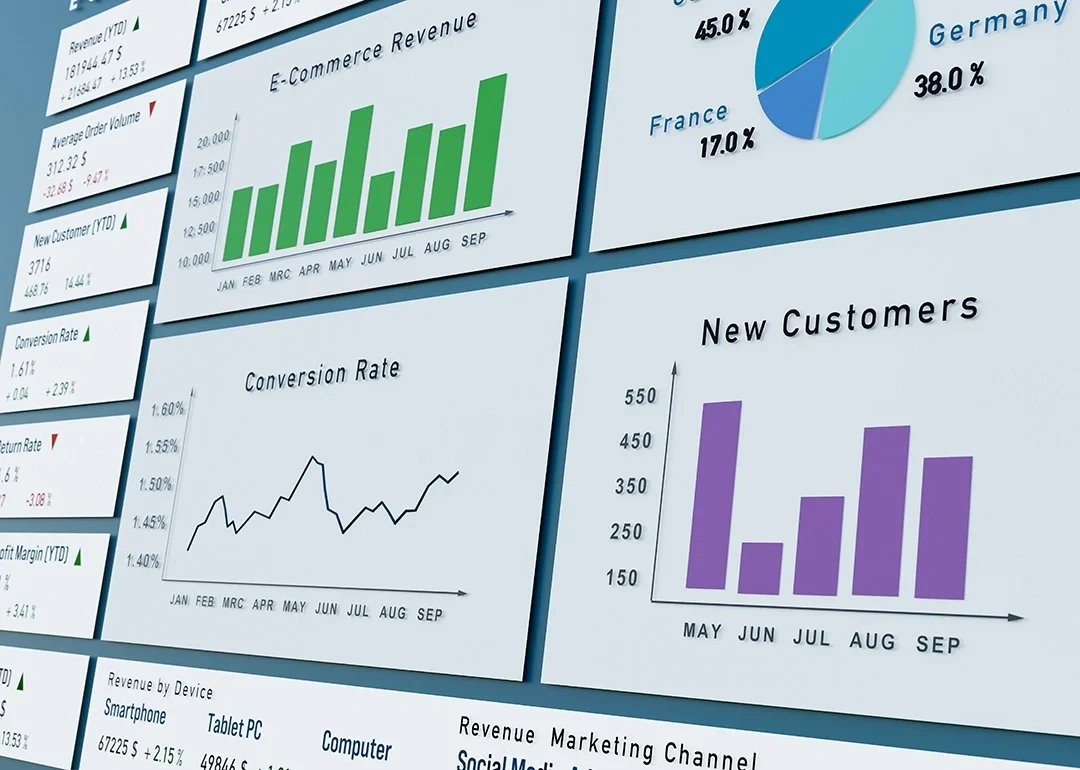
Sales analytics hasn’t delivered the competitive advantage it promised. Most sales analytics data is contained on dashboards with historical data, which show how a team performed over time. Those dashboards don’t say much about what buyers are thinking or doing.
Before AI assistants could pull live sales data, checking a dashboard often meant leaving the email inbox and customer relationship management (CRM) system for a separate analytics tool. Some reps skipped that step. In a Gartner survey of B2B sellers, 50% say they are overwhelmed by the amount of technology needed to do their jobs. Gartner also found that overwhelmed sales reps are 45% less likely to meet quota.
That gap is a consistent challenge for organizations using technology to make their sales teams more productive.
A recent Gallup study found that 47% of U.S. employees say their organization has integrated AI tools. A survey conducted by Apollo on AI in sales and go-to-market found that 97% of go-to-market (GTM) teams have adopted AI.
As investments in AI continue to grow, sales teams will likely move away from relying on dashboards for direction. According to Gartner, by 2027, 95% of sellers’ research workflows will start with AI, making the AI assistant the main repository for sales analytics.
Dashboards will still be useful for historical data. But for timely, actionable intelligence that helps reps respond to buyer inquiries and preferences, sales teams will increasingly look toward AI assistants. Once reps have instant access to that information, they’ll be able to respond more quickly, and in turn, close more deals.
Apollo reviewed and compiled research from Gartner, Gallup, Gong, OpenAI, and Anthropic, along with its own survey of 328 GTM professionals, to track how sales analytics is moving from the dashboard into the AI assistant.
Dashboards pulled reps away from selling
The classic way of reviewing sales analytics had reps leave their work to open a separate tool and view the data. After a call, they logged activity into the CRM and then opened the analytics dashboard to review pipeline coverage. Then, they returned to email to follow up.
Reps have been flagging the cost of this multi-step process for years. Sixty-one percent of sellers said their greatest productivity challenge came from administrative tasks. Inefficient processes ranked second at 47%. According to Apollo’s research, 74% of teams use anywhere from two to five GTM tools. The dashboard was one more tool on that list, and reps didn’t usually visit it.
From reporting to recommending
Sales analytics is often grouped into three categories: descriptive, predictive, and prescriptive. Most analytics work is still descriptive. The third type, prescriptive analytics, requires more sophisticated analysis because it provides suggestions that tell a rep what to do next. Prescriptive tools have often been separate portals, so reps had to leave their work to see the recommendations.
Access isn’t the only gap. Time saved doesn’t always equal more time selling. Gartner reported that AI saves sellers approximately 4.8 hours per week, but 72% of sales organizations report low reinvestment of those hours into high-value activities.
The question moves to the chat window
The AI assistant is where reps are going to find information. Gartner forecasts that by 2027, nearly all sellers’ research workflows will begin with AI. Reps can enter a query in plain language and get an answer back quickly, along with the related data, all in the same window.
Apollo’s research found that GTM teams most often use AI for prospecting and research (84.4%), followed by outbound personalization (65.7%), and lead enrichment (62.1%). Usage drops significantly further down the funnel. Only 32.4% of respondents said they use AI for pipeline management support, and only 25.7% use AI for deal execution. The greatest opportunities for expansion are in pipeline review and deal follow-up.
AI maturity is still inconsistent. According to Apollo’s survey, 36.3% of teams reported they had implemented AI but not optimized it, and 31.1% of teams are still exploring. Only 17.4% of teams reported their use of AI was fully operational, standardized, and measured.
AI usage is expanding, but buyers still want a human in the process. According to Gartner, 69% of B2B buyers would prefer to validate AI-generated insights through a sales rep. Buyers were also 39 percentage points more likely to report that a human sales rep understood their needs than to report the same about generative AI.
A rep might prompt:
-
Which accounts in my territory visited our pricing page this week, and who are the contacts?
-
Which of my open deals have gone quiet for longer than 10 days?
-
How did my last three sequence variations perform in terms of reply rate?
-
Draft a follow-up message for Thursday’s call that addresses the buyer’s concerns about timelines.
Each response relies on real-time data from the systems used across the sales environment.
MCP puts live GTM data behind the answer
Those answers are possible because of the Model Context Protocol (MCP). An MCP connector between an AI assistant and a business intelligence or CRM platform allows for communication between the two systems, making the insights provided by AI assistants much more valuable.
In November 2024, Anthropic released MCP as an open-source standard. AI assistant developers have been building on MCP since then. OpenAI added developer mode to ChatGPT in September 2025, providing full MCP support for read and write operations. One month later, it introduced company knowledge, which allows ChatGPT to pull context from connected work apps. The beta version of the Salesforce in Claude plugin was released in September 2026. The plugin, developed jointly by Salesforce and Anthropic, lets sellers view their accounts, opportunities, and pipeline within Claude using their existing Salesforce permissions. It also includes 37 prebuilt sales skills.
Revenue data vendors are also enabling access through MCP. In June 2026, Gong launched MCP connectivity with partners such as Anthropic, OpenAI, Salesforce, and Microsoft. This enables outside AI assistants to query and interact with Gong’s account and deal data directly.
This timing is important because Apollo’s recent survey found that 32% of teams begin their workflow in a SaaS application, such as a CRM, and use a large language model (LLM) to enhance it, while 31% of teams begin with an LLM and then send the results into their workflow.
Where deal-risk flags fit now
Traditionally, reps relied on manual reviews of their pipelines and account activity to find deal risks. But these reviews rarely happen until after a problem arises. Many organizations use deal-risk flags to address this. These give reps early warnings about potential problems, such as a champion going silent for an extended period or a deal stuck in the same stage for weeks. If reps catch these issues early enough, they can correct them before they cause long-term harm.
For years, flags were simply presented as a red icon on a rep’s dashboard. To see the icon, the rep had to proactively check the dashboard. Most of the time, this didn’t happen, and the flags went unnoticed.
That trend is changing. Some organizations now route deal-risk alerts to messaging platforms like Slack or Microsoft Teams so reps can quickly review the information. The assistant takes this concept even further by delivering that information on request. For instance, Gong’s MCP server lets assistants like Claude and ChatGPT access Gong-generated deal risks and next steps based on the user’s input. A rep can ask, “Which deals are at risk this quarter?” and receive the answers along with the rationale behind each one.
Reps still need to trust the AI’s output before acting on flags. According to Apollo’s survey, only 4.4% of teams fully trust AI-generated outputs without review.
Time to action is the metric that matters
A team’s ability to successfully integrate analytics into its decision-making process depends on its ability to provide the sales rep with timely, actionable information. Three key performance indicators (KPIs) measure a team’s success in bringing analytics into its sales team’s decision-making process:
-
Signal-to-response time: how long it takes a rep to react to a buyer signal.
-
Assistant-first workflows: the percentage of research and pipeline questions that start in an assistant.
-
Hours reinvested: time saved by AI compared with time added to customer conversations.
A team should focus most closely on signal-to-response time. Begin by tracking it in a shared spreadsheet. Once enough data builds up, patterns will show when delays occur.
The benefits of getting this right are quantifiable. According to Gartner, sales organizations that achieve moderate to large AI time savings and reinvest those hours into high-impact selling are 2.2 times more likely to exceed their customer growth goals and 3.1 times more likely to exceed their lead-to-opportunity conversion goals than organizations that reinvest less.
Analytics that arrives on time
Effective sales analytics relies on a culture where data is used for decision-making. It also requires delivering insights in the same place reps are already working. The teams that lead will use the AI assistant as their new analytics layer and measure its effectiveness by whether the right insight reached the right rep before the window closed.
Share this post
Start using Apollo today
Start your free trial with Apollo today—then use these resources to guide you through every step of the process.
Start using Apollo today
Start your free trial with Apollo today—then use these resources to guide you through every step of the process.
or
By signing up, I agree to Apollo's Terms of Service and Privacy Policy.
Continue Learning
Explore these handpicked resources to deepen your understanding of AI-powered GTM
The GTM engineer boom: Inside the fastest-growing job in B2B sales
GTM engineer postings have surged since 2023. Here’s what’s fueling the fastest-growing role in B2B sales, how it differs from RevOps, and what it pays.
9 Sales Tasks AI Agents Now Handle, and 4 Humans Still Own
AI agents are cutting prospect research time by 34% and email drafting by 36%. See the 9 sales tasks shifting to AI in 2026, and the 4 that stay human.
The Toggle Tax: What 1,200 Daily App Switches Are Quietly Costing Sales Teams
Sales reps spend only 40% of their week actually selling. See what the toggle tax costs the other 60%, and how to close the gap.
Agentic GTM, Explained: What Changes When Sales Agents Run the Workflow
83% of AI-using sales teams report revenue growth (Salesforce). See what separates autonomous sales agents from AI features, and what changes by 2028.