The Toggle Tax: What 1,200 Daily App Switches Are Quietly Costing Sales Teams


Sales reps spend only about 40% of their week actually selling. The rest of their time disappears into CRM data entry, quote-building, planning, and dozens of other tasks that don’t directly contribute to moving a deal forward.
If software was supposed to lighten the load, it has yet to do so. Instead, the average sales team has quietly built a stack that’s so fragmented the tools meant to save time have become part of the drag. Apollo analyzed data from Salesforce, Forrester, Okta, Harvard Business Review, Bain & Company, and Microsoft to come up with key solutions to this common pain point.
The selling time problem
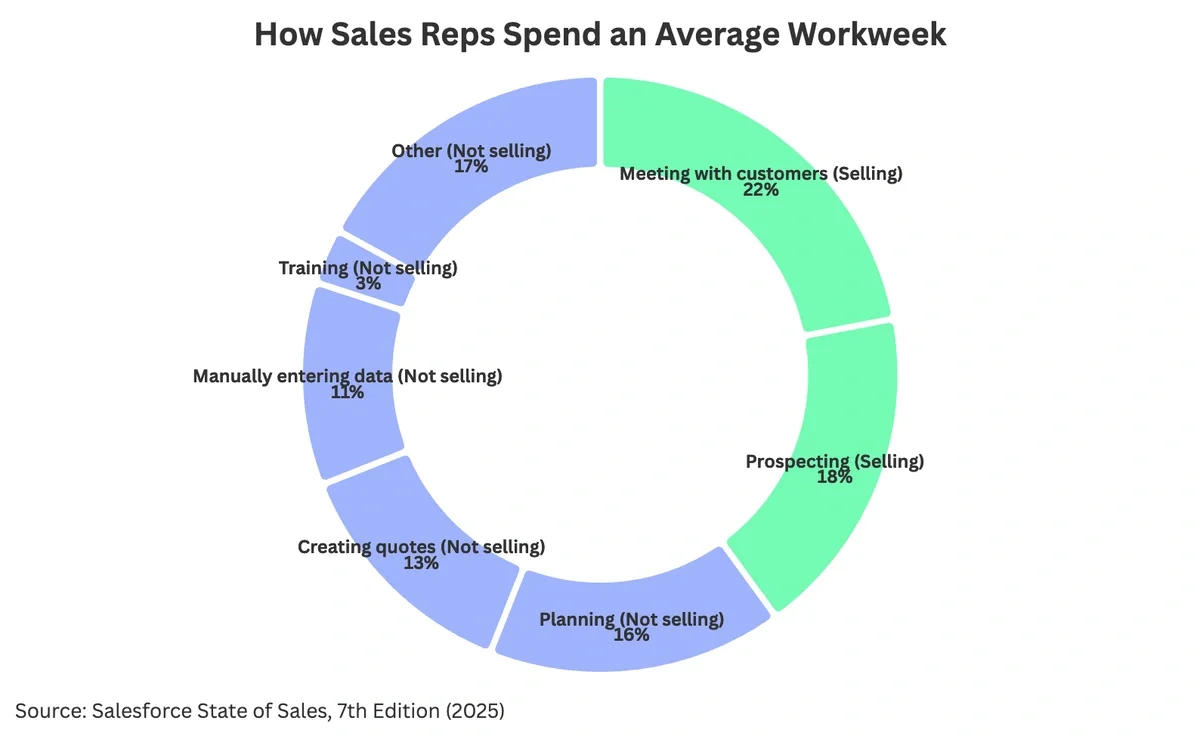
Based on Salesforce’s State of Sales report, reps now spend 60% of their time on nonselling tasks, which is down from 70% in the previous year. This is the majority of the workweek. A breakdown of an average rep’s week from the same research shows clearly where that time actually goes:
-
Meetings with customers - 22%
-
Prospecting - 18%
-
Planning - 16%
-
Creating quotes - 13%
-
Manually entering data - 11%
-
Training - 3%
-
Other nonselling work - 17%
The two primary selling tasks only make up 40% of their time.
A Forrester study of 3,031 sales reps found that the average rep burns nearly two full days a week on administrative tasks alone, which is the single biggest nonselling time sink.
When you apply this math to a whole sales team, the human capital problem is apparent. Hiring 10 reps effectively buys a company less than three full-time sellers.
The app-count problem
Part of the reason nonselling time has barely moved is that the tools piled on to fix the issue contributed additional friction.
The average company now runs 101 apps, a threshold that was crossed for the first time in 2025, according to Okta’s Businesses at Work 2025 report. Individual sales reps navigate 10 or more of those apps daily as a part of their standard workflow.
While each standalone tool may have been purchased to solve a specific pain point, collectively, the stack has become the bottleneck that many companies bought to remove. The promise of “best of” software has fragmented data and multiplied logins, and 84% of sales teams now say they plan to consolidate their tech stack into fewer, more unified platforms, according to the Okta report.
The toggle tax: Quantifying the drag
Research published in 2022 by Harvard Business Review on 137 workers across three Fortune 500 companies found that the average worker toggles between apps and websites around 1,200 times per day, adding up to nearly four hours a week or 9% of total work time. Broader cognitive science on multitasking and context switching puts that ceiling even higher, estimating that chronic task-switching can consume up to 40% of a worker’s productive capacity.
This pie chart, compiled using Salesforce State of Sales data, shows how unaffordable this loss of time is:
This issue translates directly into dollars lost. A Forrester study, Total Economic Impact of Island Enterprise Browser, modeled a composite 5,000-worker organization and found that productivity gains from reduced app-switching and latency were worth a three-year, risk-adjusted $5.1 million. This was a smaller part of a total of $9.7 million and a 344% return on investment.
Why adding more AI tools repeats the mistake
The obvious next pitch that companies inevitably consider to solve the time issue is adding artificial intelligence tools. However, there is little evidence that these tools will increase productivity.
Bain & Company’s Technology Report 2025 projects that AI could roughly double selling time for those who redesign their workflows around it. However, the gains will only go to firms that redesign how work gets done, rather than just slapping an AI tool on top of an already over-sprawling tech stack.
If fragmentation is the diagnosis, another standalone AI tool without a proper overhaul will only add more, not less. The real question isn’t which AI tool a rep should add to their rotation, but instead where needed information should live, so a rep can access it without changing tasks.
The sharper close: Intelligence in the rep’s existing surfaces
Companies are going to implement AI. The evidence of this shift is already clear. Reps are increasingly pulling live pipeline data, account details, and outreach drafts directly into the surfaces they already work in, querying Claude, ChatGPT, and Perplexity through Model Context Protocol or inside the browser and CRM itself.
This is where toggle-tax data is pointing. It’s not another app to learn, but intelligence that travels to the rep. The CRM becomes queryable from wherever the rep already is, and the browser becomes the working environment.
This follows directly from the data already on the table, including Harvard Business Review's toggling research, Forrester's dollar quantification, and Bain’s own workflow redesign. The fix for a fragmented stack goes beyond adding AI tools. The solution is smart use of the tools that work with reps, not against them.
Share this post
Start using Apollo today
Start your free trial with Apollo today—then use these resources to guide you through every step of the process.
Start using Apollo today
Start your free trial with Apollo today—then use these resources to guide you through every step of the process.
or
By signing up, I agree to Apollo's Terms of Service and Privacy Policy.
Continue Learning
Explore these handpicked resources to deepen your understanding of AI-powered GTM
9 Sales Tasks AI Agents Now Handle, and 4 Humans Still Own
AI agents are cutting prospect research time by 34% and email drafting by 36%. See the 9 sales tasks shifting to AI in 2026, and the 4 that stay human.
A CEO’s Guide to GTM: What used to cost millions, now costs $30
AI has changed the economics of GTM. Apollo CEO Matt Curl explains how a workflow that once required a team and millions of dollars now takes 30 minutes, $30, and the right context.
The Open GTM Stack: Why Closed Platforms Are Holding Your AI Back
Closed platforms made sense before AI. Now they're a liability. Here's why your GTM stack needs to be open by design.
Agentic GTM, Explained: What Changes When Sales Agents Run the Workflow
83% of AI-using sales teams report revenue growth (Salesforce). See what separates autonomous sales agents from AI features, and what changes by 2028.