Nevara Co-founders Join Apollo To Build the Future of AI Go-To-Market

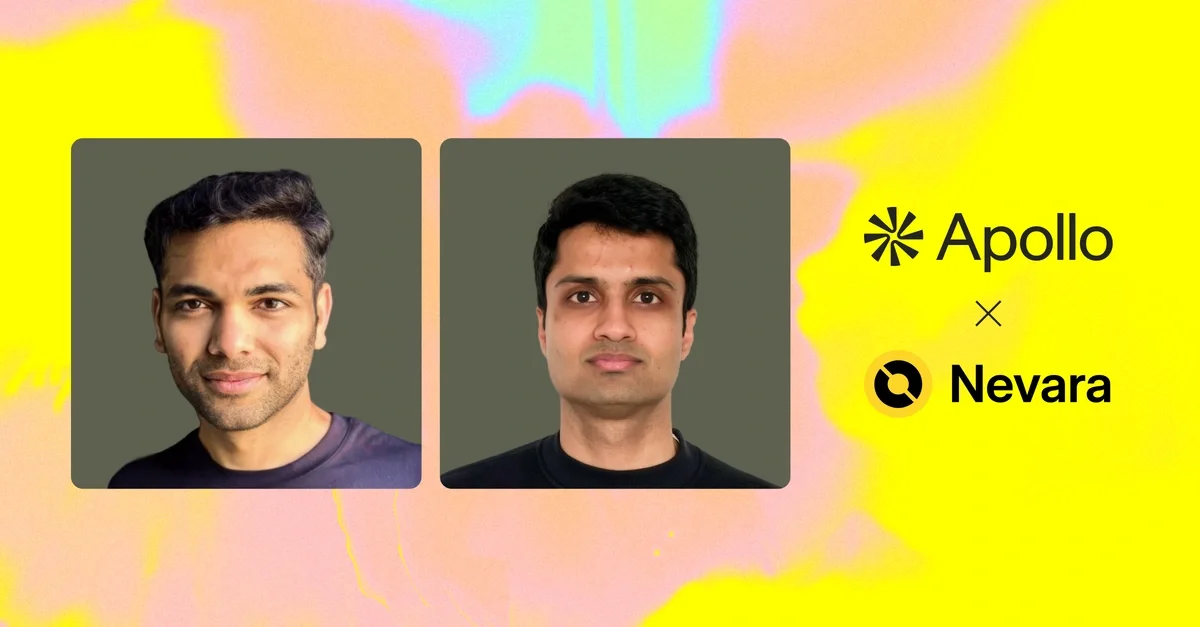
When Maruthi Medisetty and Pranav Gupta, the founders of Nevara, joined Apollo’s R&D leadership team, their mission was to build an AI-native rep experience, one where agents continuously do the groundwork so reps can spend their time with buyers.
Ask any rep where their work happens throughout a typical day, and you’ll likely hear the same thing. Prospecting is handled in one tool, account research lands in another, and call notes get populated in a third. Hours are lost to context-switching between disparate tools that don’t talk to each other, resulting in what we call “the toggle tax.”
That's the crux of the challenge Apollo is working hard to solve. And we’ve brought in new talent with fresh perspectives to help us do it.
“In the short time that Maruthi and Pranav have been at Apollo, they’ve already improved our dialer product quality and how reps interact with our product. They’re pushing boundaries on agentic go-to-market systems, pushing pace, raising the quality bar, and shipping iteratively and fast. I’m excited to get more of their innovations into customers’ hands over the coming months," said Mark Sieglock, Chief Product Officer at Apollo.
Relieving administrative burden for reps
Before starting at Apollo, Maruthi and Pranav were focused on taking on the administrative burden reps experience every day. “When we were building Nevara, there were a lot of AI tools out there that promised everything,” said Medisetty. “So we made a conscious decision to focus on just three things — briefings, live assistance, and follow-ups — the key actions that happen before, during, and after sales calls.”
The technology Maruthi and Pranav built gave the rep a brief built from historical deals before the start of a call. During the call, it offered live assistance, without being intrusive or distracting. After the call, it drafted follow-up emails and synced the CRM. And it was all made possible by agents, deployed at every deal and account level, always running in the background.
Live assist, in particular, was challenging to build and set the technology apart.
“If you’re answering a prospect’s question five seconds late, the moment is already gone,” said Pranav. “The challenge was ensuring low latency and being able to answer a prospect’s question in less than a second. It’s something dozens of other startups attempted but failed to build. But at Nevara, we figured out how to do it really well, in a way that was fast and accurate.”
What an AI-native rep experience looks like
Because AI output isn’t deterministic, building the systems around it also requires constant experimentation in a short amount of time. Maruthi and Pranav described how they worked at Nevara as a run of micro-pivots, with the team constantly adapting and responding to customer needs, “upping [themselves] every two weeks.” They’re bringing that same iterative way of working to Apollo’s R&D org.
Maruthi and Pranav will focus on delivering the GTM Harness, 24x7 background agents, and call intelligence, into Apollo’s rep-facing AI-native interface.
The goal is to free sellers from the dreaded “toggle tax.” With Apollo as their assistant, reps can focus on the last remaining human touch in sales, building connections with people.
Talking with Mark and Matt [Curl] made it clear that agents in GTM will have an insane impact on growing a business. Apollo has both a massive data foundation and the speed of a startup, and that’s a rare combination. We knew this was the shared vision and problem we wanted to work on together.
- Maruthi Medisetty and Pranav Gupta, Co-founders, Nevara
Pranav sees a future where Apollo is a coach and mentor for reps.
“Most people need a coach that challenges them and helps them grow, or a mentor who can help fill in their blind spots. I see us building that system where sellers have all those things in Apollo. When they wake up, all the work they expect an assistant to have done is already done, and they still feel like they’re the person in charge,” he said.
In an AI-native rep experience, agents continuously do the groundwork in the background and keep it prepped for the rep to action whenever they’re ready.
An SDR starts the day with calls loaded, emails queued, and guidance on what to say on each cold call. An AE starts it with the follow-up for each deal already drafted. By reducing the administrative burden, Apollo’s AI-native rep experience enables sellers to focus on what they do best: spending time with customers, earning their trust and their business.
Come build with us
Apollo is building the AI GTM system, one that continuously improves and is simple to use for sales reps and agents at companies of any size.
We’re building an AI-native rep experience where sellers always know what to work on and why. At scale, this looks like whole teams executing like their best performers, closing the gap between data signals and execution.
"Agents can finally do the groundwork reps have always had to do themselves, and that changes what a rep's day looks like. We're just getting started, and we're hiring product and engineering leaders like Maruthi and Pranav who want to help shape it," said Sieglock.
If you’re excited about the future of GTM and want to ship fast alongside top product and engineering talent, let’s talk. Check out our open Product and Engineering roles at Apollo.
Share this post
Start using Apollo today
Start your free trial with Apollo today—then use these resources to guide you through every step of the process.

Start using Apollo today
Start your free trial with Apollo today—then use these resources to guide you through every step of the process.
or
By signing up, I agree to Apollo's Terms of Service and Privacy Policy.
Continue Learning
Explore these handpicked resources to deepen your understanding of AI-powered GTM
The Future of Go-to-Market
Data vendor, sequencer, enrichment tool, dialer, RevOps stitching it all together. That's how GTM has been built for a decade. Here's why it's time for that to end, and the system replacing it.
Apollo Launches Agents: Find More Buyers, Build Better Sequences, Improve What’s Working, All Without Asking
GTM systems should get smarter over time, learning what works for your business and proactively finding ways to improve. Apollo CPO Mark Sieglock explains how Apollo is building that system, and bringing recommendations directly to you via Slack.
How Popl Turns Badge Scans Into Clean Contacts at 99% Email Coverage With Apollo
Learn how Popl, the leader in event lead capture, used the Apollo data they already knew and trusted to build an in-person go-to-market product and disrupt the lead capture space.
A CEO’s Guide to GTM: What used to cost millions, now costs $30
AI has changed the economics of GTM. Apollo CEO Matt Curl explains how a workflow that once required a team and millions of dollars now takes 30 minutes, $30, and the right context.