Inside Apollo’s GTM Methodology: 4 Elements for Outbound That Drives Pipeline


Every GTM leader is fielding some version of the same question from the board, the CEO, or their own team: what role should AI play in how we go to market?
Under pressure, most teams rushed to get ahead and layered AI (such as using “off the shelf” LLM tools) onto the processes they already had. This enabled them to turn up the volume quickly, writing emails faster, stretching "personalization" across thousands of accounts, and reaching sending capacity with a single workflow that once required a full SDR team.
The problem is everyone made the same move at the same time. Many leaders provided obligatory LLM licenses among other AI tools. But this created two problems:
-
More inboxes are now filled with similar messages because every team has access to the same tools.
-
Buyers can detect AI patterns within the first line, and the overuse of em dashes can quickly incriminate a message as AI (they’re easy to spot!). Email providers like Google and Yahoo have learned these patterns, too.
AI alone isn’t enough. You need strategy.
While the AI fervor has caused an uptick in emails sent, that increased volume doesn’t magically translate into replies without strategy behind it. Simply using AI alone isn’t enough. You need to feed it thoughtful prompts and the right context to produce high-quality, relevant outputs.
Apollo’s internal research, observing more than 475 million delivered sequence emails between February–October 2026, supports this trend. We found that AI-tagged messages had slightly lower reply rates than messages without recorded AI content. In a separate analysis of approximately 3 million delivered AI sequence emails sent between August–October 2026, messages using Apollo's Context Center V3 recorded an 11.3% higher reply rate than AI messages without Context Center.
This analysis gives GTM leaders a reason to ask an important question: what strategy, research, and judgment are we asking AI to scale?
Beyond email reply rates, revenue teams are also being asked to point to the pipeline that their GTM investments produced. We've each watched this play out from a different side of the table.
EQ, from the executive seat: I've spent years and a lot of money in GTM orgs buying software and services meant to make my teams better. The strategies that worked always started with a clear point of view on who the customer was and why they should care now. The rollouts that failed usually had plenty of tooling and little process underneath. I've sat through vendor onboardings that handed my team a login, a few templates, then left people to their own devices to figure out how it connected to our strategy. AI hasn't changed that pattern. But it has made the gap more expensive.
Tony, from the builder's seat: I run Orchestra, a GTM consultancy, so I spend most of my week inside other companies' GTM systems. The problem is rarely a shortage of tools. Each team scores accounts its own way, builds its own lists, and acts on signals disconnected from what leadership cares about. Add AI to that and you get what I call “AI spray paint": messages that are generated quickly and reach audiences en masse, but which lack the nuance and personalization that make readers actually want to take action on a cold email.
What the teams still winning do differently
The teams that keep booking meetings aren’t getting there by sending more emails than everyone else. They’ve changed how they make the three decisions that sit underneath every outbound motion: who to contact, when to reach out, and what to say.
Across hundreds of companies that we’ve worked with, the same four breakdowns kept showing up. The Apollo GTM Methodology is our answer to them, and it's the same approach our GTM engineers and certified partners use with customers today.
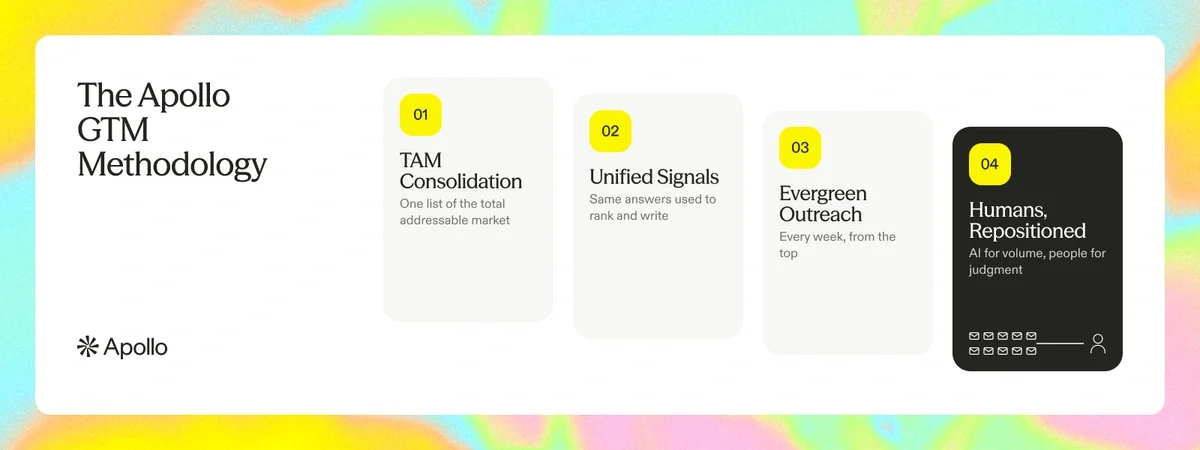
The Apollo GTM Methodology has four deliberately sequential elements:
-
TAM Consolidation: You can't prioritize a market you haven't defined
-
Unified Signals: One set of questions, using the same data and signals, decides both which accounts go first and what each message says
-
Evergreen Outreach: That ranking drives continuous outreach rather than a series of one-time campaigns
-
Humans, Repositioned: Once AI handles the volume, your people can spend their time where judgment matters
The principle running through all four is simple: AI belongs inside a sound system, not bolted onto the process you already have.
1. TAM Consolidation: One market, defined once
When businesses build new Total Addressable Market (TAM) lists every quarter, and reps and campaigns also work from their own distinct lists, pipeline reviews turn into debates about which is right. And any company of size will have to move to a territory (or at least segmented) model at some point.
TAM lists should be defined once and used everywhere. TAM Consolidation fixes the list sprawl problem at the source: one list per segment, every company evaluated against the same criteria, and every team working from it. Write the criteria the way you'd describe your best customer to a new hire. Some can be checked with a filter, like size or location. Others, like "do they actually build a software product?", need research for each account.
Tip: Keep timing out of your qualification criteria. Hiring, funding, and intent tell you when to reach out, not whether a company belongs in your market. Filter on "hiring now" and you remove a company before anyone evaluates it, even though it may be a strong customer next quarter.
TAM Consolidation pays off by giving you one trusted definition of your market that outbound, inbound, events, and paid all draw from.
2. Unified Signals: The same answers set the ranking and shape the message
In most organizations, RevOps builds the scoring model, marketing writes the templates, and the two rarely meet. This could result in an account that’s ranked first for its growth trajectory getting an email about cutting costs.
Unified Signals closes that gap. You ask the same questions about every company, and the answers do two jobs: set the ranking and shape the message. Fit tells you whether a company belongs near the top. Timing tells you whether now is the moment. If an account rises because the company just opened three new offices, the outreach talks about those three offices.
Within AI outreach, we also saw a difference. Our August–October 2026 analysis found that messages using Apollo's Context Center V3 recorded an 11.3% higher reply rate than AI messages without Context Center, pointing to a useful question for your own team: does the information guiding your outreach change what the message actually says?
This is where leadership's strategy needs to reach the inbox, ideally from intense study (or use of Apollo or third-party AI conversational intelligence) of the sales cycles where “winning” outbound meetings play out towards closed-won outcomes. Executives must decide which questions carry the most weight so when a priority shifts, ranking and messaging shift together.
Strategy is as much deciding what not to do, say, or focus on as it is what to do. The goal with deciding on signals and triggers is to map them to your actual sales cycle, as finding reliable ways to prioritize leads and message them effectively is really a hypothesis testing exercise.
3. Evergreen Outreach: Continuous, not campaign by campaign
Most outbound runs in bursts: plan a campaign, launch it, let it run out, then go quiet while the next one is planned. Every gap is pipeline that never gets built.
Evergreen Outreach replaces campaigns with continuous outreach from the top of the ranking. Contacts rest between touches, then re-enter the queue on their current score. When a priority changes, the ranking changes, and outreach follows without a relaunch.
Tip: Size your sending to your market. Start with how many people are in your market and how quickly you want to reach them. This tells you what your sending capacity will look like and gives you time to warm up any new mailboxes you may need. It also gives you a sense of refresh rate and annual cadence, or how often each person comes back around.
4. Humans, Repositioned: AI for scale, people for judgment
Most SDRs spend their day building lists and drafting emails rather than talking to buyers. That's an expensive use of the people best positioned to build relationships.
The Apollo GTM Methodology reverses it. AI handles research and first drafts. People handle replies and conversations, and review outreach to the highest-priority accounts. How much you review, every message or only the top of the ranking, is your call.
Tip: When reviewers keep making the same edit, fix it where it started. A recurring correction points to the signal, narrative, or prompt behind the email. Fix it there once. The ideal state is a feedback loop, where edits become something the system learns and implements for the future, like in Apollo’s Intelligence layer.
So what will reps do all day? Think of it like a dating app for outbound: the system surfaces the strongest options, and people decide which deserve a real conversation.
In practice: Where does your team stand?
Ask yourself these questions to get a quick read on where you stand:
-
TAM Consolidation: Does every team work from the same list of companies?
-
Unified Signals: Does your ranking and messaging come from the same signals?
-
Evergreen Outreach: Does your outreach stop when a campaign ends?
-
Humans, Repositioned: When reviewers fix the same mistake twice, does the system learn from it?
Start with the earliest "no," since each element builds on the one before. There are three ways we suggest putting this methodology into practice.
-
Build it in-house with a GTM engineer who designs and runs the system that’s aligned to your strategy
-
Work with an Apollo GTME. Apollo customers can partner with our GTM engineers, who apply this methodology every day.
-
Work with a certified Apollo partner agency trained on the methodology
“All you worry about is, how do I deliver the best message to these people…”
- Justin Wells, VP of RevOps, Power Digital
Before you buy another AI tool
Outbound comes down to three decisions: who you contact, when you reach out, and what you say. Define your market once, rank and message it from the same signals, keep outreach running, and put your people where judgment matters.
We didn't get it right on the first attempt. When we started putting this methodology together, it had seven elements. But as we ran it with customers, we kept refining based on what we saw actually moving results in the field, combining and cutting until four remained.
So before you buy another AI tool, look at the process it will run on. AI scales whatever you give it (including the broken parts), and the more you automate, the harder those parts are to fix later. Get the system right first, then let AI run it.
Want to see how the GTM Methodology applies to your market? Talk to sales.
Share this post
Start using Apollo today
Start your free trial with Apollo today—then use these resources to guide you through every step of the process.

Start using Apollo today
Start your free trial with Apollo today—then use these resources to guide you through every step of the process.
or
By signing up, I agree to Apollo's Terms of Service and Privacy Policy.
Continue Learning
Explore these handpicked resources to deepen your understanding of AI-powered GTM
What is the Best Time of Day to Call or Email Prospects?
Research says you can drastically increase your conversion rates by simply contacting your prospects at the right time of day. Learn the best times to reach out here.
Building Trust Through Data Privacy at Apollo
Apollo puts transparency and trust at the center of how we handle data. Here’s how our privacy practices, certifications, and tools help protect your information.
Apollo Wins “Best AI-Powered Sales Solution” in 2025 MarTech Breakthrough Awards
Apollo.io has been named “Best AI-Powered Sales Solution” in the 2025 MarTech Breakthrough Awards, recognized for making powerful, enterprise-grade sales tech accessible to book more meetings, boost conversions, and close deals faster with AI.
Sales Automation 101
Increasing sales activity with less resources is the key to unlocking more revenue. Learn the key ways sellers are using sales automation across prospecting, engagement, and pipeline management and the Apollo features that will help you do it.