
Best Dialer Software for Distributed SDR Teams in 2026
Distributed SDR teams face a compounding challenge: reps are spread across time zones, managers can't monitor live calls, and outbound calling is harder than ever to execute well. Choosing the right dialer software for your sales team is no longer just about dial speed. In 2026, the best dialer for a distributed SDR team balances call volume, compliance, AI-assisted coaching, and seamless CRM integration, all in one place.

Apollo Turns Research Hours Into Revenue
Tired of your reps burning the day on manual research instead of closing deals? Apollo instantly surfaces verified contacts so your team sells from minute one. Join 600K+ companies building pipeline faster.
Start Free with Apollo →Key Takeaways
- The best dialer for distributed SDR teams combines high-volume dialing with built-in compliance controls, AI call notes, and CRM auto-logging.
- Compliance is now a core selection criterion: STIR/SHAKEN attestation, DNC suppression, and audit trails separate basic VoIP from enterprise-ready dialers.
- AI features that matter most are auto-logging, call summarization, and coaching, especially when managers can't monitor reps live across time zones.
- Dialer choice is increasingly ecosystem-driven: the best fit embeds tightly into your sales engagement platform and CRM, not just your phone system.
- Apollo consolidates dialer, sequencing, and contact data into one platform, reducing the need for multiple separate tools.
What Makes a Dialer Software Right for a Distributed SDR Team?
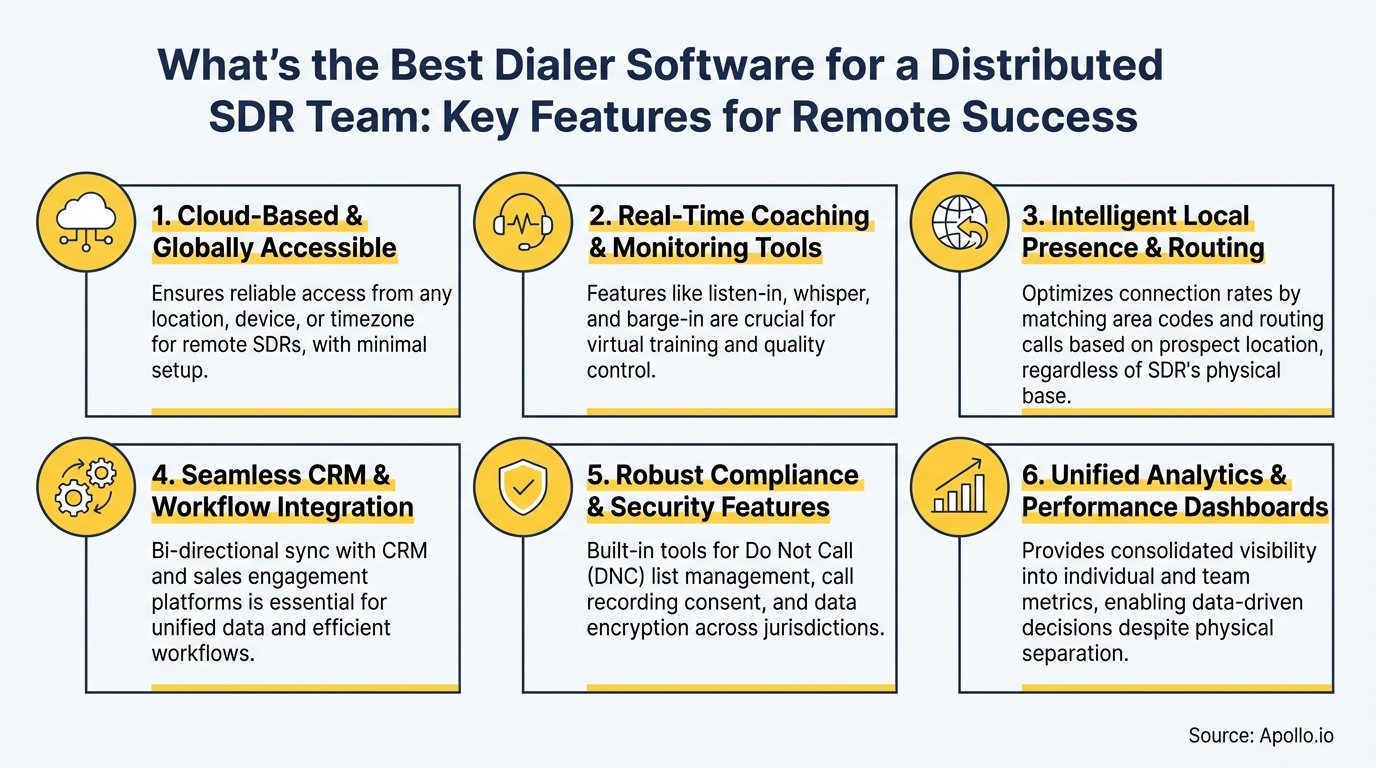
The best dialer software for a distributed SDR team is one that combines high call volume, built-in compliance, AI-powered coaching, and tight integration with your sales engagement platform. Distributed teams have unique needs that a standalone VoIP tool simply cannot meet.
Research from Persana AI shows it takes an average of 18 or more dials to connect with a prospect, with call-back rates under 1%. That reality makes volume and efficiency non-negotiable. But volume alone is not enough; how calls are managed, logged, and coached matters just as much for remote teams.
Key requirements for distributed SDR dialing:
- Power or parallel dialing to maximize live conversations per hour
- Automatic CRM logging so reps don't lose selling time to admin work
- AI call summaries and coaching for managers who can't listen live
- DNC and compliance controls built directly into the dialing workflow
- Time-zone-aware calling windows to protect against compliance exposure
- Embedded sequencing so calls fit naturally into multi-channel outreach
Why Is Compliance Now a Top Dialer Selection Criterion?
Compliance has moved from a legal checkbox to a frontline operational requirement because carrier enforcement and regulatory volume have scaled dramatically. The FTC reported approximately 258.5 million active DNC registrations as of September 30, 2025, a figure that continues to grow year over year. Dialers that automate DNC and Reassigned Numbers Database (RND) suppression protect distributed teams from inadvertent violations at scale.
STIR/SHAKEN call authentication has also become a hard requirement. The FCC expanded the definition of "Voice Service Provider" for STIR/SHAKEN compliance with enforcement beginning in late 2025, which means dialers that support strong attestation workflows give legitimate SDR calls a better chance of being answered rather than flagged as spam.
What compliance-ready dialers should include:
- Automated DNC list scrubbing before each dial session
- STIR/SHAKEN attestation support and documentation
- Time-zone calling window enforcement
- Audit-ready call logs and consent records
- Caller ID reputation monitoring
Struggling to connect calls with prospects in your sequences? Automate your multi-channel sequences with Apollo's built-in dialer and engagement platform.
How Do SDRs Get More Live Conversations with the Right Dialer?
SDRs get more live conversations by using power or parallel dialing modes that multiply dials per hour versus manual calling. According to Stakki, power dialers can make 30 to 40 dials per hour realistic, while parallel dialers can generate hundreds of dials per hour when combined with large lists or AI support.
For SDR teams running distributed outbound programs, the dialing mode needs to match the team's workflow and compliance posture. Parallel dialing maximizes raw volume but requires strong list hygiene and number reputation management. Power dialing offers a more controlled pace with better context retention per call.

| Dialer Type | Best For | Dials Per Hour | Compliance Risk |
|---|---|---|---|
| Manual / Click-to-Call | Low volume, high-touch accounts | 10–15 | Low |
| Power Dialer | Balanced volume + context | 30–40 | Moderate |
| Parallel Dialer | High-volume prospecting lists | 100+ | Higher (requires hygiene) |
| Predictive Dialer | Large teams, call center style | Variable | Highest (strict rules apply) |
Turn Funnel Gaps Into Predictable Pipeline
Tired of forecasts built on guesswork and leads that never convert? Apollo surfaces verified, in-market contacts so your pipeline reflects reality. Nearly 100K paying customers stopped flying blind — and started closing.
Schedule a Demo →What Role Does AI Play in Dialer Software for Distributed Teams?
AI in dialer software for distributed teams delivers the most value through automatic call logging, post-call summarization, and remote coaching, because managers cannot listen to live calls across time zones. Data from SalesSSO shows AI adoption in sales teams surged from 39% to 81% in just two years, with 75% of sales teams expected to use AI-powered tools. For distributed SDR programs, that shift is driven by the practical need to scale coaching without physical presence.
The AI features that produce measurable ROI for distributed SDR teams:
- Auto-logging: Eliminates manual note entry after every call, reclaiming selling time
- Call summaries: Managers review key moments asynchronously without listening to full recordings
- Objection tagging: Surfaces patterns across the team's calls for coaching and script refinement
- Call scoring: Flags low-quality calls for review without requiring manager bandwidth
- Next-step recommendations: Prompts reps to schedule follow-ups before closing the disposition
Tired of reps losing time on manual call notes? Let Apollo's AI Call Assistant handle summaries, next steps, and call coaching automatically.
What Features Should RevOps Leaders Prioritize When Evaluating Dialers?
RevOps leaders should prioritize CRM integration depth, reporting fidelity, and governance controls when evaluating dialer software for distributed SDR teams. A dialer that doesn't auto-sync dispositions, call recordings, and outcomes to your CRM creates data gaps that break forecasting and pipeline visibility.
For teams building a scalable sales tech stack, the dialer needs to fit as a native component, not a bolt-on. Ecosystem fit matters more than standalone feature counts. A dialer embedded inside your sales engagement platform eliminates the data handoff problem entirely.
RevOps evaluation checklist:
- Bi-directional CRM sync (Salesforce, HubSpot) with field-level mapping
- Call recording storage, access controls, and retention policies
- Team-level and rep-level reporting dashboards
- Number provisioning and rotation management
- Admin controls for calling hours, compliance rules, and user permissions
- Consolidation potential: does the dialer replace or require additional tools?
"Having everything in one system was a game changer" reflects what teams like Cyera found when consolidating their outbound stack. Fragmented stacks with separate dialers, sequencers, and data tools create reporting blind spots that RevOps teams can't afford.
How Does Apollo's Dialer Support Distributed SDR Teams in 2026?
Apollo's built-in dialer gives distributed SDR teams a unified platform for prospecting, sequencing, calling, and AI-assisted follow-up without adding a separate tool to the stack. Because the dialer lives inside the same workspace as Apollo's 230M+ contact database and multi-channel engagement sequences, SDRs never leave a single workspace to find a contact, build a sequence, and make a call.
Apollo's dialer includes local presence dialing, call recording, AI call summaries, and automatic CRM logging. For managers of distributed teams, the conversation intelligence layer means coaching doesn't require live call monitoring.
Teams like Predictable Revenue noted, "We reduced the complexity of three tools into one," and Census reported, "We cut our costs in half" after consolidating onto Apollo's platform.
Apollo also pairs the dialer with best-in-class cold calling guidance and call script frameworks to help distributed reps execute consistently regardless of location. For teams looking to maximize the best time to call prospects, Apollo's workflow engine can enforce time-zone-aware calling windows automatically.

Which Dialer Is Best for a Distributed SDR Team in 2026?
The best dialer for a distributed SDR team is the one that integrates natively into your sales engagement platform and CRM, enforces compliance automatically, and delivers AI coaching without requiring manager presence. Standalone dialers create tool fragmentation that distributed teams cannot absorb.
Apollo's integrated dialer stands out for distributed SDR programs because it eliminates the need for a separate dialer, sequencer, and contact database. The sales dialer market is projected to grow 15% annually through 2026 according to SuperAGI, fueled by AI and cloud adoption, and the platforms gaining ground are those that unify the full outbound workflow rather than solving one piece in isolation.
For distributed SDR teams evaluating their next dialer, the decision framework is straightforward: prioritize compliance controls, AI coaching, CRM sync depth, and ecosystem fit over raw dial speed alone. Apollo delivers all four inside a single GTM platform trusted by nearly 100,000 paying customers.
Ready to run a faster, more compliant outbound program? Get Leads Now and see how Apollo's built-in dialer, AI assistant, and 230M+ contact database work together in one platform.
Prove Pipeline ROI From Day One
ROI pressure killing your next tool renewal? Apollo delivers measurable pipeline impact fast — 46% more meetings with AI, real results your CFO can't argue with. Start free and see the value before the next budget meeting.
Start Free with Apollo →Don't miss these
Sales
Inbound vs Outbound Marketing: Which Strategy Wins?
Sales
What Is a Sales Funnel? The Non-Linear Revenue Framework for 2026
Sales
What Is a Go-to-Market Strategy? The 2026 GTM Playbook
See Apollo in action
We'd love to show how Apollo can help you sell better.
By submitting this form, you will receive information, tips, and promotions from Apollo. To learn more, see our Privacy Statement.
4.7/5 based on 9,690 reviews
