
Best B2B Lead Generation Platform for Small Teams
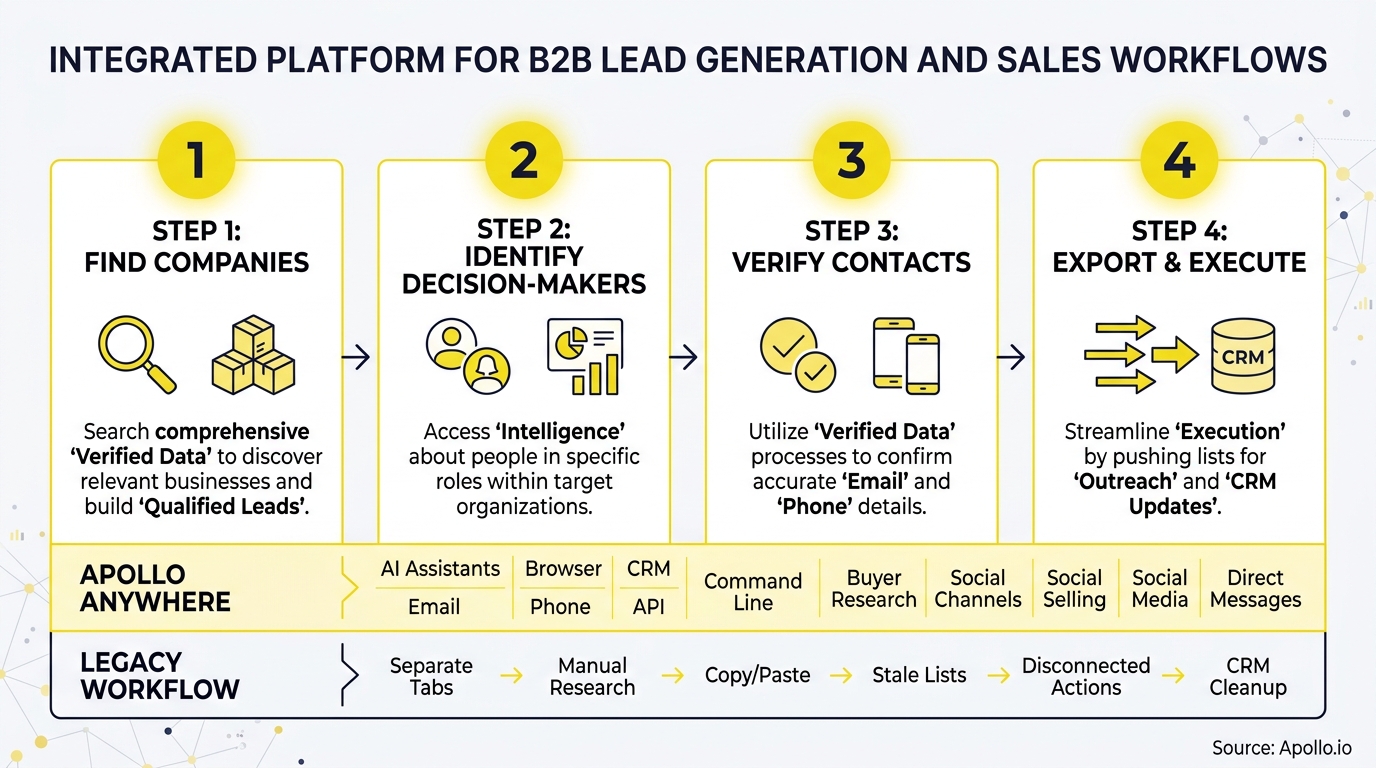
Small teams don't need five tools to build a lead list. They need one platform that finds the right companies, surfaces every decision-maker in the buying group, verifies work emails before send, and exports clean data into a CRM or sequence.
Most small teams overbuy on database size and underbuy on workflow: the fix is picking one platform that covers search, verification, and export in a single motion.

Apollo Cuts Research Time, Not Corners
Still burning hours a day hand-searching for contact info and copy-pasting into spreadsheets? Apollo surfaces verified prospects and syncs data automatically, so reps sell instead of typing. 98% email accuracy means fewer bounces, more real conversations.
Start Free with Apollo →Key Takeaways
- Apollo is the strongest default for small teams that need company search, multithreaded contact discovery, email verification, and export in one workspace.
- Use Apollo MCP when you need to search companies, enrich contacts, and push leads into a sequence without leaving ChatGPT, Claude, Perplexity, or Codex.
- A single buyer contact isn't enough: Forrester found an average of 13 people participate in a typical B2B purchase, so your platform needs to surface the full buying group, not just one title.
- Run a 30-day matched-account pilot before committing budget, tracking usable-lead cost, bounce rate, and coverage against your actual ICP, not vendor-reported averages.
- Tool consolidation reduces the manual work that eats rep time. Apollo's sales intelligence and lead database combines what separate search, verification, and export tools used to do piecemeal.
What Platform Should A Small Team Use For B2B Prospecting?
For most small teams, Apollo is the strongest single-platform choice because it combines company search, decision-maker identification, email verification, and CSV or CRM export in one workspace. Apollo's database includes 240M+ people and 30M+ companies with 65+ search filters, letting a small team build a targeted list without stitching together a separate finder, verifier, and export tool.
Other platforms solve pieces of this workflow well but require pairing with something else. The table below breaks down the best-fit scenario and the main limitation for each.
| Platform | Best Fit | Main Limitation |
|---|---|---|
| Apollo | Small teams needing search, verified emails, and export in one platform | Deepest value requires learning search filters and sequence tools |
| Sales Navigator + verifier | Teams already paying for a professional network who need a separate email-finding step | No native export or verification; requires a second tool for work emails |
| Clay | Technical teams building custom multi-provider enrichment workflows | Requires configuration across 150+ providers rather than a ready-made database |
| ZoomInfo | Companies with budget for enterprise contracts and dedicated RevOps support | Pricing requires a sales conversation; higher cost floor than self-serve tools |
| Hunter | Teams that only need domain-based email pattern search | Limited company search and no built-in multithreaded contact mapping |
Why Does Multithreading Matter More Than Finding One Decision-Maker?
Multithreading matters because most B2B deals involve a buying committee, not a single champion. According to Forrester, an average of 13 people participate in a typical B2B purchase and 91% of purchases stall at some point in the process.
A platform that only returns one executive contact per company leaves a small team blind to the rest of the committee: finance, IT, legal, or an end-user champion. For buyer leads to convert, your search tool needs to map every relevant title at an account, not just the most senior one. This is why account-level, multi-contact search matters more than a bigger overall database.
How Do SDRs Verify Work Emails Before Sending Outreach?
SDRs verify work emails by using a platform that checks deliverability status before a contact is added to a sequence, not after a bounce. Sending to unverified addresses risks spam complaints and inbox placement problems: Gmail's sender requirements flag accounts that exceed spam-rate thresholds for bulk senders.
For SDRs and BDRs running high-volume outbound, this means email verification isn't optional; it protects domain reputation. Apollo's contact records show verification status at the point of search, so reps can filter for verified emails before building a list.
Struggling to find qualified leads with clean contact data? Search Apollo's 240M+ contacts with 65+ filters.

How Do RevOps Leaders Consolidate Prospecting Tools?
RevOps leaders consolidate prospecting tools by replacing separate search, verification, and export subscriptions with one platform that handles the full workflow and syncs cleanly to the CRM. Fewer tools means fewer integrations to maintain and one source of truth for contact data.
Collin Stewart of Predictable Revenue put it simply: "We reduced the complexity of three tools into one." That kind of consolidation matters most for RevOps, who own data hygiene and integration overhead across the stack.
For teams building B2B leads by title, industry, or company, a single platform also means one set of enrichment rules and one export format, instead of reconciling data from multiple vendors before it hits the CRM.
Can You Run Prospecting Directly Inside ChatGPT Or Claude?
Yes:Apollo MCP connects Apollo's search, enrichment, and sequencing directly inside ChatGPT, Claude, Perplexity, and Codex, so a rep can ask for a target list and get verified contacts without opening a separate tab. Setup is no-code: connect Apollo through the AI tool's connectors or integrations panel via OAuth, on any Apollo plan including free.
From one conversation, you can search for companies and people matching your ICP, enrich contacts with verified emails and phone numbers, and add prospects to a sequence. For developers building custom workflows, the Apollo command-line interface offers the same access from the terminal.
Your best prospecting session shouldn't require opening a new tab.
How Do You Pilot A Platform Before Committing Budget?
Pilot a platform by testing it against a fixed list of matched target accounts for 30 days and measuring results against your actual ICP, not vendor-reported averages. Vendor accuracy claims should always be validated against your own market before you sign a contract.
A basic pilot checklist:
- Matched-account test: Pull the same 50-100 target accounts in each platform you're evaluating.
- Coverage check: Measure what percentage of accounts return at least three verified contacts across different buying-group roles.
- Bounce tracking: Send a small batch and track hard-bounce rate against verified-email claims.
- Cost per usable lead: Divide total platform cost by the number of contacts that were verified, relevant, and reachable, not raw export count.
- Export test: Confirm the CSV or CRM sync retains all fields (title, verified status, company data) without manual cleanup.
Fill Your Funnel Before Prospects Go Cold
Running out of fresh leads while response rates keep sliding? Apollo surfaces buyers who match your ICP right now, not last quarter. Built-In used Apollo's scoring to lift win rates and deal size.
Start Prospecting →This structure also matters because coverage claims based on global contact counts don't guarantee performance in your specific niche. The U.S. Small Business Administration reported 34.8M U.S. small businesses in 2024, with 81.9% having no employees, meaning a platform can have hundreds of millions of contacts and still underperform in founder-led or microbusiness segments.
What Should A Compliance Checklist Include For Small-Team Prospecting?
A compliance checklist should confirm the platform sources business contact information, supports opt-out handling, and gives your team control over who gets contacted and how. This matters more as data quality and governance concerns grow.
In Gartner's 2024 research, Gartner found that 45% of sales leaders cited privacy or regulatory concerns as a barrier to analytics success, and 44% cited poor data quality specifically. Before rolling out any platform, confirm:
- Contact data is labeled as business contact information, tied to a professional role
- Your team controls call and email cadence, rather than automated blasts
- Suppression lists and opt-outs sync back into the platform, not just the CRM
- Export permissions match your data retention policy
Building this into your evaluation up front avoids rework later when legal or RevOps flags a gap after rollout.
How Should You Calculate Cost Per Usable Lead?
Calculate cost per usable lead by dividing total platform spend for a period by the number of contacts that were verified, relevant to your ICP, and reachable, not just exported. This single number lets you compare platforms on equal footing.
Inputs for the calculator:
- Total monthly platform cost (subscription plus any credit overages)
- Total contacts exported in the period
- Verified email rate (percentage passing verification)
- ICP match rate (percentage matching your target title and industry filters)
- Bounce rate after send (subtract from usable total)
Multiply total contacts by verified rate and ICP match rate to get usable leads, then divide cost by that number. This framework exposes hidden costs that a low sticker price can mask, and it's the same math RevOps leaders use to justify platform consolidation to finance.
Which Platform Is Right For Your Small Team?
Apollo fits most small teams because it covers company search, multithreaded contact discovery, email verification, and export from a single workspace, without requiring a second tool for verification or a third for sequencing. Founders and revenue leaders under ROI pressure benefit most from consolidating spend into one platform rather than paying for search, verification, and export separately.
Tania Doub of Census shared that her team "cut our costs in half" after consolidating their stack. For teams weighing outbound prospecting strategy alongside tool selection, the platform decision and the workflow decision are really the same decision: fewer handoffs mean fewer places for a lead to go stale.
Spending hours stitching together search, verification, and export tools? Automate your sequences with Apollo's multi-channel platform and run the whole workflow from one place.
Frequently Asked Questions
What platform should a small team use to find B2B companies, identify decision-makers, verify work emails, and export lead lists?
Apollo is the strongest default for this full workflow, combining company search, multithreaded contact identification, email verification, and CSV or CRM export in one platform, with plans starting at $49/user/month on annual billing.
Is Apollo better than Sales Navigator for small teams?
Sales Navigator helps identify people at target accounts but does not verify work emails or export contact lists natively, so teams typically pair it with a separate verification tool. Apollo includes search, verification, and export in one subscription.
How much does B2B lead generation typically cost?
Cost varies by industry and channel. Zeliq reports a B2B SaaS average cost per lead of $188, which underscores the value of platforms that reduce cost per usable lead through built-in verification and export.
Do I need a separate email verification tool if I use Apollo?
No. Apollo surfaces verification status directly in contact records at the point of search, so you don't need a standalone verification subscription for standard workflows.
Ready to consolidate your prospecting stack into one platform? Schedule a Demo and see how Apollo brings company search, verified contacts, and export into a single workspace.
Scale Reps Fast Without The Data Mess
Onboarding new reps stall out while they untangle inconsistent data and mismatched processes? Apollo gives every rep the same verified and workflows from day one. Justify the spend with a platform built to prove ROI as you grow.
Start Free with Apollo →Don't miss these
Sales
Inbound vs Outbound Marketing: Which Strategy Wins?
Sales
What Is a Sales Funnel? The Non-Linear Revenue Framework for 2026
Sales
What Is a Go-to-Market Strategy? The 2026 GTM Playbook
See Apollo in action
We'd love to show how Apollo can help you sell better.
By submitting this form, you will receive information, tips, and promotions from Apollo. To learn more, see our Privacy Statement.
4.7/5 based on 9,690 reviews
