
Outbound Tooling Decisions Every VP of Sales Should Delegate to RevOps
Most VP of Sales own too many outbound tooling decisions. They choose the sequencer, approve the enrichment vendor, set deliverability rules, and greenlight AI tools — all while managing quota, coaching reps, and running forecast calls.
The result: tool sprawl, inconsistent governance, and a sales org that underperforms its potential.
The fix is clear delegation. According to Highspot, "Revenue and sales operations own your tech stack" — with other GTM leaders having input, not control. Understanding what revenue operations is and how it drives growth makes the case for this shift obvious. This article gives you a practical RACI map for outbound tooling, so you can stop making the wrong decisions and start managing to outcomes.

Build Pipeline Faster With Apollo
Tired of burning hours on manual research just to hit dead ends? Apollo surfaces verified contacts and automates outreach so your team spends time selling, not searching. Join 600K+ companies building predictable pipeline.
Start Free with Apollo →Key Takeaways
- VP of Sales should own outbound strategy, ICP definition, play selection, and rep coaching — not tool architecture or vendor contracts.
- RevOps should own the full outbound tech stack: vendor evaluation, CRM integrity, data enrichment, deliverability governance, AI policy, and attribution reporting.
- Deliverability is now a technical governance problem: Microsoft's 2025 bulk-sender enforcement means SPF/DKIM/DMARC management belongs in RevOps, not Sales.
- Companies with mature RevOps functions significantly outperform on revenue targets — the ROI case for delegation is well-documented.
- Stack consolidation is the 2026 priority: RevOps should lead vendor rationalization, while Sales defines must-have workflows.
Why Is Outbound Tooling a Governance Problem Now?
Outbound tooling has become a governance problem because the decisions involved — authentication standards, data compliance, AI permissions, integration architecture — require operational expertise that VP Sales roles are not designed to provide.
Data from SalesTechStar shows 85% of sales leaders plan to consolidate their tech stacks over the next two years to improve efficiency and reduce costs. That consolidation effort requires someone who understands integration dependencies, contract overlaps, and data model implications — all RevOps competencies.
Meanwhile, Microsoft tightened bulk-sender authentication requirements for Outlook in May 2025, enforcing SPF/DKIM/DMARC standards for high-volume senders. Choosing a sequencer without understanding those constraints is now a deliverability risk. That's an ops problem, not a sales strategy problem. For a broader view of the forces shaping execution, see what factors affect sales performance.
What Should a VP of Sales Delegate to RevOps?
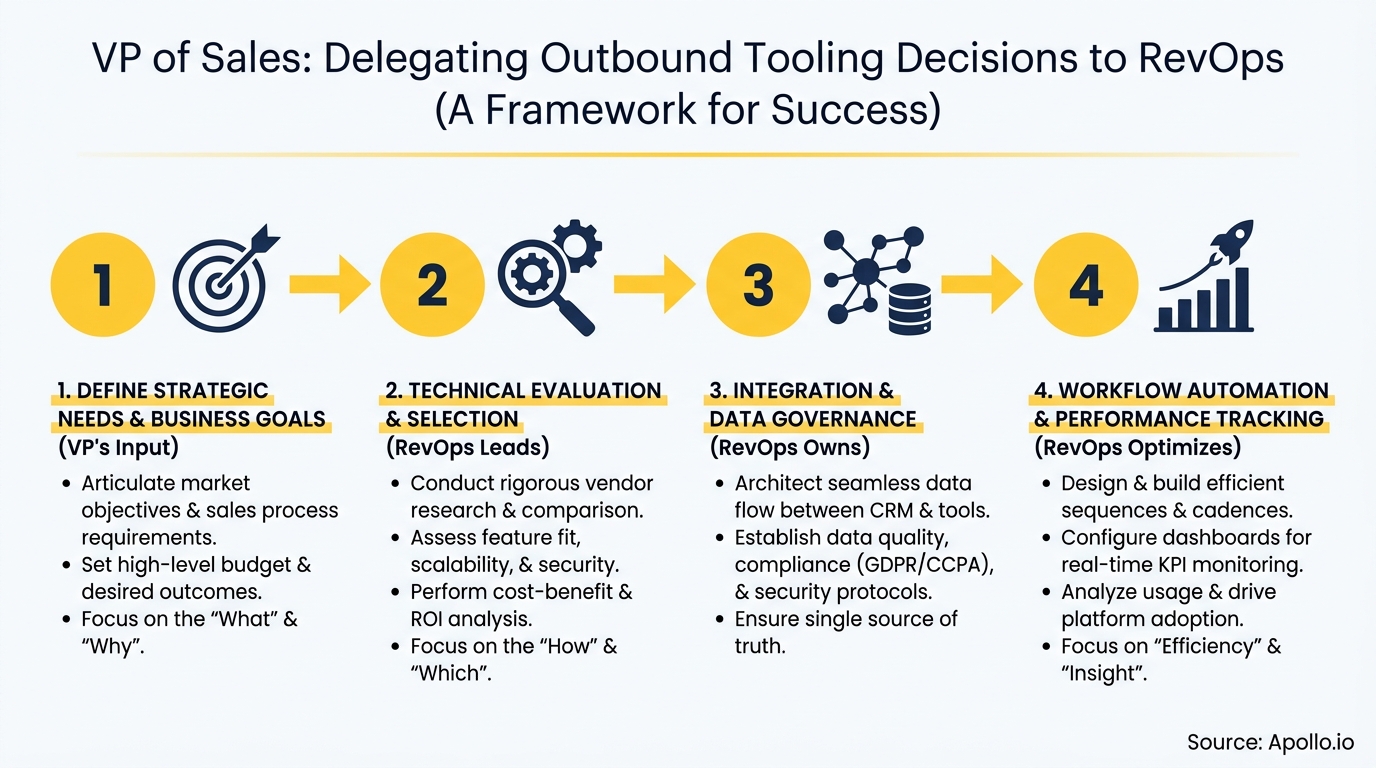
A VP of Sales should delegate all outbound tooling decisions that involve system architecture, vendor governance, data operations, and compliance — keeping strategy, play design, and rep performance firmly in Sales.
The table below maps decision rights across roles:
| Tooling Domain | VP of Sales Owns | RevOps Owns | IT / Security |
|---|---|---|---|
| Sales Engagement Platform | Workflow requirements, sequence strategy | Vendor selection, contract, integration, limits | SSO, security review |
| Data Enrichment | ICP definition, required data fields | Vendor evaluation, refresh cadence, data model | Data residency review |
| CRM | Pipeline stage definitions, rep adoption | Field architecture, hygiene rules, integrations | Access controls, backup |
| Deliverability Infrastructure | Volume targets by segment | Domain strategy, SPF/DKIM/DMARC, monitoring | DNS management |
| AI / Automation Tools | Approved use cases, outcomes to measure | Vendor approval, data access controls, audit logs | Security, data leakage policy |
| Reporting / Attribution | KPI definitions, what "good" looks like | Dashboard build, data sourcing, instrumentation | Data warehouse access |
| Compensation Tooling | Plan design, payout logic | Tool selection, CRM integration, data accuracy | Payroll system integration |
This division is supported by the revenue operations frameworkprinciple: RevOps removes operational friction so Sales can focus on selling.
How Should RevOps Handle Deliverability and AI Governance?
RevOps should treat deliverability and AI governance as distinct operational disciplines with defined KPIs, documented policies, and regular audits — not ad hoc decisions made when something breaks.
What Does a RevOps Deliverability Playbook Include?
A RevOps-owned deliverability playbook covers the full sending infrastructure, not just email copy. Core components:
- Domain strategy: Separate sending domains per segment; never use your primary domain for cold outbound at scale.
- Authentication: SPF, DKIM, and DMARC records configured and monitored — especially critical post-Microsoft's 2025 enforcement update.
- Volume controls: Per-domain daily limits, warm-up schedules, and throttling rules configured in the sequencer.
- KPIs to track: Inbox placement rate (IPR), bounce rate, spam complaint rate, unsubscribe rate — reviewed weekly.
- Monitoring: Postmaster tools (Google, Microsoft) plus a dedicated deliverability platform for alerting.
What Does an AI Governance Policy for Outbound Include?
An AI governance policy defines what outbound AI tools can do, what data they can access, and how outputs are audited before reaching prospects. RevOps owns implementation; Legal and Security are stakeholders.
- Approved tools list: Only vetted AI tools with documented data handling practices.
- Data access controls: AI tools should not access fields containing sensitive deal data or personal information beyond business contact details.
- Human-in-the-loop checkpoints: Rep review required before AI-drafted messages are sent at scale.
- Audit logs: AI-generated content tagged and logged for QA review monthly.
- Performance metrics: Reply rate, meeting rate, and complaint rate tracked separately for AI-assisted vs. rep-written sequences.
Struggling to manage outbound sequences across too many disconnected tools? Apollo's multi-channel sales engagement platform gives RevOps centralized control over sequences, limits, and reporting — all in one workspace.
Turn Funnel Guesswork Into Real Pipeline
Tired of watching marketing leads stall before they ever reach your pipeline? Apollo surfaces verified, in-market buyers so your team works real opportunities — not dead ends. Nearly 100K paying customers stopped guessing and started closing.
Start Free with Apollo →How Do RevOps Leaders Build the Business Case for Stack Consolidation?
RevOps leaders build the stack consolidation case by quantifying duplication costs, integration fragility, and productivity loss from context-switching — then proposing a rationalized platform architecture.
Research from SalesMotion shows companies with a RevOps function report 36% higher revenue growth and up to 28% more profitability than those without, citing Qwilr's 2026 RevOps research. The business case for giving RevOps tooling authority is not theoretical.
The consolidation argument for 2026 is straightforward:
- Identify overlapping capabilities across enrichment, sequencing, and intelligence tools.
- Map integration points that break when any single vendor changes its API or pricing.
- Calculate total contract value across the outbound stack, including implementation and admin time.
- Present a rationalized stack proposal with fewer vendors, deeper integrations, and clearer ownership.
As JohnnyGrow notes, the move away from fragmented point solutions toward integrated platforms is heavily influenced by RevOps. Teams that have consolidated are seeing this firsthand: "Having everything in one system was a game changer" (Cyera) and "We cut our costs in half" (Census).
Tired of managing enrichment, sequencing, and reporting across separate tools? Apollo consolidates data enrichment, engagement, and analytics into one platform — reducing stack complexity without sacrificing outbound performance.

How Should SDRs and RevOps Leaders Work Together on Tooling Decisions?
SDRs and RevOps should operate as a feedback loop: SDRs report friction points and performance gaps in daily tool use, while RevOps translates that feedback into configuration changes, vendor decisions, and process updates.
For SDRs, the practical benefit of RevOps-owned tooling is a cleaner, faster workflow. When RevOps owns data enrichment, SDRs spend less time hunting for accurate contact information. When RevOps controls sequence configuration and outbound cadence design, SDRs follow a tested playbook rather than improvising. And when RevOps owns the reporting layer, SDR performance data feeds directly into coaching conversations — making sales performance management more objective.
RevOps leaders should establish a monthly tooling review with SDR team leads: what's slowing reps down, what data is missing, and what automation could remove manual steps. This keeps tooling decisions grounded in field reality, not vendor demos.
What KPIs Should RevOps Track for Outbound Tooling Effectiveness?
RevOps should track outbound tooling effectiveness through a tiered KPI structure: system health metrics at the infrastructure level, activity metrics at the rep level, and pipeline metrics at the outcome level.
| KPI Tier | Metric | Owner | Review Cadence |
|---|---|---|---|
| Infrastructure | Inbox placement rate, bounce rate, complaint rate | RevOps | Weekly |
| Data Quality | Contact match rate, enrichment coverage, CRM hygiene score | RevOps | Weekly |
| Activity | Sequences launched, emails sent, calls logged, reply rate | RevOps + Sales Mgmt | Weekly |
| Conversion | Meeting booked rate, opportunity creation rate, pipeline sourced | VP Sales + RevOps | Weekly / Monthly |
| Tool ROI | Cost per meeting booked, cost per opportunity, stack total cost | RevOps | Quarterly |
These metrics connect directly to the sales KPIs that matter most in 2026. VP Sales should define the target thresholds; RevOps builds the instrumentation and owns the dashboard. For deeper context on how data drives these outcomes, see how sales analytics drives revenue growth.
How Should a VP of Sales Start Delegating Outbound Tooling to RevOps?
Start with a 30-day audit, not a full org redesign. The goal is to map current ownership, identify gaps, and transfer specific domains in a structured sequence.
Days 1-30: Audit and map
- List every outbound tool, its owner, its contract renewal date, and its integration dependencies.
- Identify which tools have no clear owner or have Sales and RevOps both making decisions independently.
- Document where data flows between systems and where breaks occur.
Days 31-60: Transfer ownership with documentation
- Formally assign RevOps as DRI (directly responsible individual) for each tool category in the RACI table above.
- Establish a vendor review process: RevOps evaluates, VP Sales approves based on workflow requirements.
- Stand up a deliverability monitoring dashboard and AI governance policy document.
Days 61-90: Measure and rationalize
- Run the first quarterly tool ROI review with RevOps presenting data to Sales leadership.
- Identify the first consolidation candidates — tools with overlapping capabilities or weak integration.
- Lock in the KPI dashboard and cadence for ongoing outbound tooling reviews.
This approach aligns with the broader principles of sales transformation led by RevOps — incremental, evidence-based, and outcome-focused.

Conclusion: Give RevOps the Keys to Your Outbound Stack
The VP of Sales role is most effective when focused on strategy, coaching, and pipeline outcomes — not vendor contracts, data models, or authentication records. Delegating outbound tooling governance to RevOps is not abdication; it is the right operating model for modern B2B sales.
Research from partner2b.com, citing Deloitte's 2025 study of 650 U.S. B2B sales executives, found that organizations with a firmly established RevOps model are 1.4 times more likely to exceed revenue targets by 10% or more. The data is clear: structured delegation works.
Use the RACI table and KPI framework in this article to transfer ownership systematically. Start with deliverability, then data enrichment, then AI governance.
Keep VP Sales accountable for outcomes, and let RevOps own the systems that drive them.
Ready to give your RevOps team a platform they can actually govern? Start prospecting with Apollo — one unified platform for data, engagement, and analytics that makes RevOps ownership clean and VP Sales accountability clear.
Prove Pipeline ROI Before Next Quarter
ROI pressure killing your tool budget before it even starts? Apollo delivers measurable pipeline impact fast — 46% more meetings with AI Research Agent. Nearly 100K paying customers justified the spend. Start free today.
Start Free with Apollo →Don't miss these
Sales
Inbound vs Outbound Marketing: Which Strategy Wins?
Sales
What Is a Sales Funnel? The Non-Linear Revenue Framework for 2026
Sales
What Is a Go-to-Market Strategy? The 2026 GTM Playbook
See Apollo in action
We'd love to show how Apollo can help you sell better.
By submitting this form, you will receive information, tips, and promotions from Apollo. To learn more, see our Privacy Statement.
4.7/5 based on 9,690 reviews
