
How Clay and Apollo Integrate: A Complete Workflow Guide
Clay and Apollo solve different problems: Apollo gives you a broad, verified base of business contacts and a built-in system to execute outreach, while Clay layers in multi-source enrichment, signal-based qualification, and AI content generation before records ever hit a sequence. Understanding how Clay and Apollo can be integrated means understanding a workflow, not just an API connection: source your audience in Apollo, enrich and score it in Clay, then route qualified contacts back into Apollo's sales engagement platform for execution.
In April 2026, Clay and Apollo shipped a deeper native integration that raised Apollo enrichment rate limits in Clay by at least 5x for paid customers and introduced a Sequencer API, according to Clay's own announcement. That update removed the CSV export/import handoff that used to slow this workflow down. This guide breaks down exactly how the pieces fit together.

Skip The Research, Apollo Finds Contacts Fast
Spending hours verifying emails and phone numbers before you even start selling? Apollo hands your team 240M+ verified contacts at 98% accuracy, so reps prospect instead of playing detective. Stop researching. Start closing.
Start Free with Apollo →Key Takeaways
- Apollo handles contact discovery and sequence execution; Clay handles multi-source enrichment, scoring, and AI-generated content, so pair them instead of picking one.
- The April 2026 Sequencer API update lets qualified Clay records flow straight into Apollo sequences without manual CSV uploads.
- A field-mapping table (below) keeps Apollo records, Clay enrichment columns, and sequence variables in sync so nothing breaks on handoff.
- Confidence thresholds and human review checkpoints stop low-fit or risky contacts from reaching a rep's calendar.
- Most GTM teams still run 2-5 disconnected platforms, so this integration is as much about eliminating manual work as it is about better data.
What Is the Clay and Apollo Integration?
The Clay and Apollo integration is a data pipeline that pulls Apollo's contact and company records into Clay for enrichment, then pushes qualified, enriched contacts back into Apollo for sequencing. Clay acts as the middle layer: it connects to 150+ data and AI providers to supplement what Apollo already knows about an account, then applies scoring logic before anything reaches a rep's outbound queue.
This is not two competing platforms fighting for the same job. Apollo is the source of record for contact discovery and prospecting and the engine that actually sends emails, places calls, and tracks replies. Clay is the orchestration layer that decides which of those contacts deserve a personalized touch and what that touch should say.
How Does the Source-Enrich-Score-Sequence Workflow Work?
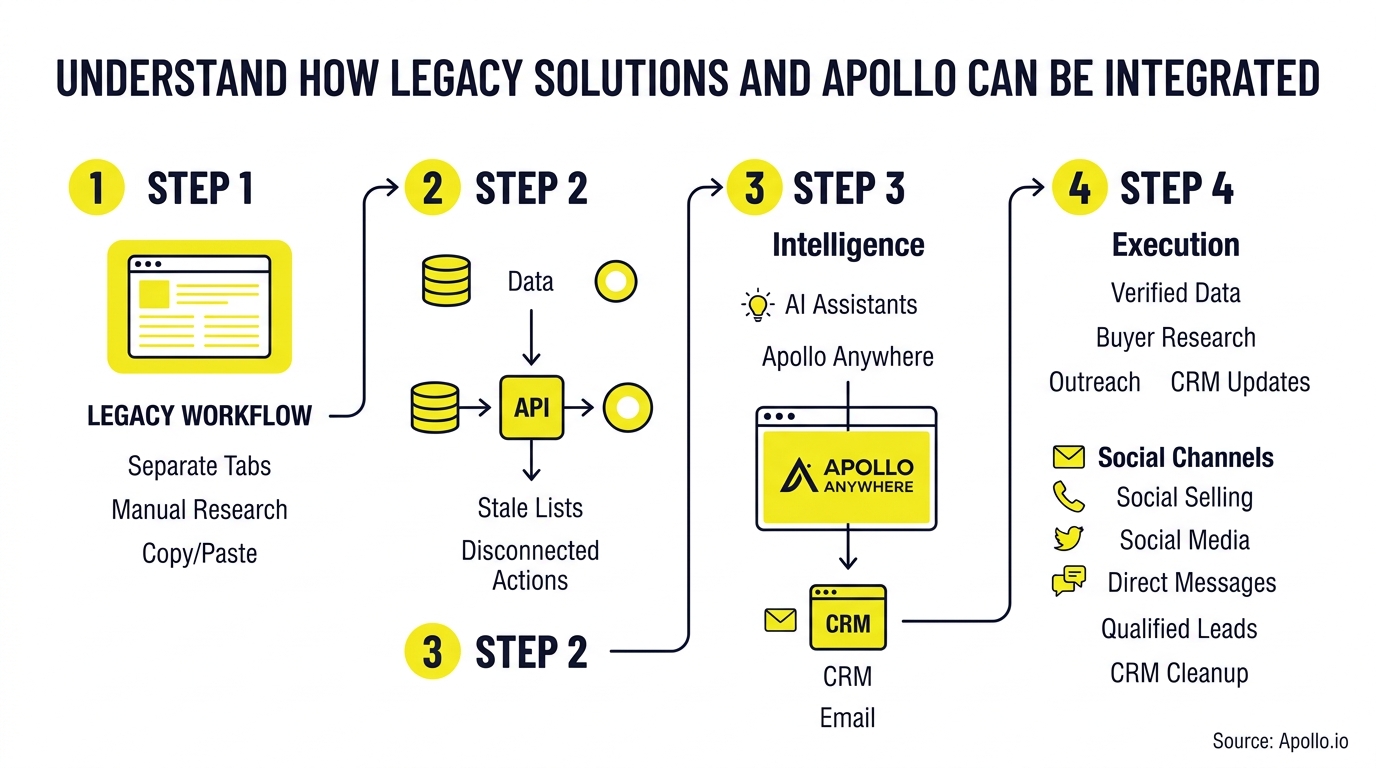
The workflow moves through four connected stages: source contacts in Apollo, enrich and validate them in Clay, apply scoring and suppression rules, then sync qualified records back into an Apollo sequence. Each stage feeds the next automatically once the pipeline is built.
- Source: Build a target account list in Apollo using firmographic and technographic filters.
- Enrich: Push that list into Clay, where it's supplemented with hiring signals, funding data, CRM history, and web intent.
- Score: Clay applies qualification logic (job title match, account fit, signal recency) and flags high-confidence records.
- Sequence: Qualified contacts sync back into Apollo, where reps or automated cadences take over outreach.
This mirrors what Apollo's 2026 survey of 328 GTM professionals found: 74% of teams still run two to five separate GTM platforms, and the biggest friction point is manual handoffs between them, not a lack of data.
How Do You Map Fields Between Apollo and Clay?
Field mapping keeps data structured as it moves between Apollo records, Clay enrichment columns, content variables, and sequence-ready fields. Skipping this step is the most common reason integrations break or produce messy personalization.
| Apollo Field | Clay Enrichment Column | Content/Sequence Variable |
|---|---|---|
| Contact Name, Title | Verified title, seniority tier | {{first_name}}, {{persona_tier}} |
| Company Name, Domain | Firmographic + tech stack match | {{company}}, {{tech_stack_note}} |
| Company Size, Industry | Funding stage, headcount growth | {{growth_signal}} |
| Recent Job Change | Hiring/promotion signal source | {{trigger_event}} |
| Email, Phone | Deliverability/validation status | Suppression flag |
| Account ID | Buying-group role tag | {{persona_variant}} |
Know Which Deals Will Close With Apollo
Forecasting off gut feel because deal stages never match reality? Apollo surfaces buying signals and intent data so reps chase ready prospects instead of guessing. Built-In saw a 10% higher win rate using Apollo's scoring.
Schedule a Demo →How Do SDRs Turn One Account Into Buying-Group Content?
SDRs turn one Apollo account into persona-specific assets by using Clay to tag each contact's role in the buying group, then generating a message variant for each tag. A single enriched account record can produce a technical-proof-point email for an engineering lead, a budget-framed message for a VP of Finance, and a risk-mitigation angle for a security stakeholder, all pulled from the same underlying account facts.
This matters because more than 40% of B2B deals stall due to internal buying-group misalignment, according to the 2025 Edelman-professional networks B2B Thought Leadership Impact Report. A worked example: an Apollo record for a 200-person fintech company gets enriched in Clay with a recent Series B and three open engineering roles. Clay generates three prompt-based variants: one referencing the funding round for the CFO, one referencing the hiring surge for the VP Eng, and one generic account-fit message for a newly identified security contact. All three sync back into separate Apollo sequences tied to the same target account list.
How Do RevOps Leaders Set Confidence Thresholds and Approval Rules?
RevOps leaders set confidence thresholds by defining a minimum enrichment score before a contact auto-enrolls in a sequence, and requiring human sign-off below that line. This prevents low-fit or stale-signal contacts from reaching a rep's outbound queue untouched.
- High confidence (auto-enroll): Verified email, matched persona tier, signal less than 30 days old.
- Medium confidence (human review): Partial enrichment, ambiguous title match, or conflicting signals.
- Low confidence (suppress): Unverified contact info, no account-fit match, or duplicate record already in an active Apollo sequence.
- Route to rep: Any account showing a high-intent signal (demo request, pricing page visit, executive job change) should bypass automated sequencing and go straight to an AE for a personal outreach.
Struggling to keep dirty or duplicate records out of your sequences? Apollo's data enrichment tools apply verification before records ever reach Clay, reducing rework downstream.

How Do You Measure Content-to-Pipeline Attribution?
You measure content-to-pipeline attribution by tagging every message variant with its signal source, persona tier, and enrichment confidence score, then tracking reply and meeting-booked rates against those tags in a shared dashboard. Without this tagging, teams can't tell whether a funding-triggered message outperformed a generic one.
A minimum KPI dashboard should track: reply rate by persona tier, meeting-booked rate by trigger-event type, sequence completion rate by confidence bucket, and pipeline value by enrichment source. Research from Derrick App's 2026 SDR Productivity Study found that teams implementing automated enrichment and scoring report a 113% increase in the number of prospects handled per SDR per day, which makes attribution tracking essential to know which of that added volume is actually converting.
For Account Executives inheriting these enriched, pre-qualified leads, having the trigger event and persona context already attached inside Apollo's deal management view shortens pre-call prep significantly.
Does Clay Replace Apollo, or Do They Work Together?
Clay does not replace Apollo. Clay is an enrichment and orchestration layer; Apollo is a contact database and execution platform, and the two are built to connect rather than compete for the same job.
Clay's September 2026 launch of its own outbound sequencer means teams now have an architectural choice: keep Apollo as the execution layer and use Clay purely for enrichment and scoring, or consolidate more of the sending workflow inside Clay itself. For teams already managing multiple point solutions, consolidating execution, data, and engagement into one platform tends to reduce overhead. As Collin Stewart of Predictable Revenue put it, "We reduced the complexity of three tools into one." Teams weighing Clay Sequencer against Apollo's built-in engagement tools should factor in credit consumption, governance needs, and how many separate subscriptions they're willing to manage.
Frequently Asked Questions
How Do You Set Up the Clay-Apollo Integration?
You set up the integration by connecting your Apollo account as a data source inside Clay's table builder, then configuring the Sequencer API to push enriched, qualified records back into a specific Apollo sequence. Both platforms publish setup documentation: Apollo's prospecting knowledge base covers the Apollo side, while Clay's integration page covers table configuration.
How Much Does the Integration Cost in Credits or Pricing?
Costs depend on your existing Apollo and Clay plans, since each platform bills enrichment and sequencing actions separately using its own credit system. Apollo's plans start at $49/user/month on annual billing; see Apollo's pricing page for current tiers. Clay bills separately based on enrichment credit consumption, so joint usage should be budgeted across both platforms rather than assumed to be a single cost.
How Does Deduplication Work Between the Two Platforms?
Deduplication works by matching on a unique identifier (typically email or Apollo contact ID) before a record re-enters a sequence, preventing the same contact from being enrolled twice. Build a suppression check into your Clay workflow so any contact already active in an Apollo sequence is flagged and skipped rather than re-synced.
Does the Sequence Status Sync Back to Clay in Real Time?
Sequence status can sync back to Clay through the Sequencer API, letting you see reply, bounce, and completion status without leaving your Clay table. This closes the loop so scoring models can be adjusted based on which enriched signals actually produced replies.
Can Marketing Teams Use This Integration, or Is It Sales-Only?
Marketing teams can use this integration for account-based content personalization, not just cold outbound sequencing. RevOps and marketing leaders can pull the same enriched account data into landing-page personalization or ad audience building, keeping messaging consistent across every channel a buyer touches.

Bringing It All Together
Clay and Apollo work best as connected stages in one pipeline: Apollo sources and executes, Clay enriches and qualifies. The field-mapping discipline, confidence thresholds, and attribution tracking outlined above are what separate a genuinely productive integration from two tools bolted together with a CSV export.
Before building out a complex multi-tool stack, make sure your foundation is solid. Apollo brings B2B data, sales engagement, and AI-powered execution together in one connected go-to-market system, so teams don't have to stitch together separate vendors for research, outreach, and analysis. Explore Apollo's go-to-market platform to see how much of this workflow you can run without ever leaving one system.
Prove ROI Fast, Scale Reps With Apollo
Still can't show leadership what your tools are actually worth? New reps take forever to ramp because best practices live in someone's head, not a system. Apollo gives every rep the same data, sequences, and playbooks from day one, so ramp time drops and pipeline impact is easy to point to. Leadium tripled annual revenue after automating outreach with Apollo.
Start Free with Apollo →Don't miss these
Sales
Inbound vs Outbound Marketing: Which Strategy Wins?
Sales
What Is a Sales Funnel? The Non-Linear Revenue Framework for 2026
Sales
What Is a Go-to-Market Strategy? The 2026 GTM Playbook
See Apollo in action
We'd love to show how Apollo can help you sell better.
By submitting this form, you will receive information, tips, and promotions from Apollo. To learn more, see our Privacy Statement.
4.7/5 based on 9,690 reviews
