
A UK email database is a licensed collection of business contacts and email addresses that sales and marketing teams use for prospecting. The right one is not the largest.
It is the one that covers your actual target segment, passes a sample audit, and fits UK legal rules. Most buyers compare record counts.
Experienced buyers compare coverage by segment, verification dates, and what each usable contact costs.
Experian's July 2026 survey of 250 UK B2B sales and marketing decision-makers found that 93% were confident in their external business data, yet 95% reported commercial consequences from poor-quality data. That gap is why this guide starts with a buying checklist, then gives you an audit worksheet, a legal decision tree, and CRM import steps. Before you buy anything, read why buying email lists fails so you know what risks a licence does not remove.

Skip Manual Research, Reach Real Buyers
Spending hours researching leads and verifying contact info while selling time disappears? Apollo finds business contacts for you, backed by 98% email accuracy. Nearly 5M users already put that time back into conversations.
Start Free with Apollo →Key Takeaways
- Judge a UK email database on coverage of your segment, sample accuracy, and cost per usable contact. Total record count is a weak signal.
- Only 25% of UK private-sector businesses had employees at the start of 2025, so company counts overstate how many contacts are reachable.
- Run a 200 to 500 contact sample audit before signing any licence. Record valid mailboxes, current employment, role accuracy, and duplicates.
- PECR rules differ for corporate subscribers and sole traders. Buying a list does not transfer compliance responsibility to the seller.
- Database quality and sender authentication are separate problems. Check SPF, DKIM, and DMARC before blaming the data.
What Should Be on Your UK Email Database Buying Checklist?
Your buying checklist should cover five items: segment-level counts, a sample you can audit, transparent pricing, licence terms, and provenance. If a supplier cannot answer all five in writing, treat the quote as incomplete.
| Checklist Item | What to Ask the Supplier | Red Flag |
|---|---|---|
| Segment counts | How many contacts match my industry, company size, region, and job function? | Only a headline total, such as "millions of UK contacts" |
| Sample access | Can I audit a random sample from my exact segment before paying? | Sample is hand-picked or limited to a few records |
| Pricing basis | Is pricing per record, per credit, per seat, or per export? What counts as a billable record? | Pricing only available after a sales call, with no unit definition |
| Licence terms | Is use one-time or ongoing? Can I load records into my CRM and keep them after the term ends? | Records must be deleted at expiry with no clarity on CRM copies |
| Provenance | Where does each record come from, and when was it last verified? | No verification date field and vague sourcing language |
| Replacement policy | Do you replace bounced or outdated contacts, and within what window? | No replacement or credit policy |
What Do Coverage Terms Actually Mean in a UK Email Database?
Coverage terms are often used interchangeably by suppliers, but they measure different things. A company is not a contact, and a contact is not a verified email address.
Knowing the difference stops you comparing unlike numbers.
| Term | Definition | Why It Matters |
|---|---|---|
| Company record | A legal entity or trading business in the database | Inflates headline totals without implying reachable people |
| Establishment | A site or branch of a company | One company can appear many times |
| Named contact | A person with a name and role at a company | Counts people, but not whether you can email them |
| Email address on file | A contact with any email string attached | May be guessed, generic, or stale |
| Verified email | An address checked for deliverability at a stated date | The only figure that approximates usable volume |
| Usable contact | A verified email for a current person in a role that matches your ICP | The number your cost should be divided by |
How Big Is the UK Market, and Why Do Business Counts Mislead?
The UK addressable market is large, but business counts are not email-contact counts. The Department for Business and Trade reported 5.7 million UK private-sector businesses at the start of 2025, up 3.5% from 2024.
Only 1.4 million, or 25%, had employees. The rest are mostly sole proprietors and owner-only companies.
Size segmentation matters even more. SMEs represented 99.85% of UK private-sector businesses in 2025, while only 38,435 businesses had 50 to 249 employees and 8,335 had 250 or more.
A database advertising millions of contacts may still thinly cover mid-market and enterprise buying committees. That implication is an inference from the official statistics, so test it against your own segment during the sample audit.

| Business Size Band (2025) | Count | Implication for Database Buyers |
|---|---|---|
| All private-sector businesses | 5.7 million | Most are not reachable B2B accounts |
| Businesses with employees | 1.4 million (25%) | The realistic pool for most outbound programs |
| 50 to 249 employees | 38,435 | Small pool, so segment coverage matters more than total volume |
| 250 or more employees | 8,335 | Enterprise targets need account-level, multi-contact coverage |
How Do You Audit a UK Email Database Sample Before Buying?
Audit a random sample of 200 to 500 contacts from your own segment, then score each record on four dimensions: mailbox validity, current employment, role accuracy, and duplication. Do this before you pay for the full file.
What Does the Audit Worksheet Look Like?
| Audit Step | How to Do It | Pass Threshold (Set Your Own) |
|---|---|---|
| 1. Request the sample | Ask for a random draw from your filters. Reject cherry-picked samples. | Supplier agrees to random selection |
| 2. Mailbox validity | Run records through an email verification tool and log valid, risky, and invalid results | Document your minimum valid rate before testing |
| 3. Current employment | Spot-check 50 records against company websites and professional profiles | Document your tolerance for people who have left |
| 4. Role accuracy | Check whether titles match your target function and seniority | Minimum share matching your ICP |
| 5. Duplicates | Dedupe against your CRM and within the sample | Overlap with existing records noted |
| 6. Provenance and dates | Check each record has a source and verification date | Date field populated for all records |
| 7. Cost per usable contact | Divide total licence cost by estimated usable contacts | Compare across suppliers on this figure only |
Set the pass thresholds yourself before you see results. Choosing them afterwards lets sunk cost bias your decision. For the verification step, this guide to verifying email addresses for B2B sales covers the practical workflow.
Why Does Data Quality Deserve This Much Effort?
Because poor data has measurable commercial consequences. Validity's 2024 study of 631 CRM users and stakeholders across the UK, US, and Australia found that 24% of CRM administrators said less than half their data was accurate and complete, and 31% reported poor-quality data costing at least 20% of annual revenue.
These are self-reported, vendor-sponsored findings rather than audited losses or UK-only estimates, but they show why a sample audit is cheap insurance.
How Does Data Freshness Affect a UK Email Database?
Freshness is an ongoing requirement because the UK business population is always changing. The Office for National Statistics recorded 317,000 UK business births in 2024, and its November 2026 release revised 2024 business deaths to 283,000, or 9.9%.
Companies open, close, merge, and restructure continuously.
Treat this as a reason to check company status and verification dates, not as an email decay rate. Business closures are not a measured rate of email address decay, and ONS business demography covers a narrower registered-business population than the Department for Business and Trade's total estimates.
Ask every supplier how often records are re-verified, and demand a last-verified date per record.
Are You Legally Allowed to Email Contacts From a UK Email Database?
It depends on who the recipient is. UK rules under PECR and UK GDPR treat corporate subscribers differently from sole traders and some partnerships, and named business contacts can still be personal data.
Buying a database does not transfer compliance responsibility to the seller. This is general information, not legal advice, so confirm your approach with your own counsel or data protection lead.
The stakes rose in 2026. On February 5, 2026, the ICO confirmed that implementation of the Data (Use and Access) Act introduced PECR fining powers of up to £17.5 million or 4% of global turnover.
Database sourcing, lawful use, and suppression processes now deserve executive-level scrutiny.
What Is the UK Subscriber-Type Decision Tree?
| Step | Question | If Yes | If No |
|---|---|---|---|
| 1 | Is the recipient a limited company, LLP, or other corporate body? | Treat as a corporate subscriber and go to step 3 | Go to step 2 |
| 2 | Is the recipient a sole trader or a partnership in England, Wales, or Northern Ireland? | Treat as an individual subscriber. Consent-style rules apply to unsolicited marketing email. | Confirm entity type before sending |
| 3 | Does the address identify a named person (for example, firstname.lastname@)? | Personal data under UK GDPR still applies. Document lawful basis and provide clear opt-out. | Generic role addresses carry less personal data risk, but UK GDPR duties still apply if a person is identifiable |
| 4 | Is the contact on your suppression list or the Telephone and Email suppression records you maintain? | Do not send | Proceed with identification, relevance, and an easy unsubscribe |
Ask suppliers for an entity-type field, a source description per record, and a suppression file process. If they cannot flag sole traders, your risk is higher than their pitch suggests.
Apollo Turns Pipeline Guesswork Into Forecasts
Forecasts feeling like a guessing game because lead flow is thin and deal stages are stale? Apollo fills your funnel with qualified prospects so you can see what's real. Nearly 5M users already forecast with more confidence. Start free today.
Start Free with Apollo →What Does Google and Microsoft's Sender Policy Mean for Your Database?
Mailbox providers now police senders directly, and a clean database does not fix an unauthenticated domain. From February 1, 2024, Google introduced additional requirements for senders exceeding 5,000 messages daily to personal Gmail accounts, including SPF, DKIM, DMARC, and one-click unsubscribe for marketing messages, with a spam-rate ceiling below 0.3%.
Google also advises against purchasing email addresses. Microsoft announced similar SPF, DKIM, and DMARC requirements for domains sending more than 5,000 messages daily to Outlook.com consumer services, with enforcement starting May 5, 2025.
Note the scope: these rules concern personal Gmail and consumer Outlook recipients, not every corporate mailbox. Still, they show where the industry is heading, and they mean sales ops, marketing ops, and IT should diagnose bounces together.
What Is the Provider-Policy Checklist?
| Check | What to Confirm |
|---|---|
| SPF | Sending domain publishes a valid SPF record covering your platforms |
| DKIM | Messages are signed and signatures validate |
| DMARC | Policy published and aligned with your From domain |
| One-click unsubscribe | Marketing messages include list-unsubscribe headers where required |
| Spam rate | Monitor complaints and stay well below provider ceilings |
| Sending volume ramp | Increase volume gradually on new domains and lists |
For setup help, see this guide to email deliverability and avoiding spam filters. Separating invalid-address failures from authentication failures prevents you from replacing a good database to fix a configuration problem.
What Should You Expect From Email Benchmarks in the UK?
Treat published benchmarks as context for opted-in marketing programs, not as promises for cold B2B outreach. The DMA's Email Benchmarking Report 2025, analysed by Climb & Conquer across more than 442 billion emails sent via major ESP partners, is a widely cited UK reference.
On engagement, DMA Datatile reports that the overall average open rate in the UK climbed to 35.9%, up from 33.5% in 2023 and 31.8% in 2022. The DMA's report also showed 98% delivery and 2.3% unique clicks for 2024. Two cautions apply. First, delivery is not inbox placement. Second, the 2025 report contextualised open rates around Apple Mail Privacy Protection, so prioritise clicks and downstream outcomes rather than using opens alone to judge a database.
| Metric (DMA, 2024 data) | Figure | How to Use It |
|---|---|---|
| Delivery | 98% | Aggregate across opted-in sending, not a purchased-list benchmark |
| Open rate | 35.9% | Inflated by privacy features, so do not use as a quality test |
| Unique click rate | 2.3% | Better directional engagement signal |
Should You Buy, Build, or Blend Your UK Contact Data?
Most teams are better served by blending: permissioned first-party contacts plus carefully vetted external enrichment. Anteriad and Ascend2's 2025 UK report found that 63% of respondents planned to increase first-party data use, and 37% cited lack of high-quality data as a major challenge.
These figures describe intentions, not confirmed adoption, but the direction is clear.
| Approach | Strength | Weakness | Best For |
|---|---|---|---|
| Buy a static file | Fast volume | Decays quickly, licence and provenance risk, no workflow | One-off research with legal review |
| Build first-party | Permissioned, relevant, durable | Slow to scale | Inbound-led teams and nurture programs |
| Use a live prospecting and enrichment platform | Segment search, verification, enrichment in one workflow | Requires your own targeting and compliance process | Outbound teams needing current data in the CRM |
| Blend | Combines permissioned contacts with enrichment | Needs process discipline | Most multi-seat B2B teams |
Need to test a live database against your own segment? Run a targeted search in Apollo using your UK segment, then compare the results against your audit worksheet before you commit budget.
How Should SDRs and RevOps Leaders Evaluate a UK Email Database?
SDRs, RevOps leaders, and sales managers should judge a UK email database by workflow fit and by sample results, not by headline record counts. Each role cares about a different failure point.
- SDRs and BDRs: Check whether you can move from search to sequence without exporting files. Time lost to manual cleanup is time not spent on outreach.
- RevOps leaders: Test CRM sync, duplicate handling, and field mapping. A database that overwrites clean records creates more work than it saves.
- Sales and revenue leaders: Ask for sample results by segment (industry, headcount, region) rather than a blended average.
- Founders: Weigh total cost, including the extra tools needed to verify, enrich, and send.
Mark Turner's experience at Built-In shows what hands-off enrichment looks like in practice:
"Apollo enriches everything we have: contacts, leads, accounts... And we don't really have to touch it, it just works."
What Does a Live Database Workflow Look Like Compared to a Static File?
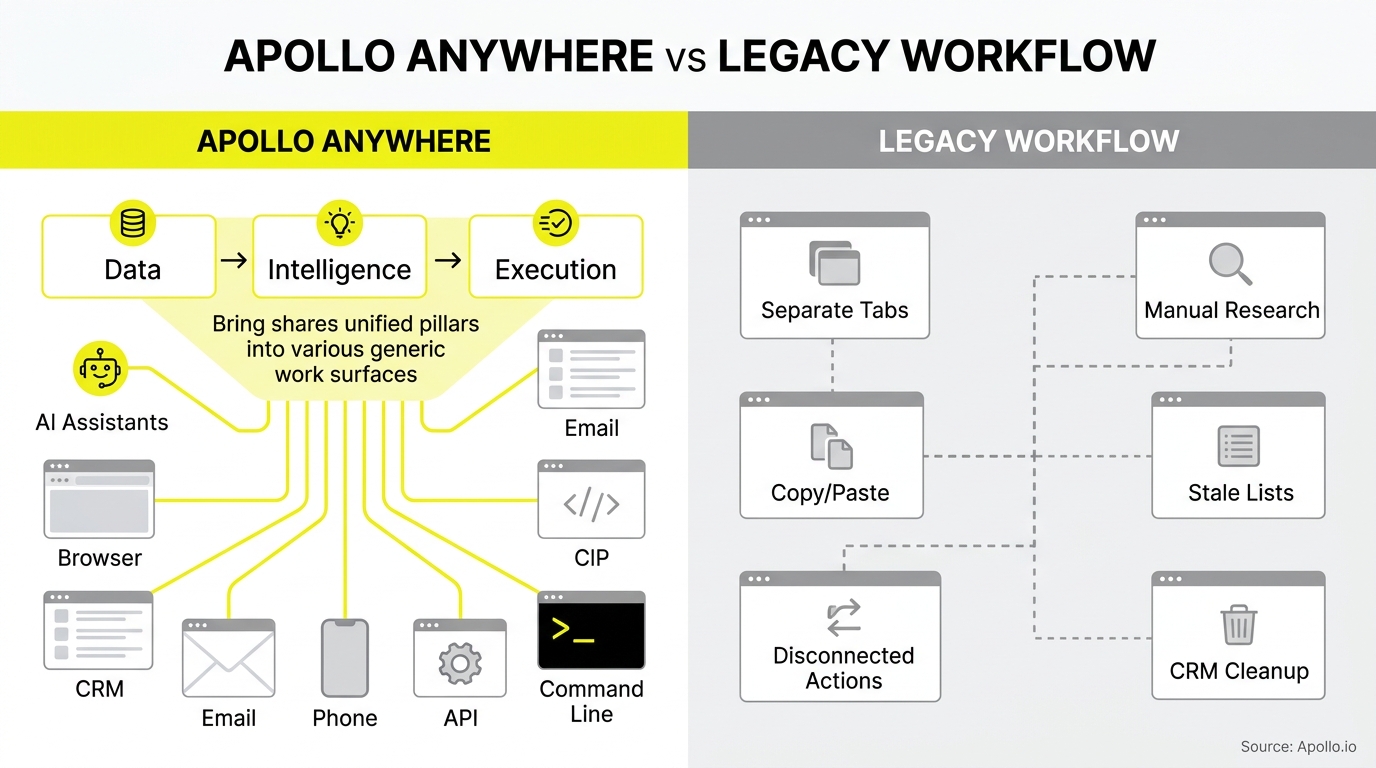
A live workflow keeps search, verification, enrichment, and outreach in one connected system, so your UK contact data does not sit in a spreadsheet decaying. Apollo brings B2B data, sales engagement, and AI-powered execution together in one connected go-to-market system, so teams don't have to stitch together separate vendors for research, outreach, and analysis.
In practice, that means:
- Search for businesses and professionals in their business capacity using prospecting filters.
- Keep CRM records current with data enrichment.
- Launch outreach from the same workspace with sales engagement sequences. You select who to contact and how.
- Reach the data where you work: the Chrome extension, Salesforce, or Apollo MCP inside AI assistants such as ChatGPT, Claude, and Perplexity.
According to Ramp's Sales Data Providers category data, Apollo was the fastest-growing vendor in the category as of November 2026. Buyers are moving toward connected platforms.
Collin Stewart of Predictable Revenue described the value of that connection:
"The thing that made me most excited as somebody who's been in sales development a long time was Apollo's integration between sales data and sales engagement and the magic that you can make happen when those two are together on the same platform."
What Are the Most Common Questions About UK Email Databases?
Is It Legal to Buy a UK Email Database?
Buying a list is not automatically unlawful, but sending is regulated. Rules differ for corporate and individual subscribers, and you remain responsible for your outreach.
Use the subscriber-type decision tree above and get legal advice for your situation.
How Many Records Should I Audit Before Buying?
Test a sample drawn from your real target segment, not a vendor-selected preview. Verify addresses, check job titles against public sources, and record bounces.
Use the audit worksheet above to score each vendor the same way.
Should a Small Team Buy a Static List or Use a Platform?
Small teams usually get more from a live platform because they avoid re-buying lists as contacts change roles. Apollo offers a Free plan at $0, and Basic starts at $49/user/month on annual billing. Check the Apollo pricing page for current billing options.
How Often Should I Re-Verify UK Contacts?
Re-verify before every major campaign and whenever bounce rates climb. Continuous enrichment inside your CRM reduces the manual effort of periodic clean-up.

Conclusion: What Is the Best Way to Choose a UK Email Database?
Choose a UK email database by testing a sample from your own segment, confirming the legal basis for your outreach, and favouring live data that stays current in your CRM. Record counts, vendor-selected previews, and open rates alone are weak buying signals.
Use the checklist, audit worksheet, and decision tree in this guide to compare vendors on equal terms. To see how connected search, enrichment, and outreach work against your own UK segment, Start Your Free Trial.
Apollo Gets New Reps Selling Faster
Onboarding new reps taking too long while leaders ask for proof of ROI? Apollo brings prospecting, outreach, and tracking into one workspace, so teams ramp quickly and show pipeline impact. Nearly 5M users already do. Start free today.
Start Free with Apollo →Don't miss these
Sales
Inbound vs Outbound Marketing: Which Strategy Wins?
Sales
What Is a Sales Funnel? The Non-Linear Revenue Framework for 2026
Sales
What Is a Go-to-Market Strategy? The 2026 GTM Playbook
See Apollo in action
We'd love to show how Apollo can help you sell better.
By submitting this form, you will receive information, tips, and promotions from Apollo. To learn more, see our Privacy Statement.
4.7/5 based on 9,690 reviews
