
The top database is the one that fits your workload, your budget, and the skills your team already has. Rankings built on a single popularity number tend to hide all three. This guide gives you a best-by-workload shortlist, a three-year cost model, and a decision tree for adding or consolidating platforms. It also covers the B2B contact side of the question, since a marketing database raises different buying criteria than a DBMS.

Skip Manual Research, Let Apollo Find Contacts
Tired of spending hours researching leads and verifying contact info instead of selling? Apollo puts 240M+ contacts and 98% email accuracy in one platform, so reps spend more time in conversations. Start prospecting free today.
Start Free with Apollo →Key Takeaways
- Match the engine to the workload first: transactional, analytical, caching, document, or embedded.
- Popularity data comes in three kinds (technographic share, developer usage, revenue share), and they answer different questions.
- Model three-year total cost, including staffing, migration, and support, rather than comparing sticker prices.
- Stale or incomplete records undermine a B2B contact database regardless of its size.
- Run a scoped proof of concept before committing to any platform.
What Is the Top Database for Each Workload?
No single database wins every workload. This guide covers database management systems (DBMS) and, in a later section, B2B contact databases.
The table maps common workloads to the engines teams most often shortlist.
| Workload | Common Shortlist | Choose It When |
|---|---|---|
| Transactional apps (OLTP) | PostgreSQL, MySQL, SQL Server | You need consistent writes, relational integrity, and mature tooling |
| Analytics and reporting | Cloud data warehouses, PostgreSQL for smaller volumes | Queries scan large datasets and run on a schedule |
| Flexible-schema documents | MongoDB | Data shape changes often and joins are rare |
| Caching and low latency | Redis | You need fast reads in front of a primary store |
| Embedded or local storage | SQLite | The database ships inside an app or device |
How Do Technographic Share, Developer Usage, and Revenue Share Differ?
Each popularity metric measures something different, so they should not be read as one ranking. Mixing them is the most common reason 'top database' lists mislead buyers.
| Metric | What It Measures | What It Misses |
|---|---|---|
| Technographic share | Companies detected running a technology | Depth of use and spend |
| Developer usage | Technologies developers report using in surveys | Enterprise budgets and licensing |
| Revenue share | Vendor spending in analyst market sizing | Free and open-source deployments |
Stack Overflow's developer survey series shows PostgreSQL leading reported usage in 2025. Gartner's 2024 market data shows nonrelational DBMS growing faster than relational.
Both are dated evidence about adoption trends, not a verdict on what is best in 2026.
Which Databases Make the Shortlist, and When Should You Avoid Them?
Keep the shortlist to three engines and test each against your own workload. Every option below has a condition under which it is the wrong choice.
| Database | Team Skill Fit | Avoid If |
|---|---|---|
| PostgreSQL | Strong SQL skills, broad hiring pool | You need a managed, locked-in vendor ecosystem |
| MySQL | Web-stack teams, wide hosting support | Complex analytics are the main use |
| SQL Server | Microsoft-centric teams | Licensing costs outweigh ecosystem benefits |
| MongoDB | Application developers working with JSON | Your data is heavily relational |
| Redis | Teams adding speed to an existing stack | You want it as your only system of record |
Hiring matters here. Job postings for database administrators lean heavily on SQL, so SQL-based engines are generally easier to staff.
How Do You Calculate Database Total Cost of Ownership?
Total cost of ownership (TCO) is the sum of licensing or hosting, staffing, migration, and support over three years. Price each line from current vendor quotes, record the quote date, and run a low, expected, and high case.
| Cost Line | Year 1 | Year 2 | Year 3 | Assumption to Document |
|---|---|---|---|---|
| Licensing or managed-service fees | Your quote | Your quote | Your quote | Quote date, usage tier |
| Infrastructure and storage | Your estimate | Your estimate | Your estimate | Growth rate in data volume |
| Staffing and training | Your estimate | Your estimate | Your estimate | Skills already on the team |
| Migration and integration | Your estimate | Lower | Lower | Number of connected systems |
| Support and downtime risk | Your estimate | Your estimate | Your estimate | Support tier, recovery targets |
Compare engines separately from managed-service pricing. An open-source engine on a managed platform is a different line item than the engine alone.
Rerun the low and high cases whenever your volume assumptions change.

What If You Need the Top B2B Contact Database Instead?
A B2B contact database is judged on accuracy, freshness, and how quickly records turn into outreach. Size alone is not the test.
Salesforce's State of Sales report (February 2026) found 74% of surveyed sales professionals focusing on data cleansing, which shows how widely data readiness is treated as a bottleneck.
The decay problem is measurable. industry analysis of B2B data decay shows contact records go stale as people change roles, companies restructure, and domains change. A large database that is not maintained can return more outdated records than a smaller, well-maintained one.
Judge a B2B contact database on four criteria:
- Email accuracy: the share of addresses that deliver without bouncing.
- Coverage: whether it includes your target titles, industries, and regions.
- Freshness: how often records are updated or verified.
- Workflow fit: whether records move into outreach without exports and re-imports.
This is different from the engine databases above. PostgreSQL, MongoDB, and Redis store your data.
A B2B contact database supplies business contact information about businesses and professionals in their business capacity.
Apollo Shows You Who's Ready To Buy Now
Quality leads not turning into real opportunities? Apollo surfaces in-market prospects and gives you a clear view of every deal, so forecasts reflect what's actually happening. Over 11,000 teams already use Apollo inside their AI tools.
Start Free with Apollo →How Does Apollo Work as a B2B Contact Database?
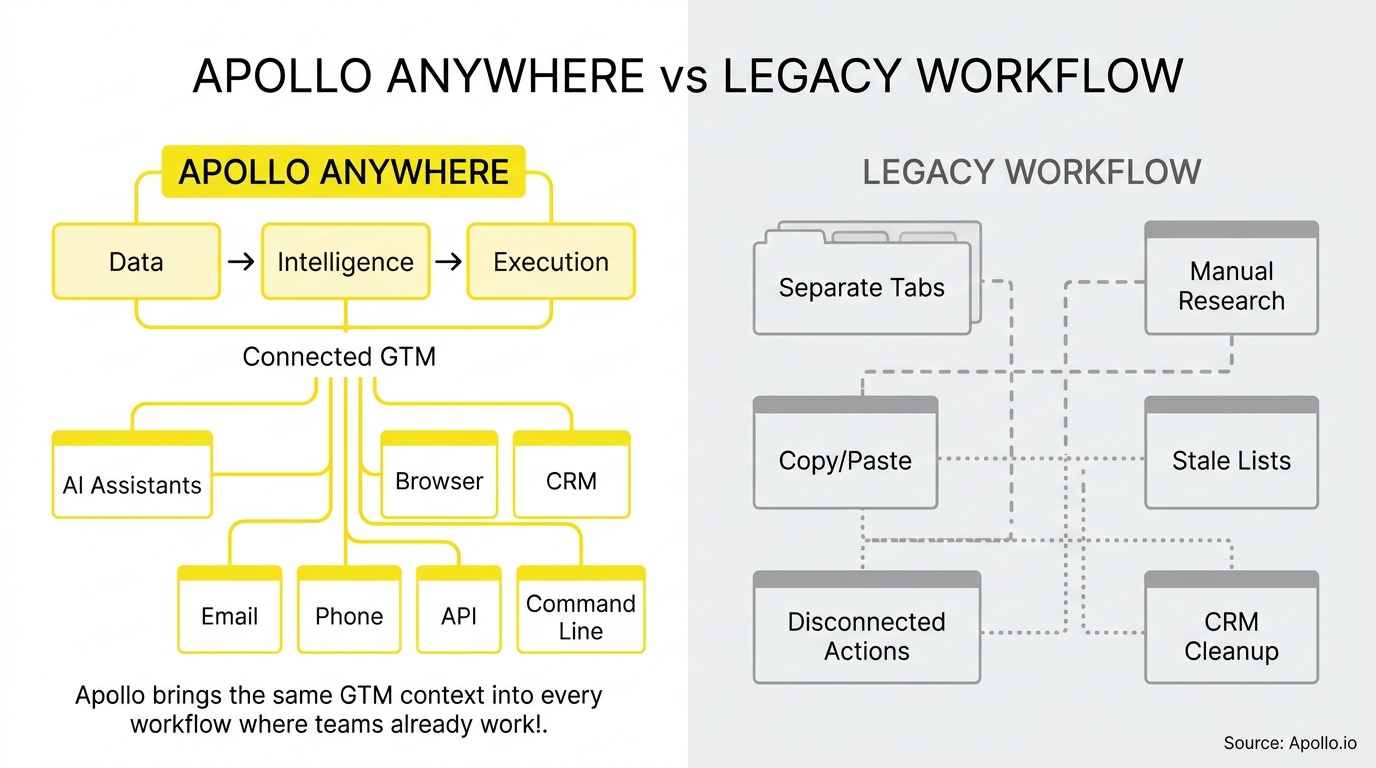
Apollo brings B2B data, sales engagement, and AI-powered execution together in one connected go-to-market system, so teams don't have to stitch together separate vendors for research, outreach, and analysis. The database holds 240M+ people and 30M+ companies, with 98% email accuracy.
Users search the Apollo database by title, industry, location, and company attributes, then choose which contacts to reach. Records move straight into sequences without a separate export step. Sales engagement covers email, phone, and social outreach in the same workspace.
According to Ramp's Sales Data Providers category data, Apollo was the fastest-growing vendor in the category as of November 2026, averaging +0.4 percentage points of adoption per month.
"Apollo enriches everything we have: contacts, leads, accounts... And we don't really have to touch it, it just works."
How Should RevOps, SDRs, and GTM Engineers Use a Contact Database?
Each role uses the database differently, so match the setup to the job.
| Role | Primary Use | Apollo Surface |
|---|---|---|
| SDRs and BDRs | Build targeted lists and start sequences | Search, sequences, Chrome extension |
| RevOps leaders | Keep CRM records current and consistent | Data enrichment, Salesforce integration |
| Sales and revenue leaders | Consolidate tools and track pipeline | Unified platform, analytics |
| GTM Engineers and AI Builders | Pull data into agents and apps | Apollo MCP, CLI, and API |
For GTM Engineers, Apollo's AI platform works inside AI assistants like Claude, ChatGPT, and Perplexity through Apollo MCP. Teams can run prospecting and enrichment requests without leaving those tools.
Consolidation is also a cost argument. Sylvain Giuliani of Census described it this way:
"We paid less for one tool than for two tools together... we cut our costs in half."
Which Database Should You Choose?
Start with the job to be done, then apply the TCO table above.
- Storing and querying application data: shortlist an engine by workload (relational, document, key-value, or analytical) and model three-year TCO.
- Finding and contacting business buyers: choose a B2B contact database based on accuracy, coverage, and how directly records feed outreach.
- Both: keep the two decisions separate. The engine behind your product has no bearing on the contact data behind your pipeline.
Before committing to either, run a pilot on your own data, document the assumptions, and revisit the numbers after one quarter.

Ready to Put the Right Database to Work?
The top database depends on the workload: engines for application data, a contact database for pipeline. If your goal is reaching business buyers, Apollo combines search, enrichment, and outreach in one workspace.
To see why Apollo stands alone as the only fully agentic GTM platform, combining sales intelligence, outbound execution, and enrichment in one workspace, start free with Apollo today.
Prove ROI Fast With Apollo's Unified GTM Platform
Budget approval stuck on unclear ROI? Apollo brings data, engagement, and AI into one workspace, so you can show pipeline impact fast. Leadium tripled annual revenue by automating follow-up and outbound. Give your team wins worth defending at renewal.
Start Free with Apollo →Don't miss these
Sales
Inbound vs Outbound Marketing: Which Strategy Wins?
Sales
What Is a Sales Funnel? The Non-Linear Revenue Framework for 2026
Sales
What Is a Go-to-Market Strategy? The 2026 GTM Playbook
See Apollo in action
We'd love to show how Apollo can help you sell better.
By submitting this form, you will receive information, tips, and promotions from Apollo. To learn more, see our Privacy Statement.
4.7/5 based on 9,690 reviews
