
Outbound Outreach Support: Finding Contacts and Automating Follow-Ups
Outbound outreach breaks down in three places: teams can't find the right contacts, verified data goes stale before anyone touches it, and automated sequences fire without any signal that the timing is right. Fixing outreach means fixing the whole pipeline, not just adding another automation layer on top of bad data.
This piece walks through a six-step operating system for outbound: identifying ICP signals, mapping the contact graph, verifying data, writing role-based messaging, automating with guardrails, and measuring results in your CRM. For a broader comparison of platforms that handle this workflow, see Apollo vs Outreach vs Salesloft.

Skip The Research, Apollo Finds Buyers Fast
Spending hours manually researching leads and chasing bad emails? Apollo hands you verified contact info instantly, so reps sell instead of digging. 98% email accuracy means fewer bounces and more real conversations.
Start Free with Apollo →Key Takeaways
- Finding contacts and automating follow-ups only works when built on a repeatable workflow, not a single tool bolted onto bad data.
- Buying groups have grown, so contact discovery must map multiple stakeholders per account, not just one lead.
- Personalized, signal-based outreach consistently outperforms high-volume generic sequences.
- Deliverability infrastructure (SPF, DKIM, DMARC) is now a baseline requirement, not an optional best practice.
- Consolidating contact discovery, verification, and sequencing into one workspace cuts the operational drag of stitching together separate tools.
What Is Support For Outbound Outreach?
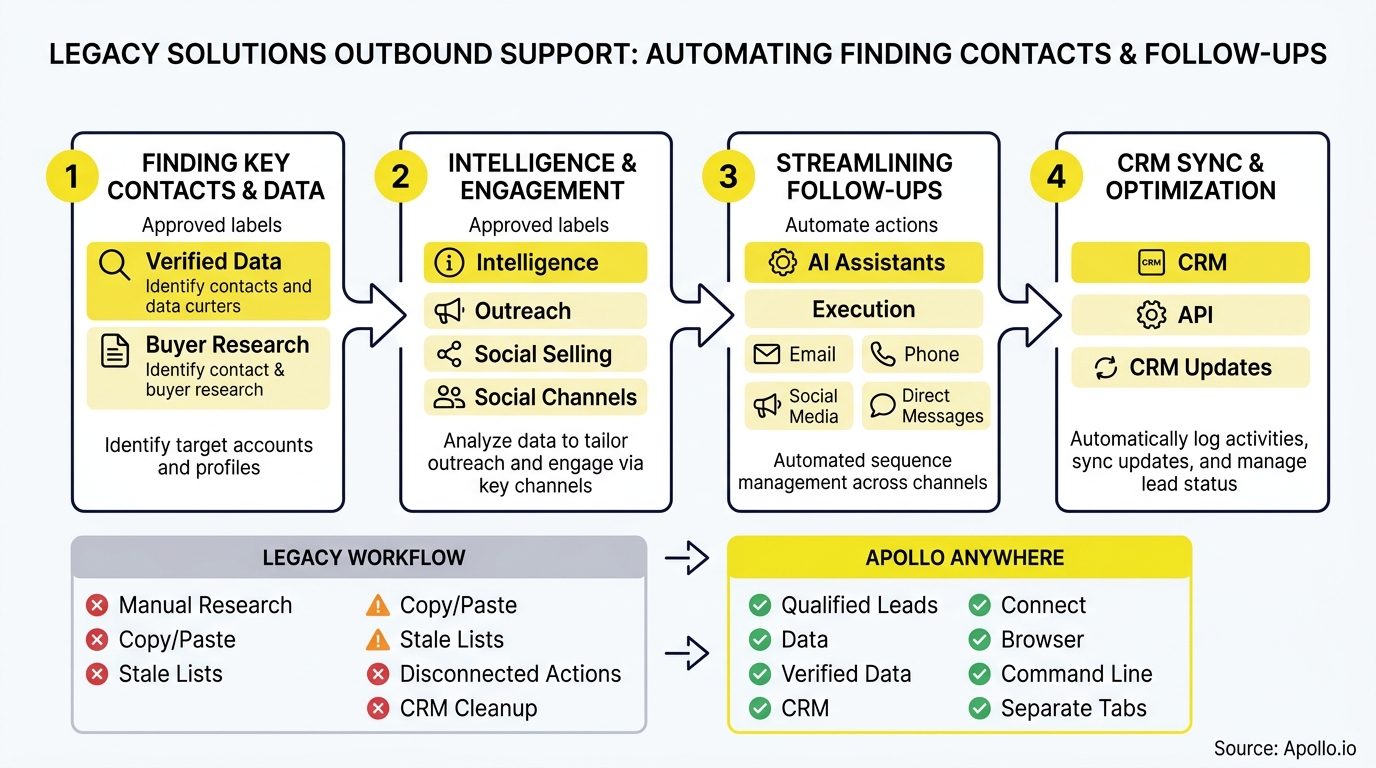
Support for outbound outreach means the combined set of tools and processes that help teams find accurate contacts, verify that data, and automate outreach sequences and follow-ups without losing personalization or deliverability. It is not just a list of cold email tools.
It's a workflow that connects ideal customer profile (ICP) signals, contact discovery, data verification, messaging, automation, and CRM measurement into one system.
Historically, this workflow lived across multiple disconnected tools: a data vendor for lists, a separate sequencer for emails, and a CRM for tracking. Today, outbound outreach support is converging into unified platforms that handle contact finding and automated follow-ups together, reducing the handoffs where data quality and personalization typically break down.
How Does Outbound Outreach Support Work?
Outbound outreach support works through six connected steps: define ICP signals, build the contact graph, verify data, craft role-based messaging, automate with guardrails, and measure in the CRM. Each step feeds the next, so weak data early in the process compounds into wasted sequences later.
| Step | What Happens | Why It Matters |
|---|---|---|
| 1. ICP Signals | Define firmographic, technographic, and intent criteria | Focuses effort on accounts likely to convert |
| 2. Contact Graph | Map every stakeholder in the buying group | Buying committees now average 11.2 people for deals over $50k, per Forrester/6sense data cited by Digital Applied |
| 3. Verification | Confirm emails and numbers are current | B2B contact data decays at roughly 28% annually, according to Smarte |
| 4. Role-Based Messaging | Tailor content to each stakeholder's function | Generic messaging gets ignored by multithreaded buying groups |
| 5. Guarded Automation | Sequence with suppression rules and sending limits | Protects sender reputation and deliverability |
| 6. CRM Measurement | Track replies, meetings, and pipeline in one system | Connects activity to revenue outcomes |
Struggling to find qualified leads across a growing buying group? Search Apollo's 240M+ contacts with 65+ filters to map every stakeholder before you send a single email.
How Do SDRs Find the Right Contacts for a Buying Group?
SDRs find the right contacts by mapping every stakeholder role in a target account, not just the first name that shows up in a list. B2B buying groups typically include finance, procurement, legal, operations, technical, and executive stakeholders, and missing even one can stall a deal.
A practical buying-group worksheet includes:
- Economic buyer: controls budget approval
- Technical evaluator: assesses fit and implementation
- End user/champion: uses the product daily and advocates internally
- Procurement/legal: reviews contracts and compliance
- Executive sponsor: signs off on strategic priority
SDRs using a structured contact graph instead of single-lead lists report more complete account coverage, which matters as professional networks's B2B research found buying groups have grown and purchasing now takes longer than it did three years earlier. For a deeper walkthrough of contact discovery tactics, see Outbound Prospecting: How to Find, Reach, and Win B2B Leads.

Why Does Contact Verification Matter Before Automating Follow-Ups?
Contact verification matters because automating outreach on top of stale or duplicated data scales wasted activity instead of results. Salesforce's 2024 survey found only 35% of sales professionals fully trusted their organization's data accuracy, and that distrust compounds once sequences run on autopilot.
A verification checklist before any automated sequence launches:
- Confirm email deliverability status (not just format validity)
- Cross-check job title and company against current employment
- Remove duplicate or merged records before enrollment
- Flag contacts tied to recently churned or acquired accounts
Tired of dirty data undermining your sequences? Start free with Apollo's verified contact data to catch stale records before they enter a sequence. RevOps leaders responsible for CRM hygiene should also review Email Database for B2B: Find, Clean, and Connect for ongoing maintenance practices.
What Automation Should Be Guarded vs. Fully Automatic?
Guarded automation means some outreach steps should require human review while others can run fully automatically, based on risk and personalization needs. Not every touchpoint deserves the same level of automation.
| Outreach Task | Automation Level | Reason |
|---|---|---|
| Initial contact discovery | Fully automatic | Low risk, high volume, data-driven |
| First-touch personalization | Guarded (AI-assisted, human-reviewed) | 78% of buyers expect personalization, per a 2024 professional networks-Ipsos survey |
| Follow-up sequences | Automatic with suppression rules | Reduces manual load while protecting reputation |
| Reply handling | Human-owned | Nuanced responses need rep judgment |
| Suppression/unsubscribe | Fully automatic | Compliance requirement, zero tolerance for error |
Multi-channel sequences that combine email, social, and phone touchpoints report 40% higher response rates and 31% lower cost per lead than single-channel approaches, according to Martal Group. Spending hours manually coordinating channels? Automate your sequences with Apollo's multi-channel platform.
See Every Deal Stage Before It Stalls
Forecasting off gut feel because deal data is never up to date? Apollo syncs verified contact and account activity in real time, so your pipeline reflects what's actually happening. Built-In improved win rates using Apollo's scoring and signals.
Schedule a Demo →How Do RevOps Leaders Measure Outbound Outreach Success?
RevOps leaders measure outbound success by tracking reply rates, meetings booked, and pipeline generated in the CRM, not just emails sent. Activity volume without CRM-connected outcomes tells you little about whether outreach is working.
Core metrics to track:
- Reply rate by channel and by role-based message variant
- Meetings booked per 100 contacts enrolled
- Pipeline value sourced from outbound sequences
- Deliverability health (bounce rate, spam complaint rate)
Deliverability rules changed the baseline for these metrics. Since 2024, high-volume senders to Gmail must implement SPF, DKIM, DMARC, and one-click unsubscribe, and Google recommends keeping spam complaints below 0.1%. Microsoft applied similar authentication requirements to Outlook.com senders starting in May 2025. Any team measuring outreach ROI needs deliverability data alongside reply and meeting metrics. For RevOps teams building this measurement layer, see What Is Sales Transformation and How Can RevOps Lead It?
How Do AEs and Founders Keep Outreach Personal at Scale?
AEs and founders keep outreach personal at scale by using role-specific messaging templates layered with account-level research, rather than generic merge-field emails.
Gartner's 2025 report found 73% of B2B buyers actively avoid suppliers that send irrelevant outreach, making relevance the deciding factor over volume.
For Account Executives managing multiple deals, this means:
- Referencing recent account signals (funding, hiring, product launches) in first-touch messages
- Adjusting message angle by stakeholder role (financial risk for CFOs, implementation ease for technical evaluators)
- Timing follow-ups around buyer engagement signals instead of a fixed cadence
Founders building outbound from scratch often lack a dedicated SDR team, making tool consolidation critical. As Collin Stewart of Predictable Revenue put it: "We reduced the complexity of three tools into one." That kind of consolidation matters most when a small team is running the entire outbound motion alone. Explore Apollo Outreach: Multichannel Sales Engagement Platform for a single workspace covering contact discovery through follow-up.
What Compliance Rules Apply to Automated Outreach in 2026?
Compliance for automated outreach in 2026 centers on email authentication, suppression management, and data provenance, not just message content. Regulatory and platform requirements have tightened significantly.
- Gmail/Outlook authentication: SPF, DKIM, and DMARC are mandatory for senders exceeding 5,000 daily messages, with one-click unsubscribe required.
- CAN-SPAM: Requires accurate sender information, clear opt-out mechanisms, and honoring unsubscribe requests promptly.
- California DROP system: Starting August 1, 2026, registered data brokers must check California's Delete Request and Opt-Out Platform at least every 45 days and process deletion requests, increasing the need for suppression list management across contact databases.
- Spam complaint thresholds: Google recommends keeping reported spam below 0.1% and never reaching 0.3%.
Teams still managing suppression lists manually across spreadsheets face growing operational risk as these rules tighten. Consolidating verification, suppression, and sequencing into one platform reduces that risk surface.
What's the Best Way to Consolidate Outbound Tools?
The best way to consolidate outbound tools is to replace separate point solutions for contact finding, verification, and sequencing with one connected workspace that shares data across every step. Fragmented stacks create the exact handoff failures that cause bad data to reach automated sequences in the first place.
Christina Nguyen of Cyera described this shift directly: "Having everything in one system was a game changer." Teams running contact discovery, verification, messaging, and CRM measurement in separate tools often duplicate effort and lose context between steps.
Apollo brings B2B data, sales engagement, and AI-powered execution together in one connected go-to-market system, so teams don't have to stitch together separate vendors for research, outreach, and analysis. This matters most for RevOps leaders maintaining fewer integrations and for founders who can't afford a bloated stack.
See Apollo.io: Sales Intelligence & Lead Database for B2B Prospecting for how contact finding and enrichment connect directly to outreach execution.
Frequently Asked Questions
What Is Email Verification and Why Does It Matter for Outbound?
Email verification confirms that an email address is active and deliverable before it enters an outreach sequence. Skipping this step increases bounce rates, which damages sender reputation and can get entire domains flagged by inbox providers.
What Is Multithreading in Outbound Sales?
Multithreading means engaging multiple stakeholders within the same target account simultaneously, rather than relying on a single contact. Since buying groups now average double digits in size for larger deals, multithreading reduces the risk of a deal stalling when one contact goes quiet.
How Does CAN-SPAM Apply to Automated Follow-Up Sequences?
CAN-SPAM requires every automated commercial email to include accurate sender identification, a working opt-out link, and prompt honoring of unsubscribe requests. Automated sequences must build these requirements into every step, not just the first email.
What Are Gmail's Sender Rules for High-Volume Outreach?
Gmail requires senders exceeding 5,000 daily messages to implement SPF, DKIM, and DMARC authentication along with one-click unsubscribe, effective since February 2024. Google recommends keeping spam complaint rates below 0.1% to maintain inbox placement.
What Metrics Should Teams Track for Outbound Outreach Health?
Teams should track deliverability rate, reply rate, meeting-booked rate, and unsubscribe/spam-complaint rate as core health signals. Deliverability and spam-complaint rates catch technical problems before they tank a domain's reputation, while reply and meeting-booked rates measure whether messaging and targeting are actually working.
RevOps leaders typically review these weekly at the sequence level and monthly at the rep or team level to catch drift early.

Bringing It All Together
Outbound outreach support works best when contact discovery, verification, and follow-up automation live in one connected system instead of several disconnected tools. Fragmented stacks force reps to manually move data between a database, a verification service, and a sequencing tool, and every handoff is a chance for errors or delays.
A unified workflow means the moment a contact is found and verified, it can flow directly into a compliant, personalized sequence without manual re-entry.
This matters most for the people actually running outbound:SDRs and BDRs need speed without sacrificing accuracy, AEs need multithreaded visibility into buying groups, RevOps needs clean data and fewer integrations to babysit, and revenue leaders need confidence that automation is scaling good behavior, not spam risk. Apollo brings B2B data, sales engagement, and AI-powered execution together in one connected go-to-market system, so teams don't have to stitch together separate vendors for research, outreach, and analysis.
Whether you're an SDR trying to hit a weekly meetings quota or a RevOps leader trying to cut down on integration maintenance, the underlying principle is the same: verified data plus guarded automation plus clear compliance guardrails equals outreach that scales without breaking trust.
Ready to see how a connected outbound workflow can help your team book more meetings with less manual work? Schedule a Demo and find out how Apollo can support your outbound motion from first contact to closed deal.
Prove ROI Fast With Apollo Automation
Can't justify the spend without quick, measurable wins? Apollo automates outreach at scale so reps produce more pipeline without more headcount. Leadium tripled annual revenue by automating outbound with Apollo.
Start Free with Apollo →Don't miss these
Sales
Inbound vs Outbound Marketing: Which Strategy Wins?
Sales
What Is a Sales Funnel? The Non-Linear Revenue Framework for 2026
Sales
What Is a Go-to-Market Strategy? The 2026 GTM Playbook
See Apollo in action
We'd love to show how Apollo can help you sell better.
By submitting this form, you will receive information, tips, and promotions from Apollo. To learn more, see our Privacy Statement.
4.7/5 based on 9,690 reviews
