
Streamlining and Automating Marketing Outreach for Sales Teams
Sales reps spend only 28-30% of their time actually selling, according to Cirrus Insight, citing Salesforce's State of Sales research. The rest disappears into data entry, manual follow-ups, and research that automation can now handle. Streamlining and automating marketing and outreach for sales means building a workflow where signals, content, and human judgment connect instead of colliding.
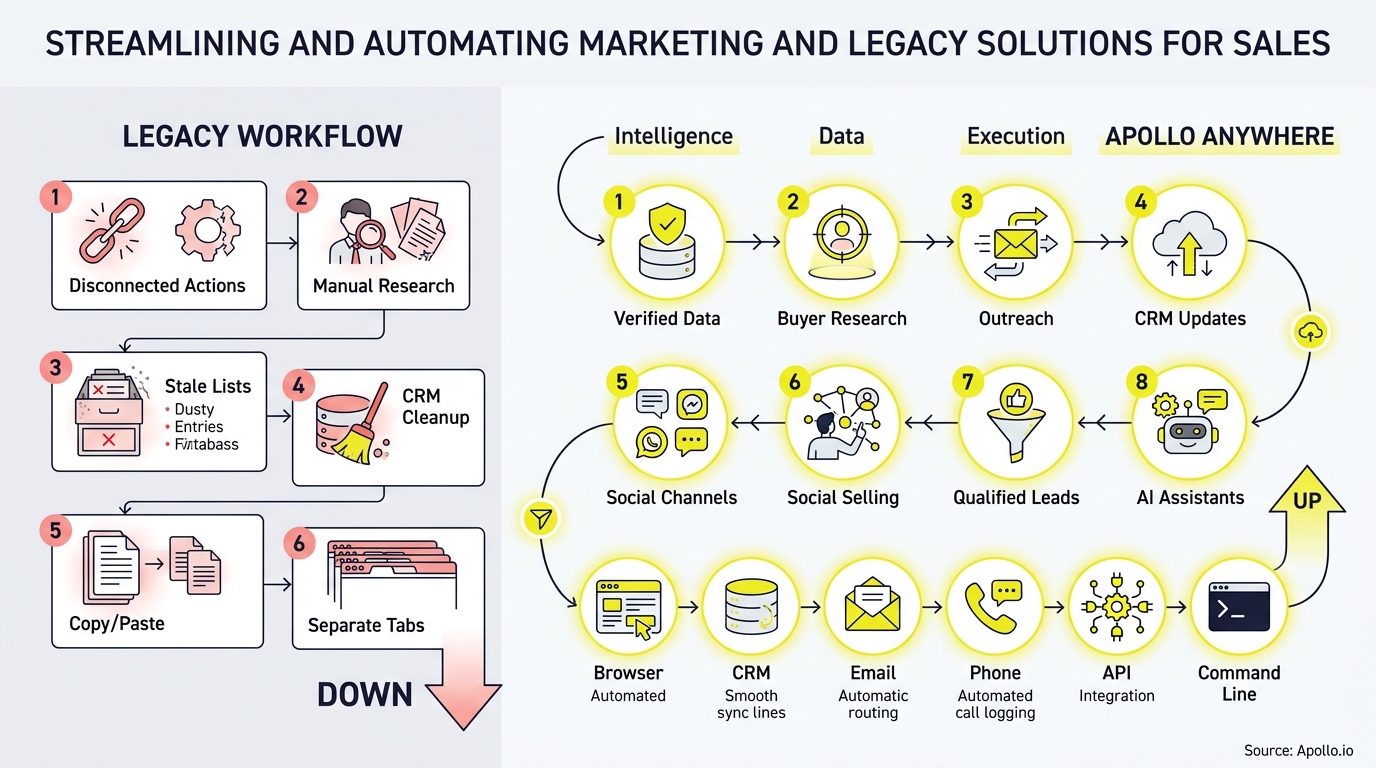

Skip Manual Research, Apollo Verifies Contacts
Spending hours a day chasing bad emails and stale contact info? Apollo verifies business contacts with 98% email accuracy so your reps sell instead of searching. Join 600K+ companies building pipeline on clean data.
Start Free with Apollo →Key Takeaways
- Automation works best when it augments rep judgment instead of replacing it, keeping humans in the loop for review and sequencing decisions.
- A shared context layer connecting CRM data, intent signals, and engagement history matters more than any single AI feature.
- Signal-based outreach targeting the right accounts at the right moment outperforms fixed, high-volume sequences.
- Governance guardrails around fact-checking, brand voice, and deliverability protect sender reputation as volume scales.
- Measuring pipeline influence requires shared RevOps definitions, not just activity counts like emails sent.
What Is Streamlining And Automating Marketing/Outreach For Sales?
Streamlining and automating marketing and outreach for sales is the practice of connecting buyer signals, enrichment data, content, and sequencing into one operating model so reps spend less time on manual tasks and more time selling.
It is not the same as blasting generic templates at scale.
The distinction matters: automation without shared context just accelerates fragmented, irrelevant messaging, while automation built on unified data produces outreach that feels personal.
A 2026 funding round for AI-native startup Alta underscored this shift. According to SiliconANGLE, the company is building a shared "company brain" connecting CRM records, emails, calls, and deal data so coordinated agents can automate outreach without producing disconnected, generic messages. The real competitive advantage isn't the AI model, it's the context feeding it.
How Does The End-To-End Automation Workflow Work?
The workflow moves through eight connected stages: signal capture, enrichment, content selection, draft, human review, sequencing, handoff, and measurement. Each stage has an owner and a guardrail so automation speeds things up without sacrificing quality.
- Signal capture: Intent data, firmographic changes, and website activity flag which accounts are worth pursuing now.
- Enrichment: Contact and company data gets verified and filled in so reps aren't guessing at titles or emails.
- Content selection: The system matches the account's stage and industry to approved messaging or case studies.
- Draft: AI generates a first-pass message using account context, not a generic template.
- Human review: A rep or SDR checks accuracy, tone, and relevance before anything sends.
- Sequencing: Approved messages enter a multi-channel cadence across email, phone, and social.
- Handoff: Engaged leads route to the right rep with full context attached.
- Measurement: Pipeline and revenue outcomes tie back to the specific content and sequence that drove them.
This mirrors what McKinsey found in its 2026 B2B research: growth leaders who embed AI into core workflows cite seller efficiency as the top benefit, but fewer than 10% of organizations have scaled AI in any single function. The gap isn't the technology, it's workflow design. Learn more about the underlying framework in the sales acceleration formula.
What Is The Task-By-Task Automation Matrix?
The automation matrix assigns each outreach task an owner, required data, guardrail, and KPI so teams know exactly where humans stay in the loop.
| Task | Owner | Required Data | Guardrail | KPI |
|---|---|---|---|---|
| Account prioritization | RevOps | Intent signals, firmographic fit | Score threshold before outreach triggers | % accounts meeting ICP fit |
| Contact enrichment | SDR/BDR | Verified email, title, company data | Waterfall verification before send | Data accuracy rate |
| Message drafting | AI + Rep | CRM history, prior engagement | Human review before send | Approval turnaround time |
| Sequence execution | Sales Engagement Platform | Approved content library | Send caps, unsubscribe compliance | Reply and meeting rate |
| Lead handoff | AE | Engagement history, deal context | SLA on response time | Speed-to-lead |
| Pipeline attribution | RevOps | Closed-won/lost data tied to sequence | Shared attribution definitions | Pipeline influenced by content/sequence |
Spending hours on manual outreach coordination? Automate your sequences with Apollo's multi-channel platform and keep every task above connected in one workspace.
How Do SDRs And AEs Use Automation To Book More Meetings?
SDRs and AEs use automation to cut research and admin time so more of the day goes toward live conversations. Research from Martal Group shows AI agents can now handle up to 80% of SDR tasks, including prospecting and scheduling, freeing reps for higher-value conversations.
For Account Executives managing a full deal load, automation shows up differently: pre-meeting intelligence, deal-stage alerts, and automated follow-up drafts that AEs review rather than write from scratch. SDRs report that automated enrichment alone removes the guesswork of chasing down a prospect's current title or company. According to professional networks's ROI of AI report, 38% of sellers using AI for lead and company research save over 1.5 hours per week.
Struggling to find qualified leads before your next sequence goes out? Search Apollo's 240M+ contacts with 65+ filters to build lists that match your ICP before a single message sends.
See Deal Stages Clearly, Forecast With Apollo
Forecasting off gut feel because deal data lives in five different places? Apollo unifies signals, engagement history, and CRM activity so every stage reflects reality. Built-In improved win rates using Apollo's scoring and signals.
Request a Demo →How Do You Automate Outreach Without Sounding Automated?
You automate outreach without sounding automated by keeping a human in the review loop and building messages from real account context instead of generic fields.
AI drafts based on CRM history and recent activity read differently than templates with a first-name merge tag.
- Require rep sign-off before any AI-drafted message sends to a real prospect.
- Pull specific context (recent funding, product launch, job change) into the first line.
- Cap sequence volume per account so signal-based relevance beats raw send volume.
- Rotate messaging based on engagement, not a fixed calendar.
This shift toward signal-based outreach over fixed, high-volume sequences reflects where the market is heading. Salesforce's own agentic marketing announcement in June 2026 highlighted systems that continuously evaluate intent signals to decide who receives outreach and when a human should step in.
What Governance Guardrails Protect Deliverability?
Governance guardrails protect deliverability by enforcing authentication standards, fact-checking AI output, and setting escalation rules before scale becomes a liability. Major mailbox providers have tightened requirements for high-volume senders, making SPF, DKIM, and DMARC authentication a baseline requirement rather than an option.

- Fact-check AI drafts: Require a named reviewer to confirm claims before send.
- Brand voice checks: Maintain an approved messaging library AI must pull from.
- Privacy review: Confirm enrichment data sources meet your team's data handling policies.
- Escalation path: Define who gets notified when a sequence generates a complaint or bounce spike.
How Do You Measure Outreach Pipeline Impact?
You measure outreach pipeline impact by tying every sequence, message, and piece of content to closed-won revenue using shared RevOps definitions across sales and marketing. Activity metrics like emails sent or calls dialed don't tell you what drove a deal.
Sales teams that automate lead management see a 10% or greater increase in revenue within 6-9 months, according to Overton Collective, citing Gartner research. That kind of gain only shows up in reporting when attribution ties back to specific content and sequences, not just aggregate activity.
Track these fields at minimum inside your CRM:
- Source sequence or campaign ID attached to every touch
- Content asset ID used in each outreach message
- Engagement stage (opened, replied, meeting booked, opportunity created)
- Attribution weight assigned by shared marketing/sales agreement
See how sales analytics connects these data points to revenue outcomes, and review sales performance management strategy for building the reporting cadence that keeps sales and marketing aligned on the same numbers.
What Does A 30-Day Rollout Checklist Look Like?
A 30-day rollout checklist breaks automation implementation into weekly phases so teams avoid launching untested workflows at full volume.
| Week | Focus | Key Actions |
|---|---|---|
| Week 1 | Data foundation | Audit CRM fields, connect enrichment source, define ICP criteria |
| Week 2 | Content and templates | Build approved messaging library, set brand voice guardrails |
| Week 3 | Pilot sequence | Run automation on a small account segment with full human review |
| Week 4 | Scale and measure | Expand to full territory, connect attribution reporting, review deliverability |
Teams consolidating this rollout inside a single platform typically see the fastest wins. As Collin Stewart of Predictable Revenue put it: "We reduced the complexity of three tools into one." Explore how to build a sales tech stack that scales revenue for a deeper implementation framework, and check what sales transformation looks like when RevOps leads it.
What's Next For Sales Automation In 2026?
What's next is a move from standalone AI copilots toward autonomous orchestration across the full revenue lifecycle. Recent funding activity supports this: Gradial raised $65 million to expand AI agents executing marketing work across systems like Adobe and Salesforce, with Axios reporting a customer example of reduced campaign-execution time.
The pattern across every major 2026 announcement is the same: connected context beats isolated point solutions. Apollo brings B2B data, sales engagement, and AI-powered execution together in one connected go-to-market system, so teams don't have to stitch together separate vendors for research, outreach, and analysis.
As Census put it after consolidating their stack: "We cut our costs in half."
Frequently Asked Questions
How Do RevOps Leaders Consolidate Automation Tools?
RevOps leaders consolidate automation tools by auditing overlapping capabilities across their data, engagement, and analytics platforms, then moving to a unified system that handles enrichment, sequencing, and reporting together. Fewer integrations mean fewer points of data drift and less time reconciling conflicting records between systems.
What Should Founders Building Outbound Prioritize First?
Founders building outbound should prioritize clean contact data and a defined ICP before adding automation layers on top. Automating a broken targeting strategy just produces irrelevant outreach faster.

Ready To Connect Your Outreach Workflow?
Streamlining and automating marketing and outreach for sales isn't about replacing reps with bots. It's about building a workflow where signals, content, and human judgment work together so every message lands with context and every result ties back to pipeline. Schedule a Demo to see how Apollo connects your data, engagement, and reporting in one workspace built for modern GTM teams.
Prove ROI Fast, Scale Without New Hires
Struggling to justify tool spend before the next budget review? Apollo replaces scattered point solutions with one platform reps actually use, so results show up before renewal conversations start. Leadium 3x'd annual revenue after consolidating on Apollo.
Start Free with Apollo →Don't miss these
Sales
Inbound vs Outbound Marketing: Which Strategy Wins?
Sales
What Is a Sales Funnel? The Non-Linear Revenue Framework for 2026
Sales
What Is a Go-to-Market Strategy? The 2026 GTM Playbook
See Apollo in action
We'd love to show how Apollo can help you sell better.
By submitting this form, you will receive information, tips, and promotions from Apollo. To learn more, see our Privacy Statement.
4.7/5 based on 9,690 reviews
