
How to Set Up Email Cadences for Prospect Outreach
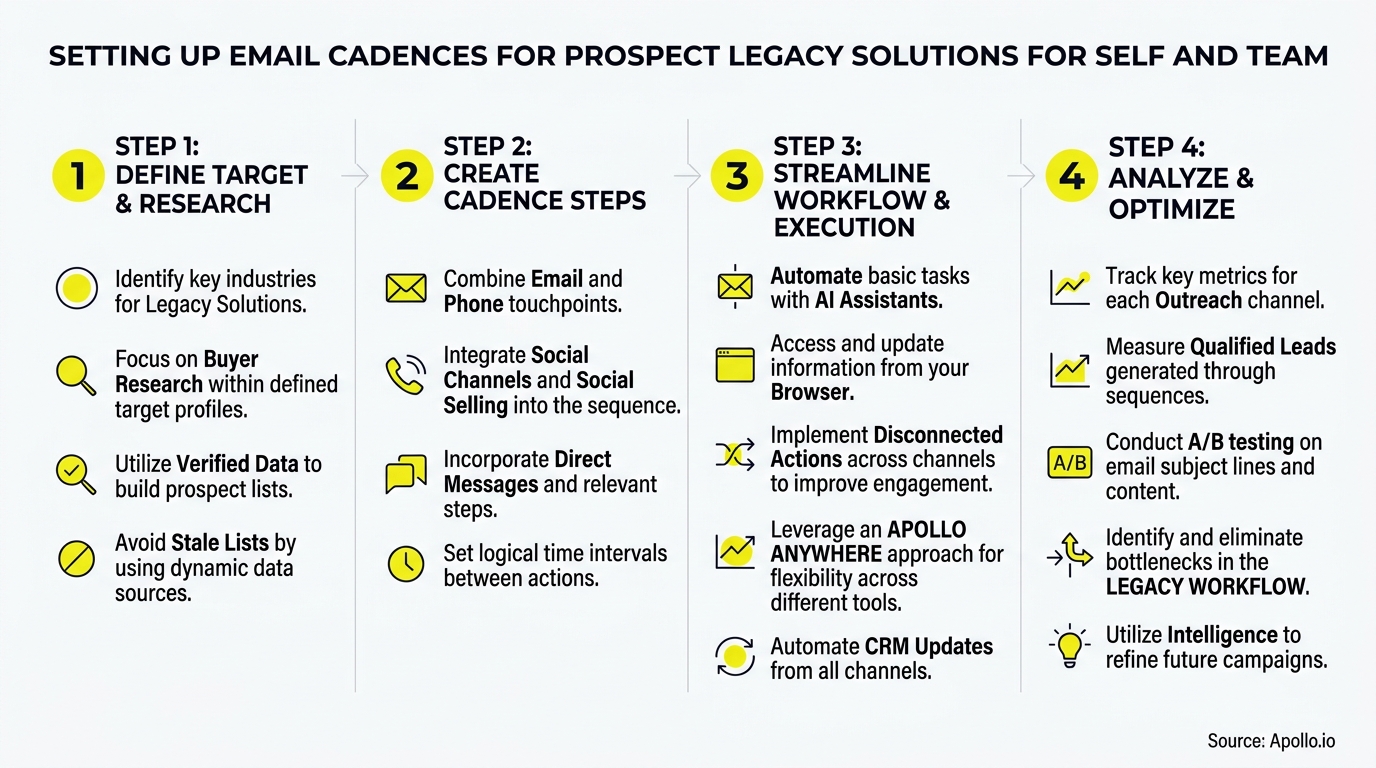
Most reps build a cadence, blast it to 200 prospects, and wonder why replies trickle in at 1-2%. The fix isn't more touches, it's a governed system: a personal cadence you can run this week, plus a team rollout that keeps deliverability, compliance, and quality intact as headcount grows.
This guide gives you both tracks: a 14-day starter cadence you can launch solo, and a manager checklist to scale it without torching your domain reputation. You'll also get a channel-by-day framework, a personalization decision tree, and stop rules that keep your team compliant and your replies climbing.

Skip The Research, Apollo Finds Verified Contacts
Spending hours manually researching leads and double-checking emails that still bounce? Apollo delivers verified contact data with 98% email accuracy, so reps spend less time digging and more time selling.
Start Free with Apollo →Key Takeaways
- A finite, multichannel cadence outperforms an endless email drip. Most prospects respond within 8-12 touches, not 20+.
- Manual personalization still beats full automation. Reserve automation for scheduling and tracking, not message quality.
- Team cadences need domain-level governance: shared suppression lists, sending throttles, and one approval workflow to protect deliverability for everyone.
- Measure meetings and pipeline per enrolled prospect, not opens. Open-rate tracking is increasingly unreliable as inbox providers filter more aggressively.
- Consolidating prospecting, enrichment, and sequencing into one platform cuts the coordination overhead that breaks cadences at scale.
What Is An Email Cadence For Prospect Outreach?
An email cadence is a planned sequence of timed touchpoints, across email, phone, and social, designed to reach a prospect with increasing context until they respond or opt out.
It is not a single follow-up email or an unlimited drip campaign.
A cadence is defined by three things: touch count (how many attempts), channel mix (email, call, social), and spacing (days between touches). Cold Email Manifesto reports that the average B2B prospect requires 8 to 12 touchpoints over 17 to 21 days to book a first meeting, which sets a practical ceiling for how long a sequence should run before you stop or re-segment the prospect.
Cadences differ from generic drip marketing because they're built for 1:1 sales conversations, not broadcast messaging.
Each touch should reference the prospect's role, company signal, or prior engagement, not just insert a first name into a template.
How Do You Set Up A Personal Email Cadence For Prospecting?
You set up a personal cadence by defining your ICP, mapping touches to a 14-day window, and mixing email with calls and social before you write a single line of copy.
Start with the structure, then fill in messaging.
What Does A 14-Day Starter Cadence Look Like?
Use this table as your baseline.
Adjust touch count based on your segment (see the decision tree below).
| Day | Channel | Action | Goal |
|---|---|---|---|
| Day 1 | Personalized opener referencing a specific trigger (funding, hire, tool change) | Establish relevance | |
| Day 1 | Social | Connection request or engagement on a recent post | Build familiarity |
| Day 3 | Call | Cold call, leave voicemail if no answer | Add a human channel |
| Day 3 | Short follow-up referencing the voicemail | Reinforce the call | |
| Day 7 | Value-add follow-up (case study, resource) | Provide new reason to reply | |
| Day 10 | Call | Second call attempt | Re-engage via voice |
| Day 14 | Breakup email with clear opt-out | Force a decision, protect list health |
Gong's benchmark data shows that starting a sequence with a cold call can double the subsequent email reply rate, and a voicemail alone doubles the likelihood of an email reply.
That's why Day 3 pairs a call with a follow-up email instead of running email-only.
For send timing, review the best times to email and call prospects before you schedule Day 1 and Day 3 touches.
How Do You Decide Touch Count And Personalization Level?
Use a simple decision tree based on deal size and signal strength:
- High-value account + strong buying signal (recent funding, new VP hire, competitor churn): 10-12 touches, fully manual personalization, multichannel from Day 1.
- Mid-tier account + moderate fit: 6-8 touches, templated opener with one personalized line, automate scheduling only.
- Volume/low-tier account: 4-5 touches, lightweight personalization (company name, industry), automate sending and follow-up logic.
Gong's 2025 benchmarks found manual emails achieve a 2.1% median reply rate versus 1.1% for automated emails, with top-quartile reps hitting 3.9%.
Reserve your manual effort for the accounts where it matters most, and let automation handle logistics, not message quality, everywhere else.
Need help writing the actual messages? See how to write sales emails that get responses and how to personalize emails with smart content for templates that fit each tier.
How Do SDRs And AEs Book More Meetings With A Structured Cadence?
SDRs and AEs book more meetings by pairing a defined touch sequence with account signals instead of blasting a flat list.
A signal-triggered opener, referencing a job change, funding round, or tech stack shift, consistently outperforms a generic template.
For SDRs managing volume, this means segmenting lists before enrollment so high-signal accounts get the 10-12 touch treatment while cold list-fill gets 4-5 lighter touches. MarketBetter's 2026 SDR benchmarks report a median monthly target of 12-15 qualified meetings, with top performers hitting 20+, a gap that often comes down to cadence discipline, not raw volume.
For AEs running their own outbound alongside SDR-sourced pipeline, cadences should trigger from deal-stage signals: a stalled opportunity, a champion who went quiet, or a multi-threading gap. Struggling to find the right decision-makers to add to these cadences? Search Apollo's 240M+ contacts with 65+ filters to build signal-qualified lists before you write a single email.

How Do You Scale An Email Cadence From One Rep To A Full Team?
You scale a cadence to a team by centralizing template ownership, setting domain-wide sending limits, and building shared suppression lists before you add a second sender.
Individual reps improvising their own sequences is what breaks deliverability and brand consistency at scale.
What Should Be In A Manager Rollout Checklist?
- Template governance: One approved template library per persona/segment, version-controlled, so reps aren't inventing messaging that contradicts marketing content.
- Sending throttles: Cap daily sends per mailbox and monitor domain-wide volume. Gmail treats domains sending roughly 5,000 messages to personal accounts in 24 hours as bulk senders, per Google's bulk sender guidelines, so team-wide coordination matters more than any single rep's volume.
- Shared suppression lists: One master opt-out and do-not-contact list across the team, synced in real time.
- Authentication: SPF, DKIM, and DMARC configured at the domain level before scaling sends past a handful of reps.
- QA rubric: Spot-check a sample of live sequences weekly for personalization quality, broken merge fields, and tone consistency.
- Reporting cadence: Weekly review of replies, meetings booked, and complaint rates by sequence, not just by rep.
RevOps teams often own this rollout.
As Terret notes, RevOps has become the connective tissue for teams managing these complex cadences, since no single rep can see domain-wide sending health or cross-sequence suppression conflicts.
How Do You Keep Team Cadences Compliant?
You keep team cadences compliant by centralizing opt-out handling, monitoring complaint rates, and auditing message content against CAN-SPAM and platform bulk-sender policies.
This is a governance function, not a per-rep responsibility.
- Every email must include a working one-click unsubscribe.
- Complaint rates should stay well under Google's warning threshold, per the bulk sender guidelines cited above.
- Physical business address and clear sender identification are required in every commercial email under CAN-SPAM.
- Suppression syncs should run in real time, not overnight, so a prospect who opts out with one rep doesn't get contacted by another.
Tired of managing suppression lists and sending limits across five different tools? Apollo's sales engagement platform centralizes sequencing, suppression, and reporting so your team isn't stitching governance together by hand.
See Every Deal Stage Before It Stalls
Forecasting off gut feel because deal stages are always a guess? Apollo gives you real-time pipeline visibility so nothing slips through the cracks. Built-In improved win rates using Apollo's scoring and signals.
Start Free with Apollo →How Do You Measure Whether A Cadence Is Working?
You measure cadence performance by tracking replies, meetings, and pipeline per enrolled prospect, not opens or clicks.
Open-tracking has become unreliable as inbox providers filter more aggressively, so anchor your dashboard to outcomes further down the funnel.
| Metric | Why It Matters |
|---|---|
| Positive reply rate | Signals message relevance, not just deliverability |
| Meetings booked per 100 enrolled | Ties cadence directly to pipeline generation |
| Complaint/unsubscribe rate | Early warning for deliverability risk |
| Pipeline generated per sequence | Connects cadence design to revenue, not just activity |
Gradient Works' 2025 benchmarks found that just 14% of sellers now drive 80% of revenue, an 11x gap between top and bottom quartiles.
Cadence discipline, segmentation, and personalization quality are frequently what separates those tiers, not raw activity volume.
What Are Common Email Cadence Mistakes To Avoid?
The most common mistake is running one identical cadence for every prospect regardless of fit or signal strength.
This wastes touches on low-intent accounts and under-serves high-value ones.
- Email-only sequences: Skipping calls and social touches leaves reply-rate gains on the table, since multichannel touches outperform email-only drips.
- No stop rules: Cadences that never end damage sender reputation and annoy prospects.
Cap at 10-12 touches and force a decision with a breakup email. - Fully automated personalization: Templates with only a first-name merge field consistently underperform manual, signal-based openers.
- Ignoring domain-wide volume: One rep's aggressive sending can flag the whole company's domain as a bulk sender, hurting deliverability for every rep on that domain.
- No shared suppression list: Prospects who opt out with one rep get re-contacted by another, creating compliance risk and prospect frustration.
Review why emails land in spam and how to fix it if your team is seeing declining reply rates despite good copy, deliverability issues are often the hidden culprit.
What's Next For Email Cadences In 2026?
Cadences are shifting from fixed, calendar-based sequences to signal-triggered outreach that adapts based on account fit and buyer behavior.
Static "Day 1, Day 3, Day 7" templates still work as a baseline, but the highest-performing teams increasingly re-route or pause a cadence based on real-time engagement signals rather than running it blind to completion.
This shift also means treating your prospecting stack as one connected system rather than a patchwork of point tools. Teams that consolidate data, enrichment, and sequencing report meaningfully less coordination overhead. Collin Stewart of Predictable Revenue put it simply: "We reduced the complexity of three tools into one."
Frequently Asked Questions
How Many Touchpoints Should A Sales Cadence Have?
Most B2B cadences perform best with 8-12 touchpoints spread across 17-21 days, per Cold Email Manifesto's research. Reevo reports that 70% of reps quit after just one email, yet 80% of sales require 5 or more follow-ups, so the biggest lever most teams have is simply not stopping too early.
Should Email Cadences Be Automated Or Manual?
A hybrid approach works best: automate scheduling, sending, and follow-up logic, but keep message personalization manual for your highest-value accounts. Automating message content across the board consistently underperforms manual, signal-based personalization.
How Do You Avoid Deliverability Problems When Scaling A Team Cadence?
Avoid deliverability problems by authenticating your domain (SPF, DKIM, DMARC), capping daily sends per mailbox, and monitoring domain-wide volume so no single rep pushes the whole team's domain into bulk-sender status. This requires centralized oversight, usually from RevOps, not per-rep management.
What's The Difference Between A Cadence And A Drip Campaign?
A cadence is a multichannel, finite sequence built for 1:1 sales conversations with defined stop rules. A drip campaign is typically email-only, broadcast-style, and often continues indefinitely without a clear exit point.
How Fast Should The First Follow-Up Email Go Out?
Cybergarden's research found that a 3-day delay before the first follow-up yielded a 31% increase in replies compared to waiting longer, making it a reasonable default for Day 3 of your sequence.

Ready To Run Cadences Without The Tool Sprawl?
Building a cadence is one thing. Running it across prospecting, enrichment, sequencing, and reporting without juggling four separate logins is another.
Apollo brings B2B data, sales engagement, and AI-powered execution together in one connected go-to-market system, so teams don't have to stitch together separate vendors for research, outreach, and analysis.
Whether you're an SDR launching your first personal cadence or a RevOps leader rolling out governance across 30 re ps, Apollo's sales engagement platform gives you the contact data, sequencing tools, and performance reporting in one workspace instead of a patchwork of point solutions.
Start free with Apollo and build your first cadence today.
Ramp New Reps Fast, Prove ROI With Apollo
New reps taking months to hit quota while leadership questions the tool spend? Apollo gives every rep the same playbooks, sequences, and data from day one, so ramp time shrinks and results show up in pipeline, not spreadsheets. Leadium 3x'd revenue after automating outbound with Apollo.
Start Free with Apollo →Don't miss these
Sales
Inbound vs Outbound Marketing: Which Strategy Wins?
Sales
What Is a Sales Funnel? The Non-Linear Revenue Framework for 2026
Sales
What Is a Go-to-Market Strategy? The 2026 GTM Playbook
See Apollo in action
We'd love to show how Apollo can help you sell better.
By submitting this form, you will receive information, tips, and promotions from Apollo. To learn more, see our Privacy Statement.
4.7/5 based on 9,690 reviews
