
SalesPipe is the name of a founder-run outbound service, not a generic sales pipeline tool, and that distinction decides how you should evaluate it. This guide explains what the service says it does, who it may fit, how to score it against other options, and how to measure ROI. It draws on Apollo's prospecting platform workflows and standard vendor-evaluation criteria. It does not draw on insider knowledge of SalesPipe's client results, so verify every claim directly with the vendor.

Skip Manual Research. Apollo Finds Buyers.
Burning hours researching leads and verifying contact info before you ever hit send? Apollo puts 240M+ contacts and 98% email accuracy in one workspace, so your team spends the day selling. Start free and see your first list in minutes.
Start Free with Apollo →Key Takeaways
- SalesPipe is a service, not software. Evaluate it like an agency (people, process, reporting), not like a CRM or data tool.
- Ask for evidence. Request references, sample sequences, and reporting examples before you sign.
- Score every option on the same rubric. Compare outsourced, hybrid, and in-house models on cost, control, speed, and data ownership.
- Define ROI before launch. Agree on meetings, qualified pipeline, and cost per opportunity up front.
- In-house is a real alternative. A unified platform lets a small team run outbound with full control of its data.
What Is SalesPipe, and What Is It Not?
SalesPipe is a founder-run outbound service that sets up and runs prospecting on behalf of clients. It is not a CRM, a pipeline-tracking dashboard, or a self-serve prospecting database.
The name causes confusion because "sales pipe" and "sales pipeline" are also generic terms for the stages a deal moves through. Searches for the brand often return pipeline-management content instead.
| It Is | It Is Not |
|---|---|
| A done-for-you outbound service | A software license you operate yourself |
| A vendor relationship with scope, deliverables, and reporting | A generic pipeline-stage framework |
| A decision about outsourcing execution | A replacement for your CRM or your sales process |
Confirm scope, contract terms, and pricing on SalesPipe's own site or in a requested quote, since details change and are not verified here.
Who Might an Outbound Service Like SalesPipe Fit?
Outsourced outbound tends to suit teams that need meetings quickly but have not hired or ramped an SDR team. Fit depends on your motion, deal size, and appetite for handing over messaging.
- Founders and CEOs: Useful when you are still selling personally and have no one to own outbound.
- Sales and revenue leaders: Useful as a test of a new segment before you commit headcount.
- RevOps: Needs clear data handoff, CRM hygiene, and attribution rules from day one.
- SDR/BDR managers: May prefer keeping prospecting in-house to preserve coaching and message control.
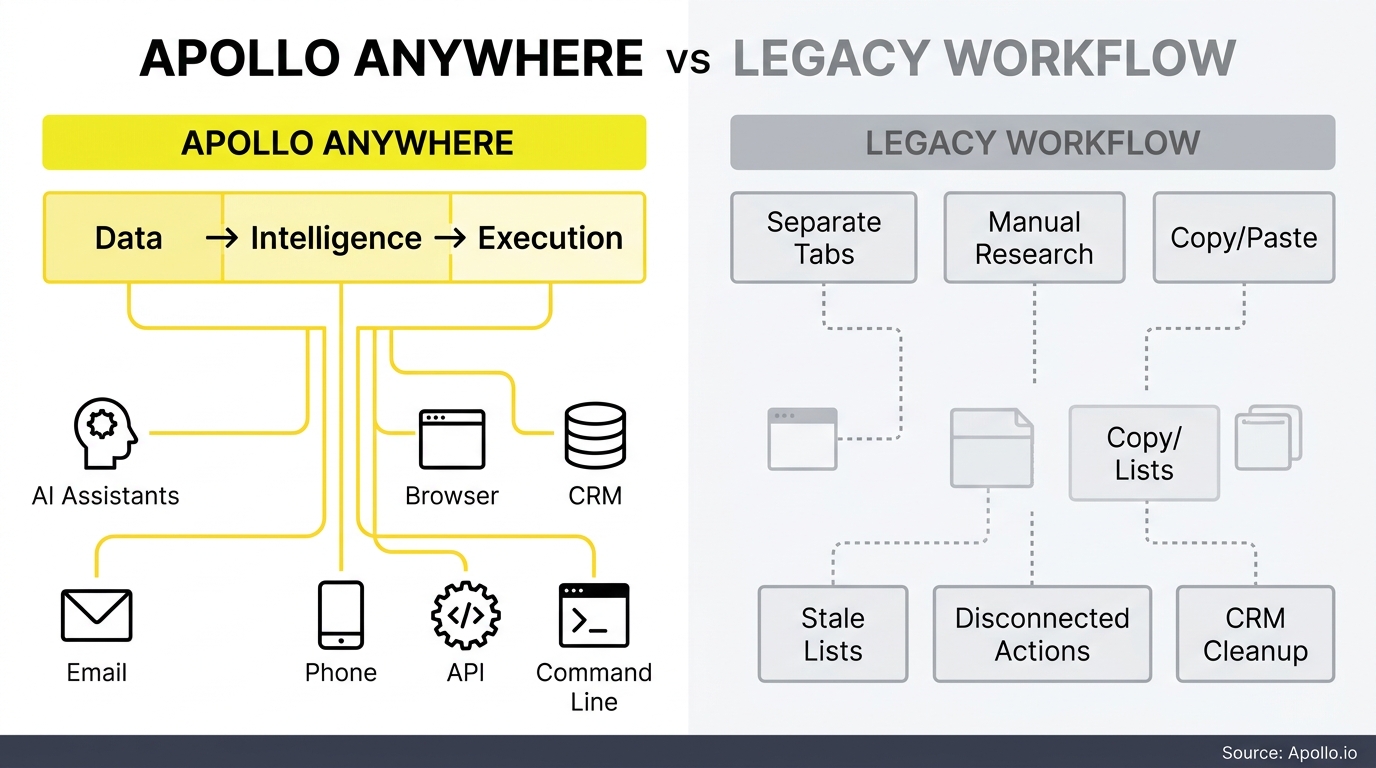
Apollo serves B2B GTM teams, GTM Engineers, and AI Builders building headless GTM workflows with the Apollo API, CLI, and MCP, alongside Sales Professionals, SDRs/BDRs, AEs, RevOps, Marketing, and Revenue Leaders. That spread of roles is why many teams weigh a service against running outbound themselves.

How Should a RevOps Leader Score SalesPipe Against Other Options?
Score every option on the same weighted rubric. This keeps a persuasive sales call from deciding the outcome.
| Criterion | Questions to Ask |
|---|---|
| Targeting | Who defines the ICP, and how are lists built and approved? |
| Messaging | Who writes copy, and can you review it before it sends? |
| Data ownership | Do you keep contacts, sequences, and reply history if you leave? |
| Reporting | Do you get meeting, reply, and pipeline data in your CRM? |
| Contract terms | What are the minimum term, exit clause, and scope of work? |
| Cost | What is the total monthly cost against cost per qualified meeting? |
Run the same rubric against an in-house build and a hybrid model. Compare total cost, not just the headline retainer.

How Do You Measure ROI on Outsourced Outbound?
Measure ROI by cost per qualified opportunity and pipeline created, not by raw meeting count. Meetings that never convert inflate results without adding revenue.
- Set definitions: Agree in writing on what counts as a qualified meeting.
- Set a baseline: Record your current reply rate, meeting rate, and cost per opportunity.
- Track by stage: Follow each lead from send to reply, meeting, qualified opportunity, and closed-won.
- Calculate cost per qualified opportunity: Divide total spend (retainer, tools, and internal time) by qualified opportunities created.
- Compare against payback: Weigh pipeline value and win rate against total cost over at least two full sales cycles.
Judge results over a window long enough to cover your typical sales cycle. A short pilot can show reply and meeting trends, but it rarely shows revenue impact.
What Should You Ask Before Signing With an Outbound Provider?
Ask questions that expose how the work is done, who owns the assets, and how you can leave. Clear answers up front prevent expensive surprises later.
- Who writes the messaging, and do you approve it before it sends?
- Where does the contact data come from, and how is it verified?
- Which sending domains and inboxes are used, and who owns them?
- How do you handle opt-outs, bounces, and compliance requirements?
- What counts as a qualified meeting, and what happens when a meeting no-shows?
- Can you export contacts, sequences, and reply history at any time?
- What is the minimum term, and what does the exit process look like?
Apollo Turns Forecast Guesswork Into Pipeline
Comparing outsourced outbound to in-house while your funnel runs thin on quality leads? Apollo puts 240M+ contacts and every deal stage in one workspace, so you see what's real before you commit. Forecasts finally match reality. Start free and see your pipeline clearly.
Start Free with Apollo →How Does Apollo Fit Into an Outbound Strategy?
Apollo gives your team the data and execution layer to run outbound itself or to keep visibility alongside an agency. You can build targeted lists, enrich contacts, sequence outreach, and track results in one platform.
- Prospecting data: Search by title, industry, company size, and other filters to build focused lists.
- Sequencing: Run multi-step email and call sequences with reply tracking.
- Visibility: Keep contacts, activity, and outcomes in a system your team owns.
- Flexibility: Start in-house, add outsourced help where it makes sense, and keep your data either way.
Owning the data layer also makes any vendor comparison easier. You can benchmark an outsourced program against your own results using the same metrics.
Frequently Asked Questions
Is salespipe the right choice for every B2B company?
No. Outsourced outbound tends to suit teams that need pipeline faster than they can hire and ramp reps.
Teams with a well-defined motion and capacity to run it may do better in-house or with a hybrid model.
How long should I test an outbound service before judging it?
Give it enough time to cover setup, warm-up, a few message iterations, and at least part of your sales cycle. Early signals like reply rate help, but pipeline and closed revenue are the real tests.
What metrics matter most when evaluating outsourced outbound?
Focus on reply rate, qualified meeting rate, cost per qualified opportunity, pipeline created, and win rate. Raw meeting volume alone can be misleading.
Should I own the data and sending infrastructure?
Whenever possible, yes. Owning your contacts, sequences, and reply history means you can switch providers or bring the work in-house without starting over.
Can I combine an outbound service with my own team?
Yes. Many teams use a hybrid approach, with a provider handling part of the volume while internal reps focus on high-value accounts. Shared reporting keeps both efforts comparable.
Conclusion
Choosing an outbound partner like salespipe comes down to fit, transparency, and measurable return. Score every option with the same rubric, define a qualified meeting in writing, and track cost per qualified opportunity over a full sales cycle.
Whichever path you choose, keep ownership of your data so your pipeline engine stays yours.
Ready to build or benchmark your outbound motion? Try Apollo to find your target accounts, run sequences, and track pipeline results in one place.
Apollo Delivers ROI From Day One
Onboarding new reps taking too long while leadership asks for proof of ROI? Apollo gives every rep one workspace with 240M+ contacts, so new hires ramp faster and pipeline impact is easy to show. Start free and see value in minutes.
Start Free with Apollo →Don't miss these
Sales
Inbound vs Outbound Marketing: Which Strategy Wins?
Sales
What Is a Sales Funnel? The Non-Linear Revenue Framework for 2026
Sales
What Is a Go-to-Market Strategy? The 2026 GTM Playbook
See Apollo in action
We'd love to show how Apollo can help you sell better.
By submitting this form, you will receive information, tips, and promotions from Apollo. To learn more, see our Privacy Statement.
4.7/5 based on 9,690 reviews
