Salesforce is the better fit for most teams buying a CRM today, while Siebel makes sense mainly for organizations already running it with deep customizations and strict on-premises requirements. The real decision for existing Siebel customers is not "Salesforce or Siebel" but "modernize, migrate, or phase the transition." This guide gives you the comparison, the decision framework, and the worksheets to make that call with evidence instead of vendor narratives. If your reps also spend hours on manual research, an integrated CRM strategy matters as much as the CRM itself.

Skip Manual Research - Apollo Finds Contacts
Tired of burning hours researching leads and verifying emails by hand? Apollo puts verified business contact info in front of you in seconds, with 98% email accuracy. Spend your day selling, not copy-pasting. Start finding your exact buyers today.
Start Free with Apollo →Key Takeaways
- New buyers will generally find Salesforce the more practical choice; existing Siebel customers should weigh modernization against migration before committing.
- Oracle has committed to Siebel Premier Support through at least 2037 (announced March 25, 2026), so a migration business case should rest on business value, not an imminent support deadline.
- Feature checklists are a weak way to choose. Test real workflows, data readiness, and total five-year cost.
- AI claims from both vendors need controlled pilots with measurable outcomes.
Salesforce vs Siebel: Which Should You Choose?
Choose Salesforce if you are a new CRM buyer, want a cloud-delivered platform with a broad ecosystem, and need fast iteration. Keep or modernize Siebel if you run a heavily customized deployment, have regulatory or deployment constraints that favor on-premises control, and your current system still supports your processes.
Consider coexistence if you need to migrate in phases. The table below summarizes fit across the dimensions that matter most.
| Dimension | Salesforce | Oracle Siebel CRM |
|---|---|---|
| Best fit | New buyers and teams prioritizing speed, ecosystem, and cloud delivery | Existing Siebel customers with complex, customized, long-running processes |
| Deployment model | Cloud-delivered SaaS | Traditionally installed on customer-managed infrastructure; deployment options vary by version, so confirm with Oracle |
| Cost structure | Subscription licensing plus add-ons; AI usage may add variable costs (Agentforce offers Flex Credits, conversation-based, and user-based models) | License and support relationship with Oracle, plus infrastructure, administration, and upgrade effort |
| Integrations | Large partner ecosystem; data governance expanded with the Informatica acquisition (completed November 18, 2025) | Integrates with Oracle stack and custom connectors; complexity depends on your existing architecture |
| Usability | Test with your own roles and workflows | Test with your own roles and workflows |
| Support horizon | Ongoing SaaS releases | Premier Support through at least 2037 per Oracle's March 2026 announcement |
| AI direction | Agentforce is in market; Salesforce reported Agentforce ARR above $1.5 billion in Q2 FY2027 | July 22, 2026 roadmap describes planned agents, assistants, MCP integration, and analytics; roadmap items are not universally available today |
How Big Is Salesforce Compared With Siebel in the CRM Market?
Salesforce is the market leader by revenue share, but market share does not tell you which product performs better for your team. According to Salesforce's summary of IDC research, the company has held the #1 global CRM market share position for 13 consecutive years. IDC's earlier tracker, as reported by Salesforce, put its 2024 worldwide CRM revenue share at 20.7%.
History adds useful context. A migration-focused analysis on Medium notes that Siebel Systems held approximately 45% of the worldwide CRM market at its peak in 2000 to 2002, before Oracle acquired it in 2006. That shift took two decades.
Two cautions apply. First, these figures describe vendor revenue position, not product quality or customer ROI.
Second, much of the share data is republished by vendors, so treat it as directional. Do not infer Siebel's current market share from Salesforce's number.
Is Siebel Still Supported, and Do You Need to Migrate Now?
Siebel is still supported, and no deadline forces an immediate migration. Oracle announced on March 25, 2026 that Siebel support extends through at least 2037, continuing its rolling ten-year commitment.
Earlier, in March 2025, Oracle had committed to Premier Support through at least 2036.
That changes how a migration proposal should be argued. A credible business case needs to show gains in seller productivity, campaign execution, integration cost, or customer experience. "Siebel is old" is not enough.
These are vendor commitments, not independent performance findings, so confirm the terms of your own support agreement.

Should You Modernize, Replace, or Coexist? A Decision Tree
Use this weighted decision framework to choose a path. Score each criterion from 1 to 5, multiply by the weight, and compare totals. Treat any disqualifying constraint as an override.
| Criterion | Weight | Points toward modernizing Siebel | Points toward replacing with Salesforce |
|---|---|---|---|
| Degree of customization | 20% | Heavy, business-critical customizations that would be costly to rebuild | Light customization or processes you want to standardize |
| Seller and user experience | 20% | Users are productive and adoption is healthy | Low adoption, heavy training burden, workarounds in spreadsheets |
| Integration architecture | 15% | Tight links to Oracle ERP and back-office systems that work well | Need for a wide ecosystem of third-party and AI tools |
| Data quality and governance | 15% | Clean, well-governed data already in place | Fragmented data you plan to consolidate during migration |
| Deployment and compliance constraints | 15% | Requirements for infrastructure control | Comfort with cloud delivery and vendor-managed releases |
| Transition risk tolerance | 15% | Low tolerance for disruption during revenue-critical periods | Capacity for a funded, staffed migration program |
What Are the Disqualifying Constraints?
- Replace is off the table if regulatory or contractual requirements prohibit your data from living in a vendor-managed cloud, or if you cannot fund parallel operations.
- Modernize is off the table if the platform cannot support a business process you have committed to, or key skills for maintaining customizations are unavailable.
- Coexist is the fallback when neither extreme works: migrate one business unit, region, or process first and keep the rest on Siebel until the evidence is in.
What Does Each Platform Really Cost Over Five Years?
Total cost of ownership is the most underbuilt part of most Salesforce-versus-Siebel comparisons. Research benchmarking the two platforms, such as Coffee.ai's analysis of Salesforce migration costs, evaluates them across market share, technographic footprint, migration costs and TCO, and user satisfaction. Use the worksheet below to build your own numbers with real quotes rather than generic benchmarks.
| Cost line item (5-year view) | Stay on / modernize Siebel | Migrate to Salesforce |
|---|---|---|
| License and support fees | Annual Oracle support and license costs | Annual subscription by edition and user count |
| Infrastructure and hosting | Servers, databases, environments, disaster recovery | Largely included, plus sandboxes and data storage add-ons |
| Customization and development | Ongoing configuration and upgrades | Rebuild of workflows, custom objects, and integrations |
| Data migration and remediation | Minimal, unless cleaning data in place | Extraction, cleansing, mapping, validation |
| Parallel operations | Not applicable | Running both systems during transition |
| Training and change management | Refresher training and process updates | Full retraining, adoption program, super-user network |
| AI and automation usage | Depends on which roadmap features are available in your version | Model realistic activity volumes; Agentforce pricing includes Flex Credits, conversation, and user-based options |
| Risk reserve | Upgrade and talent-retention risk | Contingency for schedule overrun and rollback |
Request written quotes from both vendors and your implementation partner, then fill in every row. Model AI costs at realistic activity levels, such as account research and lead follow-up volumes, rather than assuming equal seat counts produce comparable budgets.
Fill Your Funnel With Leads That Convert
Tired of guessing which leads will turn into real opportunities? Apollo connects you with the right business contacts and shows where every deal stands, so your forecast stops being a coin flip. Nearly 5M users already build pipeline with Apollo.
Start Free with Apollo →How Do You Migrate From Siebel to Salesforce Without Breaking Revenue?
Migrate in stages, with explicit exit criteria and a tested rollback plan for each. One benchmark cited by Microsoft's Dynamics 365 blog reports that enterprises moving legacy Siebel and multi-CRM stacks to unified cloud architectures achieved up to a 43% increase in order accuracy and a 23% increase in contact center productivity. That result comes from a competing vendor's marketing and describes a different target platform, so treat it as an illustration of what unified architectures can deliver, not a promise for any specific migration.
Migration Checklist
- Inventory. Catalog objects, customizations, integrations, reports, and user roles. Retire what nobody uses.
- Remediation. Deduplicate accounts and contacts, standardize fields, and define data ownership before moving anything.
- Design. Map Siebel processes to Salesforce objects and flows. Decide what to standardize and what to rebuild.
- Pilot. Migrate one team or region and measure against your baseline.
- Parallel operations. Define how long both systems run, which one is the system of record, and how conflicts are resolved.
- Cutover. Schedule outside peak selling periods, freeze changes, validate record counts, and test integrations.
- Rollback. Set objective triggers (for example, failed reconciliation or blocked order flow) and rehearse the reversal.
- Stabilize. Hold daily triage for the first weeks, track adoption, and fix defects before expanding.
Data readiness deserves special attention. Gartner reported in February 2025 that 63% of organizations lacked, or were unsure they had, appropriate data-management practices for AI.
Salesforce's completed Informatica acquisition shows how central data integration and governance have become, but neither platform fixes poor data on its own.
What Are the Key Differences in Usability and Adoption?
The product your team will use daily is the one that wins, so compare through real workflows rather than feature counts. Gartner's January to March 2024 survey of 1,026 B2B sellers found that 50% felt overwhelmed by required technology and 72% felt overwhelmed by required skills.
That is sales-wide research, not a Salesforce-versus-Siebel finding, but it supports a simple test design.
Workflow Scorecard Template
| Workflow | Steps / clicks | Time to complete | Training needed | Admin effort | Score (1-5) |
|---|---|---|---|---|---|
| Create and qualify a lead | |||||
| Update an opportunity and forecast | |||||
| Log a call and schedule follow-up | |||||
| Run a pipeline report | |||||
| Add a custom field and report on it |
Have representative reps, managers, and admins run identical tasks in both systems.
Record the results before drawing conclusions.
How Should You Evaluate AI in Salesforce vs Siebel?
Evaluate AI with a controlled pilot that measures completed work, not feature availability. Salesforce's February 2026 survey of more than 4,000 sales professionals found that 87% of sales organizations use some form of AI, which makes AI a baseline expectation.
But that is vendor-sponsored evidence, and it does not show that either platform performs better.
Independent research points the same direction. A 2023 NBER study reported nearly 14% higher customer-support productivity with AI assistance, with gains of approximately 35% among the least experienced and lowest-skilled workers.
That supports role-specific pilots; it does not say Salesforce or Siebel delivers those gains. McKinsey's 2025 survey of 1,993 participants found 88% reporting AI use in at least one business function, yet only 7% reporting fully scaled deployment.
Available AI and measurable AI value are not the same thing.
AI Pilot Scorecard Template
| Use case | Baseline (current process) | Salesforce pilot result | Siebel pilot result | Cost per successful task |
|---|---|---|---|---|
| Account research summary | ||||
| Lead scoring accuracy | ||||
| Follow-up email drafting | ||||
| Forecast accuracy |
Run both platforms on identical accounts, use the same reviewers, and report qualified meetings, hours saved, conversion rates, and cost per successful workflow.
Be cautious with vendor-reported activity metrics.
Salesforce itself introduced "Agentic Work Units" and reported 2.4 billion cumulative units in February 2026, but activity volume alone is not business impact. Salesforce also broadened its Agentforce ARR definition in Q2 FY2027 to include Slackbot and Headless 360, which complicates comparisons with earlier quarters.
On the Oracle side, the July 2026 roadmap describes planned functionality, so verify what is generally available in your version.
Why Do Sales Teams Still Need Data Beyond the CRM?
A CRM stores and organizes what you already know; it does not by itself find the contacts you do not have. Whether you choose Salesforce or Siebel, reps still need accurate prospect data and a way to act on it. Tired of dirty CRM records and manual list building? Start free with Apollo's 240M+ People and 30M+ Companies database to enrich the records your CRM already holds.
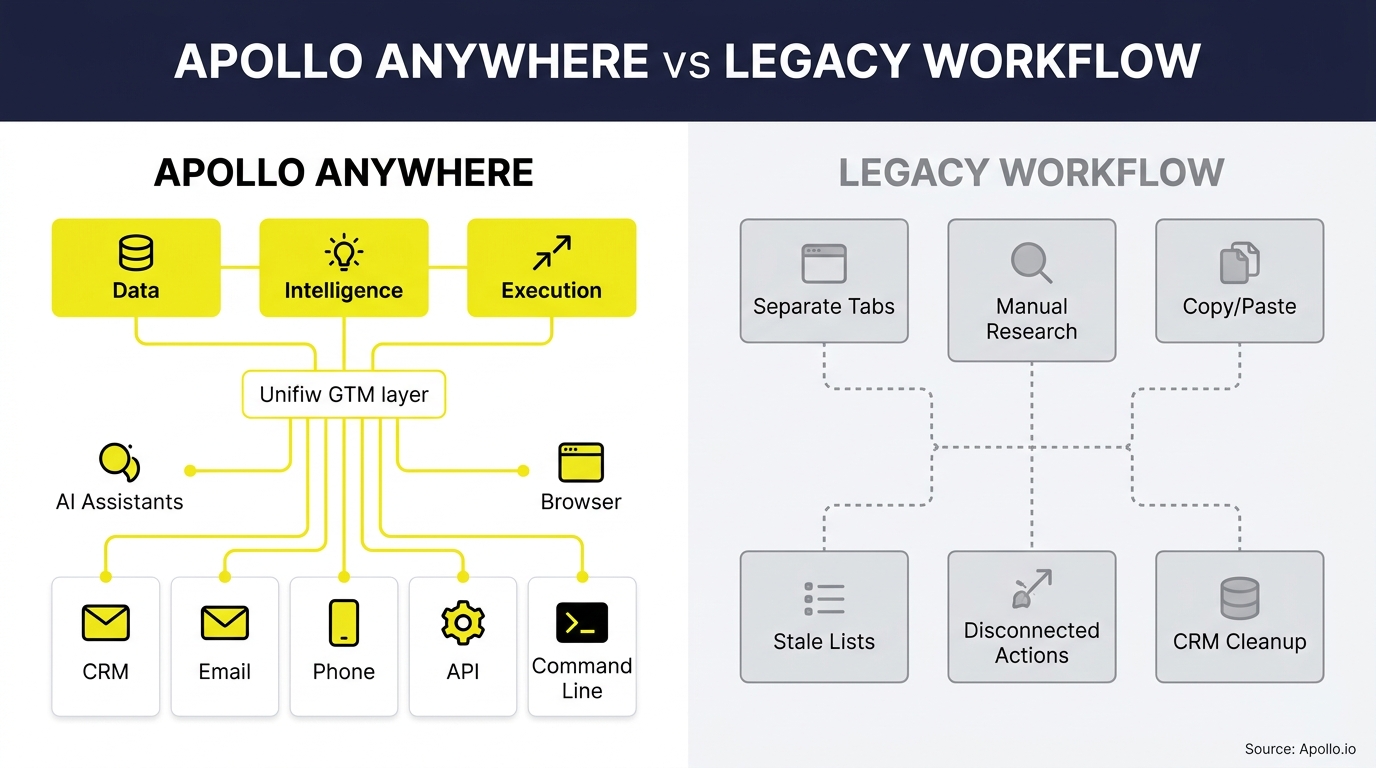
Apollo also brings B2B data, sales engagement, and AI-powered execution together in one connected go-to-market system, so teams don't have to stitch together separate vendors for research, outreach, and analysis. It works alongside Salesforce through native integrations, and reps can also use it across the web with the Chrome extension or inside AI assistants through Apollo MCP.
"The thing that made me most excited as somebody who's been in sales development a long time was Apollo's integration between sales data and sales engagement and the magic that you can make happen when those two are together on the same platform."
Your CRM choice and your data layer are separate decisions. Pair either system of record with sales engagement tools so sequences, calls, and tasks sync back to the opportunity record.
"Apollo enriches everything we have: contacts, leads, accounts... And we don't really have to touch it, it just works."
What Do Sales Leaders and RevOps Teams Ask About Salesforce vs Siebel?
Should a RevOps Leader Replace Siebel With Salesforce?
It depends on your disqualifying constraints, not on feature lists. If you have heavy custom logic, regulated data residency, or deep back-office integrations, a phased modernization or coexistence plan can carry less risk than a full cutover.
If your reps struggle with usability and your support timeline is tightening, migration usually deserves a funded business case.
Is Salesforce Easier for SDRs and AEs to Use Than Siebel?
Adoption is the deciding factor, so test it with your own reps. Run the workflow scorecard above with SDRs and AEs on the same tasks: logging a call, updating an opportunity, and building a follow-up.
Measure clicks, time to complete, and error rates rather than relying on general reputation.
Can You Run Salesforce and Siebel Together?
Yes, many companies coexist during a transition. Common patterns include moving front-office sales to Salesforce while Siebel keeps handling legacy order or service processes.
Define a single source of truth for each object (accounts, contacts, opportunities) up front so records do not diverge.
What Should Sales Leaders Measure Before Choosing?
Track five-year total cost, migration risk, rep adoption, and pilot results on identical accounts. Add pipeline outcomes such as qualified meetings and conversion rates so the decision rests on revenue impact, not vendor activity metrics.

Which CRM Should You Choose in 2026?
Choose Salesforce when you want a continuously updated platform, a broad ecosystem, and a simpler path to AI features. Keep or coexist with Siebel only when specific constraints make migration riskier than staying put, and confirm your support timeline with Oracle.
In both cases, validate costs over five years and test usability with your own reps.
Whichever system of record you pick, the CRM only works as well as the data and activity flowing into it. To see why Apollo stands alone as the only fully agentic GTM platform, combining sales intelligence, outbound execution, and enrichment in one workspace, Start Free with Apollo today.
Apollo Turns Tool Spend Into Provable Pipeline
Budget approval stuck because nobody can quantify the payoff? Apollo puts prospecting, outreach, and deal tracking in one platform, so pipeline impact is easy to show. Built-In saw a 10% lift in win rate and ACV. Start free and show your CFO real numbers.
Start Free with Apollo →Don't miss these
Sales
Inbound vs Outbound Marketing: Which Strategy Wins?
Sales
What Is a Sales Funnel? The Non-Linear Revenue Framework for 2026
Sales
What Is a Go-to-Market Strategy? The 2026 GTM Playbook
See Apollo in action
We'd love to show how Apollo can help you sell better.
By submitting this form, you will receive information, tips, and promotions from Apollo. To learn more, see our Privacy Statement.
4.7/5 based on 9,690 reviews
