Salesforce is the company. Sales Cloud is one of its products.
That is why "salesforce or salesforce" has no real winner: you are comparing a parent brand with one of its own CRM products, not two rival vendors.
Searchers land here for three reasons: they want to understand the brand, research Sales Cloud specifically, or compare Salesforce with other CRM options. This guide covers all three, then gives you a framework to decide what fits your team. For teams already running Salesforce, our guide to connecting Apollo with Salesforce and HubSpot shows how to add data and engagement on top of your CRM.

Apollo Gives Reps Their Selling Time Back
Spending hours researching leads and verifying contact info while quota clock ticks? Apollo finds verified business contacts with 98% email accuracy, so reps skip the data entry and start selling. Start building pipeline in minutes.
Start Free with Apollo →Key Takeaways
- Salesforce is the umbrella brand. Sales Cloud, Service Cloud, Marketing Cloud, and other products sit under it.
- Sales Cloud is the sales CRM product. It handles leads, opportunities, accounts, and forecasting.
- Market leadership is not buyer fit. Process complexity, integrations, admin capacity, and total cost decide the right choice.
- Data quality gates AI value. Clean, connected data matters more than feature count.
- Pilot before you commit. Test workflows against acceptance criteria, not demo scripts.
Is Salesforce the Same Thing as Salesforce Sales Cloud?
No. Salesforce is the company and platform.
Sales Cloud is one product on that platform, built for sales teams. Calling it "Salesforce vs.
Sales Cloud" is like asking whether Microsoft or Excel is better.
| Term | What It Means | Typical User |
|---|---|---|
| Salesforce | The company and its platform of cloud products | Anyone researching the brand |
| Sales Cloud | CRM product for leads, opportunities, accounts, and forecasts | Sales teams and sales leaders |
| Service Cloud | Customer support and case management product | Support teams |
| Marketing Cloud | Marketing automation and campaign product | Marketing teams |
Verify product names and packaging against Salesforce's current documentation before you buy, since bundles and editions change.
Which Path Matches What You Searched For?
Your next step depends on your intent. Use this table to route yourself.
| If You Want To... | Do This |
|---|---|
| Understand the Salesforce brand | Read the product relationship section above |
| Evaluate Sales Cloud for a sales team | Use the fit matrix and pilot scorecard below |
| Compare Salesforce against other CRMs | Review the CRM strategy guide and your integration needs |
How Big Is Salesforce in the CRM Market?
Salesforce is the largest CRM vendor by revenue share. According to Salesforce's summary of IDC research, the company secured a 20.0% to 20.7% share of the worldwide CRM market, marking 13 consecutive years as the global number-one CRM provider. This is vendor-reported analyst data.
Market leadership does not tell you whether a product fits your team. A 20% share also means roughly 80% of the market runs on something else.
Share figures also measure vendor revenue, not customer outcomes, and revenue growth can reflect price increases as well as adoption.
How Do You Decide Whether Sales Cloud Fits Your Team?
Judge fit on four factors: process complexity, integrations, administration capacity, and total cost. Score each honestly before you talk to any vendor.
| Factor | Fits Sales Cloud Well | Warning Signs |
|---|---|---|
| Process complexity | Multi-stage sales, custom approvals, territory rules | Simple pipeline with one or two stages |
| Integrations | Many connected systems and custom data flows | Few tools and light reporting needs |
| Admin capacity | Dedicated admin or RevOps owner | No one to configure and maintain it |
| Total cost | Budget covers licenses, implementation, and admin time | License price is the only line in the budget |
Total cost is where most buyers underestimate. Add licenses, implementation, integrations, admin headcount, training, and any add-on products.
Treat any worked example as illustrative until you price your own setup.
What Are Sales Reps Actually Doing All Day?
Most rep time goes to work other than selling. Coverage of Salesforce's 6th State of Sales report notes that reps spent only 30% of their work week selling, with 70% consumed by non-selling tasks such as admin, CRM data entry, and internal coordination. In the 7th edition, Perficient reports sellers spent 40% of the week selling and 60% on non-selling tasks.
These are vendor-sponsored surveys of sales professionals across platforms, not measurements of Salesforce customers alone. Still, the pattern is useful: any CRM you pick should reduce admin burden, not add to it.
If a tool requires constant manual updates, reps will skip them and your data degrades.
"I love the fact that everything is in there together. It's all streamlined and connected."
Does AI Make Salesforce a Better Choice?
AI helps only when your data and workflows are ready for it. Salesforce's 2026 State of Sales research found 87% of sales organizations report using some form of AI for tasks such as lead scoring, forecasting, prospecting, and drafting communications.
Adoption is not outcome. Evaluate AI by specific workflow: account research, quoting, follow-up drafting, or forecasting.
Ask which tasks it removes, what a rep must still review, and how permissions are enforced. The same research found 51% of sales leaders with AI said disconnected systems slowed their initiatives, so integration and data cleanup deserve budget alongside AI licenses.
Fill Your Funnel With Leads Worth Chasing
Struggling with leads that never become real opportunities? Apollo surfaces in-market prospects and verified business contacts, so reps focus on buyers who are ready to talk. Teams actively using Apollo's AI Assistant are up 2,156% since December 2025.
Start Free with Apollo →What Is the Timely Angle for 2026 Buyers?
CRM work is moving into collaboration tools and AI interfaces. On November 17, 2026, Salesforce and Microsoft announced Copilotforce, bringing Salesforce customer context and sales workflows into Microsoft Copilot.
Availability varies: the Copilot integration is in public beta, Teams functionality is in pilot, and Fabric-to-Data 360 federation is generally available.
For buyers, the question is no longer only which CRM stores your data. It is where your sellers do their work and whether permissions and approvals stay intact.
Build a beta-versus-generally-available checklist before relying on any announced capability.
Salesforce also published sales-agent ROI findings on November 10, 2026, reporting an average six hours saved per seller weekly. That survey covered only 24 active customer organizations, so treat it as a pilot benchmark, not a guaranteed return.

How Do You Test a CRM Before You Commit?
Run a pilot against acceptance tests built from your real workflows, not a vendor demo script. Use this scorecard as a starting point.
| Workflow Test | Pass Criteria |
|---|---|
| Lead to opportunity handoff | Marketing leads route to the right rep with no manual re-keying |
| Account research | A rep builds a prospect list in minutes, not hours |
| Forecast accuracy | Managers trust pipeline numbers without side spreadsheets |
| Data hygiene | Duplicates, ownership, and account hierarchies stay clean |
| Admin effort | A stage or field change takes days, not weeks |
Measure selling time, qualified pipeline, conversion, and implementation cost before and after. Set a pass threshold in advance so you decide on evidence, not enthusiasm.
How Should Data Quality Shape Your Decision?
Clean data matters more than any feature on a comparison sheet. Duplicate records, stale contacts, and unclear account ownership undermine forecasting, routing, and AI alike.
Run a readiness check covering duplicates, account hierarchies, consent, ownership, and sales-to-marketing handoffs before you migrate or add agents.
Teams struggling with stale or missing contacts often add a data layer on top of their CRM. Looking for fresh contacts to fill gaps? Start free with Apollo's data enrichment to keep records accurate inside your existing CRM. See also how to integrate Apollo with your CRM without manual entry.
What Else Should Buyers Check Before Signing?
Check contract timing, product overlap, and roadmap commitments. Salesforce's proposed Braze acquisition, reported by MarTech in October 2026 at roughly $5.7 billion, shows why.
Closing is expected in Salesforce fiscal 2028 and subject to approvals, and analysts flagged potential overlap with Marketing Cloud.
Do not assume consolidation benefits arrive automatically. Ask about renewal dates, duplicate licensing, migration support, and who owns integration work.
Distinguish announced plans from delivered features.
Can a Unified Platform Replace a Stack of Separate Tools?
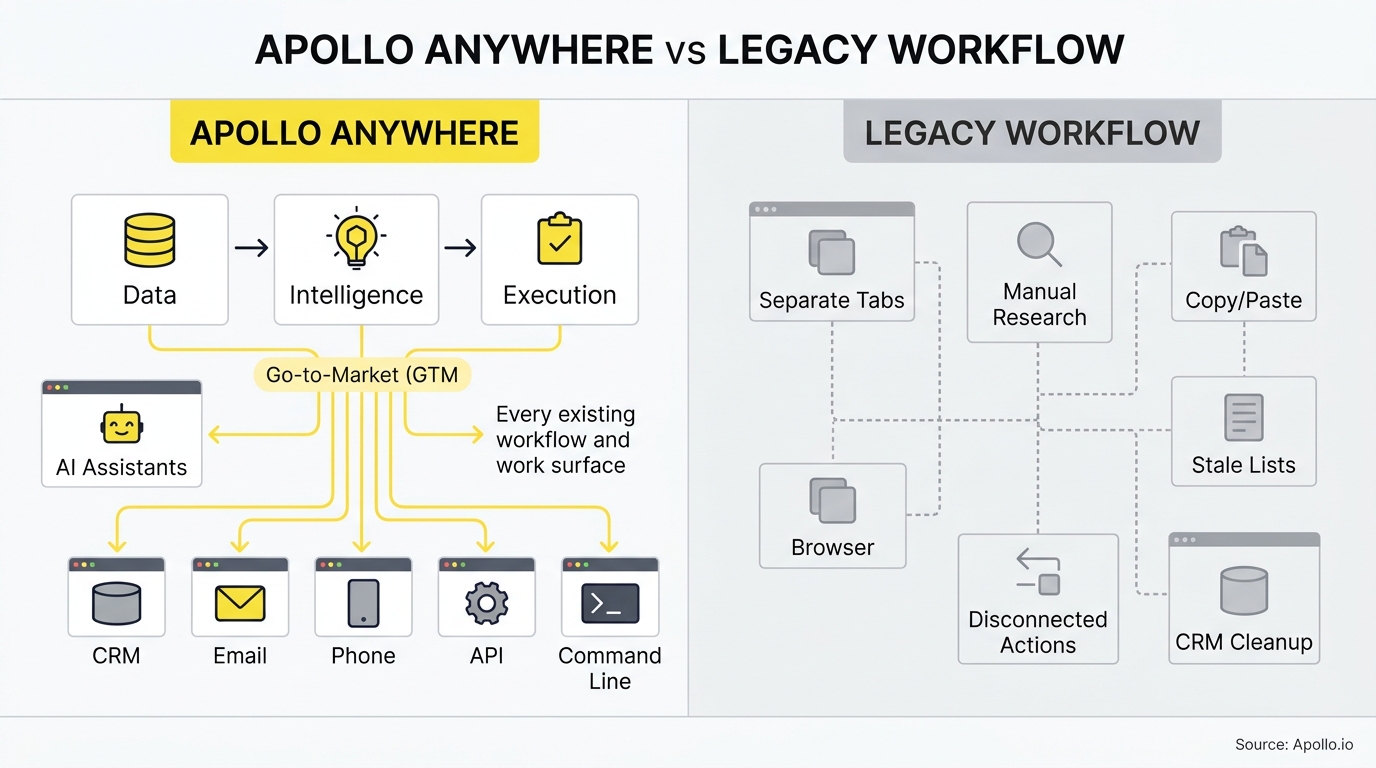
For some teams, yes. Many sales teams run a CRM plus separate tools for data, outreach, and calling, and stitching them together adds cost and complexity.
Apollo brings B2B data, sales engagement, and AI-powered execution together in one connected go-to-market system, so teams don't have to stitch together separate vendors for research, outreach, and analysis.
"We reduced the complexity of three tools into one. We're getting higher reply rates, open rates are doubled, meetings are up, and speed to booking a meeting is cut in half."
Sales leaders and RevOps managers can read more in our guide to enterprise sales solutions, and in the walkthrough on building a sales tech stack. Struggling to find qualified leads? Search Apollo's 240M+ contacts with filters built for B2B prospecting.
Frequently Asked Questions
Is Salesforce a CRM or a company?
Both. Salesforce is a company that sells a platform of cloud products, and its CRM products are what most people mean when they say "Salesforce." Sales Cloud is the sales-focused CRM product within that platform.
Which Salesforce product should a sales team start with?
Most sales teams evaluate Sales Cloud first, since it covers leads, opportunities, accounts, and forecasting. Confirm current editions and features in Salesforce's documentation, because packaging changes.
Should a RevOps manager or an SDR lead make the CRM decision?
RevOps managers typically own configuration, integrations, and data governance, so they should lead the technical evaluation. SDR leaders and sales managers should define the workflow tests, since they know where reps lose time.
Does market leadership mean Salesforce is right for every team?
No. A leading revenue share reflects vendor scale, not fit. Smaller teams or those with simple processes may not need the complexity, and admin capacity is a real constraint.

Ready to Fill the Gaps in Your CRM Stack?
Salesforce and Sales Cloud are not rivals, and the right choice comes from your workflows, integrations, admin capacity, and total cost. Use the fit matrix, run a pilot with the scorecard, and fix your data before you add AI. Whatever CRM you choose, pair it with fresh contact data and connected engagement so reps spend time selling. Schedule a Demo to see how Apollo works alongside your CRM.
Prove Your Sales Stack's ROI With Apollo
Budget approval stuck because nobody can quantify time saved or pipeline impact? Apollo puts prospecting, engagement, and AI in one platform, so wins are easy to show. Leadium tripled annual revenue. Start free and show results fast.
Start Free with Apollo →Don't miss these
Sales
Inbound vs Outbound Marketing: Which Strategy Wins?
Sales
What Is a Sales Funnel? The Non-Linear Revenue Framework for 2026
Sales
What Is a Go-to-Market Strategy? The 2026 GTM Playbook
See Apollo in action
We'd love to show how Apollo can help you sell better.
By submitting this form, you will receive information, tips, and promotions from Apollo. To learn more, see our Privacy Statement.
4.7/5 based on 9,690 reviews
