
The best Salesforce competitors in 2026 are HubSpot, Microsoft Dynamics 365, Zoho CRM, Pipedrive, and Apollo, and the right pick depends on your team size, existing stack, and whether you need a full CRM or a sales execution layer. Salesforce is the benchmark, not the only option. According to Salesforce's reporting on IDC data, its market share slipped slightly to 20.0% in 2025, its 13th consecutive year as the #1 CRM provider. That leaves roughly 80% of the market with other vendors.
Market leadership does not equal fit. A team of 10 reps with a lean RevOps function has different needs than a 500-seat enterprise. This guide gives you a shortlist, a decision framework, a workflow test protocol, and a cost model so you can validate alternatives with your own data. Teams already running CRM integrations can start with Apollo's guide to connecting Apollo to Salesforce and HubSpot.

Apollo Hands You Verified Leads In Minutes
Tired of burning hours researching leads and verifying contact info while your selling time disappears? Apollo finds accurate business emails and phones for you, with 98% email accuracy. Spend your day on live conversations, not data entry.
Start Free with Apollo →Key Takeaways
- Salesforce held 20.0% of worldwide CRM revenue in 2025 per IDC data reported by Salesforce, so no single vendor owns the market.
- The best alternative depends on use case: HubSpot for marketing-led teams, Dynamics 365 for Microsoft shops, Zoho and Pipedrive for budget-conscious teams, Apollo for data-plus-execution.
- Compare equivalent requirements and three-year total cost, not advertised list prices.
- Run a workflow test with your own records before you sign.
- Decide whether to switch or fix: many Salesforce pain points are configuration problems, not platform problems.
Which Salesforce Competitor Fits Which Team?
The right Salesforce competitor depends on your motion, stack, and admin capacity. The table below gives a quick shortlist.
Always verify current editions and pricing with each vendor before purchase, since packaging changes often.
| Platform | Best Fit | Poor Fit | Key Limitation to Verify |
|---|---|---|---|
| HubSpot | Marketing-led teams wanting CRM, marketing, and service in one suite | Highly customized enterprise sales processes | Cost growth as contacts, seats, and AI credits scale |
| Microsoft Dynamics 365 | Organizations built on Microsoft 365, Teams, and Azure | Small teams without admin resources | Implementation complexity and partner dependence |
| Zoho CRM | Cost-sensitive SMBs wanting broad functionality | Teams needing deep enterprise governance | Third-party depth and ecosystem breadth |
| Pipedrive | Small sales teams that want simple pipeline management | Teams needing service or complex data models | Limited native depth beyond sales pipeline |
| Apollo | B2B teams that want data, engagement, and AI execution in one system, alongside or in place of a CRM | Teams needing a service desk or marketing automation suite | Not a service or support platform |
What Does Salesforce's Market Share Actually Tell You?
Market share tells you about vendor scale, not whether a product fits your team. According to CX Today, Salesforce held 20.7% market share in 2024 with over $21.6 billion in CRM software revenue, generating more than its next four competitors combined. Per Gartner, worldwide CRM software revenue totaled $128.0 billion in 2024, up 13.4% year over year.
Third-party trackers use different methods. Install-base counts, like those on technographic sites, measure how many companies use a product.
Revenue-share figures from analysts measure dollars. These numbers answer different questions and should not be compared directly.
A vendor can lead in installs among small companies yet trail in revenue.
What Are the Best Salesforce Sales Cloud Alternatives?
Sales Cloud replacements need to match pipeline management, forecasting, and customization. The best alternatives depend on how much of Sales Cloud you actually use.
- HubSpot Sales Hub: Strong for teams that want CRM and marketing in one place. It reported 311,704 customers in Q3 2026, up 12%, per its earnings release.
- Dynamics 365 Sales: A natural fit for Microsoft-centric organizations. Microsoft recently demonstrated Sales Qualification and Sales Opportunity agents inside the product.
- Zoho CRM: Broad functionality at a lower entry cost, with a growing campaign and AI layer.
- Pipedrive: Best when simplicity matters more than customization depth.
- Apollo: Strong when prospecting, enrichment, and outreach are the real bottleneck. Apollo brings B2B data, sales engagement, and AI-powered execution together in one connected go-to-market system. Explore how Apollo's search and prospecting fits into your stack.
Many teams find that the CRM works fine as a system of record, and the real pain is upstream: dirty data, manual research, and fragmented outreach. In those cases, adding an execution layer can solve the problem without a full migration. Apollo's guide to CRM integration strategy covers which integrations drive the most value.
What Are the Best Salesforce Service Cloud Alternatives?
Service Cloud replacements must handle case management, routing, knowledge, and omnichannel support. This is a different buying decision than Sales Cloud, so evaluate it separately.
| Requirement | What to Test |
|---|---|
| Case routing | Can rules match your current queue logic without custom code? |
| Knowledge base | Can agents search and surface articles inside the case view? |
| Omnichannel | Are email, chat, and phone unified, and at which edition? |
| Reporting | Can you reproduce your current SLA and backlog reports? |
| AI assistance | Do suggested replies require extra credits or higher editions? |
Candidates commonly evaluated include HubSpot Service Hub, Dynamics 365 Customer Service, and Zoho Desk. Apollo is not a service platform, so it is not a fit for this replacement intent.
How Do You Compare Salesforce Alternatives on Equivalent Requirements?
Compare alternatives by writing your requirements first, then mapping each vendor's edition to them. Advertised list prices often exclude capabilities you already rely on, such as advanced automation, sandbox environments, or API limits.
- List must-have capabilities. Include objects, automation, permissions, reporting, integrations, and API volume.
- Identify the edition that includes each capability. A feature on the pricing page may require a higher tier.
- Add usage-based costs. HubSpot describes value-linked pricing with a unified credit mechanism, and Zoho's multichannel campaigns require purchased sending credits.
- Add implementation and admin cost. Include partner fees, internal admin time, and training.
- Add integration cost. Include middleware, data enrichment, and any tools you must keep.
How Do You Build a Three-Year Cost Worksheet?
A three-year cost worksheet captures total cost of ownership, not year-one price. Build it as a spreadsheet with editable assumptions so finance and RevOps can adjust inputs.
| Cost Line | Year 1 | Year 2 | Year 3 | Assumption to Edit |
|---|---|---|---|---|
| Licenses | Seats x price | Seat growth | Seat growth | Headcount plan, discount, renewal uplift |
| Usage and credits | Estimated volume | Growth rate | Growth rate | AI, email, SMS, API volume |
| Implementation | Partner and internal hours | Enhancements | Enhancements | Complexity and customization |
| Admin and support | FTE share | FTE share | FTE share | Admin hours per month |
| Add-on tools | Data, engagement, dialer | Same | Same | Tools you keep or retire |
| Migration and training | One-time | None | None | Data cleanup and enablement |
Consolidation can change the math. Collin Stewart, CEO at Predictable Revenue, said:
"We reduced the complexity of three tools into one. We're getting higher reply rates, open rates are doubled, meetings are up, and speed to booking a meeting is cut in half."
That is one customer's outcome. Model your own stack, and use Apollo's guide to building a sales tech stack to map which tools overlap.
How Should You Test a Salesforce Alternative With Your Own Workflows?
Test alternatives by running real workflows with your own records, using agreed success measures. Gartner's January to March 2024 survey of 1,026 B2B sellers found that 70% felt overwhelmed by the technologies required for their work, so ease of task completion matters as much as feature count.
- Pick 5 to 7 core workflows. Examples: log a call, create an opportunity, route a lead, generate a forecast, update an account, run a renewal.
- Load a sample of your real data. Use a few thousand records with your actual field structure.
- Time each task. Record clicks, minutes, and errors per workflow for two or three users.
- Test AI on completed work. HubSpot reported 64% quarter-over-quarter growth in agent trials, but conversion depends on results. Measure whether the AI finishes the task, not whether the output reads well.
- Score administration effort. Have your admin build one automation and one report in each platform.
- Document rollback criteria. Define what failure looks like before the trial starts.
Measured results from controlled trials will be the strongest evidence you can collect. Until you have them, treat vendor benchmarks as directional.
Zoho's reported internal tests of up to 4x faster email sending are an example of a vendor-run figure and not a customer result.

Is It Better to Switch CRMs or Fix Your Salesforce Setup?
Fix first if your problems come from configuration, data quality, or adoption. Switch if the platform cannot meet a requirement at an acceptable cost.
Many teams blame the platform for problems rooted in unused fields, duplicate records, or unmanaged automation.
| Symptom | Likely Cause | Better Move |
|---|---|---|
| Reps avoid logging activity | Too many required fields | Fix: simplify layouts and automate capture |
| Reports disagree | Duplicates and inconsistent definitions | Fix: dedupe and standardize |
| Renewal cost outpaces value | Unused licenses or add-ons | Fix: audit seats, then renegotiate |
| Outreach data is stale | No enrichment layer | Fix: add a data and engagement layer such as Apollo's data enrichment |
| Required capability missing at any affordable edition | Platform gap | Switch: evaluate alternatives |
For teams that want to keep Salesforce or HubSpot as the system of record, Apollo's guide to using Apollo with HubSpot and Salesforce shows how to layer in prospecting and sequencing without migrating.
Apollo Shows You Which Deals Are Really Moving
Forecasts feeling like guesswork because deal data is stale? Apollo gives your team live buyer signals and a clear view of where every prospect stands, so you work the right deals first. Nearly 5M users already sell with it.
Start Free with Apollo →What Should You Ask in a Salesforce Competitor Demo?
Ask questions that expose cost, effort, and risk, not just features. Recent news gives you timely prompts.
HubSpot announced co-founder Brian Halligan's return as CEO on November 12, 2026, with a mandate to rethink products and go-to-market strategy. That is not evidence of changes, but it is a fair reason to ask about roadmap and implementation commitments.
- Which edition includes every capability on my requirements list?
- What usage or credit costs apply at my expected volume?
- What does a typical renewal uplift look like in years two and three?
- How do AI agents handle approvals, errors, and audit trails?
- Can I run a pilot with my own data and agreed success measures?
- What is the support model and who owns implementation?
- What happens to my data if I leave?
HubSpot also noted longer approval cycles, larger buying committees, and greater price sensitivity in its Q3 2026 filing. Expect vendors to compete on proof of value, so ask for it in writing.
How Do You Migrate Away From Salesforce Safely?
Migrate in phases with acceptance criteria and a rollback plan at each stage. A big-bang cutover raises risk and is rarely necessary.
| Phase | Scope | Acceptance Criteria | Rollback Trigger |
|---|---|---|---|
| 1. Data audit | Dedupe, map fields, archive stale records | Mapped fields signed off by RevOps | Unresolved mapping gaps |
| 2. Pilot team | One team on new platform, others on Salesforce | Core workflows completed within agreed time and error limits | Pipeline reporting breaks or adoption stalls |
| 3. Integration cutover | Email, calendar, enrichment, billing, support | Sync accuracy verified on sample records | Sync failures above agreed threshold |
| 4. Full rollout | Remaining teams, retired automations | Forecast reconciles to prior period | Forecast variance beyond agreed tolerance |
| 5. Decommission | Export, archive, and shut off old instance | Final backup verified and stored | Missing records discovered |
Keep read-only access to the old instance for a defined period after cutover. Finance, legal, and audit requests often surface weeks later.
Where Does Apollo Fit Alongside or Instead of Salesforce?
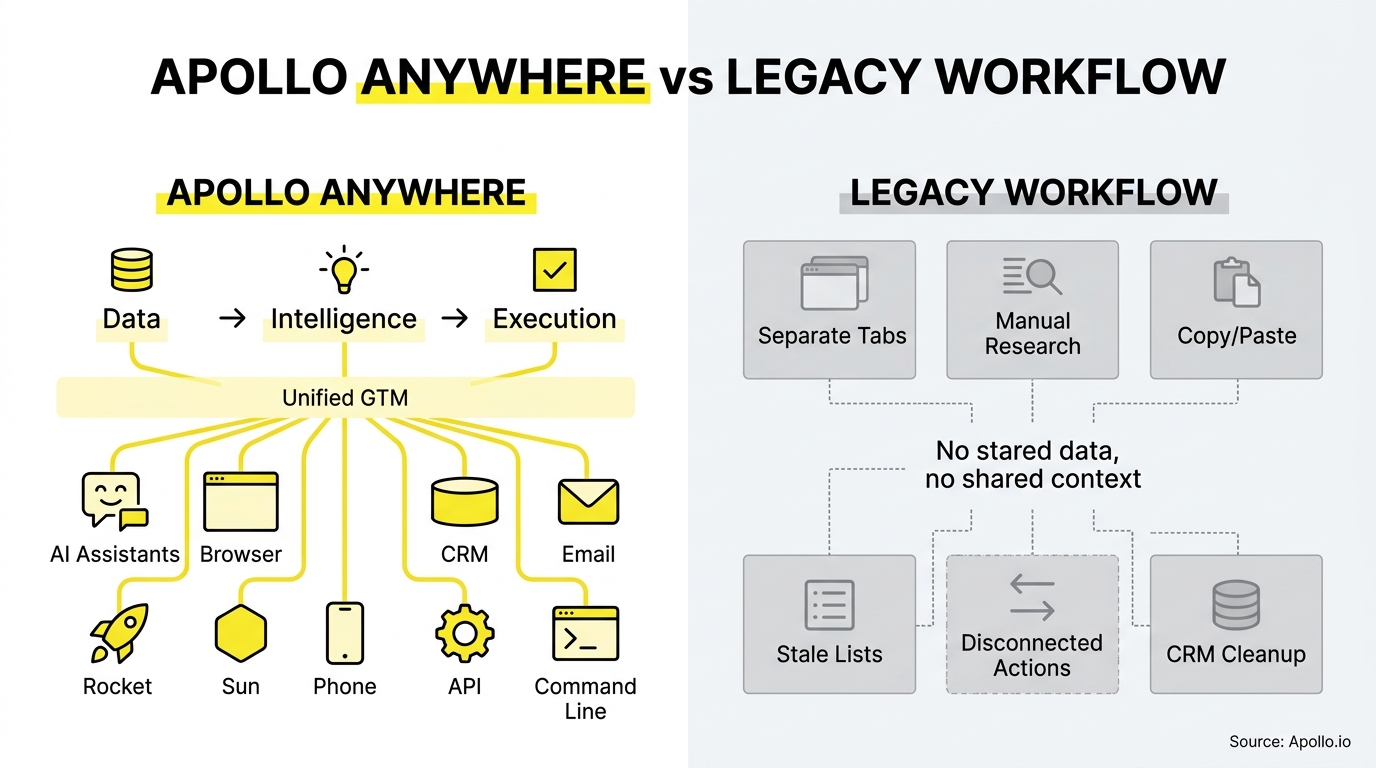
Apollo is an AI GTM system that brings B2B data, sales engagement, and AI-powered execution together in one connected go-to-market system. Teams can run it alongside Salesforce or use it as the workspace where prospecting and outreach happen, so they don't have to stitch together separate vendors for research, outreach, and analysis.
Apollo serves B2B GTM teams, GTM Engineers, and AI Builders building headless GTM workflows with the Apollo API, CLI, and MCP, alongside Sales Professionals, SDRs/BDRs, AEs, RevOps, Marketing, and Revenue Leaders. It also works inside the tools teams already use, including Salesforce, the Chrome extension, and AI assistants such as ChatGPT, Claude, and Perplexity through Apollo MCP.
How Should an SDR Manager or RevOps Leader Evaluate Apollo?
Start with the workflow, not the feature list. An SDR manager should test whether reps can find and prioritize prospects and launch multichannel sequences without switching tabs. A RevOps leader should check how records sync through Apollo's integrations and how data enrichment keeps CRM fields current.
"The thing that made me most excited as somebody who's been in sales development a long time was Apollo's integration between sales data and sales engagement and the magic that you can make happen when those two are together on the same platform."
For managing pipeline inside the same workspace, review Apollo's deal management. Apollo's database holds 240M+ people and 30M+ companies, which gives pilots a large pool of business contact information to test against.
Does Apollo Work for Mid-Market and Enterprise Teams?
Yes. Apollo's Organization plan is $119/user/month billed annually (minimum 3 users) and adds admin controls, governance, and security features for larger teams. For Basic and Professional monthly prices, see Apollo's pricing page.
According to Ramp's Sales Data Providers category data, Apollo is the fastest-growing vendor in that category as of November 2026.
Can Apollo Reduce the Number of Tools in Your Stack?
It can, depending on what you run today. Teams that pay separately for data, engagement, and dialing can test whether one workspace covers those jobs, then compare the three-year cost using the worksheet above.
"Apollo could be a third of the cost if you look at the full price of what we were spending on ZoomInfo, Outreach, Salesforce, and admins to make it all work."
That quote reflects one customer's cost comparison. Run your own numbers before drawing conclusions for your team.
What Do Teams Ask Most About Salesforce Competitors?
What Is the Best Salesforce Competitor?
It depends on your requirements. Mid-sized teams often shortlist CRMs with simpler administration, while support-heavy teams compare service platforms.
Score every option against the same requirements, then verify the top two in a pilot.
Is Switching From Salesforce Worth It?
Switching pays off when the pain comes from licensing, complexity, or tools you no longer use. If the pain comes from poor data hygiene or unused automations, fixing the current setup is usually cheaper and faster.
Can I Keep Salesforce and Add a Different Tool for Prospecting?
Yes. Many teams keep Salesforce as the system of record and add a prospecting and engagement layer that syncs to it. Test the sync on real records before committing.
How Long Does a Salesforce Migration Take?
Timelines depend on data volume, integrations, and customization. Use the phased plan above, agree acceptance criteria in writing, and treat any vendor timeline without a pilot as an estimate.

Conclusion: How Do You Choose the Right Salesforce Competitor?
Define your requirements, compare options on the same criteria, price three years, pilot with your own workflows, and migrate in phases. That sequence protects your pipeline and keeps vendor claims honest.
If prospecting, enrichment, and outreach are where your current stack slows reps down, test how Apollo handles them in one workspace, with or without Salesforce. To see why Apollo stands alone as the only fully agentic GTM platform, combining sales intelligence, outbound execution, and enrichment in one workspace, start free with Apollo today.
Prove Apollo's ROI Fast With Real Pipeline
New reps ramping slowly while leadership wants proof the stack pays off? Apollo gives every rep verified contacts and a repeatable outbound workflow from week one. Built-In saw +10% win rate and +10% ACV.
Start Free with Apollo →Don't miss these
Sales
Inbound vs Outbound Marketing: Which Strategy Wins?
Sales
What Is a Sales Funnel? The Non-Linear Revenue Framework for 2026
Sales
What Is a Go-to-Market Strategy? The 2026 GTM Playbook
See Apollo in action
We'd love to show how Apollo can help you sell better.
By submitting this form, you will receive information, tips, and promotions from Apollo. To learn more, see our Privacy Statement.
4.7/5 based on 9,690 reviews
