
A Salesforce competitive analysis weighs Salesforce against HubSpot and Microsoft Dynamics 365 on workflow fit, total cost, and rollout effort. Market share alone won't settle it.
Leadership in a revenue table says little about which CRM your team will adopt and use daily.
This guide gives you a weighted scorecard, a plain-language explanation of conflicting market-share numbers, and a rollout checklist. If your team already runs Salesforce or HubSpot, see how Apollo works alongside both CRMs before you decide whether to switch.

Skip Manual Research. Apollo Finds Contacts
Spending hours researching leads and double-checking contact info instead of selling? Apollo puts verified business contacts at your fingertips with 98% email accuracy. Start free and get your selling hours back.
Start Free with Apollo →Key Takeaways
- Salesforce holds the top spot in worldwide CRM revenue, but its share has slipped slightly year over year.
- HubSpot and Dynamics 365 win on different criteria: ease of adoption and Microsoft ecosystem fit.
- Different market-share figures use different denominators, so never compare them directly.
- Pilot against pipeline outcomes, not AI demos or feature counts.
- Data readiness and migration effort belong on every CRM scorecard.
How Do Salesforce, HubSpot, and Dynamics 365 Compare at a Glance?
The three platforms differ most in customization depth, adoption effort, and ecosystem fit. Use the matrix below as a starting point, then assign your own weights to each criterion.
| Criterion | Salesforce | HubSpot | Dynamics 365 |
|---|---|---|---|
| Customization depth | Extensive objects, flows, and app ecosystem | Configurable within a unified platform | Configurable, built on the Microsoft Power Platform |
| Adoption effort | Teams commonly dedicate administrators | Often lighter setup for smaller teams | Depends on existing Microsoft footprint |
| Best-fit team | Complex, multi-product, multi-region sales orgs | Growing teams wanting marketing and sales in one place | Organizations standardized on Microsoft tools |
| Pricing model | Edition-based, add-ons vary | Tier-based, with seat and contact variables | Module-based, bundled with other Microsoft licensing |
| Key trade-off | Capability breadth versus administrative effort | Simplicity versus advanced enterprise customization | Ecosystem alignment versus module complexity |
What Should RevOps Leaders and CROs Weigh Most?
RevOps leaders should weight data model flexibility, integration coverage, and administration cost. CROs should weight time-to-value and forecast visibility.
SDR managers should weight how quickly reps can log activity and launch outreach. Score each criterion from 1 to 5, multiply by your weight, and compare totals across vendors.
What Do Salesforce Market Share Numbers Actually Tell You?
Market share figures answer different questions depending on what they count. Revenue-based analyst data measures vendor sales.
Technology trackers measure how many companies are detected running a product. Neither measures fit for your team.
According to CX Today, Salesforce held the number one CRM position globally with a 20.0% share in 2025, down from 20.7% in 2024 and 21.7% in 2023. TechnologyChecker reports that Salesforce earned over $21.6 billion in CRM-specific revenue in 2024, more than its four nearest competitors combined.
| Metric Type | What It Counts | How to Use It |
|---|---|---|
| Revenue share (analyst) | Vendor CRM revenue as a share of total market revenue | Gauge vendor scale and financial staying power |
| Install-base share (tracker) | Companies detected using a product in a tracked universe | Gauge ecosystem familiarity and hiring pool |
| Company growth rate | Vendor revenue growth over a reporting period | Gauge momentum, not market position |
Why Do Install-Base Percentages Differ From Revenue Share?
The denominators differ. Install-base trackers divide by the companies they can detect, while revenue share divides by total market spending.
A product can appear in a larger share of detected stacks than its revenue share suggests, because revenue reflects price per seat and deal size as well as adoption. Compare numbers only within the same methodology and year.
Per Command Linux, vendors outside the "Big Five" collectively captured over 60% of the overall CRM market by 2025, up from 56.6% in 2021. Leadership by a single vendor still leaves most of the market with alternatives.

How Does Salesforce Compare to HubSpot?
Salesforce is built for configurability across complex organizations. HubSpot brings marketing, sales, and service into one connected platform and is often evaluated by teams that want faster setup.
Both vendors have announced AI agent capabilities, so the useful question is which one improves your measured outcomes.
- Choose by workflow: map your lead-to-close process and test each vendor against it with real records.
- Test AI on outcomes: measure qualified meetings, opportunities advanced, and how often a human must step in.
- Check marketing alignment: if marketing and sales share one data model, price both teams' seats together.
Salesforce's agent revenue disclosures describe the vendor's business, not your ROI. Ask each vendor for baseline performance, intervention rates, and attributable pipeline impact from a comparable customer.
How Does Salesforce Compare to Dynamics 365?
Dynamics 365 appeals most to organizations already standardized on Microsoft tools, since it connects with the Power Platform and Microsoft's productivity suite. Salesforce offers a broad app marketplace and a large pool of experienced administrators and consultants.
Dynamics 365 growth figures typically bundle ERP and CRM, so they don't isolate CRM share. Salesforce generated $37.9 billion in revenue in FY2025, with roughly 150,000 or more customers, according to Salesforce's FY2025 results. Revenue figures describe vendor scale. They don't show which platform fits your team's workflow.
Apollo Turns Forecast Guesswork Into Pipeline
Forecasts feeling like a coin flip because the data is stale and leads never become real opportunities? Apollo puts verified business contacts and live deal visibility in one workspace. Teams actively using Apollo's AI Assistant are up 2,156% since December 2025.
Start Free with Apollo →How Does Apollo Fit Alongside Salesforce?
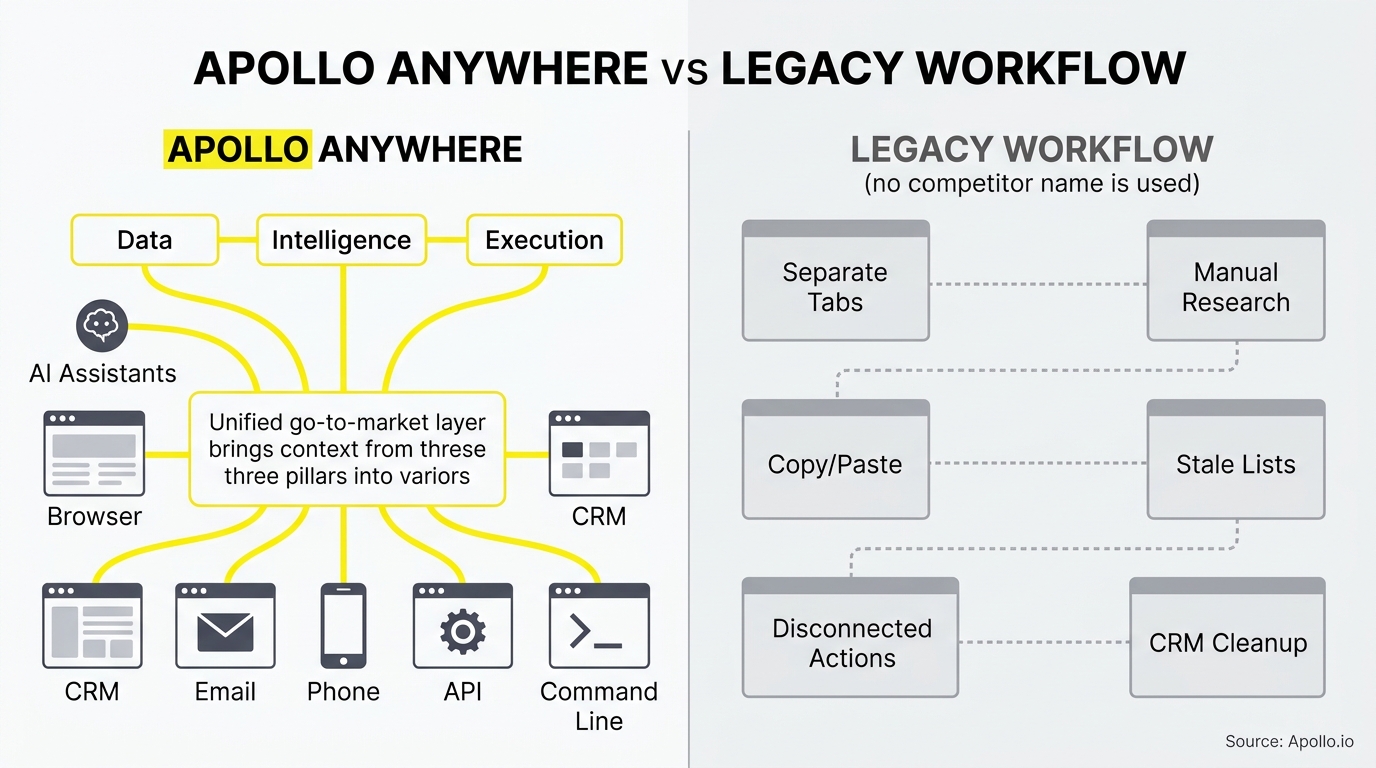
Apollo is an AI GTM system that brings B2B data, sales engagement, and AI-powered execution together in one connected go-to-market system. It works with a CRM instead of competing with it as a system of record.
Apollo syncs with Salesforce, so reps can prospect, enrich, and engage without leaving their workflow.
A CRM stores and reports on pipeline. Apollo helps teams find business contacts and accounts, keep records current with data enrichment, and run outreach through sales engagement sequences. Users control who they contact and how they use the product.
| Layer of the Stack | Question to Ask | Where Apollo Fits |
|---|---|---|
| System of record | Where do accounts, opportunities, and forecasts live? | Apollo syncs with your CRM through native integrations. |
| Data and enrichment | Are records complete and current? | Apollo enriches contacts, leads, and accounts. |
| Outbound execution | Can reps act on data without switching tools? | Sequences, dialer, and AI assistance run in one workspace. |
| AI access | Can your team use data inside AI tools? | Apollo MCP connects Apollo to assistants like Claude, ChatGPT, and Perplexity. |
Consolidation is a common reason teams review their stack. Predictable Revenue described the cost side of that decision:
"Apollo could be a third of the cost if you look at the full price of what we were spending on ZoomInfo, Outreach, Salesforce, and admins to make it all work."
For SDR and BDR managers, speed from selection to outreach matters. Andrew Froning of Cyera described how that works in Apollo:
"The moment we select someone in our database, they're instantly added to a sequence and we can take action right away. We're effective and efficient with our outreach."
Market data points the same way. According to Ramp's vendor data, Apollo adoption sits at 31% among both mid-market and enterprise companies as of November 2026, so it is not an SMB-only tool. Apollo's Organization plan ($119/user/month billed annually, minimum 3 users) adds the admin controls larger teams expect.
Frequently Asked Questions About Salesforce Competitive Analysis
What Is a Salesforce Competitive Analysis?
A Salesforce competitive analysis compares Salesforce against alternatives such as HubSpot and Dynamics 365 on workflow fit, AI capabilities, cost, and integration needs. It is not a market share ranking.
Install-base and revenue figures describe vendor scale, not whether a platform improves your team's results.
How Should a RevOps Leader Evaluate Salesforce Against Alternatives?
A RevOps leader should map the lead-to-close process, run each vendor against real records, and measure outcomes like qualified meetings and manual intervention rates. Price every seat that touches the data model, including marketing and service users, and ask each vendor for comparable-customer results.
Should a VP of Sales Replace Salesforce to Improve Outbound?
Not necessarily. Outbound problems often come from stale data or disconnected tools instead of the CRM.
A VP of Sales can keep Salesforce as the system of record and add a platform like Apollo for prospecting, enrichment, and sequencing, then judge the change on meetings booked.
Is Salesforce Still the Market Leader in CRM?
Salesforce is widely regarded as a leading CRM vendor, but the figure depends on whether you measure revenue, install base, or category definition. Dynamics 365 growth numbers often bundle ERP and CRM, which makes direct comparisons imprecise.
Does Apollo Work With Salesforce?
Yes. Apollo integrates with Salesforce so enriched data and engagement activity can flow into your existing records. GTM engineers and AI builders can also reach Apollo data through the API, CLI, and Apollo MCP.

What Is the Right Next Step After Comparing CRMs?
Choose the CRM that
fits your sales motion, your team's admin capacity, and your budget, then pressure-test that choice against real pipeline workflows before you commit. A spreadsheet comparison only goes so far.
The strongest evaluations use your own data, your own reps, and a defined success metric.
Here is a practical sequence RevOps leaders and CROs can follow:
- Define the decision criteria. Weight customization, reporting depth, integration needs, total cost of ownership, and rep adoption according to what matters most to your team.
- Audit your current data quality. Check contact accuracy, duplicate rates, and field completeness. Poor data undermines any CRM, so fix it before blaming the platform.
- Run a scoped pilot. Test one team or one segment for a fixed period, and compare against a control group where possible.
- Layer in your go-to-market tools. Confirm that prospecting, enrichment, and sequencing tools sync cleanly with the CRM you are evaluating.
- Measure outcomes, not features. Track meetings booked, pipeline created, and time spent on admin rather than counting capabilities.
In many cases, the answer is not to replace your CRM but to strengthen what surrounds it. If Salesforce, HubSpot, or Dynamics 365 already stores your accounts and opportunities, the biggest gains often come from feeding it better data and giving reps a faster way to act on it.
Conclusion
A Salesforce competitive analysis is most useful when it moves past brand loyalty and market share headlines. Salesforce, HubSpot, and Dynamics 365 each serve distinct needs, and the right fit depends on your complexity, ecosystem, and team resources.
Whichever CRM you choose, pipeline results depend on the quality of the data inside it and how quickly your reps can act on it.
Apollo helps you do both. Use it alongside Salesforce or your CRM of choice to find accurate contacts, enrich records, and run outbound sequences from one platform. Start free with Apollo and see how much more pipeline your current CRM can generate.
Ramp Reps Faster. Prove ROI Sooner.
New reps taking forever to ramp while leadership asks for ROI proof? Apollo gives every rep verified business contacts and AI-assisted outreach from day one. Teams actively using Apollo's AI Assistant are up 2,156% since December 2025.
Start Free with Apollo →Don't miss these
Sales
Inbound vs Outbound Marketing: Which Strategy Wins?
Sales
What Is a Sales Funnel? The Non-Linear Revenue Framework for 2026
Sales
What Is a Go-to-Market Strategy? The 2026 GTM Playbook
See Apollo in action
We'd love to show how Apollo can help you sell better.
By submitting this form, you will receive information, tips, and promotions from Apollo. To learn more, see our Privacy Statement.
4.7/5 based on 9,690 reviews
