
Sales Insights: How Data-Driven Intelligence Transforms Modern Selling
Sales teams in 2026 face a critical challenge: buyers have changed how they buy. According to Gartner, 61% of B2B buyers prefer an overall rep-free buying experience, and 73% actively avoid suppliers who send irrelevant outreach. Sales insights are the data-driven intelligence that help teams understand buyer behavior, prioritize the right opportunities, and deliver relevant interactions that buyers actually want. Modern sales analytics platforms turn raw data into actionable signals that drive revenue.

Apollo Eliminates 4+ Hours Of Daily Research
Tired of spending 4+ hours daily hunting for contact info? Apollo delivers 224M verified contacts with 96% email accuracy. Join 550K+ companies who turned research time into selling time.
Start Free with Apollo →Key Takeaways
- Sales insights transform raw CRM data into actionable intelligence that shortens sales cycles and improves win rates
- AI-powered insights now execute tasks autonomously, moving from passive reporting to active deal orchestration
- Revenue teams consolidate fragmented tools into unified platforms that surface insights directly in sellers' workflows
- Data governance and cross-functional alignment determine whether insights are trusted and adopted across the organization
What Are Sales Insights?
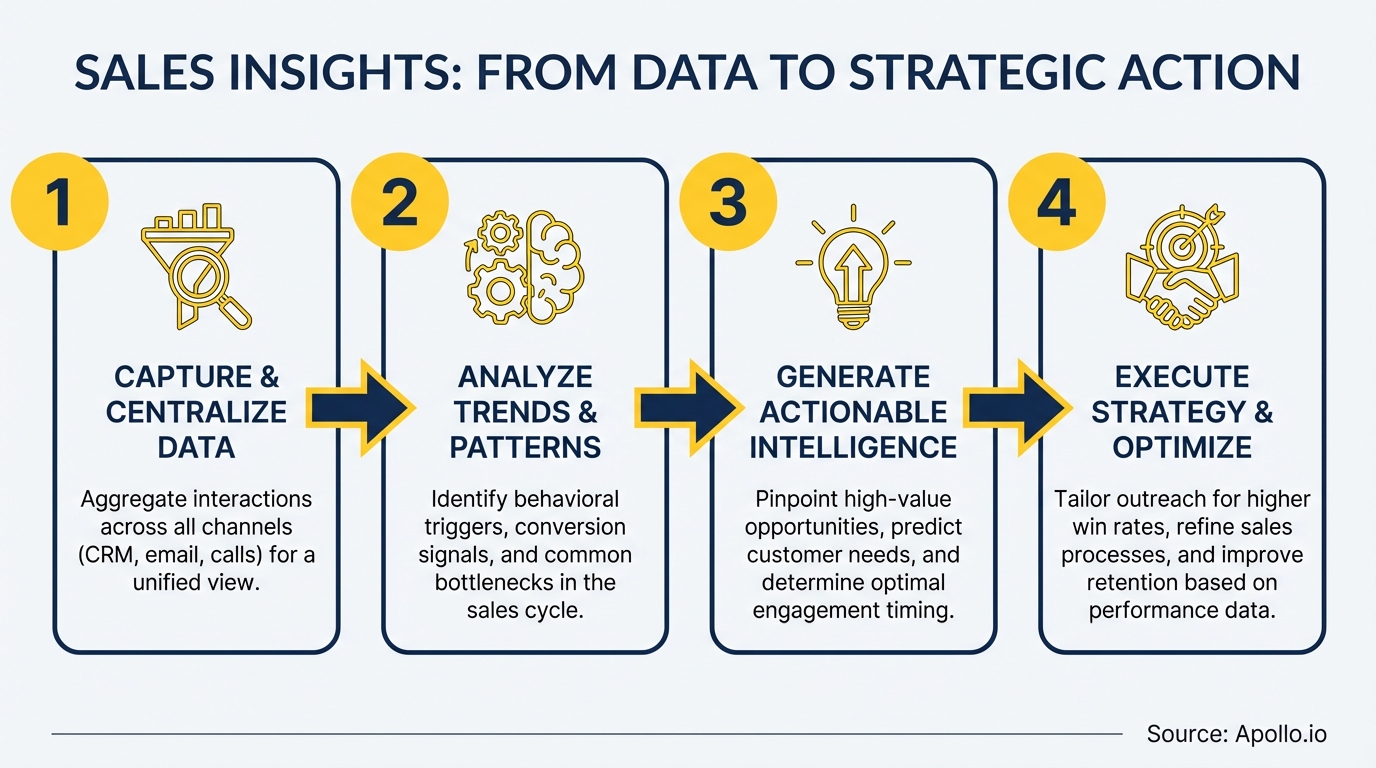
Sales insights are actionable intelligence derived from customer data, interaction history, and market signals that help sales teams prioritize opportunities and personalize outreach. They answer critical questions: Which leads are most likely to convert?
What messaging resonates with specific buyer personas? Where are deals getting stuck?
Modern sales insights combine multiple data sources:
- Behavioral signals: Email opens, website visits, content downloads, and product usage patterns
- Engagement data: Call recordings, meeting notes, and conversation intelligence from AI call assistants
- Pipeline analytics: Deal velocity, stage conversion rates, and forecast accuracy metrics tracked through sales performance management systems
- Account intelligence: Technographic data, org charts, buying committee composition, and intent signals
Research from Outreach shows that opportunities closed within 50 days have a 47% win rate, which drops to 20% or lower after that threshold. Sales insights help teams identify which deals need immediate attention to stay within that winning window.
How Do Sales Insights Drive Revenue Growth?
Sales insights translate into revenue impact through three core mechanisms: prioritization, personalization, and prediction. Teams that leverage insights effectively focus energy on high-probability opportunities rather than spreading resources across every lead.
Prioritization through scoring and signals: Lead and account scoring models surface which prospects are ready to buy. SDRs using insights-driven prospecting tools report booking more qualified meetings because they reach out when buyers show active intent signals. B2B sales organizations use technographic data to identify accounts with the right tech stack fit and budget authority.
Personalization at scale: Insights enable Account Executives to tailor their approach based on buyer journey stage, pain points mentioned in previous conversations, and competitive intelligence. BookYourData reports that by 2025, 80% of B2B sales interactions are expected to occur through digital channels, making data-driven personalization essential for standing out.
Predictive forecasting: RevOps leaders use pipeline insights to forecast revenue with greater accuracy. Historical win rates by deal size, industry, and rep performance inform quota planning and resource allocation. Sales Leaders gain visibility into which reps need coaching and which deals need executive involvement.

Struggling with scattered data across multiple tools? Apollo's deal management platform consolidates your sales intelligence into one workspace, giving you complete pipeline visibility without the toggle tax.
Turn Forecast Guesswork Into Revenue Certainty
Forecasts unreliable because pipeline data isn't real-time. Apollo tracks every deal stage automatically with 224M+ verified contacts. Built-In increased win rates 10% with Apollo's intelligence.
Start Free with Apollo →What Types of Sales Insights Should Teams Track in 2026?
Effective sales insights fall into four categories: buyer engagement insights, pipeline health metrics, rep performance analytics, and market intelligence. Each category serves distinct use cases across the revenue organization.
| Insight Category | Key Metrics | Primary Users |
|---|---|---|
| Buyer Engagement | Email response rates, meeting attendance, content engagement, intent signals | SDRs, BDRs, AEs |
| Pipeline Health | Stage velocity, conversion rates, deal size trends, forecast accuracy | Sales Leaders, RevOps |
| Rep Performance | Activity volume, win rates, quota attainment, ramp time | Sales Managers, Enablement |
| Market Intelligence | Competitive win/loss data, buyer journey length, economic indicators | Executives, Product Marketing |
For a comprehensive view of the most important metrics, explore what sales KPIs you should track in 2026.
How Do Sales Leaders Implement Sales Insights Effectively?
Successful insights implementation requires three foundational elements: clean data, embedded workflows, and cross-functional alignment. According to Landbase, B2B buyers spend only 17% of purchase time with all vendors combined, making it critical that your insights help reps maximize every interaction.
Data governance comes first: Fragmented systems and conflicting pipeline signals undermine trust in insights. Establish single sources of truth for account data, deal stages, and activity logging. RevOps teams should audit data quality quarterly and implement validation rules in your CRM.
Embed insights in seller workflows: Insights delivered in BI dashboards get ignored. Push actionable recommendations directly into CRM records, email clients, and calendar tools. Sales Managers coaching reps benefit from conversation intelligence that surfaces objection patterns and competitive mentions during calls. Learn more about how sales automation software drives revenue by embedding intelligence where reps work.
Align cross-functional teams: Revenue insights should flow between Sales, Marketing, Customer Success, and Finance. Marketing needs closed-loop reporting on which campaigns generate pipeline. CS teams surface expansion opportunities and churn risks. Finance requires accurate forecasts for planning. Revenue operations orchestrates this alignment.
How Are AI and Automation Changing Sales Insights?
The shift from passive reporting to agentic insights is transforming how sales teams work. AI-powered systems in 2026 don't just surface data; they execute tasks, prioritize actions, and orchestrate multi-step workflows autonomously.
From copilot to autonomous agents: Early AI sales tools provided recommendations. Modern platforms take action: automatically researching accounts, drafting personalized emails, scheduling follow-ups, and routing leads based on fit scores. AI sales tools that actually close more deals combine insights generation with execution capabilities.
Real-time conversation intelligence: Call recording and analysis tools now provide live coaching during sales calls, surfacing competitive battlecards, pricing objections, and next-best-actions while reps are still on the phone. Post-call summaries with action items are auto-generated and synced to CRM records immediately.
Predictive deal scoring: Machine learning models analyze historical won/lost patterns to score current opportunities. These models consider dozens of variables: stakeholder engagement levels, budget discussions, competitive displacement signals, and buying committee completeness. Sales Leaders use these scores to allocate resources and forecast with greater accuracy.
Can't keep up with manual prospecting and outreach? Apollo's AI sales automation consolidates prospecting, enrichment, and engagement into one platform, eliminating the need for multiple point solutions.
What Sales Insights Do SDRs and AEs Need Most?
Different sales roles require different insights. SDRs focus on account selection and outreach timing.
AEs need deal progression signals and stakeholder mapping. Sales Engineers require technical fit assessment data.
For SDRs and BDRs: Intent signals showing when accounts are researching solutions, job change alerts for champions who moved to new companies, and engagement scoring that identifies warm leads versus cold prospects. Prospecting workflows benefit from sales tech stacks that surface buying signals automatically.
For Account Executives: Multi-threading insights showing which stakeholders are engaged versus ghosting, competitive intelligence from conversation analysis, and deal health scores predicting close probability. AEs managing complex deals need visibility into buying committee dynamics and executive sponsor engagement.
For Sales Leaders: Team performance dashboards comparing rep productivity, coaching insights identifying skill gaps, and pipeline coverage metrics forecasting whether the team will hit quarterly targets. Leaders benefit from sales productivity analytics that highlight where process improvements drive the most impact.
Conclusion: Turn Sales Insights Into Revenue Action
Sales insights in 2026 are no longer optional; they're the foundation of competitive selling. Buyers demand relevance, and teams that leverage data-driven intelligence win deals while those relying on intuition fall behind.
The most successful organizations consolidate fragmented tools into unified platforms that surface actionable insights directly in seller workflows.
As Collin Stewart from Predictable Revenue shared: "We reduced the complexity of three tools into one." Modern revenue teams need platforms that combine contact data, engagement tracking, conversation intelligence, and pipeline analytics without forcing reps to toggle between systems. Data governance and cross-functional alignment determine whether insights drive adoption or get ignored.
Ready to transform your sales insights into revenue growth? Try Apollo Free and access 224M+ verified contacts, AI-powered automation, and deal management tools in one workspace. Cut your tech stack complexity and give your team the insights they need to close more deals faster.
Prove Apollo's ROI In Your First 30 Days
Budget approval stuck on unclear metrics? Apollo tracks every touchpoint to pipeline—quantifying time saved, meetings booked, and deals closed. Customer. io achieved 50% YoY growth with measurable Apollo impact.
Start Free with Apollo →Don't miss these
Sales
Inbound vs Outbound Marketing: Which Strategy Wins?
Sales
What Is a Sales Funnel? The Non-Linear Revenue Framework for 2026
Sales
What Is a Go-to-Market Strategy? The 2026 GTM Playbook
See Apollo in action
We'd love to show how Apollo can help you sell better.
By submitting this form, you will receive information, tips, and promotions from Apollo. To learn more, see our Privacy Statement.
4.7/5 based on 9,690 reviews
