
What Is Sales Automation Software and How Does It Actually Drive Revenue?
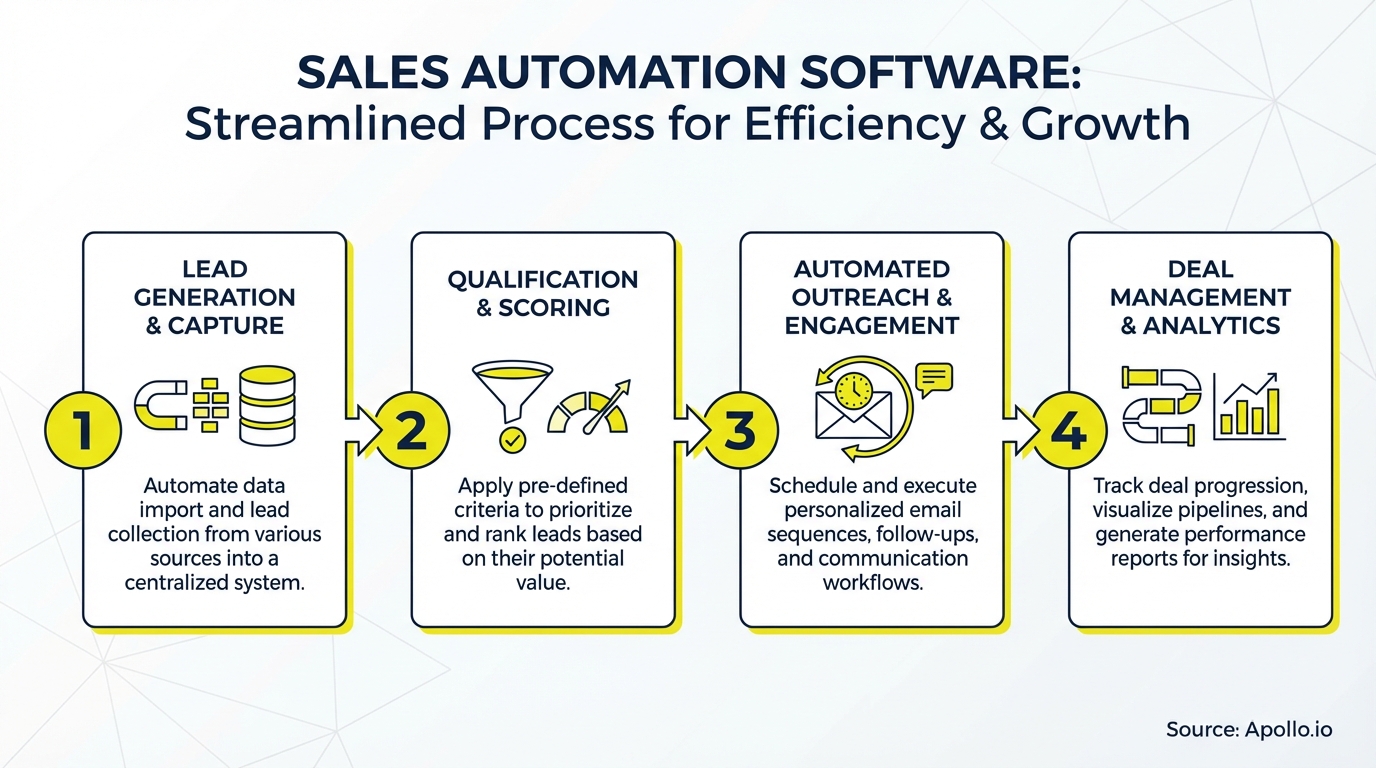
Sales automation software eliminates repetitive tasks so your team can focus on closing deals. In 2026, 92% of businesses are investing in AI-powered sales tools because manual prospecting, follow-ups, and data entry waste hours every day. The right platform transforms how you find leads, engage prospects, and manage pipeline.
This guide shows you how to implement AI-powered sales automation that delivers measurable ROI. You'll get step-by-step playbooks, real customer outcomes, and evaluation frameworks to choose the right tools for your team size and deal complexity.

Apollo Eliminates 4+ Hours Of Daily Research
Tired of spending 4+ hours daily hunting for contact info? Apollo delivers 224M verified contacts with 96% email accuracy instantly. Join 550K+ companies who turned research time into selling time.
Start Free with Apollo →Key Takeaways
- Sales automation software handles repetitive tasks like prospecting, email sequences, data entry, and follow-ups so reps focus on high-value selling activities.
- AI-powered automation delivers 46% more meetings and 35% higher booking rates when integrated properly with your existing workflows.
- Successful implementation follows six phases: Assess current processes, Plan integration strategy, Build workflows, Train teams, Launch gradually, and Measure ROI.
- The best platforms consolidate prospecting, engagement, enrichment, and deal management in one workspace, cutting tech stack costs by 50% or more.
- Self-serve digital channels now process over half of large B2B transactions, requiring automation that aligns with how modern buyers research and purchase.
Why AI-Powered Sales Automation Matters in 2026
The B2B buying landscape has fundamentally shifted. According to Forrester Research, more than half of large B2B purchases over $1 million are now processed through digital self-serve channels. Buyers research, evaluate, and even purchase without ever speaking to a sales rep.
This shift demands sales automation that works across the entire customer journey. Your automation must deliver the right message at the right time, whether prospects are browsing your website, reading cold emails, or evaluating competitors.
Modern sales automation software combines three critical capabilities:
| Capability | What It Does | Business Impact |
|---|---|---|
| Intelligent Prospecting | Identifies and enriches ideal customer profiles using 224M+ verified contacts and 65+ filters | Cuts research time from hours to minutes |
| Multi-Channel Engagement | Automates personalized outreach across email, phone, LinkedIn with AI-generated messaging | Doubles reply rates and halves time to meeting |
| Pipeline Intelligence | Captures every conversation, scores deals, and surfaces next-best actions | Increases win rates by 20-75% |
"We reduced the complexity of three tools into one. We're getting higher reply rates, open rates are doubled, meetings are up, and speed to booking a meeting is cut in half."
The 6-Phase Implementation Playbook
Most sales automation projects fail because teams jump straight to tool selection without assessing current workflows or defining success metrics. Follow this proven six-phase framework to implement AI-powered automation that actually drives revenue.
Phase 1: Assess Current State
Map your existing sales process from first touch to closed-won. Identify bottlenecks where reps spend time on low-value activities.
Common pain points include manual list building, repetitive follow-ups, data entry, and meeting scheduling.
Key questions to answer:
- How many hours per week do reps spend on non-selling activities?
- What percentage of leads receive timely follow-up?
- How accurate is your contact and company data?
- Which manual tasks cause the most frustration?
Phase 2: Plan Integration Strategy
Define clear success metrics before selecting tools. Choose 3-5 KPIs that directly tie to revenue: meetings booked, pipeline generated, win rate, sales cycle length, or rep productivity.
Evaluate your tech stack consolidation opportunities. Unified platforms that combine prospecting, engagement, and deal management eliminate integration headaches and cut costs significantly.
"Apollo could be a third of the cost if you look at the full price of what we were spending on ZoomInfo, Outreach, Salesforce, and admins to make it all work."

Phase 3: Build Workflows
Start with your highest-impact use case. Most teams begin with automated lead generation and prospecting because it delivers immediate time savings.
Create workflow templates for:
- Inbound lead qualification and routing
- Outbound prospecting sequences by persona
- Meeting follow-up and nurture campaigns
- Deal stage progression and alerts
Struggling to find qualified leads? Search Apollo's 224M+ contacts with 65+ filters to build targeted lists in minutes.
Phase 4: Train Teams
Sales automation only works if your team actually uses it. Invest in comprehensive training that covers both technical skills and best practices.
Training should include:
- How to build and segment prospect lists
- Writing effective sequence messaging
- Personalizing outreach at scale with AI
- Interpreting engagement signals and prioritizing follow-up
- Managing pipeline and forecasting accurately
Apollo Finds Ready Buyers Before They Go Cold
Missing in-market prospects while competitors close your deals? Apollo's buyer signals reveal who's ready to buy right now. Built-In boosted win rates 10% with Apollo's scoring.
Start Free with Apollo →Phase 5: Launch Gradually
Roll out automation in stages rather than a big-bang deployment. Start with a pilot team of 3-5 reps who are tech-savvy and influential with their peers.
Gather feedback, refine workflows, then expand to the broader team.
Monitor adoption metrics weekly: active users, sequences sent, emails delivered, replies received, meetings booked. Address adoption barriers immediately.
Phase 6: Measure and Optimize
Track your defined KPIs against baseline metrics. Most teams see measurable improvements within 30-60 days.
Continuously test messaging variations, sequence timing, and channel mix to optimize performance.
Spending hours on manual outreach? Automate your sequences with Apollo and book 2.5x more meetings.
Real Results: Industry-Specific Outcomes
Sales automation delivers different benefits across industries based on deal complexity, sales cycle length, and buyer behavior. Here's what teams actually achieve when they implement properly.
| Industry | Primary Use Case | Measurable Outcome |
|---|---|---|
| SaaS | Outbound SDR prospecting and qualification | 75% increase in meetings booked, 2x call conversations over one minute |
| Agencies | Multi-client campaign management and reporting | 3x annual revenue without decreasing efficiency |
| Financial Services | Compliance-friendly outreach and relationship nurturing | 50% reduction in bounce rates, higher deliverability scores |
| Technology | Enterprise account-based selling with personalization at scale | 39% open rates with AI-powered personalization, 100+ hours saved monthly |
How to Evaluate Sales Automation Software
Most buying guides focus only on features and pricing. That's a mistake.
The right evaluation framework considers integration readiness, data requirements, security, governance, and total cost of ownership.
Data Quality and Coverage
Your automation is only as good as your data. Evaluate providers on contact accuracy, mobile number availability, email deliverability, and enrichment capabilities.
Look for platforms with 224M+ contacts, 96%+ email accuracy, and automatic data refresh.
Platform Consolidation Potential
Every additional tool in your stack creates integration complexity, data silos, and higher costs. All-in-one platforms that unify prospecting, engagement, enrichment, and deal management eliminate these problems while cutting tech spend by 50% or more.
AI Capabilities and Governance
AI features should enhance productivity without introducing risk. Evaluate how the platform uses AI: Is messaging tailored based on input and context?
Can you review AI suggestions before sending? Are there guardrails to prevent inappropriate outreach?
Avoid platforms that make vague claims about AI "learning" or "training" without explaining governance controls.
Integration and Workflow Flexibility
Your automation must work with existing systems like your CRM, calendar, and communication tools. Check for native integrations, API availability, and visual workflow builders that let you customize automation without developer resources.
Security and Compliance
For enterprise buyers, security certifications and data handling practices are non-negotiable. Verify SOC 2 compliance, GDPR data processing agreements, and how the platform handles business contact information in compliance with regulations.
ROI Calculation Framework
Sales automation delivers ROI through time savings, increased productivity, and higher conversion rates. Use this framework to calculate expected return:
Time Savings: Hours saved per rep per week × Number of reps × Hourly cost × 52 weeks
Productivity Gains: Increase in meetings booked × Show rate × Close rate × Average deal size
Cost Reduction: Eliminated tool licenses + Reduced admin overhead + Lower data costs
Example: A 10-person SDR team spending 15 hours/week on manual prospecting saves 7,800 hours annually with automation. At $30/hour loaded cost, that's $234,000 in time savings alone.
Add 30% more meetings booked and the ROI exceeds 10x in year one.

Governance and Risk Mitigation
AI-powered automation requires clear governance to prevent misuse and maintain compliance. Establish policies covering:
- Message approval workflows: Who reviews AI-generated content before deployment?
- Data usage guidelines: Which contact types are appropriate for automated outreach?
- Volume limits: What daily/weekly sending caps prevent spam complaints?
- Opt-out handling: How quickly are unsubscribe requests processed?
- Performance monitoring: Who tracks deliverability, bounce rates, and engagement metrics?
Document these policies in your sales playbook and train teams quarterly on updates.
Aligning Automation with Self-Serve Channels
With over half of B2B purchases happening through digital self-serve channels, your automation must support how modern buyers actually research and buy.
Key alignment strategies:
- Trigger automated sequences based on website behavior and content engagement
- Sync automation with your self-serve product trial or freemium experience
- Use AI to personalize messaging based on buyer research signals
- Enable sales to assist rather than interrupt the digital buying journey
The CRM digital commerce market is projected to reach $21.7 billion by 2027 according to Gartner research, driven by this shift toward buyer-driven digital experiences.
Implementation Checklist
Use this checklist to ensure successful deployment:
- ☐ Document current sales process and identify automation opportunities
- ☐ Define 3-5 success metrics tied directly to revenue
- ☐ Evaluate platform options for data quality, integration, and consolidation potential
- ☐ Build workflow templates for top 3 use cases
- ☐ Train pilot team on technical skills and best practices
- ☐ Launch pilot and gather feedback for 30 days
- ☐ Refine workflows based on pilot results
- ☐ Roll out to full team with ongoing training
- ☐ Monitor adoption and performance metrics weekly
- ☐ Optimize messaging, timing, and channel mix monthly
- ☐ Review governance policies and compliance quarterly
Frequently Asked Questions
What tasks can sales automation software handle?
Sales automation software handles repetitive tasks including prospecting and lead generation, email sequences and follow-ups, data entry and CRM updates, meeting scheduling, call logging, pipeline management, and reporting. The goal is eliminating manual work so reps focus on conversations that close deals.
How much does sales automation software cost?
Pricing varies widely based on features and team size. Entry-level tools start around $50-100 per user monthly. Enterprise platforms with AI capabilities range from $100-300+ per user. However, all-in-one platforms often cost less than multiple point solutions while delivering better results through unified data and workflows.
How long does implementation take?
Basic setup takes 1-2 weeks. Full deployment with training and workflow optimization typically requires 4-8 weeks.
Teams see measurable results within 30-60 days of launch when following a structured implementation plan.
Will automation replace sales reps?
No. Sales automation eliminates repetitive tasks so reps can focus on high-value activities like building relationships, handling objections, and closing complex deals.
The best teams use automation to augment human selling, not replace it.
How do I measure sales automation ROI?
Track time saved on manual tasks, increase in qualified meetings booked, improvement in conversion rates, reduction in sales cycle length, and cost savings from tech stack consolidation. Most teams achieve 5-10x ROI in year one through productivity gains and increased pipeline.
Start Automating Your Sales Process
Sales automation software transforms how modern revenue teams prospect, engage, and close deals. The right platform eliminates hours of manual work, doubles reply rates, and cuts your tech stack costs in half.
Success requires more than just buying tools. Follow the six-phase implementation framework: Assess your current state, Plan your integration strategy, Build targeted workflows, Train your team thoroughly, Launch gradually with a pilot, and Measure ROI continuously.
Ready to see how AI-powered automation drives measurable revenue growth? Schedule a Demo to discover how Apollo's all-in-one platform helps teams book 2.5x more meetings while cutting costs by 50% or more.
Prove Apollo's ROI In Your First 30 Days
Budget approval stuck on unclear metrics? Apollo tracks every dollar with real-time pipeline impact dashboards. Customer. io achieved 50% YoY growth with measurable automation ROI.
Start Free with Apollo →Don't miss these
Sales
Inbound vs Outbound Marketing: Which Strategy Wins?
Sales
What Is a Sales Funnel? The Non-Linear Revenue Framework for 2026
Sales
What Is a Go-to-Market Strategy? The 2026 GTM Playbook
See Apollo in action
We'd love to show how Apollo can help you sell better.
By submitting this form, you will receive information, tips, and promotions from Apollo. To learn more, see our Privacy Statement.
4.7/5 based on 9,690 reviews
