
How to Replace or Augment ZoomInfo with MCP Connectors
ZoomInfo isn't going away, but it's no longer the only decision that matters. With ZoomInfo's own MCP server now exposing its data to Claude, ChatGPT, and Copilot, the real question for 2026 GTM teams isn't "ZoomInfo or not?" It's which capabilities belong in a single database and which belong in a modular, connector-driven layer you control.
This matters because the old model, buy one big contact database and build workflows on top, breaks down when data goes stale in weeks, not years. RevOps leaders evaluating a data enrichment tools stack need a framework, not a vendor pitch.

Skip The Research, Apollo Finds Contacts Fast
Still burning hours a day chasing down emails and phone numbers that turn out wrong? Apollo verifies contact data instantly with 98% email accuracy, so reps spend time selling, not searching. Start finding real prospects today.
Start Free with Apollo →Key Takeaways
- Replacing or augmenting ZoomInfo is an architecture decision, not just a pricing decision, since most enterprise app stacks are poorly connected in the first place.
- Waterfall enrichment across multiple providers consistently beats single-vendor coverage, which is why more GTM teams are orchestrating data instead of buying it from one source.
- MCP and connector protocols are becoming the new interface for sales data, letting AI tools query enrichment, CRM, and outbound systems directly.
- Deliverability, verification, and suppression logic now determine whether outbound campaigns even reach the inbox, making these core requirements, not nice-to-haves.
- A phased 90-day rollout, baseline, shadow enrichment, controlled sends, then scale, reduces the risk of a full rip-and-replace migration.
Should You Replace, Augment, Or Retain ZoomInfo?
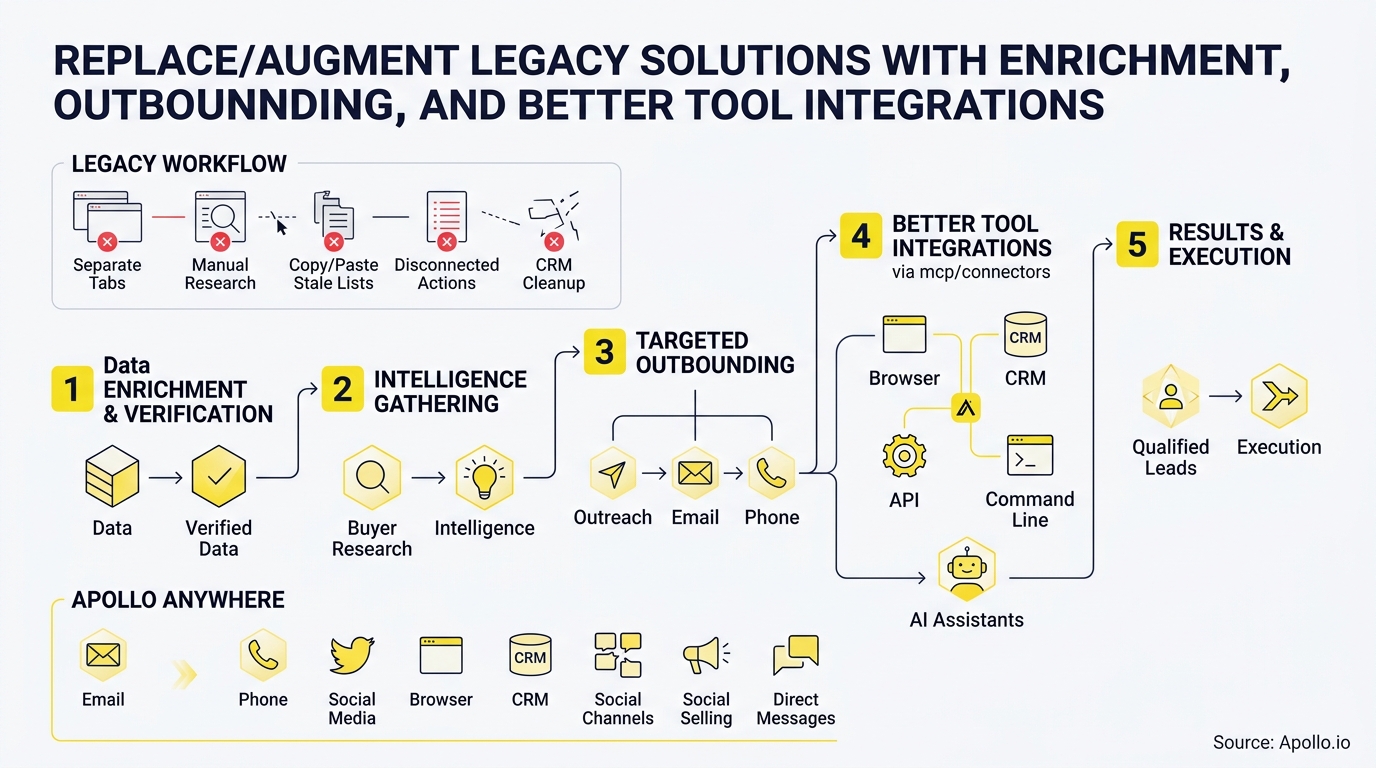
The right choice depends on which specific capability you're evaluating, not on ZoomInfo as a single monolithic product. Break the decision into three buckets: capabilities to retain (intent data or existing CRM integrations already embedded in workflows), capabilities to augment (contact and email coverage via waterfall enrichment), and capabilities to replace (outbound execution, sequencing, and AI-assisted research).
A single-vendor database rarely covers your full target list. According to Yalc.ai, single-vendor B2B databases typically deliver only 55%-70% verified email coverage for a target list, which is why waterfall enrichment across providers has become the default architecture rather than the exception.
| Scenario | Best Fit | Why |
|---|---|---|
| Retain | Existing intent feeds tied to legacy workflows | Switching cost outweighs marginal gain |
| Augment | Contact/email coverage gaps | Waterfall enrichment fills verified-coverage gaps |
| Replace | Outbound execution, sequencing, dialer | Unified data-to-action systems close the workflow gap |
What Is A Capability-To-Stack Decision Scorecard?
A capability-to-stack decision scorecard maps each GTM function, data, enrichment, outbound, and analytics, against the tool best suited to run it, instead of assuming one vendor should own everything. Score each capability on three axes: data freshness needs, workflow integration depth, and cost per outcome.
- Data freshness: Contact and firmographic data decay fast. DataMagnet's 2026 benchmark report found B2B contact data now decays at 25%-30% per year, which argues for continuous enrichment over annual database refreshes.
- Workflow integration: Does the tool need to talk to your CRM, sequencer, and AI assistant simultaneously, or just sit as a lookup table?
- Cost per outcome: Price per contact matters less than the cost of the meetings or pipeline it generates.
Struggling to find qualified leads inside a bloated stack? Search Apollo's 240M+ contacts with 65+ filters to see how a single workspace scores against a scorecard built from data, sequencing, and dialer combined.
How Do MCP And Connectors Change Sales Data Architecture?
MCP and connectors let AI tools query enrichment, CRM, and outbound platforms directly instead of forcing reps to switch between disconnected dashboards. Anthropic released the Model Context Protocol in November 2024, and by December 2025 it reported more than 10,000 active public MCP servers with adoption across ChatGPT, Gemini, Microsoft Copilot, Cursor, and VS Code.
Adoption has moved fast since then. Openclaw.direct reports MCP SDK downloads exploded from 100K to more than 97 million per month in 2025, signaling a shift toward agentic sales workflows where AI assistants act on live data instead of static exports.
ZoomInfo's own MCP server launch in March 2026 reflects this shift: rather than remain a closed destination, it now exposes contact, intent, and technographic data to MCP-compatible tools including Claude, ChatGPT, and Slack. This makes ZoomInfo easier to run as a background data source even when reps do their actual work somewhere else, which is exactly the "augment, don't replace" pattern many RevOps teams are adopting.
For technical teams building headless GTM workflows, the Apollo API supports the same connector-driven model, letting GTM Engineers query and enrich records centrally instead of exporting CSVs between tools.
Why Does Waterfall Enrichment Outperform Single-Vendor Data?
Waterfall enrichment outperforms single-vendor data because it queries multiple providers in sequence and keeps the best available result for each field, instead of accepting one vendor's gaps as the ceiling. This "best provider per field" approach has become the emerging default architecture across the enrichment category.
The ROI case is measurable. Research from Openprise found Adobe moved from a 50% single-vendor match rate to an 88% match rate using a multi-vendor waterfall, generating $250,000 in net annual savings from automated list loading alone.
The cost of skipping this step falls on your team. Landbase found SDRs lose an average of 500 hours annually, about 62 working days, simply validating and correcting contact info, representing a 25% waste of total selling capacity. Tired of dirty data eating into selling time? Start free with Apollo's waterfall enrichment built into the same workspace as your outbound sequences.
See Every Deal Stage Before It's Too Late
Forecasting off stale spreadsheets while deals quietly slip through the cracks? Apollo gives you real-time visibility into every stage, so you catch stalled deals before they die. Built-In saw a 10% win rate lift using Apollo's signals.
Schedule a Demo →How Can SDRs And AEs Book More Meetings With A Modular Stack?
SDRs and AEs book more meetings when enrichment, prioritization, and sequencing run in one workflow instead of across disconnected tabs. Gartner's 2024 survey of 1,026 B2B sellers found effective AI partners were 3.7 times more likely to help sellers meet quota, but half of sellers felt overwhelmed by their technology, and overwhelmed sellers were 45% less likely to attain quota.
That finding supports consolidation over addition. For SDRs, that means enrichment happens automatically before a sequence sends, not as a separate manual step.
For Account Executives prepping for a call, pre-meeting intelligence should pull from the same record the SDR enriched, not a second export.
Predictable Revenue's Collin Stewart summed up this shift after consolidating tools: "We reduced the complexity of three tools into one." RevOps leaders managing integration sprawl should audit which of their current tools duplicate enrichment, sequencing, or CRM sync before adding another point solution.

How Does Outbound Execution Fit Into A Replace-Or-Augment Plan?
Outbound execution needs to be treated as a core requirement, not an afterthought, because deliverability now gates whether any enrichment investment pays off. Gmail classifies domains sending roughly 5,000 messages per day as bulk senders and recommends spam rates below 0.1%, while Microsoft added SPF, DKIM, and DMARC authentication requirements in 2025 for high-volume Outlook.com senders.
That means verification, suppression, and authentication monitoring belong in the same system as your enrichment and sequencing, not bolted on separately. Spending hours stitching together sequencing, verification, and a dialer? Automate multi-channel outreach with Apollo's sales engagement platform, where enrichment feeds directly into email, phone, and social sequences.
What Does A 90-Day Replace-Or-Augment Rollout Look Like?
A 90-day rollout de-risks migration by testing new enrichment and outbound layers in parallel with your existing stack before cutting anything over. Follow this phased approach:
- Days 1-15 (Baseline): Audit current match rates, bounce rates, and cost per verified contact from your existing database.
- Days 16-40 (Shadow enrichment): Run a waterfall enrichment layer alongside your current source on a sample list, without touching live campaigns.
- Days 41-55 (Field-level provenance): Tag which provider sourced each field so you can measure accuracy by source, not just in aggregate.
- Days 56-75 (Controlled sends): Move a small segment of outbound volume to the new stack with authentication and suppression rules active.
- Days 76-90 (Rollback and scale): Compare reply and bounce rates against baseline, then scale the winning configuration or roll back cleanly.
This phased model directly answers the architecture problem identified across enterprise IT: most application stacks are large but poorly connected, so a staged rollout with clear checkpoints avoids compounding integration failures into a live outbound program.
What Are The Most Common Questions About Replacing ZoomInfo?
Is It Safer To Replace ZoomInfo Or Augment It With Connectors?
Augmenting is safer for most teams because it preserves existing intent data and CRM integrations while adding enrichment and outbound capabilities around them. Full replacement makes sense only when your primary use case, like outbound execution or multi-source enrichment, has clearly outgrown the incumbent tool.
What Security Considerations Apply To MCP Connectors?
MCP connector security depends on scoping access tightly and auditing which tools can read or write to your CRM and enrichment data. According to The Agentics' 2026 enterprise MCP guide, 41% of technical leaders report having MCP servers already in production for enterprise AI workflows, so treat connector permissions the same way you'd treat API key governance.
Does A Modular Stack Cost Less Than A Single Vendor?
It depends on how many redundant tools you're currently running. Oliv.ai found the average B2B sales team uses 10-15 tools but utilizes only 42% of paid capabilities, meaning consolidation into fewer, better-integrated tools often reduces waste even if per-seat pricing looks similar. Census reported a concrete outcome after consolidating: "We cut our costs in half."

Ready To Build A Modular GTM Stack That Actually Connects?
Replacing or augmenting ZoomInfo isn't about finding a cheaper database. It's about deciding which capabilities deserve a dedicated, connected system and which are better served by a unified workspace where enrichment, outbound, and pipeline data live together.
Apollo brings B2B data, sales engagement, and AI-powered execution together in one connected go-to-market system, so teams don't have to stitch together separate vendors for research, outreach, and analysis. Explore sales intelligence tools or see how AI sales tools compare before you commit to a migration plan.
Start Free with Apollo today to test waterfall enrichment, multi-channel sequencing, and CRM sync in one workspace:Start Free with Apollo.
Ramp Reps Faster, Prove ROI With Apollo
New reps taking months to ramp while leadership questions the tool budget? Apollo gives every rep the same verified data and proven workflows from day one, so ramp time drops and results are easy to show. Leadium 3x'd revenue after automating outbound with Apollo.
Start Free with Apollo →Don't miss these
Sales
Inbound vs Outbound Marketing: Which Strategy Wins?
Sales
What Is a Sales Funnel? The Non-Linear Revenue Framework for 2026
Sales
What Is a Go-to-Market Strategy? The 2026 GTM Playbook
See Apollo in action
We'd love to show how Apollo can help you sell better.
By submitting this form, you will receive information, tips, and promotions from Apollo. To learn more, see our Privacy Statement.
4.7/5 based on 9,690 reviews
