
Replace Outreach and ZoomInfo With Apollo to Save Money
Paying for two or three overlapping sales tools while your reps still can't hit quota is a budget problem and a workflow problem. If you're evaluating whether to replace Outreach and ZoomInfo with a single platform, the answer depends on your team size, data needs, and how deep your current ABM plays run.
This guide gives you a replace/combine/keep decision framework, a real TCO comparison, and a 30-day pilot structure so you're not guessing.

Skip The Research, Apollo Finds Contacts Fast
Still burning hours a day chasing down emails and phone numbers that bounce anyway? Apollo hands your team verified contact data instantly, with 98% email accuracy built in. Spend that time selling instead of searching.
Start Free with Apollo →Key Takeaways
- Consolidating sales data and engagement tools into one platform can cut software costs significantly, but the real win is fewer logins, less admin work, and faster rep ramp time.
- A 2023 Apollo customer story showed Census replacing Outreach and ZoomInfo contracts with Apollo, cutting reported stack costs and improving contact coverage.
- Before switching, run a 30-day parallel test measuring contact match rates, bounce rates, and meetings booked, not just sticker price.
- Teams running complex intent-based ABM plays should evaluate signal depth carefully since Outreach has added ZoomInfo buying signals to its own workflows.
- Apollo's published annual pricing makes it easier to model total cost than quote-based competitors.
Should You Replace, Combine, Or Keep Outreach And ZoomInfo?
The right choice depends on team size, deal complexity, and how much you rely on advanced intent signals. Use this matrix as a starting point:
| Scenario | Recommendation | Why |
|---|---|---|
| Startup or SMB team (1-20 reps), straightforward outbound motion | Replace both with Apollo | Lower entry cost, unified data + engagement, faster onboarding |
| Mid-market team running basic ABM, no complex intent stacking | Replace both with Apollo | Consolidates sequences, dialer, and enrichment into one workspace |
| Enterprise team with deep intent-signal ABM programs | Combine or pilot first | ZoomInfo's signal depth (hiring, funding, leadership changes) may still add value |
| Team mid-contract with heavy Salesforce customization tied to Outreach | Pilot Apollo in parallel before migrating | Reduces risk of workflow or reporting gaps during transition |
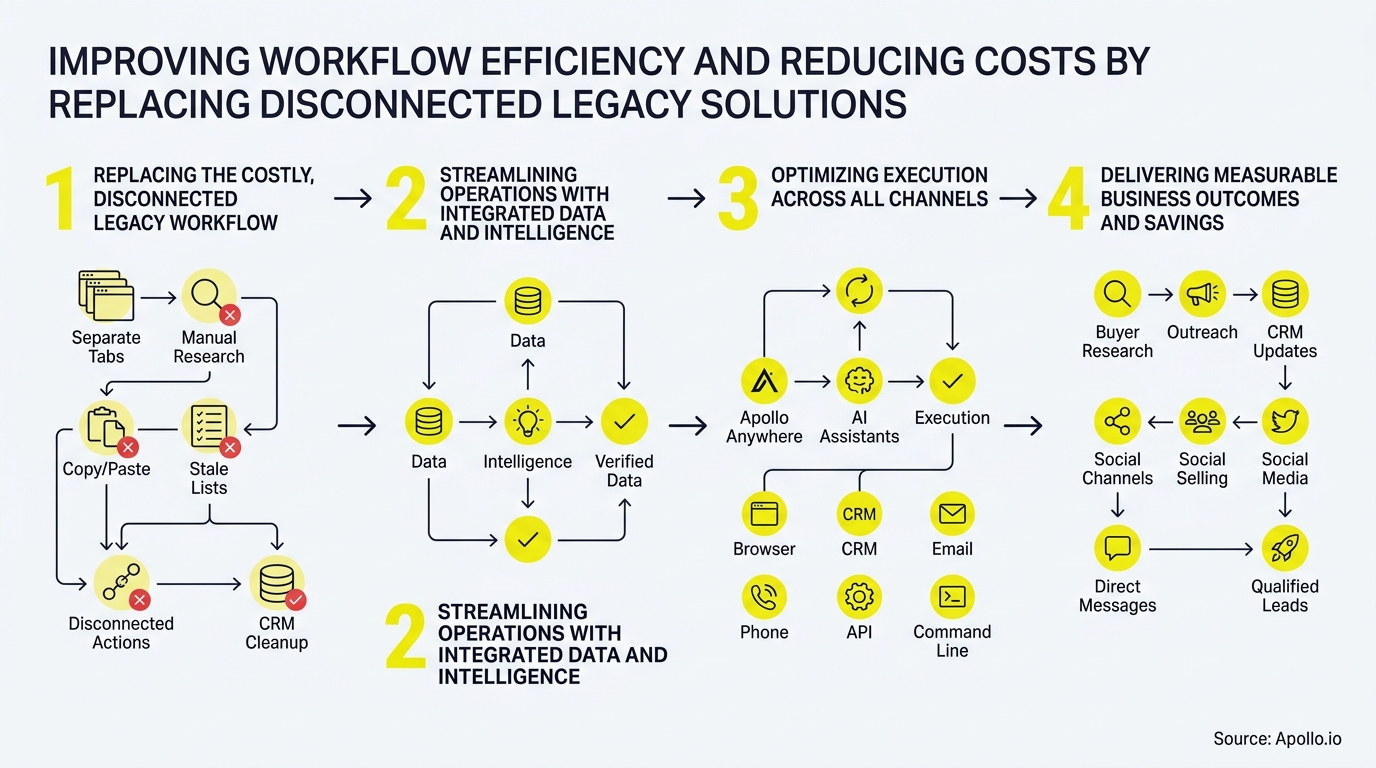
For most growing GTM teams, replacing both tools with a single go-to-market platform removes the integration tax between separate data and engagement vendors.
How Much Does Apollo Actually Cost Versus Outreach And ZoomInfo?
Apollo publishes annual pricing starting at $49/user/month (Basic), $79/user/month (Professional), and $119/user/month (Organization, minimum 3 users), while Outreach and ZoomInfo both use custom, quote-based pricing. That transparency alone makes Apollo easier to model in a budget spreadsheet.
According to Modern Inbound, Outreach typically requires an annual commitment with a floor near $20,000/year for mid-sized teams, with per-seat costs between $100-$160/month. ZoomInfo's pricing is also not publicly displayed, requiring a sales conversation for a quote.
A documented case study shows what this looks like in practice: Census replaced separate Outreach and ZoomInfo contracts with Apollo, reducing stack costs by 64% while reporting more email addresses, more phone numbers, and higher data quality. "We cut our costs in half," said the Census team in their published case study. This is a vendor-reported result specific to Census, not a universal benchmark.
| Plan | Monthly List Price (per user) | Annual Cost (per user) |
|---|---|---|
| Apollo Basic | $49 | $588 |
| Apollo Professional | $79 | $948 |
| Apollo Organization | $119 | $1,428 |
| Outreach (estimated floor) | $100-$160 | ~$20,000/year minimum for mid-sized teams |
| ZoomInfo | Not publicly displayed | Requires custom quote |
For a 10-seat team, Apollo Professional runs approximately $9,480/year before add-ons, well under a single incumbent Outreach renewal. Visit Apollo's official pricing page for current plan details and billing options.

What Does A 30-Day Apollo Pilot Scorecard Look Like?
A 30-day pilot measures whether Apollo's data and workflows hold up against your current stack before you cancel anything. Run Apollo in parallel with your existing tools against the same target account list, then compare results on these metrics:
- Verified contact coverage: percentage of target accounts with valid email and phone data
- Bounce rate: email bounce percentage across matched sequences
- Direct-dial connect rate: live conversations per 100 dials
- Reply and meeting rate: meetings booked per 1,000 prospects contacted
- Rep adoption: percentage of reps actively using the new workspace daily
- RevOps admin hours: weekly hours spent maintaining lists, integrations, and data hygiene
Set pass/fail thresholds before you start. If Apollo matches or beats your current benchmarks on four of six metrics, you have a data-backed case to migrate.
If not, combine platforms for specific use cases instead of a full replacement.
Struggling to find qualified leads during your pilot? Search Apollo's 240M+ contacts with 65+ filters to build your test account list.
See Every Deal Stage Before It's Too Late
Forecasting off gut feel because your pipeline data is always a week behind reality? Apollo gives you live deal intelligence so you can spot stalled opportunities before they slip. Built-In improved win rates using Apollo's scoring and signals.
Schedule a Demo →How Do SDRs And AEs Save Time By Consolidating Tools?
SDRs and AEs save time by working in one workspace instead of toggling between a data provider, a sequencing tool, and a dialer. According to Sales Motion, sales reps currently spend only 28% to 30% of their week on actual selling activities, with the rest lost to research, data entry, and tool-switching.
For SDRs, that means less time copying contact data between platforms and more time on live conversations. For Account Executives, pre-meeting intelligence and deal tracking live in the same system as outreach history, so there's no context lost between prospecting and closing. Predictable Revenue reported: "We reduced the complexity of three tools into one."
RevOps leaders benefit too: fewer integrations mean fewer breakages and less time reconciling data between systems. Lokalise research found that workers lose 51 minutes per week specifically to tool fatigue and managing redundant platforms, a cost that compounds across a full sales team.
What Are The Risks Of Switching From Outreach And ZoomInfo?
The main risk is losing signal depth or workflow governance that your team currently depends on. Outreach's September 2026 release expanded its Omni AI agent into Slack with mobile record creation and persistent user preferences, raising the bar for any replacement to match collaboration and governance features, not just sequencing.
Outreach has also added ZoomInfo buying signals covering intent, hiring, funding, and leadership changes into its own workflows. Teams running sophisticated ABM programs that depend on this signal stacking should pilot carefully rather than switching immediately.
Data quality is the other risk. Salesforce's 2024 survey found only 35% of sales professionals completely trusted their organization's data, and Gartner identified poor data quality as an analytics barrier for a large share of sales leaders.
A lower-cost platform only saves money if match rates and connect rates hold up, which is exactly what the 30-day scorecard above is designed to test.
How Do You Migrate From Outreach And ZoomInfo Without Losing Data?
A clean migration requires exporting historical data, mapping fields, and running a rollback plan before you cancel any contracts. Follow this checklist:
- Export all active sequences, templates, and suppression lists from Outreach
- Export enriched contact and company records from ZoomInfo, including custom fields
- Map Salesforce or HubSpot fields to Apollo's CRM integration before go-live
- Rebuild your highest-performing sequences using Apollo's sales sequence builder
- Re-upload suppression and do-not-contact lists to avoid compliance gaps
- Run reporting in parallel for two weeks to confirm pipeline and meeting metrics match before fully cutting over
- Keep a 30-day rollback window with your incumbent tools in case reporting parity issues surface
Cyera's team summarized the payoff after consolidating: "Having everything in one system was a game changer."
What Does Enterprise-Fit Look Like For A Consolidated Stack?
Enterprise teams can run Apollo's Organization tier alongside advanced routing, governance, and admin controls without sacrificing security requirements. Apollo serves B2B GTM teams, GTM Engineers, and AI Builders alongside Sales Professionals, SDRs/BDRs, AEs, RevOps, Marketing, and Revenue Leaders, including teams at Fortune 500 companies.
ZoomInfo reported having 1,867 customers spending more than $100,000 in annual contract value as of the end of 2024, per its SEC filing, showing continued enterprise demand for its data depth. Enterprise teams evaluating consolidation should weigh that signal depth against admin overhead, and run the same 30-day pilot scorecard at the department level before a company-wide rollout.
Frequently Asked Questions
How Do Apollo Credits Work Compared To ZoomInfo Contracts?
Apollo uses a credit system tied to your plan tier for exports and enrichment, while ZoomInfo typically locks contact and company credits into a custom annual contract. Check Apollo's pricing page for current credit allowances by plan.
Can Apollo Replace ZoomInfo For Enterprise ABM Programs?
It depends on how deep your intent-signal requirements are. Run a parallel pilot measuring signal accuracy and account coverage before replacing an enterprise ZoomInfo contract outright.
Does Switching To Apollo Affect Salesforce Reporting?
Migration can affect reporting temporarily if fields aren't mapped correctly. Follow the migration checklist above and run parallel reporting for two weeks to confirm parity.
What Happens To Suppression Lists During Migration?
Suppression and do-not-contact lists must be manually exported and re-uploaded into Apollo to maintain compliance continuity during the switch.

Ready To Cut Your Sales Tech Stack?
Replacing Outreach and ZoomInfo with a single platform isn't automatic for every team, but for most growing GTM organizations, tool consolidation reduces both cost and complexity. Run the 30-day pilot, compare real numbers against your current renewals, and let the data decide.
Schedule a Demo and see how Apollo brings data, engagement, and AI-powered execution into one workspace built to save your team time and money.
Prove ROI Fast, Scale Reps Without New Hires
Struggling to justify tool spend before the next budget review? Apollo replaces scattered point solutions with one platform your team adopts in days, not quarters. Leadium tripled annual revenue after consolidating with Apollo.
Start Free with Apollo →Don't miss these
Sales
Inbound vs Outbound Marketing: Which Strategy Wins?
Sales
What Is a Sales Funnel? The Non-Linear Revenue Framework for 2026
Sales
What Is a Go-to-Market Strategy? The 2026 GTM Playbook
See Apollo in action
We'd love to show how Apollo can help you sell better.
By submitting this form, you will receive information, tips, and promotions from Apollo. To learn more, see our Privacy Statement.
4.7/5 based on 9,690 reviews
