
Prospecting for Your Incubator: Find Contacts and Automate Outreach
A three-person incubator team can't manually research founders, mentors, investors, corporate partners, and sponsors five days a week. Yet most incubators still run prospecting like a side project instead of a system.
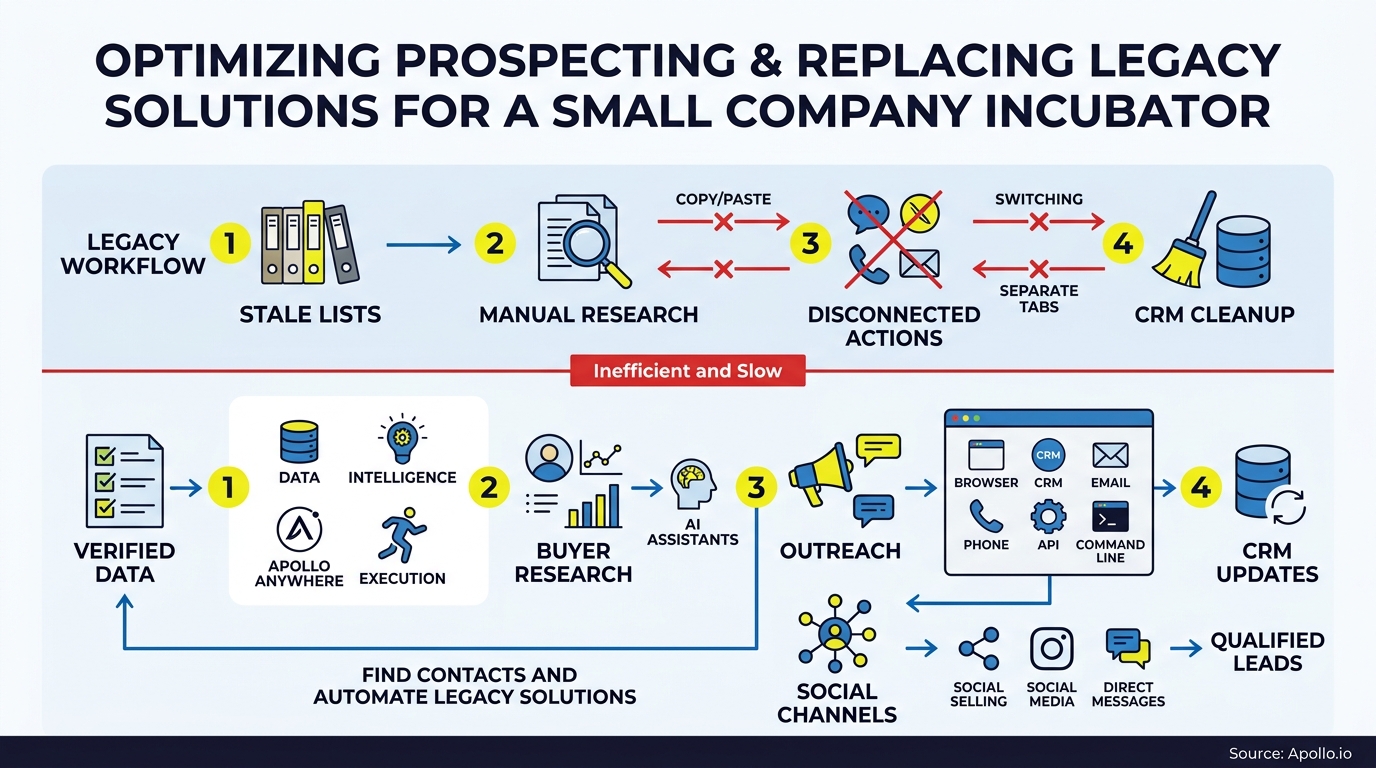
The fix is a structured prospecting operating system: five stakeholder pipelines, each with its own targeting criteria, outreach cadence, and success metric, built on verified contact data rather than guesswork.
This matters now. Mailbox providers tightened bulk-sender rules in 2025, requiring domain authentication for high-volume senders, and professional networks has pursued legal action against unauthorized data scraping. Incubators relying on sketchy contact sources risk deliverability problems and compliance exposure. Teams that build with verified prospecting systems from day one avoid both.

Apollo Ends Manual Research For Good
Burning hours verifying emails and phone numbers that bounce anyway? Apollo hands you 240M+ verified contacts with 98% email accuracy, no digging required. Spend that time selling instead of searching.
Start Free with Apollo →Key Takeaways
- Incubators need five separate prospecting pipelines (founders, mentors, investors, corporate partners, sponsors), not one generic contact list.
- Signal-based targeting (funding news, hiring activity, program applications) outperforms static list-buying for small teams with limited outreach capacity.
- Data provenance and suppression lists are now core compliance requirements, not optional extras, given tightening anti-scraping enforcement and mailbox-provider rules.
- Human review still matters: buyers want AI-assisted research paired with a real person validating the message before it sends.
- A 30-day rollout with weekly data-quality checks lets a lean team stand up a working system without a dedicated RevOps hire.
What Is Incubator Prospecting?
Incubator prospecting is the structured process of finding, verifying, and reaching the people an incubator needs to run its program: applicant founders, mentors, investors, corporate sponsors, and university partners. It is often confused with general B2B lead generation, but unlike a typical sales funnel, incubator prospecting runs five parallel, non-competing pipelines toward different outcomes (applications, mentor matches, capital introductions, partnership deals, and sponsorship revenue).
It is not just cold outreach volume. A 2024 Wharton-affiliated study found that accelerator participants who received active program support, including mentor and investor introductions, were 3.4 percentage points more likely to raise venture capital, according to Wharton research. The pipeline design matters more than the message count.
What Are the Five Stakeholder Pipelines an Incubator Needs?
An incubator needs five distinct prospecting pipelines because each stakeholder type has different decision criteria, timelines, and outreach cadences.
| Pipeline | Target Contact | Primary Signal | Outreach Cadence | Success Metric |
|---|---|---|---|---|
| Founders | Early-stage CEOs, co-founders | New incorporation, demo day, hiring first employee | Weekly email + social | Applications submitted |
| Mentors | Operators, former founders, execs | Job change, public speaking, advisory roles | Monthly personal outreach | Mentor matches confirmed |
| Investors | Angels, seed VCs, scouts | New fund announcement, recent check written | Bi-weekly + event invites | Capital introductions made |
| Corporate Partners | Innovation/partnerships leads | New CSR or innovation program launch | Monthly | Signed partnerships |
| Sponsors | Marketing/brand leaders | Budget cycle, competitor sponsorships | Quarterly | Sponsorship revenue |
Each pipeline needs its own ideal customer profile (ICP) template, scoring rubric, and CRM field set so a lean team doesn't mix mentor outreach with founder recruitment in the same sequence.
How Do You Build a Step-By-Step Prospecting Workflow?
The workflow runs in five stages: source, verify, score, engage, and route to CRM. Each stage has a specific owner and output so a small team doesn't lose track of who's responsible for what.
- Source: Pull contacts by role, company stage, and location using filters rather than broad exports. Search Apollo's 240M+ contacts with 65+ filters to pull founder or mentor lists by title, industry, and funding stage in minutes instead of days.
- Verify: Confirm email and role accuracy before any send. Research from Landbase found that between 23% and 30% of B2B email addresses become outdated annually, so stale lists quietly erode reply rates over a program cycle.
- Score: Rank each contact against pipeline-specific ICP criteria (stage, signal recency, geographic fit).
- Engage: Launch a multi-channel sequence (email, phone, social) matched to that pipeline's cadence.
- Route: Push qualified replies into your CRM via native Salesforce or HubSpot integration with pipeline tags intact.
Apollo Flags Buyers Before They Cool Off
Good leads sitting untouched while marketing hands you names with no context? Apollo surfaces intent signals and buying activity so reps engage prospects at the exact moment they're ready. Built-In saw a 10% win rate lift using Apollo's scoring.
Start Free with Apollo →How Can a Program Director Automate Outreach Without Losing Personalization?
A program director can automate research and first-draft messaging while keeping a human in the loop for final review and send approval on priority contacts. Gartner's May 2026 research found that a majority of B2B buyers still want a human to validate AI-generated outreach before trusting it. Full automation without review risks generic messaging that investors and mentors ignore.
The practical split: let automation handle sourcing, enrichment, and first-draft personalization. Reserve director or founder time for the final send on investor and corporate-partner pipelines, where relationship context matters most.
Smaller volume, higher relevance pipelines (mentors, sponsors) can tolerate lighter review since the stakes per message are lower.
Spending hours manually drafting every message? Automate first-draft outreach with Apollo's AI-powered sequences while keeping approval in your hands.
How Do RevOps Leaders Keep Incubator Contact Data Clean?
RevOps leaders keep incubator contact data clean by running weekly verification checks, maintaining a suppression list, and documenting where every contact record originated. This matters more now that California's DROP system lets a single consumer request reach over 600 registered data brokers, increasing the odds that a purchased list contains records flagged for deletion.
For a lean team without a dedicated RevOps hire, build these habits into the 30-day rollout:
- Weekly bounce-rate review against a 2-3% threshold
- Monthly suppression-list sync pulled from unsubscribes and bounces
- Quarterly source audit confirming where each contact list originated
Apollo's enrichment tools refresh contact records against a verified database, reducing the manual cleanup load on a small team.

What Does a 30-Day Rollout Look Like for a Small Incubator Team?
A 30-day rollout for a small incubator team moves from pipeline setup to live outreach in four weekly phases, with a data-quality and compliance check built into each week.
| Week | Focus | Weekly Check |
|---|---|---|
| 1 | Build ICP and scoring templates for all five pipelines | Confirm CRM field mapping is pipeline-specific |
| 2 | Source and verify first contact batches | Review bounce rate before first send |
| 3 | Launch sequences; apply human review on investor/partner drafts | Audit suppression list for opt-outs |
| 4 | Route replies to CRM; measure applications, matches, and intros | Document contact-source provenance |
This cadence gives a founder or program director weekly visibility without requiring daily oversight, which matters when outreach is one of several responsibilities on a small team.
How Do SDRs and Founders Measure Prospecting Success for an Incubator?
SDRs and founders measure incubator prospecting success by tracking pipeline-specific outcomes rather than generic open rates. For the founder pipeline, that's applications submitted and accepted.
For investors, it's confirmed introductions and follow-on meetings. For mentors, it's matches made and session completion.
Salesforce's 2024 survey found that sales reps spent 70% of their time on non-selling work, and teams using AI reported higher revenue growth than those without it. For incubator teams wearing multiple hats, that gap is often wider: automating sourcing and enrichment frees up director time for the mentor calls and investor meetings that actually move a cohort forward.
Struggling to keep five pipelines visible in one place? Track every stakeholder relationship with Apollo's deal management view, from first contact through signed partnership.
FAQ: Incubator Prospecting Compliance and Tools
Does CAN-SPAM Apply to Incubator Outreach Emails?
Yes, CAN-SPAM applies to commercial and business-development emails sent by incubators, including founder recruitment and sponsor outreach. Every message needs a working unsubscribe link, accurate sender information, and prompt honoring of opt-out requests.
Users control who they contact and how they use the outreach platform, so building a suppression-list habit from week one keeps a small team compliant without legal overhead.
How Do You Verify Contact Data Before Outreach?
Verify contact data by checking email deliverability and confirming the role is current before adding a contact to any sequence. Given that a meaningful share of B2B emails go stale each year, as cited above, a verification pass before each send cycle protects both deliverability and sender reputation.
Can AI Outreach Replace Manual Relationship-Building for Investor Introductions?
No, AI outreach should support, not replace, manual relationship-building for investor introductions. Automation handles research, enrichment, and first-draft messaging, but warm investor intros still benefit from a founder or director's personal review and send, especially given that buyers increasingly want human validation on AI-assisted outreach.

Build Your Incubator's Prospecting System Today
Five pipelines. One verified data source.
A 30-day rollout that doesn't require a full-time RevOps hire. That's the operating system a lean incubator team needs to stop losing founders, mentors, and investors to manual, ad hoc outreach.
Apollo brings B2B data, sales engagement, and AI-powered execution together in one connected system, so your team doesn't have to stitch together separate vendors for sourcing, verification, and outreach across five different stakeholder pipelines. As Collin Stewart of Predictable Revenue put it, "We reduced the complexity of three tools into one."
Explore outbound prospecting strategies built for lean teams, or start building your five pipelines now.
Prove Pipeline ROI Without The Guesswork
Struggling to justify the spend before leadership asks again? Apollo replaces scattered tools with one platform so every rep's activity ties straight to pipeline. Leadium 3x'd revenue by automating outreach and speeding follow-up.
Start Free with Apollo →Don't miss these
Sales
Inbound vs Outbound Marketing: Which Strategy Wins?
Sales
What Is a Sales Funnel? The Non-Linear Revenue Framework for 2026
Sales
What Is a Go-to-Market Strategy? The 2026 GTM Playbook
See Apollo in action
We'd love to show how Apollo can help you sell better.
By submitting this form, you will receive information, tips, and promotions from Apollo. To learn more, see our Privacy Statement.
4.7/5 based on 9,690 reviews
