
Programmatic advertising platforms are software systems that automate how ad inventory is bought, sold, targeted, and measured, usually through real-time auctions or pre-negotiated deals. The category includes demand-side platforms (DSPs), supply-side platforms (SSPs), account-based marketing (ABM) advertising tools, and closed-network buying tools.
Each solves a different problem, and the wrong pick wastes budget quietly.
The category is large. Christoph Olivier Consulting reports that US internet programmatic advertising revenue reached $162.4 billion in 2025, up 20.5% year over year. Spend is growing faster than most buyers' ability to audit it. That gap is where this guide focuses: how to pick a platform, what it really costs to own, and how to prove it created pipeline.
If your pipeline starts with a named-account list, the ad platform is only half the system. Sales teams still need accurate contacts to follow up on ad engagement, which is why many B2B teams pair advertising with a go-to-market strategy that connects ads to outreach.

Apollo Gives Selling Time Back To Your Reps
Spending hours researching leads and verifying contact info by hand? Apollo finds business contacts and delivers 98% email accuracy, so your reps stop doing data entry and start booking meetings. Start building pipeline today, free.
Start Free with Apollo →Key Takeaways
- Match the platform type to the job. DSPs buy media, SSPs sell it, ABM tools target named accounts, and closed networks sell their own inventory.
- Total ownership cost goes beyond CPM. Fees, data access, inventory controls, and measurement all change what you actually pay.
- Cheap impressions are not good impressions. Placement quality and supply-chain transparency matter as much as targeting.
- Run a pilot before scaling. Baseline, account matching, quality checks, CRM outcomes, and a lift test separate real pipeline from correlation.
- Pair ads with outreach. Ad exposure warms accounts, and sales follow-up turns attention into meetings.
What Are the Main Types of Programmatic Advertising Platforms?
The main types are DSPs, SSPs, ABM advertising platforms, and closed-network or walled-garden buying tools. They differ by who they serve and where the inventory comes from, and most B2B buyers need only one or two of them.
| Platform Type | Who Uses It | What It Does | Typical B2B Use Case |
|---|---|---|---|
| DSP (demand-side platform) | Advertisers and agencies | Buys inventory across many exchanges with audience and bid controls | Broad reach, retargeting, CTV and display at scale |
| SSP (supply-side platform) | Publishers | Sells and manages ad inventory | Rarely bought by B2B marketers directly; matters for inventory quality |
| ABM advertising platform | B2B marketing teams | Targets named accounts using firmographic and intent data | Reaching a defined target-account list |
| Closed network / walled garden | Advertisers | Sells inventory inside one ecosystem with that owner's data | Professional-audience targeting inside a single network |
How Do DSPs Differ from ABM Advertising Platforms?
A DSP is a general-purpose media-buying engine, while an ABM advertising platform is built around account lists, firmographic data, and sales signals. DSPs offer more inventory and more flexibility but typically expect more media expertise.
ABM platforms trade some flexibility for account matching and sales alignment.
Where Do SSPs Fit for Buyers?
SSPs serve publishers, so B2B marketers rarely license one. They still matter to you because SSP choices shape which inventory reaches your DSP and how transparent the supply path is.
Ask your DSP which SSPs and paths your spend travels through.
How Big Is the Programmatic Advertising Platform Market?
The standalone platform software market, covering DSPs, SSPs, and ad exchanges, is a fraction of the media spend that flows through it. Grand View Research values it at $12.5 billion in 2025, growing to $15.8 billion in 2026. Software revenue and ad revenue are different numbers, so check which one a source is quoting.
On the B2B side, MarketingCharts reports US B2B digital ad spending grew to $18.3 billion in 2024 (up 14.9%) and is forecast to reach $23.05 billion in 2026. B2B budgets are rising, which makes selection discipline more valuable, not less.
| Metric | Figure | Source Scope |
|---|---|---|
| US programmatic revenue (excluding search), 2024 | $134.8 billion, up 18.0% | IAB/PwC, advertising revenue, not B2B-only |
| US internet programmatic revenue, 2025 | $162.4 billion, up 20.5% | Christoph Olivier Consulting |
| Platform software market, 2025 | $12.5 billion | Grand View Research, software only |
| US B2B digital ad spend, 2024 | $18.3 billion | MarketingCharts |
Note the scope differences. These figures come from different methodologies and should not be added together or compared line by line.
What Changed in B2B Programmatic Advertising in 2026?
Three developments shape 2026 buying decisions: channel expansion, professional-audience access through major DSPs, and AI moving from recommendations to execution.
- Channel expansion. On November 17, 2026, Metadata expanded its B2B advertising platform to 12 channels, adding programmatic display, connected TV, out-of-home, and audio. Its benchmark covers $57.6 million in 2025 spending across 153 B2B advertisers, with a $202 median professional networks cost per lead. That is a reason to test other channels, not proof they deliver cheaper qualified pipeline.
- Professional targeting on CTV. As of May 7, 2026, US advertisers can use professional networks audiences (job title, industry, seniority) across streaming inventory through Amazon DSP. That gives revenue teams another route to professional audiences.
- Autonomous campaigns. PubMatic reported in November 2026 more than 120 fully autonomous, end-to-end agentic campaigns, up from over 80 the previous quarter. These are company-reported adoption figures, not B2B performance benchmarks. The buying question becomes: which decisions run automatically, which need approval, and what is the system optimizing toward?
On the AI maturity point, the IAB's 2025 State of Data study found 70% of agencies, brands, and publishers had not fully scaled AI across media planning, activation, and analysis. A platform with AI features does not guarantee your team can use them well.
How Much Do Programmatic Advertising Platforms Really Cost?
The real cost of a programmatic platform is media spend plus platform fees, data costs, managed-service charges, and the staff time to run it. Quoted CPMs capture only part of that.
Vendors price differently (percentage-of-spend, flat subscription, managed-service retainers, or minimums), and many do not publish rates, so request quotes and compare line by line.
What Should Go in an Ownership Cost Worksheet?
| Cost Line | Questions to Ask | Fill In |
|---|---|---|
| Platform fee | Flat, percentage of spend, or tiered? Any annual minimum? | $____ |
| Media cost | What CPM range applies to your channels and audience? | $____ |
| Data fees | Are firmographic, intent, or third-party segments billed separately? | $____ |
| Inventory controls | Can you apply allowlists, blocklists, and supply-path filters at no extra charge? | $____ |
| Verification and measurement | Is viewability, brand safety, or lift testing an add-on? | $____ |
| Managed service | What does the retainer include, and what is the minimum commitment? | $____ |
| Integration work | CRM and marketing automation connectors: native or custom? | $____ |
| Internal labor | Hours per week for setup, optimization, and reporting? | $____ |
Why Doesn't a Low CPM Mean Good Value?
A low CPM can mean low-quality placements. The Association of National Advertisers' (ANA) August 2025 benchmark estimated $26.8 billion in annual global media value lost to programmatic inefficiencies.
That is an industrywide estimate, not B2B-specific, but it makes the point: judge placement quality and effective exposure, not unit price. The Trade Desk's OpenSincera, a free transparency application announced in May 2025, reports metrics such as ads-to-content ratio, ad refresh rate, and average ads in view, which give buyers a concrete way to question cheap inventory.

How Should You Choose Between a DSP and an ABM Platform?
Choose a DSP when you need scale, channel breadth, and hands-on control, and an ABM platform when your motion revolves around a defined target-account list with sales alignment. Many teams eventually run both, but start with whichever matches your sales motion.
| Decision Factor | DSP Fits Better When | ABM Platform Fits Better When |
|---|---|---|
| Audience | You target broad personas or lookalikes | You target a named-account list |
| Team skills | You have in-house media buyers or an agency | You have B2B marketers without media expertise |
| Channels | You want display, video, CTV, audio, and native in one buy | You want account-level reporting tied to sales stages |
| Reporting | You can build your own measurement | You want account engagement surfaced for sales |
| Control | You want granular bidding and inventory controls | You prefer opinionated workflows |
Targeting method also matters. Demandbase, an ABM vendor, reports approximately 80% of B2B programmatic campaigns now rely on firmographic or account-level targeting rather than broad audience proxies. Treat that as a vendor-published view, but it matches the direction of the market.
Managed Service or Self-Service?
Self-service gives you control and lower fees but needs a skilled operator. Managed service reduces setup burden but adds cost and can limit transparency.
Ask managed vendors for log-level or placement-level reporting so you can audit where spend went.
Pipeline Clarity Starts With Apollo
Forecasts feeling like a guessing game because your pipeline data is out of date? Apollo brings your prospecting and deal activity into one place, so your team spots in-market buyers sooner and works opportunities that actually convert. Start free and see where every deal stands.
Start Free with Apollo →How Do You Evaluate Platform Candidates Without Falling for "Best" Lists?
Evaluate candidates against criteria you define in advance, using vendor documentation, a demo, and a pilot. Rankings from any single source, including vendors with a stake in the answer, should be treated as inputs, not conclusions.
This guide intentionally does not rank vendors, because capabilities, names, and pricing change frequently and should be verified directly before any purchase.
Candidate platforms commonly considered in B2B programmatic include ABM-focused vendors such as 6sense and Demandbase, broad DSPs such as The Trade Desk and StackAdapt, and professional networks Campaign Manager for network-native professional targeting.
Verify each vendor's current capabilities and pricing directly.
What Belongs on a Procurement Checklist?
- Fees: Platform fee structure, minimums, and any charges for data, verification, or support.
- Inventory controls: Allowlists and blocklists, supply-path visibility, and which exchanges and SSPs your spend uses.
- Data access: Can you bring your own account list and first-party data? Who owns the audience data afterward?
- Account matching: How the platform maps your list to devices or IPs, and what match rate it reports.
- CRM integration: Native connection to your CRM and the ability to pass account-level engagement to sales.
- Measurement: Support for holdout or lift testing, and clear definitions of terms like "pipeline influenced."
- AI controls: Which decisions are automated, which need human approval, and whether optimization targets leads, opportunities, or revenue.
- Contract terms: Length, renewal conditions, and data export rights.
What Does a B2B Programmatic Pilot Look Like?
A reliable pilot runs 8 to 12 weeks, compares exposed accounts to a held-out group, and judges success by CRM outcomes rather than impressions or clicks.
Use the steps below as a template.
- Set the baseline. Record current opportunity creation, pipeline, and win rates for your target-account list before any spend starts.
- Define the account list and split it. Divide accounts into exposed and holdout groups of comparable size, industry, and stage.
- Check account matching. Ask the vendor for the match rate between your list and reachable audiences, and confirm you are not paying to reach unmatched traffic.
- Run quality checks. Review placements, viewability, frequency, and ads-to-content ratio weekly. Block poor domains early.
- Track CRM outcomes. Measure meetings booked, opportunities created, and pipeline by group, not just clicks or form fills.
- Test lift where feasible. Compare exposed accounts against the holdout. If a clean holdout isn't possible for small lists, state the limitation and treat results as directional.
- Document and decide. Record methods, spend, results, and limitations, then decide whether to scale, adjust, or stop.
Pipeline Influence or Pipeline Lift: What's the Difference?
Influenced pipeline counts opportunities that touched an ad at any point. Incremental pipeline counts only opportunities that exist because of the ads, which requires a comparison group.
Demandbase's April 2026 launch of Demandbase AI, which added Pipeline Influence measurement, shows vendors are investing in this reporting. Ask any vendor how they separate correlation from lift before trusting a dashboard number.
How Does Channel Choice Affect B2B Results?
Channel mix determines reach and cost, and no single channel wins for every B2B team. StackAdapt's 2026 report shows connected TV receiving 19.6% of spend in its B2B advertiser dataset for year-to-date 2025, versus 50.89% for display.
Those shares describe StackAdapt customers, not the entire market.
Display is also expected to grow in importance. Bidscube reports display is forecast to account for more than 50% of US B2B digital ad spend for the first time by 2026, overtaking search.
| Channel | Strength for B2B | Main Risk | What to Measure |
|---|---|---|---|
| Display | Scale and account-based retargeting | Low-quality placements | Viewability, placement quality |
| CTV | Reaching executives in high-attention environments | Unclear account-level reach | Frequency, incremental opportunities |
| Audio | Hard to attribute to accounts | Completion rate, branded search lift | |
| Native | Content distribution to in-market readers | Weak creative-to-landing-page fit | Engaged visits, account match rate |
Pick channels by where your target accounts spend time and by what you can measure. Start with one or two channels in the pilot, then expand only after the results hold up.
How Do Programmatic Ads and Outbound Work Together?
Programmatic ads warm up accounts, and outbound turns that attention into conversations. The two work best when they share one account list and one view of who has been contacted.
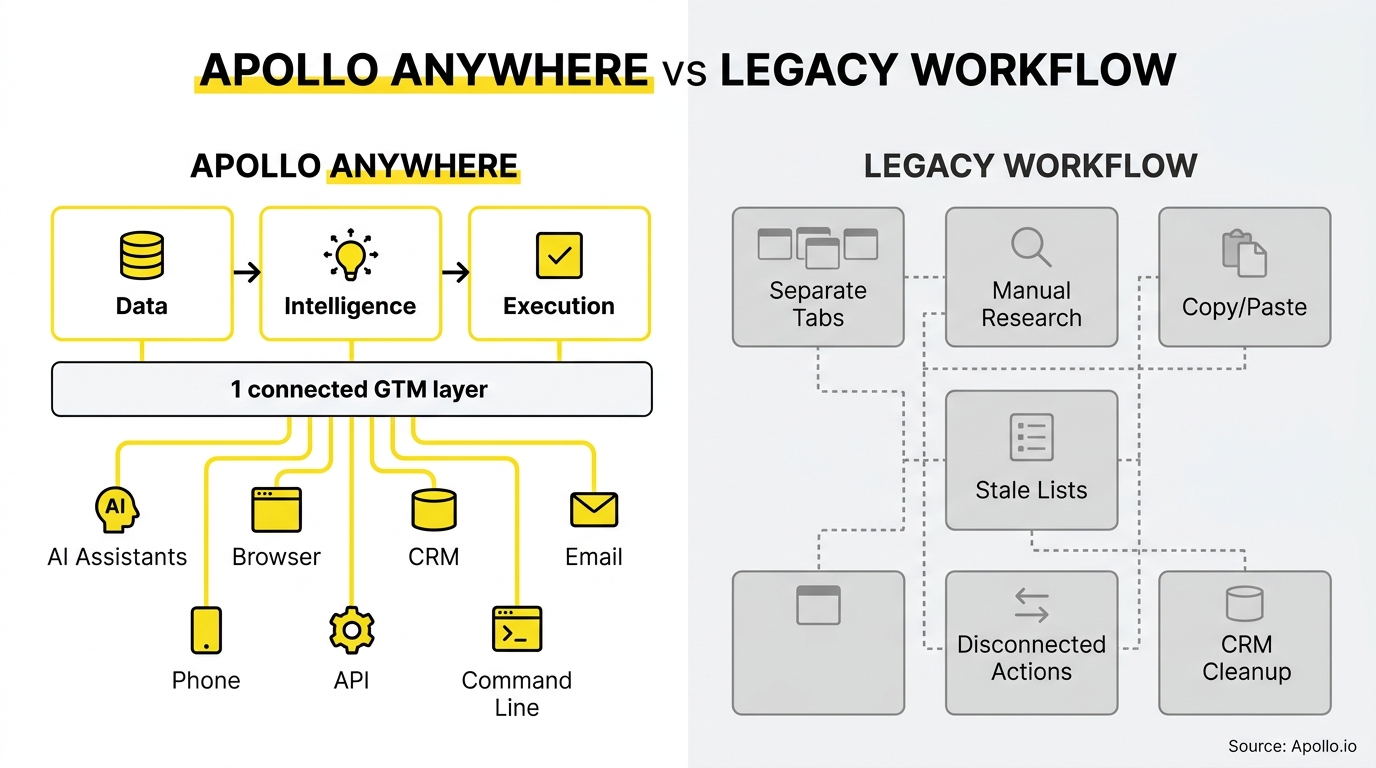
Apollo brings B2B data, sales engagement, and AI-powered execution together in one connected go-to-market system. Teams can build target account lists with Apollo's prospecting tools, hand them to the ad platform for targeting, and then run follow-up through sales engagement sequences across email, phone, and social. Users control who they contact and how they use the product.
"The thing that made me most excited as somebody who's been in sales development a long time was Apollo's integration between sales data and sales engagement and the magic that you can make happen when those two are together on the same platform."
Apollo's data enrichment keeps the account and contact records behind that list current, so ad audiences and outbound lists stay aligned with business contact information in your CRM.
"The moment we select someone in our database, they're instantly added to a sequence and we can take action right away. We're effective and efficient with our outreach."
What Should a Marketing Leader or RevOps Manager Do Next?
Start with a small, measurable test and a shared definition of success. A Marketing Leader owns audience and creative, a RevOps Manager owns attribution and CRM hygiene, and SDRs and AEs own follow-up on engaged accounts.
Align all three before spending.
- Define the account list. Agree on a tiered list of target accounts and the buying roles inside them.
- Pick one platform type. Choose a DSP, an ABM advertising platform, or a managed service based on your team's capacity.
- Set a control group. Hold out comparable accounts so you can measure lift, not just influence.
- Route engaged accounts to sales. Give SDRs and AEs a clear trigger and sequence for accounts showing activity.
- Review at a fixed date. Judge results on opportunities created and pipeline, not impressions.

Conclusion: Which Programmatic Advertising Platform Should You Choose?
The right programmatic advertising platform depends on your team's resources, target account list, and how rigorously you can measure results. DSPs offer reach and control, ABM platforms offer account-level targeting, and managed services reduce operational load.
Whichever you choose, model total cost of ownership, run a controlled pilot, and insist on lift measurement.
Ads create awareness, but pipeline comes from conversations. Apollo helps B2B GTM teams, including SDRs, AEs, RevOps, Marketing, and Revenue Leaders, find the right accounts and contacts and act on them in one workspace. Start Your Free Trial and turn ad-engaged accounts into booked meetings.
Apollo Delivers ROI From Week One
Ramp time dragging while leadership asks for proof the spend is working? Apollo puts business contact data, outreach, and AI in one workspace, so new reps ship their first sequences fast and you can show pipeline impact sooner. Start free and see results before you commit.
Start Free with Apollo →Don't miss these
Sales
Inbound vs Outbound Marketing: Which Strategy Wins?
Sales
What Is a Sales Funnel? The Non-Linear Revenue Framework for 2026
Sales
What Is a Go-to-Market Strategy? The 2026 GTM Playbook
See Apollo in action
We'd love to show how Apollo can help you sell better.
By submitting this form, you will receive information, tips, and promotions from Apollo. To learn more, see our Privacy Statement.
4.7/5 based on 9,690 reviews
