
Outbound Prospecting for Small BDR Teams: Fixing Deliverability vs HubSpot
A 3-person BDR team doesn't need HubSpot's maximum sending capacity. It needs a deliverability floor that keeps every sequence out of spam.
HubSpot may suspend marketing email at a 5% hard-bounce rate, but that's an emergency cutoff, not a target. A small team chasing volume against that ceiling is already flying too close to the edge.

Skip The Research, Apollo Verifies Contacts
Spending hours manually researching leads and chasing bad emails? Apollo verifies contact data instantly with 98% email accuracy, so reps sell instead of digging. Access 240M+ verified contacts in one search.
Start Free with Apollo →Key Takeaways
- HubSpot's 5% bounce suspension threshold is roughly 4x higher than healthy sending benchmarks, so treat it as a warning line, not a goal.
- Spam complaints matter more than bounces: providers flag risk at just 0.1% complaint rates, far before bounce limits kick in.
- Most teams skip basic list hygiene. Pre-send verification and blocklist monitoring set small BDR teams apart.
- Inbox placement (not just delivery) is the real deliverability metric, especially for Microsoft-hosted domains.
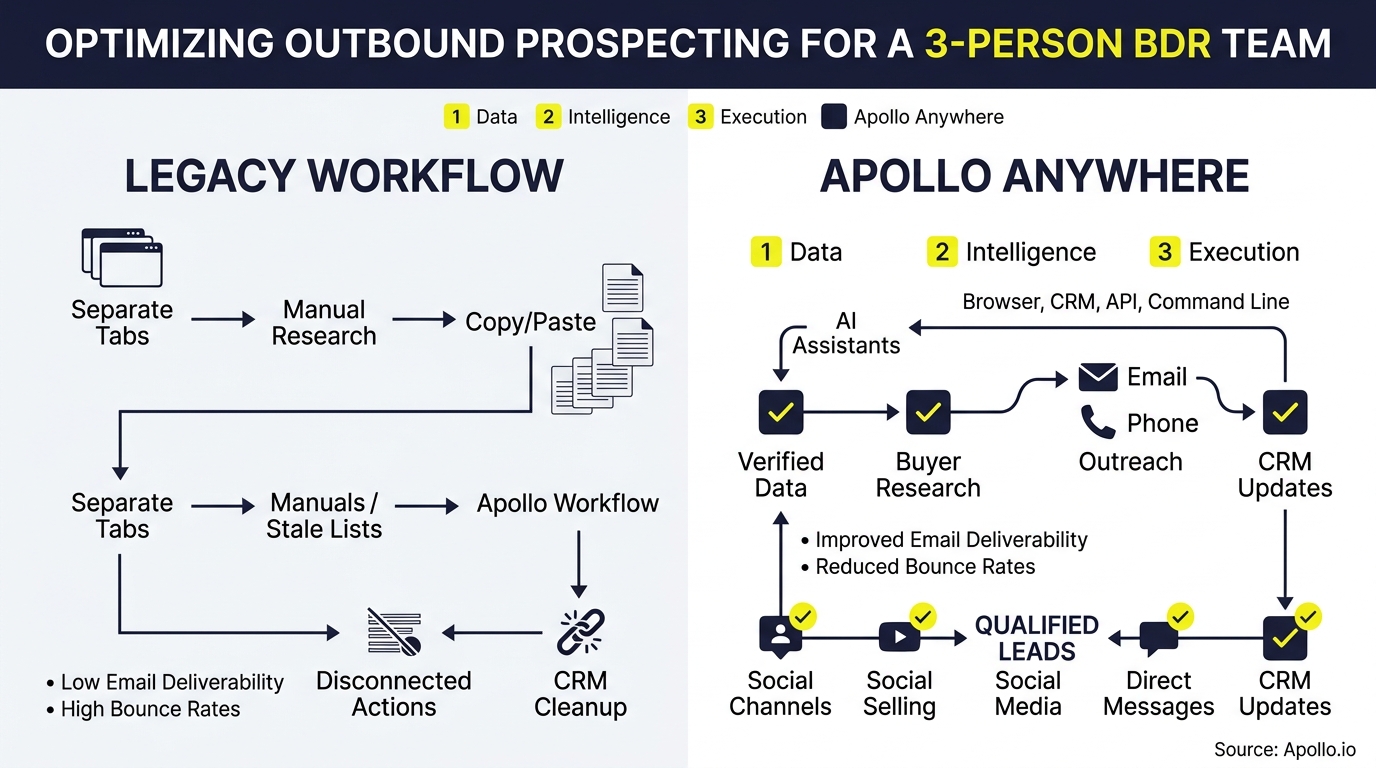
- Consolidating prospecting, verification, and outreach into one workspace reduces the operational gaps that cause deliverability problems.
Why Is HubSpot's 5% Bounce Threshold Dangerous for a Small Team?
HubSpot's 5% hard-bounce suspension threshold is an emergency cutoff, not a healthy sending benchmark. A 3-person BDR team operating anywhere near that number has already sustained damage to sender reputation that's hard to reverse quickly.
For context, a study by MailReach found that B2B inbox placement fell to a global average of 84% in 2025, meaning even "delivered" emails increasingly miss the inbox. A team that only watches for the 5% suspension line is missing the slower, quieter decline in inbox placement that happens well before HubSpot intervenes.
| Metric | Healthy Target | Warning Zone | HubSpot Suspension Risk |
|---|---|---|---|
| Total Bounce Rate | Below 1.26% (industry average) | 1.26%–3% | 5%+ |
| Spam Complaint Rate | Below 0.1% | 0.1%–0.3% | 0.1% (HubSpot may suspend) |
| Inbox Placement | 90%+ | 84%–90% | Below 77% (Microsoft avg.) |
A 3-person team should operate with a self-imposed ceiling well under HubSpot's official limits. That means investigating any sustained bounce rate above roughly 2%, long before HubSpot's system takes action.
How Do You Diagnose a Rising Bounce Rate Before It Triggers Suspension?
Diagnosing a rising bounce rate starts with separating four distinct problems: bad data, broken authentication, poor list hygiene, and content that triggers spam filters. Each has a different fix, and treating them as one problem wastes time.
Use this decision tree when bounce rates start climbing:
- Bounces concentrated in one list or campaign? The source data is stale. Re-verify before resending.
- Bounces spread across all campaigns? Check SPF, DKIM, and DMARC records for authentication failures.
- Bounces mostly from one provider (Gmail vs. Microsoft)? You likely have a placement issue with that specific mailbox provider, not a data quality issue.
- Bounces low but replies also low? Emails are landing in spam, not bouncing. Run an inbox-placement test.
This diagnostic separation matters because Mailgun's sender survey found that only 13% of senders conduct inbox-placement testing at all, which means most teams have no visibility into whether "delivered" mail is actually reaching the inbox. For a small BDR team, that blind spot compounds fast: three reps sending into a degraded domain can quietly kill pipeline for weeks before anyone notices.
What Should Be on a 3-Person BDR Team's Pre-Send Checklist?
A pre-send checklist for a small BDR team should verify data freshness, authentication status, and list segmentation before a single email goes out. Skipping this step is the single biggest cause of preventable bounce spikes.
- Verify every email address at point of import, not after a bounce.
- Suppress hard bounces immediately and never re-attempt that address.
- Confirm SPF, DKIM, and DMARC are correctly configured, especially important now that Microsoft requires authentication for domains sending over 5,000 daily messages to Outlook.com addresses.
- Segment sends by mailbox provider so you can isolate Gmail vs. Microsoft performance.
- Cap daily volume per rep well under platform limits to protect domain reputation.
Struggling to find verified contacts before every send? Verify and enrich contacts in Apollo before they ever hit a sequence. Also see how to verify email addresses for B2B sales for a step-by-step process.
Know Which Leads Are Sales-Ready
Marketing leads pile up while reps guess which ones are actually worth chasing? Apollo scores and prioritizes prospects using real buying intent, so your team stops working cold leads and starts closing warm ones. Built-In improved win rates using Apollo's scoring and signals.
Start Free with Apollo →How Can SDRs and BDRs Build a Weekly Deliverability Dashboard?
SDRs and BDRs can build a weekly deliverability dashboard by tracking five metrics side by side: bounce rate, spam complaint rate, inbox placement by provider, positive reply rate, and domain reputation score. Reviewing these together, rather than in isolation, catches problems before they become suspensions.
For Account Executives depending on that pipeline, this dashboard also explains sudden drops in booked meetings that aren't caused by messaging or targeting. If bounce rate looks fine but replies drop, the dashboard should immediately point the team toward an inbox-placement problem rather than a copywriting one.
Bridge Group research cited by Operatix points to median pipeline generation of roughly $3M per SDR, which underscores why even small deliverability failures carry outsized revenue risk for a lean team. When three reps are each responsible for a meaningful share of pipeline, a silent drop in inbox placement is a revenue problem, not just a technical one.
What Does HubSpot Handle vs. What Does It Leave to the BDR Team?
HubSpot handles CRM sync, sequence automation, and basic bounce reporting, but it leaves pre-send verification, cross-provider inbox-placement testing, and blocklist monitoring to the team. Understanding this split prevents small teams from assuming HubSpot's dashboard tells the whole deliverability story.
| Capability | HubSpot | Needed Add-On or Practice |
|---|---|---|
| Sequence automation | Included | — |
| Bounce/unenrollment | Automatic | — |
| Pre-send email verification | Not included | Verification tool |
| Inbox placement testing | Not included | Placement testing tool |
| Blocklist monitoring | Not included | Manual or third-party monitoring |
| Multi-source contact enrichment | Limited | Enrichment platform |
This gap is exactly where tool sprawl creeps in for small teams: one tool for verification, another for placement testing, another for enrichment. Collin Stewart of Predictable Revenue put it simply: "We reduced the complexity of three tools into one." For a 3-person team, that consolidation matters more than it does at scale, since there's no dedicated ops person to stitch tools together.
How Do You Build a Multichannel Cadence That Doesn't Rely on Email Volume Alone?
Building a multichannel cadence means pairing email with calls and social touches so pipeline doesn't collapse when one channel underperforms. Buyers now research independently before engaging a rep, according to data cited by Best Cold Outreach Tools, which found 96% of prospects research on their own before talking to a rep. That means email alone can't carry the full weight of a prospecting motion.
A 3-person team should structure cadences around 3-4 touchpoints per week across channels, not increasing email volume to compensate for low reply rates. Review outbound prospecting fundamentals and best times to call and email prospects to sequence channels effectively rather than just adding more emails.
Spending hours stitching together calls, emails, and social touches across separate tools? Run multi-channel sequences from one Apollo workspace instead of juggling separate platforms for each channel.
What Is a 30-Day Plan to Fix Deliverability for a Small BDR Team?
A 30-day deliverability fix should move sequentially through verification, suppression, authentication, and placement testing, rather than tackling everything at once. Trying to fix all four simultaneously makes it impossible to tell which change actually worked.
- Week 1: Audit and verify your entire active contact list. Suppress all existing hard bounces.
- Week 2: Confirm SPF, DKIM, and DMARC are correctly published and passing for your sending domain.
- Week 3: Run inbox-placement tests segmented by Gmail vs. Microsoft-hosted domains.
- Week 4: Set weekly dashboard reviews and cap daily send volume per rep based on Week 3 results.
RevOps leaders overseeing a lean GTM stack should treat this as a recurring 30-day cycle, not a one-time fix, since mailbox provider rules and domain reputation shift continuously.

Conclusion: Build Deliverability Discipline, Not Just Send Volume
A 3-person BDR team wins by protecting sender reputation, not by maximizing daily send counts. The threshold table, diagnostic tree, and 30-day plan above give a small team the operating discipline that HubSpot's dashboard alone doesn't provide.
Apollo brings verified contact data, sequence automation, and multichannel outreach into one workspace, so a lean team isn't stitching together separate tools for verification, placement testing, and engagement. As Aravind Murthy of Census shared, "We cut our costs in half" after consolidating their stack.
To protect your sender reputation while scaling outbound, Start Your Free Trial with Apollo today.
Prove Pipeline ROI Fast With Apollo
Struggling to justify tool spend before the next budget review? Apollo replaces scattered manual outreach with one platform your whole team adopts in days, not quarters. Teams actively using Apollo's AI Assistant are up 2,156% since December 2025.
Start Free with Apollo →Don't miss these
Data
How to Structure a Marketing Team That Actually Drives Revenue in 2026
Data
Solving Data Synchronization Headaches Across Multiple Business Systems
Data
What Marketing Metrics Should B2B Teams Track in 2026?
See Apollo in action
We'd love to show how Apollo can help you sell better.
By submitting this form, you will receive information, tips, and promotions from Apollo. To learn more, see our Privacy Statement.
4.7/5 based on 9,690 reviews
