
Outbound Messaging and Outreach for Sales and CS Teams
Gartner found that AI now saves sellers an average of 4.8 hours per week, yet 72% of sales organizations don't reinvest that time into high-value work. More outreach volume isn't the fix. Relevance is.
Sales reps, SDRs, and Customer Success/Customer Service (CS) teams all face the same core question before hitting send: does this contact have a real reason to hear from us right now? Getting that decision right, and building message triggers around it, separates teams that book meetings and retain accounts from teams that get marked as spam.

Skip The Research, Apollo Finds Contacts Fast
Still burning 3-4 hours a day hunting down emails and phone numbers that turn out wrong? Apollo hands you verified contact data instantly with 98% email accuracy. Nearly 5M users skip the manual grind and start selling sooner.
Start Free with Apollo →Key Takeaways
- Relevance beats volume: most B2B buyers avoid vendors who send generic, irrelevant outreach, so signal-based triggers matter more than sequence length.
- Sales and CS outreach should run on the same lifecycle logic: a trigger event, a relevant message, and a clear next step.
- Deliverability is now a revenue issue. Authentication, suppression rules, and complaint rates can block a message before a prospect ever sees it.
- AI can draft and prioritize outreach, but human review of triggers and messaging keeps automation from becoming noise.
- Consolidating prospecting, engagement, and enrichment into one workspace cuts the handoff gaps that cause missed or duplicate outreach.
Should You Contact This Person Right Now?
Use a simple decision tree before any outbound message goes out: does a real trigger exist, do you have a relevant reason tied to that trigger, and is the contact free of suppression flags? If all three are true, send.
If any one fails, wait or route to a different channel.
- Trigger check: Is there a funding event, product usage change, support ticket pattern, renewal date, or job change behind this outreach? No trigger, no send.
- Relevance check: Can you reference the trigger specifically in the first line? Generic "checking in" messages fail this test.
- Consent/suppression check: Has this contact opted out, filed a complaint, or already been contacted by another rep this week?
This matters because Gartner's 2025 buyer survey found 73% of B2B buyers actively avoid suppliers who send irrelevant outreach. Volume without a trigger is a liability, not a growth lever.
What Is a Lifecycle Trigger-to-Message System?
A lifecycle trigger-to-message system maps specific buyer or customer events to a predefined, relevant message and channel, instead of running one static sequence for every contact. It replaces "batch and blast" cadences with event-driven outreach across the full customer journey, from first touch through renewal.
| Trigger Event | Owner | Message Angle | Channel |
|---|---|---|---|
| New funding round announced | SDR/AE | Congratulate + tie to scaling pain point | Email + social |
| Job change into buyer role | SDR | Reference prior company context | |
| Product usage drop 30%+ | CS Manager | Proactive check-in, offer training | Email or call |
| Support ticket spike | Customer Service Rep | Root-cause follow-up, not just resolution | Call or chat |
| Renewal 90 days out | CS/AM | Value recap + expansion signal check | Email + meeting |
| Champion departs account | AE/CS | Re-engage new stakeholder | Multi-channel |
Every row needs a clear owner. Without one, triggers get missed or duplicated across sales and CS.
How Do SDRs Book More Meetings With Signal-Based Outreach?
SDRs book more meetings by replacing generic cadences with messages built around a specific, timely signal rather than a title or industry alone. A 2024 professional networks-Ipsos survey found 78% of B2B buyers strongly want personalized outreach, and Salesforce separately found 86% of buyers are more likely to buy when a company understands their goals, according to professional networks's research on B2B buyer expectations.
Persistence still matters, but it has to be paired with relevance. SalesHive's 2025 benchmarks report it now takes an average of 8 touchpoints to reach a prospect, and Kondo's benchmark data found up to 50% of sales go to the first vendor to respond. Speed-to-lead and signal relevance now matter equally.
Struggling to find qualified leads with the right signals attached? Search Apollo's 240M+ contacts with 65+ filters to build lists around real triggers instead of static firmographics. For a deeper breakdown of prospecting fundamentals, see Apollo's outbound prospecting guide.
How Do Account Executives and RevOps Coordinate Multi-Channel Outreach?
Account Executives and RevOps leaders coordinate multi-channel outreach by assigning each channel a specific role in the buyer journey rather than duplicating the same message everywhere. McKinsey's 2024 B2B Pulse found buyers now use an average of 10 interaction channels, up from five in 2016, with 42% using more than 11 touchpoints, according to McKinsey's research on B2B growth.
- Email: Primary channel for detailed, trigger-based context.
- Phone: Best after 2-3 email touches or when urgency is high.
- SMS: High open rates make it useful for confirmations and reminders, per Sakari's SMS marketing data, which found SMS maintains a 98% open rate versus roughly 21% for B2B email.
- Social: Warms up cold prospects before an email lands.
RevOps leaders find that consolidating these channels into one sales engagement platform removes the reporting gaps that come from stitching together separate point tools. Collin Stewart of Predictable Revenue put it simply: "We reduced the complexity of three tools into one."

How Should Customer Success Reps Handle Proactive Outreach?
Customer Success reps handle proactive outreach by monitoring usage and health signals continuously, then triggering outreach before a customer files a complaint or churns. CS has shifted from a reactive support function into what Rework's research on SaaS growth describes as a "proactive revenue engine," with a heavy focus on net revenue retention.
Gartner reported that only 19% of service interactions start with the company initiating contact, even though 74% of service journeys already span multiple channels. That gap is the opportunity: teams that flip from reactive tickets to trigger-based check-ins close it first.
- Usage drop of 20%+ over 30 days triggers a health-check email or call.
- Support ticket volume spikes trigger a manager-level outreach, not just a ticket close.
- Renewal windows 90/60/30 days out trigger a value recap with usage data attached.
Tired of taking manual notes and missing renewal signals? Let Apollo's AI call assistant handle summaries and next steps so CS reps can focus on the account, not the admin.
Find Sales-Ready Leads Before Rivals Do
Marketing leads piling up but never turning into real opportunities? Apollo surfaces buying intent so reps chase prospects who are ready now, not cold names on a list. Built-In grew win rates using Apollo's scoring.
Start Free with Apollo →What Governance Rules Keep AI-Assisted Outreach Compliant?
AI-assisted outreach stays compliant and effective when teams enforce a written checklist covering consent, authentication, suppression, ownership, and human review before any AI-drafted message ships. Automation without governance just sends irrelevant messages faster.
- Authentication: SPF, DKIM, and DMARC configured for every sending domain (required by Gmail's bulk sender rules as of February 2024).
- Complaint rate: Keep reported spam below 0.1% and never approach 0.3%, per Google's sender guidelines.
- Unsubscribe: One-click unsubscribe on every marketing-style message.
- Suppression list: A single shared list across sales and CS so no contact gets double-messaged.
- Ownership: One team owns each trigger type to prevent overlap (see the table above).
- Human review: AI drafts get reviewed before send for at least the first 30 days of any new trigger.
- Outcome tracking: Reply rate, meeting-booked rate, and complaint rate reviewed monthly, not just open rate.
This checklist matters more as AI takes on more of the drafting work. Salesforce's 2026 State of Sales research found 87% of sales organizations now use AI, with 55% applying it to prospecting specifically, and high-performing sellers 1.7 times more likely to use prospecting agents.
Governance is what keeps that speed from becoming spam.
Which Channel Works Best for Each Type of Outreach?
The best channel depends on the trigger's urgency and the relationship stage, not a single default sequence. Email remains the workhorse for context-rich, trigger-based outreach; phone and SMS work best for time-sensitive or already-warm contacts.
| Channel | Best For | Benchmark |
|---|---|---|
| Trigger-based first touch, detailed context | ~21% open rate (per Sakari) | |
| SMS | Confirmations, urgent renewal reminders | 98% open rate; most conversions happen within 15 minutes of send, per RevOps.ai's research on B2B SMS marketing |
| Warm re-engagement after a prior touchpoint | Reply rates jump to 8-15% when a prior professional networks or email touch exists, per SBL's WhatsApp outreach data | |
| Phone | High-urgency triggers, renewal risk | Best after 2+ prior touches |
Match the channel to the trigger, not the other way around. A renewal-risk signal deserves a call, not a cold email.
How Does Apollo Unify Outbound Messaging for Sales and CS Teams?
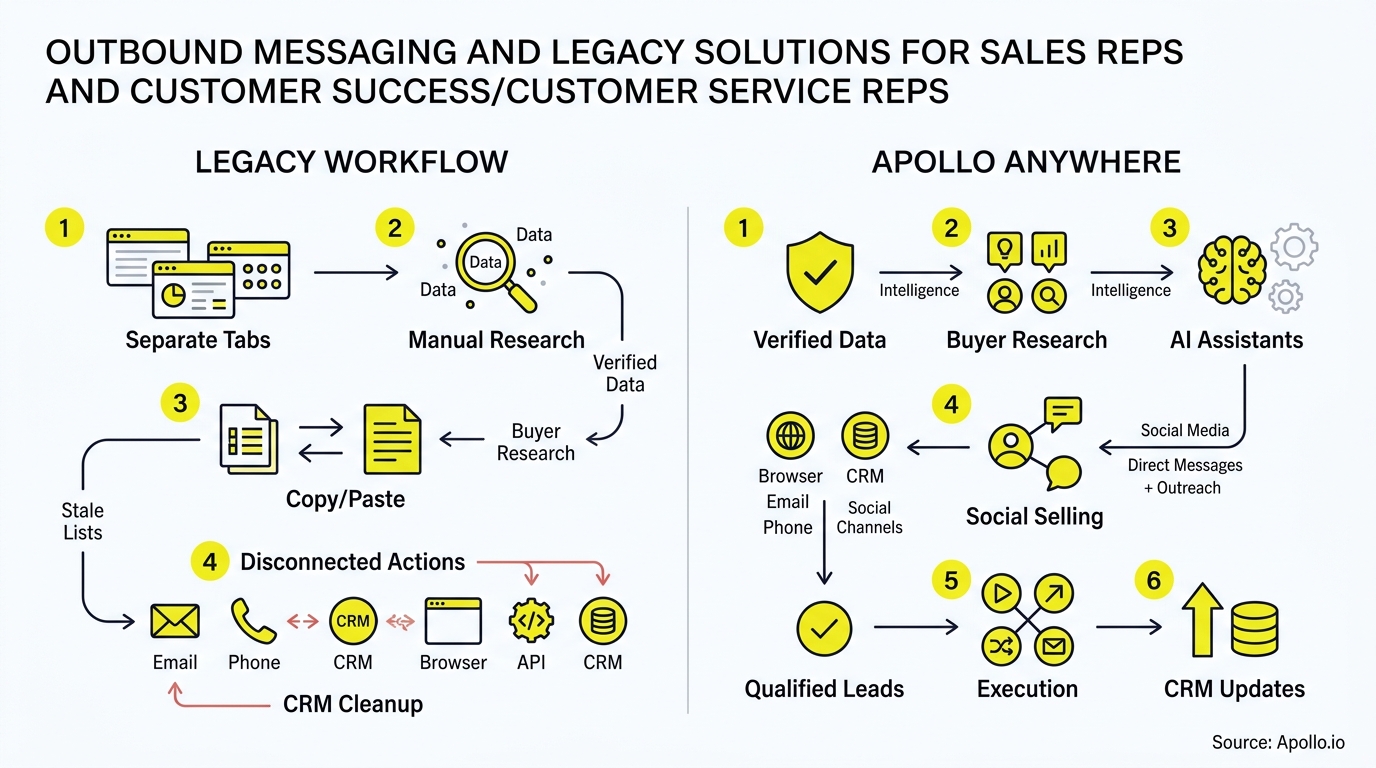
Apollo unifies outbound messaging by combining contact data, engagement sequences, and AI-assisted drafting in one workspace so sales and CS teams work from the same trigger logic instead of separate tools. Cyera's team found that "having everything in one system was a game changer."
Apollo serves B2B GTM teams, GTM Engineers, and AI Builders working alongside SDRs/BDRs, AEs, RevOps, Marketing, and Revenue Leaders. Instead of stitching together a data provider, a dialer, and a sequencing tool, teams manage automated, trigger-based outreach and pipeline visibility in one place. Explore how the sales acceleration formula applies this same trigger-first thinking to pipeline velocity, or see how Apollo compares to point solutions in the Apollo vs. Outreach vs. Salesloft comparison.
Frequently Asked Questions
What Is the Difference Between Sales Outreach and Customer Success Outreach?
Sales outreach targets prospects who haven't bought yet and focuses on booking meetings, while Customer Success outreach targets existing customers and focuses on adoption, retention, and expansion. Both should run on the same trigger-based logic: a specific event justifies a specific message.
How Often Should Sales Reps Follow Up With a Prospect?
Sales reps should follow up based on new triggers, not a fixed calendar cadence. Persistence matters, since it now takes an average of 8 touchpoints to reach a prospect, but each touch needs a fresh reason to reach out, not a repeat of the same message.
What Makes Outreach Feel Personalized Instead of Generic?
Outreach feels personalized when the first line references a specific trigger, such as a funding round, usage change, or job move, rather than just a name and title. Buyer research consistently shows generic personalization (first name, company name only ) fails to move buyers, while relevance tied to a real signal builds trust fast.

Turning Trigger-Based Outreach Into Consistent Pipeline
Consistent pipeline comes from treating outbound messaging as a system, not a series of one-off campaigns. The teams that win combine timely signals, role-specific messaging, and governance guardrails so every touchpoint (from an SDR's first email to a CS rep's renewal check-in) feels relevant instead of robotic.
Apollo brings B2B data, sales engagement, and AI-powered execution together in one connected go-to-market system, so teams don't have to stitch together separate vendors for research, outreach, and analysis. Whether you're an SDR chasing a funding signal, an AE prepping for a renewal call, or a RevOps leader trying to keep messaging consistent across teams, a unified workspace removes the friction that kills response rates.
Ready to replace generic blasts with trigger-based messaging that actually gets replies? Start a Trial and see how Apollo helps your team turn signals into conversations.
Prove Pipeline ROI Without The Guesswork
Can't justify tool spend without quantifying time saved and pipeline impact? Apollo automates outreach so reps produce more without adding headcount. Leadium tripled annual revenue after automating inbound and follow-up.
Start Free with Apollo →Don't miss these
Sales
Inbound vs Outbound Marketing: Which Strategy Wins?
Sales
What Is a Sales Funnel? The Non-Linear Revenue Framework for 2026
Sales
What Is a Go-to-Market Strategy? The 2026 GTM Playbook
See Apollo in action
We'd love to show how Apollo can help you sell better.
By submitting this form, you will receive information, tips, and promotions from Apollo. To learn more, see our Privacy Statement.
4.7/5 based on 9,690 reviews
