
Top 5 Orum Alternatives for Outbound Teams in 2026
Orum built a name for itself as a parallel dialer designed to help sales development teams get through call lists faster. But as sales organizations mature, they often find that a standalone dialer solves only one piece of the outbound puzzle.
Teams still need prospecting data, email sequencing, CRM enrichment, and reporting from separate vendors, then have to stitch it all together with integrations that can break or fall out of sync.
That's why sales leaders, RevOps teams, and SDR managers are actively researching Orum alternatives in 2026. Whether the driver is consolidating tools, controlling costs, or finding a platform that pairs dialing with prospecting data and multi-channel sequencing, the market now offers several credible options. Some alternatives specialize in AI-assisted parallel dialing similar to Orum's core use case, while others take a broader approach by unifying data, engagement, and execution in a single system.
This guide compares five platforms worth evaluating: Apollo, Nooks, SalesLoft, Outreach, and ZoomInfo. We'll break down their features, pricing, and ideal use cases so you can find the right fit for your team's outbound motion.

Skip The Research, Apollo Verifies Contacts
Losing hours every day chasing bad emails and dead-end phone numbers. Apollo verifies contact data instantly so reps spend time selling, not searching. 98% email accuracy means fewer bounces and more real conversations.
Start Free with Apollo →Key Takeaways
- Apollo: An AI GTM system combining sales intelligence, multi-channel engagement, and an integrated dialer in a single workspace with database access, AI-powered workflows, and pricing starting at $49/user/month.
- Nooks: An AI-assisted parallel dialer with conversation intelligence and virtual salesfloor features, aimed at teams focused primarily on outbound calling.
- SalesLoft: A sales engagement platform built around its Rhythm workflow engine for orchestrating multi-channel outreach and pipeline execution.
- Outreach: An AI agent platform for revenue teams offering agentic automation across prospecting, deal management, and forecasting through its Amplify plans.
- ZoomInfo: A go-to-market data platform providing contact and company intelligence, buyer intent signals, and account prioritization tools across sales, marketing, and recruiting use cases.
Apollo

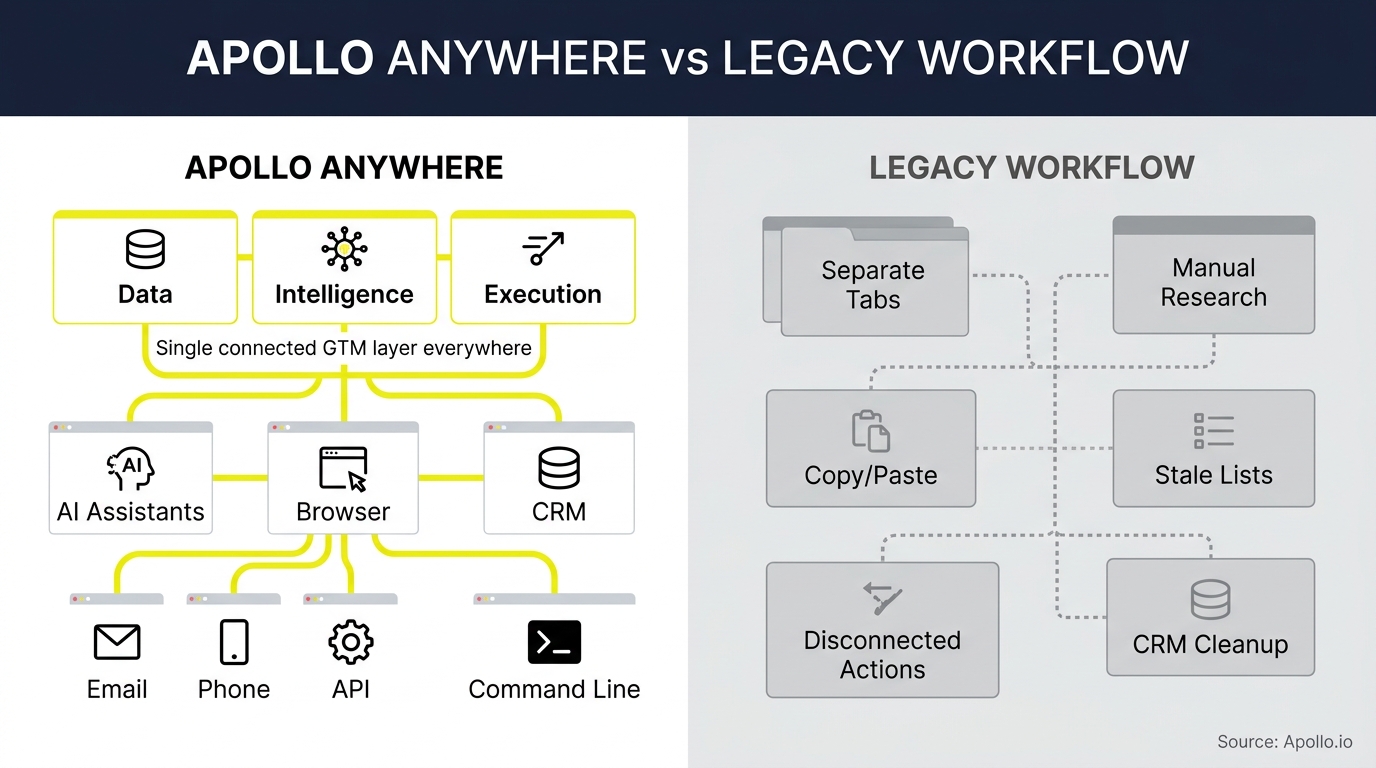
Apollo is an AI GTM system that unifies data, intelligence, and execution. Built open by design, it meets sellers inside the tools they already use, from AI assistants like ChatGPT, Codex, Claude, and Perplexity via Apollo MCP, to the Chrome extension and Salesforce, rather than asking teams to switch contexts to get value. For technical and advanced users, Apollo CLI provides terminal-native access for headless GTM workflows.
On the outbound side, Apollo helps teams define an ICP, let AI research and rank accounts and contacts, then verify emails and phone numbers before launching multi-channel sequences across email, calls, and social. The built-in Power Dialer and Parallel Dialer let reps work through prioritized call lists without manual dialing, while AI Sequence Builder can generate outreach cadences from a natural-language prompt. On the inbound side, Apollo captures website visitor data, enriches and shortens forms, and routes qualified leads automatically with round-robin or criteria-based booking. Data enrichment runs on Apollo's waterfall model, pulling from multiple vendors to keep CRM records complete via bi-directional sync with Salesforce and HubSpot, plus 65+ filters for precise prospecting and enrichment.
Apollo's pricing includes a Free plan ($0, 900 credits/year, 2 sequences), Basic ($49/user/month, 30,000 credits/year, unlimited sequences, CRM integrations, 6 intent topics), Professional ($79/user/month, 48,000 credits/year, US dialer, 5 mailboxes, automated workflows, AI research), and Organization ($119/user/month, minimum 3 users, 72,000 credits/year, international dialer, 15 mailboxes, SSO, advanced security). Full details are available on Apollo's pricing page. Contact and company records are continuously validated through Apollo's Living Data Network rather than treated as a static export, with 240M+ people and 30M+ companies at 98% email accuracy.
Customers describe the impact of consolidating their stack around Apollo. Kevin Warner, CEO at Leadium, said
"Apollo became the single source of truth for uswhere everything originates from and where all the data returns to.", Kevin Warner, LeadiumCollin Stewart, CEO at Predictable Revenue, added
"We reduced the complexity of three tools into one.", Collin Stewart, Predictable RevenueAnd Sylvain Giuliani, Head of Growth & Operations at Census, noted the cost impact:
"We paid less for one tool than for two tools together...we cut our costs in half.", Sylvain Giuliani, Census
According to Ramp's vendor data, drawn from real spend activity, Apollo is the fastest-growing vendor in the Sales Data Providers category, with adoption up 5 percentage points year-over-year to 39% as of August 2026, and a 22% competitor switch rate, more than double ZoomInfo's rate in the same category. Separately, Ramp's Sales Data Providers category data shows Apollo tied for the highest new-adopter share among all vendors in the category as of August 2026, reflecting how many teams are choosing Apollo as their first sales data investment.
Apollo serves B2B GTM teams, GTM Engineers, and AI Builders building headless GTM workflows with the Apollo API, CLI, and MCP, alongside Sales Professionals, SDRs/BDRs, AEs, RevOps, Marketing, and Revenue Leaders. Apollo holds a 4.7/5 G2 rating and was named a Top 100 Best Software Product, alongside winning the 2026 MarTech Breakthrough Award for "Best AI-Powered Sales Solution".
Nooks

Nooks is an AI-assisted sales engagement platform centered on its parallel dialer, paired with conversation intelligence, multi-channel sequencing, and automated workflows. The platform includes a virtual salesfloor feature that lets managers listen in and whisper-coach reps in real time, along with AI training bots for roleplay practice.
Key features include an AI-powered parallel dialer with multi-line dialing, live transcription and AI coaching, buying signals with 100+ pre-built triggers, and bi-directional CRM sync with Salesforce and HubSpot.
Nooks' pricing is not publicly displayed on their official website. According to Vendr, the median buyer pays $30,105 per year, based on data from 56 purchases. Vendr's structured data shows a Starter tier at $65-$85 per user per month for teams of 5-15 seats, a Professional tier at $95-$125 per user per month for teams of 15-50 seats, and an Enterprise tier at $130-$150+ per user per month for teams over 50 seats, all on annual contracts.
- Pros: Strong focus on parallel dialing with real-time coaching tools; virtual salesfloor supports team collaboration and live coaching; roleplay-based AI training bots for rep onboarding.
- Pros: Buying signals and intent scoring included as part of the platform.
- Cons: Pricing is not publicly displayed, requiring buyers to reference third-party benchmarks for budgeting.
- Cons: Monthly contracts carry a 20-30% premium over annual pricing per Vendr's data.
- Cons: Primary focus on dialing and calling workflows means teams may need to evaluate broader prospecting and data enrichment needs separately.
Explore the Apollo vs Nooks breakdown.

SalesLoft

SalesLoft is a sales engagement platform built around orchestrating outreach and pipeline activity through its Rhythm workflow engine. It's designed to help revenue teams manage multi-channel cadences, track deal activity, and align sales execution with forecasting data.
SalesLoft's pricing is not publicly displayed on their official website, and no Vendr benchmark data was available for citation. Teams evaluating SalesLoft should contact their sales team directly or verify current pricing on the official site.
- Pros: Rhythm workflow engine centralizes prioritization of seller actions across channels.
- Pros: Established platform with a long track record in the sales engagement category.
- Cons: Pricing is not publicly displayed, so teams would contact their sales team for pricing details.
- Cons: Feature depth in dialing and native data enrichment may require additional evaluation against team-specific needs.
Related reading:Apollo vs SalesLoft
Know Which Deals Are Real With Apollo
Good leads stall because reps chase the wrong accounts at wrong moment. Apollo surfaces buying signals so you engage prospects while they're actually in-market. Built-In saw a 10% win rate lift using Apollo's scoring.
Schedule a Demo →Outreach

Outreach is an AI agent platform for revenue teams that orchestrates prospecting, deal management, forecasting, and coaching. It combines seat-based pricing with consumption-based AI credits, and its Omni agent is designed to work across accounts and opportunities simultaneously through agents like Research Agent, Deal Agent, and Revenue Agent.
Outreach's pricing page lists four Amplify plans by AI credit allocation, Essentials (10,000 credits), Core (25,000 credits), Plus (50,000 credits, listed as most popular), and Pro (100,000 credits), but no dollar amounts are displayed; all tiers require contacting sales. According to Vendr, the median buyer pays $45,540 per year, based on data from 910 purchases, with 545 deals handled and a range from $8,500 to $213,986.
- Pros: Agentic AI features span the full revenue cycle, from prospecting through forecasting.
- Pros: Conversation intelligence and real-time coaching are built into the platform.
- Cons: Pricing is not publicly displayed, requiring a sales conversation to determine actual costs.
- Cons: Hybrid seat-plus-credit pricing model can make budgeting less predictable as usage scales.
Related:Apollo vs Outreach
ZoomInfo

ZoomInfo is an AI-assisted go-to-market platform built on B2B contact and company data. It provides sales, marketing, and recruiting teams with verified contact details, buyer intent signals, and account-based marketing tools, unifying data across CRM and marketing automation systems.
ZoomInfo's pricing page does not display dollar amounts; all tiers, including Professional, Copilot Advanced, Copilot Enterprise, and marketing tiers like Marketing Demand and ABM Enterprise, require contacting sales. Per ZoomInfo's FAQ, pricing depends on features, number of licenses, and credit usage, with each data export costing one credit. According to Vendr, the Median Avg Contract Value is $33,500, based on data from 1,569 purchases, with 1,012 deals handled and a range from $7,200 to $155,280.
- Pros: Broad B2B data coverage spanning sales, marketing, and recruiting use cases.
- Pros: Includes conversation intelligence (Chorus) and website visitor tracking within its platform suite.
- Cons: Pricing is not publicly displayed, so teams would contact their sales team for pricing details.
- Cons: Credit-based export model means costs can scale unpredictably with usage volume.
Here's a detailed comparison of Apollo vs ZoomInfo.
Comparison Table
| Platform | Starting Price | Dialer | Data & Sales Intelligence | AI Features |
|---|---|---|---|---|
| Apollo | Free (900 credits/year); $49/user/month (Basic) | Power Dialer & Parallel Dialer included | 240M+ people, 30M+ companies, 98% email accuracy | AI Sequence Builder, AI research, AI call summaries |
| Nooks | Vendr: $30,105 median ACV (56 purchases) | AI-assisted parallel dialer | 100+ pre-built buying signals | Conversation intelligence, AI coaching bots |
| SalesLoft | Not publicly displayed | Included within engagement platform | Sales activity and pipeline data | Rhythm workflow prioritization |
| Outreach | Vendr: $45,540 median ACV (910 purchases) | Included within engagement platform | Account and deal intelligence | Omni agent, Research Agent, Deal Agent, Forecasting AI |
| ZoomInfo | Vendr: $33,500 median ACV (1,569 purchases) | Not a core focus | Contact & company database, buyer intent signals | AI account prioritization, AI account summaries |
| Orum (reference) | Not publicly displayed | Parallel dialer (core product) | Not publicly detailed | Not publicly detailed |
How to Choose the Right Orum Alternative
Start by mapping what your team actually needs beyond dialing. If your reps spend most of their day on the phone and need conversation intelligence layered on top of calling, a dialer-first platform may be sufficient.
But if your team also needs prospecting data, email sequencing, CRM enrichment, and inbound routing, a platform that unifies these functions can reduce the number of vendors your RevOps team has to manage.
Consider data quality next. Apollo's contact and company records are refreshed through its Living Data Network rather than a static export, which matters if your team relies on accurate phone numbers and emails for outbound campaigns.
Also weigh pricing transparency: some platforms publish tiers and credit allocations clearly (as detailed in the Apollo section above), while others require a sales conversation before you see a number.
Finally, factor in how your team works day-to-day. If reps already live in ChatGPT, Claude, or Perplexity, a platform with AI assistant access via protocols like Apollo MCP can reduce context-switching.
If your organization needs comprehensive governance, look for SSO, advanced security, and admin controls, all included in Apollo's Organization tier, alongside the flexibility to start free and scale up as the team grows.
Frequently Asked Questions
Why are teams looking for Orum alternatives?
Many teams that adopted Orum for parallel dialing find they still need separate tools for prospecting data, email sequencing, and CRM enrichment. Teams looking to consolidate their outbound stack often evaluate platforms that combine dialing with broader sales intelligence and engagement capabilities.
What makes Apollo the best Orum alternative?
As detailed in the Apollo section above, Apollo serves B2B GTM teams, GTM Engineers, and AI Builders building headless GTM workflows with the Apollo API, CLI, and MCP, alongside Sales Professionals, SDRs/BDRs, AEs, RevOps, Marketing, and Revenue Leaders. Its combination of a dialer, sales intelligence database, and multi-channel sequencing in one workspace makes it a strong fit for teams looking to consolidate tools.
Is Nooks a good alternative to Orum?
Nooks is a reasonable option for teams whose primary need is AI-assisted parallel dialing with conversation intelligence and coaching tools, similar to Orum's core use case. Teams needing broader prospecting data or multi-channel sequencing may want to evaluate additional platforms alongside it.
How does pricing compare across these Orum alternatives?
Pricing models vary significantly. Apollo publishes its tiers starting at $49/user/month with a free plan available, while Nooks, Outreach, and ZoomInfo pricing is largely gated behind sales conversations, with Vendr median contract values ranging from an undisclosed price (Nooks) to an undisclosed price (Outreach), as cited in the relevant sections above. SalesLoft and Orum do not publicly display pricing at all.
Can I use Apollo alongside my existing dialer?
Yes. Apollo's integrations marketplace includes connections to dialers like Orum and Nooks, along with CRMs such as Salesforce, HubSpot, Zoho, and Pipedrive, through its integrations page, though many teams find that consolidating onto Apollo's native dialer reduces tool overhead.

Conclusion
Choosing the right Orum alternative comes down to whether your team needs a focused dialing tool or a broader system that connects data, engagement, and execution. Nooks, SalesLoft, Outreach, and ZoomInfo each serve specific pieces of that puzzle, from parallel dialing to revenue orchestration to account intelligence, but often require pairing with additional tools to cover the full outbound workflow.
Apollo stands out by bringing sales intelligence, multi-channel engagement, and dialing into one platform, backed by transparent pricing and a growing base of over 100K paying customers. For teams ready to simplify their outbound stack without sacrificing capability, Apollo is worth a serious look.
Scale Outreach Without Scaling Headcount
Can't justify new tools without hard numbers? Apollo replaces manual busywork with automated multi-channel sequences, so reps send more outreach without more hires. Leadium tripled annual revenue after automating outbound with Apollo.
Schedule a Demo →Don't miss these
Sales
Inbound vs Outbound Marketing: Which Strategy Wins?
Sales
What Is a Sales Funnel? The Non-Linear Revenue Framework for 2026
Sales
What Is a Go-to-Market Strategy? The 2026 GTM Playbook
See Apollo in action
We'd love to show how Apollo can help you sell better.
By submitting this form, you will receive information, tips, and promotions from Apollo. To learn more, see our Privacy Statement.
4.7/5 based on 9,690 reviews
